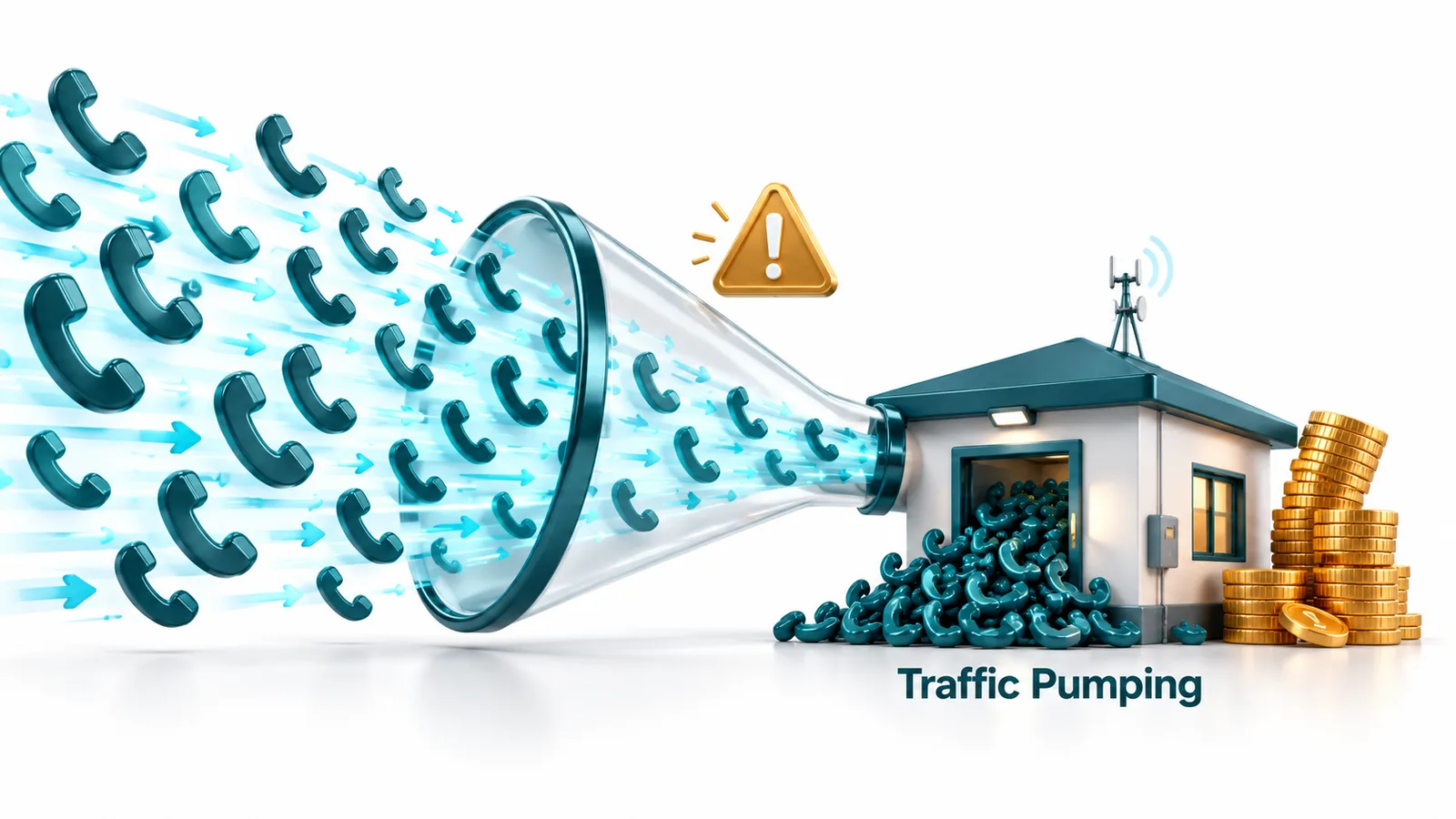
Traffic pumping, also called access stimulation, is a way of inflating the number of calls that end on one local phone line so that someone can earn money on each call. Most of those calls never reach a person who wanted to talk. A wholesale buyer usually notices the scheme indirectly, as a destination that carries far more traffic than its campaign ever targeted, or as a termination charge that does not match the rate deck. This article explains how the money moves, what the FCC's rules say as of this review, and how to screen a destination before the problem shows up on an invoice.
How the money moves
When a long-distance call ends on a local phone network, a local carrier has to deliver it to the line being called. The long-distance carrier pays that local carrier a fee for the delivery. This fee is called an access charge, and it is billed per minute under the local carrier's tariff, the published price list filed with the regulator. A higher tariffed rate means more revenue for every minute that terminates on that carrier's network.
A traffic pumping scheme adds a partner to that arrangement. The local carrier, often a small rural local exchange carrier (LEC), agrees to share access revenue with a high-volume partner such as a free conference-call service or a chat line. The partner sends a very large number of calls to the carrier's end office, which is the local switch that delivers calls to the lines it serves. Each call that terminates there generates an access charge, and part of that charge flows back to the partner.
The direction of the money is the point. The calls are valuable because each minute carries a fee, not because anyone on the other end needs to hear from the caller. That is why the traffic looks so unlike ordinary calling, with very short calls, unusual concentration, and volume that grows without any matching business activity.
A worked example with invented numbers
The figures below are invented to show the arithmetic. They do not describe any real carrier, and real access rates come from tariffs that differ by carrier and by territory.
| Item | Illustrative figure |
|---|---|
| Interstate terminating minutes in one end office, one month | 2,000,000 |
| Interstate originating minutes from the same end office, same month | 300,000 |
| Terminating-to-originating ratio (2,000,000 / 300,000) | about 6.7 to 1 |
| Access charge billed to the long-distance carrier | $0.02 per minute |
| Access revenue for the month (2,000,000 x $0.02) | $40,000 |
| Share paid to the conference partner (assumed 50 percent) | $20,000 |
The ratio in the table is terminating minutes divided by originating minutes. A ratio of about 6.7 to 1 is above the 6:1 test that applies to a competitive LEC, which the rules section below explains. In this invented month, the partner keeps $20,000 from calls that did not need to reach anyone, and the long-distance carrier that handed those calls to the end office pays $40,000 in access charges on minutes that were generated to earn that fee.
Notice what the example does not show. A wholesale buyer never signs up with the conference partner. Its exposure comes from routing. If its traffic reaches one of these end offices, it can pay for minutes it did not plan, or find that a destination's rate, availability, or acceptance has changed without warning.
How it reaches a wholesale buyer
A buyer's cost rarely arrives as a line item that says traffic pumping. It arrives as a destination that behaves differently from the rest of the rate deck. Depending on the contract and the route, the effects can include termination charges higher than expected, a destination whose rate changes between invoices, calls to a number that a downstream carrier rejects or blocks, or a billing dispute over access-related charges on the buyer's traffic.
The rules explain why carriers react quickly. Under the FCC framework, a LEC engaged in access stimulation can no longer bill interexchange carriers for certain terminating tandem switching and transport charges, and an intermediate provider cannot collect those charges for traffic bound to a flagged IP-based provider. A carrier that handles this traffic may find those costs landing on it, which gives it a reason to block or reprice a destination. A buyer should expect that reaction, and should read its contract to see how much notice it would receive.
What the FCC has done
The FCC has addressed traffic pumping in several orders since 2011. Each order responded to a new way of routing around the previous one, so the history helps when a provider explains why a destination was flagged or repriced.
| Date | Action | Status in the sources reviewed |
|---|---|---|
| 2011 | Original access stimulation rules. The revenue-sharing test used a 3:1 ratio or more than 100 percent growth in switched access minutes. | The revenue-sharing test still appears in 47 CFR 61.3(bbb)(1)(i). |
| September 2019 | Order FCC 19-94 in WC Docket 18-155. It shifted certain access costs to the access-stimulating carrier and added ratio tests that do not require a revenue-sharing agreement. | The ratio tests are in the current text of 47 CFR 61.3(bbb). |
| April 20, 2023 | Second order in the same docket. It extends the rules to traffic terminated through IPES (internet protocol enabled service) providers, which the 2019 rules did not reach. | Effective January 2, 2024. Compliance was required by February 16, 2024 for the additions to 47 CFR 51.914(d) and (g). |
| December 2025 (adopted), March 19, 2026 (effective) | Third Report and Order, FCC 25-86. Numbering authorization holders must certify that they comply with 47 CFR 51.914. | The certification item's compliance date is deferred to a later Federal Register notice. No such notice was found in the sources reviewed. |
| February 2026 | A proposed rulemaking on legacy rules (FCC 26-11). It describes the IPES rules as adopted. | A proposal, not a final rule. No final action on it was found. |
The current traffic-ratio tests
Under the current text of 47 CFR 61.3(bbb), a carrier engages in access stimulation if it meets one of two alternatives. The first is a revenue-sharing agreement that would result in a net payment based on access charges billed to interexchange or wireless carriers, combined with a ratio or growth test. The second is a standalone ratio test. The thresholds differ by type of carrier.
| Carrier type | Ratio test (interstate terminating to originating) | Other condition | How the ratio is measured |
|---|---|---|---|
| Competitive LEC or IPES provider | At least 6:1 | None | Per end office or equivalent, per calendar month |
| Rate-of-return LEC | At least 10:1 | 500,000 or more interstate terminating minutes per month in the same end office | Averaged over a three-calendar-month period |
The revenue-sharing alternative uses a 3:1 ratio in a calendar month, or more than 100 percent growth in interstate switched access minutes, as its second element. The rule's definitions matter as much as the numbers. "End office or equivalent" is the counting point, and for an IPES provider the rule defines where traffic terminates for this purpose. A single office can cross the line even when a carrier's network as a whole looks normal, so the count is taken office by office.
Where things stand
The 2019 and 2023 rules are in the current federal regulations. The 2023 IPES extension has a published effective date and compliance date, both listed in the table above. The 2025 numbering item is the most recent change that touches this area, and it is aimed at who can obtain direct access to numbers, not at the terminating traffic itself.
The sources reviewed for this article did not show a final action on the February 2026 proposal, and they did not show a compliance date for the numbering certification. Check the Federal Register and the FCC docket before relying on either date.
How to screen a destination
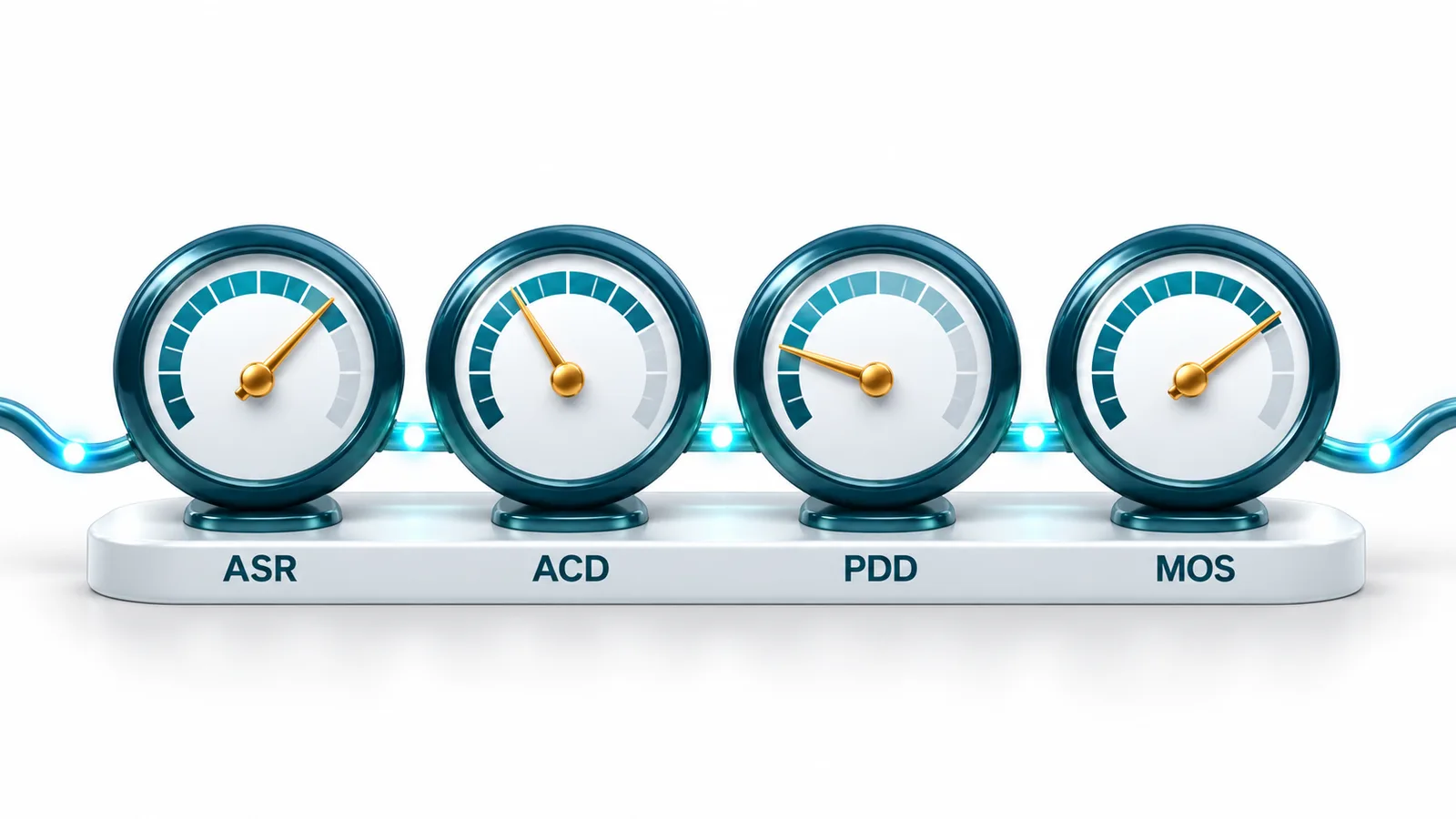
Screening is a pattern check, not a single test. No one number proves that traffic is pumped. A combination of signals on one destination is what deserves a closer look. Most buyers cannot see end-office minute counts directly, so the first steps rely on the buyer's own records.
- Compare the destination mix to the campaign list each week. Any destination that no campaign targets goes on a review list.
- Watch the volume trend. A destination that grows week over week, with no change in campaign activity, needs a closer look.
- Read duration and completion together. High completion with very short calls, or calls that never reach a conversation, is a warning pattern.
- Look for concentration. Many calls to a few numbers, or to a narrow range of numbers within one block, can indicate automated traffic.
- Check the rate history. A rate that changes on one destination without a matching change in the rate deck should be questioned.
- Ask how the traffic is routed. A route that passes through an intermediate or IP-based provider adds another party whose screening you should understand.
- Keep call detail records. Retain the records for the period in question so the pattern can be shown to your provider or to a regulator.
If a provider reports terminating and originating minutes by end office, the ratio can be compared directly to the 6:1 and 10:1 tests above. Ask for that comparison as part of a routing review rather than trying to estimate it from invoices.
What a buyer should ask
- How do you identify access-stimulating destinations before you route traffic to them?
- Which measures do you use: end-office ratio, minute volume, growth, call duration, or completion?
- Do you apply the FCC ratio tests, and do you also apply your own internal thresholds?
- If a destination is flagged, will you tell me before you block, reprice, or reroute it?
- How will a rate change on one destination appear in the rate deck and on invoices?
- If you hold direct numbering access, how have you handled the certification required under 47 CFR 51.914?
- How do you handle a dispute from another carrier over access-related charges on traffic I sent?
A note on scope
This article is general education, not legal advice. Whether a particular carrier, route, or contract falls under these rules depends on facts that this article does not have. A buyer with a billing dispute or a regulatory question should speak with counsel who works on telecom regulation.
Sources
Rule text and status were checked on October 16, 2026. Where a source was a secondary summary, or the primary document could not be opened in full, that is noted below.
- 47 CFR 61.3, eCFR: paragraphs (bbb), (ccc), and (eee), covering the traffic-ratio tests, the intermediate access provider, and the IPES provider. Text read in full on October 16, 2026.
- 47 CFR 51.914, Cornell Legal Information Institute: access stimulation billing and timing rules. Read through a summary tool, so check the eCFR wording before quoting it.
- Federal Register, December 1, 2023 (2023-26349): effective date of January 2, 2024, compliance date of February 16, 2024, and the June 1, 2023 summary at 88 FR 35743. Read on October 16, 2026.
- Telecompetitor, April 20, 2023: the 2023 order's adoption date and how the IPES route worked. Secondary source.
- TransNexus, September 26, 2019: the 2019 order in WC Docket 18-155 and the shift of access costs to the access-stimulating carrier. Secondary source. The order itself is FCC 19-94.
- Federal Register, February 17, 2026 (Numbering Policies for Modern Communications): final rule, effective March 19, 2026, with the access stimulation certification for numbering authorization holders. Read on October 16, 2026.
- Wiley client alert on the FCC's numbering order: adoption date of December 18, 2025 for FCC 25-86. Secondary source.
- Federal Register, March 24, 2026 (FCC 26-11): a proposed rulemaking that describes the IPES rules as adopted. It is a proposal, not a final rule.
Related reading
Traffic pumping sits next to several other termination problems. The wholesale voice termination guide explains how termination routes are priced and sold. The rate deck guide shows where a sudden rate change should appear. The IRSF and toll fraud guide compares traffic pumping with international revenue share fraud, and the traceback requests guide explains what happens when a carrier asks where a call came from.