Call recording captures the audio of telephone conversations and stores them for later retrieval. For businesses, recorded calls serve multiple practical purposes: quality assurance, agent training, dispute resolution, compliance documentation, and feeding transcription and analytics workflows that would otherwise require a human listener.
This article covers how call recording works, what it is used for, how it connects to transcription and AI analysis, and the legal and privacy considerations that every organization using call recording should understand.
Definition: Call recording is the capture and storage of telephone conversation audio for later playback, review, or analysis. In business contexts, calls are recorded on both sides — inbound customer calls and outbound agent calls — and the recordings are stored in the cloud phone platform or associated storage, searchable by date, agent, customer number, call duration, or other criteria.
How Call Recording Works
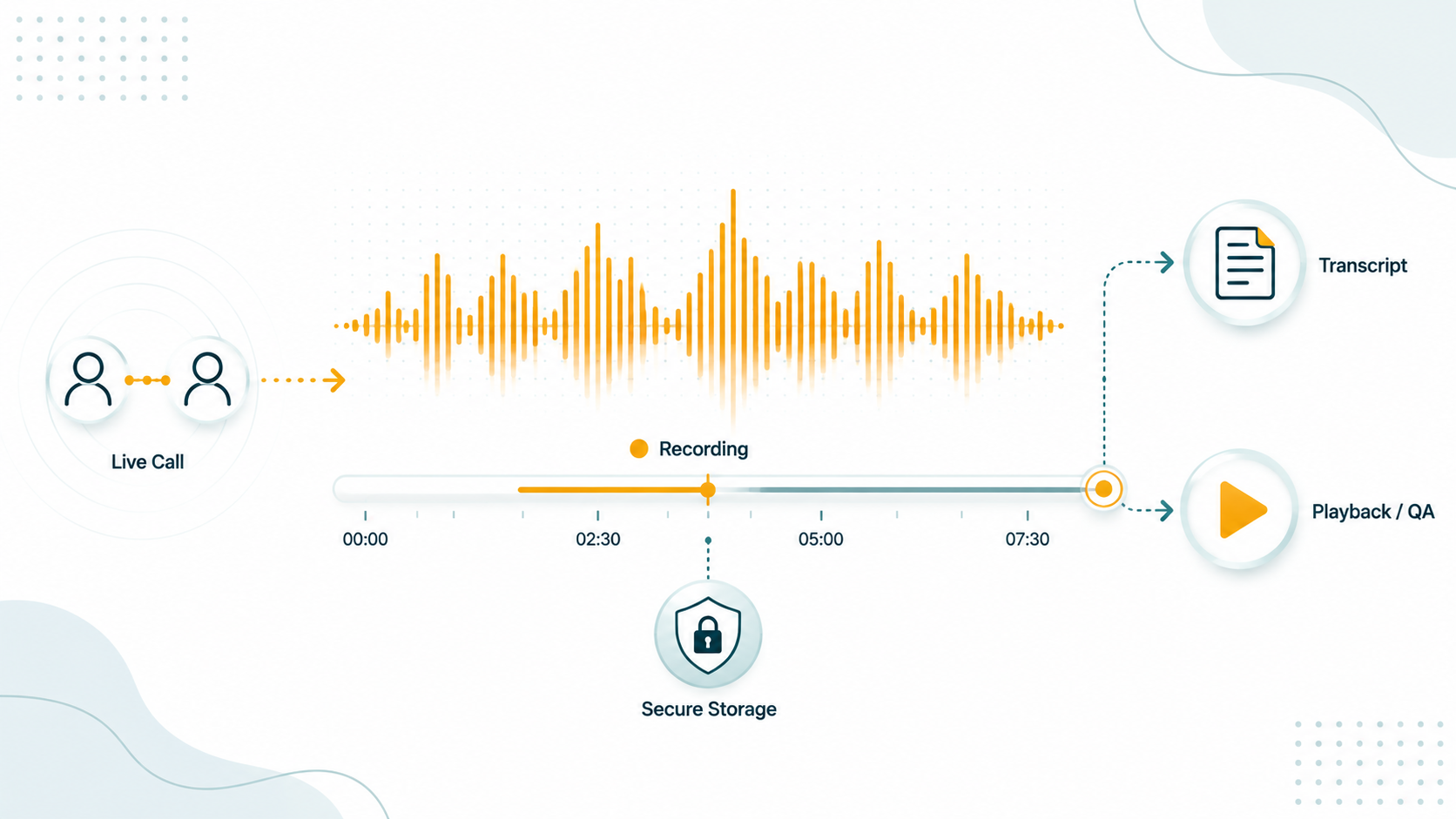
In a cloud phone system, call recording happens at the platform level. When a call is flagged for recording — either automatically based on policy rules or manually triggered by an agent — the platform captures the audio stream of both call legs (the agent and the caller) and writes the combined audio to a storage location.
The recording typically begins at the moment the call connects and ends when one party hangs up. Depending on configuration:
- Recording may start immediately and include hold music segments (the periods when the caller is on hold).
- Recording may pause when the caller is placed on hold and resume when they return to the active conversation.
- Recording may be paused manually by the agent — for instance, while the customer provides a credit card number or other sensitive payment information.
The audio file is stored in a format (typically a compressed audio format) and indexed with metadata: call date and time, agent extension, customer phone number, call duration, queue or campaign association, and any outcome or disposition the agent logged.
Inbound vs outbound recording
Most business call recording platforms handle both inbound and outbound calls within the same recording framework. Inbound calls from customers to the business are recorded as they route through the platform's queues and IVR. Outbound calls — whether manually dialed or campaign-driven — are recorded when they connect to a live answer. The recording infrastructure is the same in both cases; only the direction of the call differs.
Storage and retention
Recorded calls are stored in cloud storage and typically made available through the phone platform's administration interface. Access controls determine which users — agents, supervisors, administrators — can play back recordings. Retention periods vary by platform, plan, and configured policy. Many organizations have specific retention requirements driven by industry regulations, legal hold obligations, or internal policy. Retaining recordings longer than necessary introduces privacy risk; deleting them too soon may destroy evidence relevant to a dispute.
Business Use Cases
Quality assurance
Supervisors review recorded calls to assess whether agents are following scripts, handling objections correctly, complying with disclosure requirements, and maintaining appropriate tone. QA teams often score calls against rubrics — did the agent identify themselves properly? Did they offer the correct resolution? Did they escalate appropriately? — and the scores feed coaching and training decisions.
AI-assisted QA tools can now analyze recorded calls automatically, flagging interactions that score below thresholds or that contain specific phrases, for human review. This scales QA beyond what a manual sampling approach can cover.
Agent training
Recorded calls — both positive examples and instructive negative ones — are among the most effective training materials for new agents. Real calls with real customers are more instructive than role-play scenarios because they capture the actual variation in customer communication that agents will encounter. Many contact centers maintain libraries of well-handled calls for onboarding and ongoing development.
Dispute resolution
When a customer disputes what was agreed to on a call — a specific offer, a cancellation, a commitment from an agent — the recording is the authoritative record. Sales organizations use recordings to verify what was promised. Customer service operations use them to resolve "he said / she said" disputes. Financial services and other regulated industries may have specific documentation obligations that recordings satisfy.
Compliance documentation
In regulated industries, recordings may be required as evidence of compliance. Financial services organizations must document certain advisory conversations. Insurance organizations must document scope of appointment and plan presentations. Organizations making outbound calls under TCPA or FTC TSR frameworks may retain recordings as evidence of proper disclosures and agent conduct. The recording itself may not create compliance — it records what happened, which may or may not have been compliant — but it creates the documentation trail that enables compliance verification.
Transcription and AI Analysis
Recording captures the audio; transcription converts it to text. Once a call is transcribed, it becomes searchable, analyzable, and processable by AI and text analytics tools.
Transcription
Automated speech recognition (ASR) systems transcribe call audio into text — typically within minutes of the call ending, or in near-real-time on some platforms. Transcription accuracy varies based on audio quality, accents, background noise, and the vocabulary specific to the industry or product. Contact center transcription tools are often trained on call center audio specifically, which improves accuracy for that domain compared to general-purpose speech recognition.
Transcripts enable text search across call libraries — finding all calls where a specific product was mentioned, or where a specific phrase was used. They also make calls accessible to non-audio workflows: text can be fed into analytics, sentiment scoring, and machine learning pipelines that audio cannot.
AI summaries
AI summary tools process transcripts to generate concise summaries of what was discussed, what actions were agreed, and what the outcome was. A three-minute call summary appears in seconds, without an agent having to write it. Summaries feed into CRM records, reducing after-call work time and improving the quality of notes that future agents will use when reviewing account history.
Sentiment analysis
Sentiment analysis tools classify call segments — or entire calls — as positive, negative, or neutral based on language patterns in the transcript. Calls flagged as highly negative can be prioritized for supervisor review, even if no other quality alert triggered. Sentiment trends over time can surface product or service issues before they appear in formal feedback channels.
EaseDial's platform includes call recording with transcription, AI summaries, and sentiment analysis — allowing teams to get structured output from recorded calls without additional integration work.
Privacy and Consent Considerations
Recording telephone conversations without consent is regulated in the United States and many other countries. The legal requirements are more nuanced than the commonly cited "one-party vs two-party" shorthand suggests — and getting this wrong creates genuine legal exposure.
Important legal note: This section provides general information about call recording laws for educational purposes. It is not legal advice. Recording laws vary significantly by jurisdiction, call type, and context. Always consult qualified legal counsel for your specific situation before implementing call recording practices.
Federal law in the United States
The federal Wiretap Act, Title III of the Omnibus Crime Control and Safe Streets Act of 1968 (18 U.S.C. §§ 2510-2522), generally permits recording a telephone call when at least one party to the conversation consents. Because a business is always a party to its own calls, its own consent satisfies the federal requirement — meaning the federal standard is effectively a one-party consent regime. However, federal law is a floor, not a ceiling.
State laws vary significantly
Many states impose stricter requirements than federal law. Recording-consent requirements vary by state, jurisdiction, call context, and where each party to the call is located. A number of states have enacted all-party (or two-party) consent requirements, meaning all participants in a conversation must consent before recording is legal — California is the most frequently cited example, but several other states have enacted similar requirements. The list of states with heightened consent rules, the scope of those rules, and judicial interpretations of them evolve over time. State law should not be assumed stable or complete based on any published list.
The practical implication: a business in a one-party consent state (such as Texas or New York) that records its calls without informing the caller may be compliant under federal law and that state's law — but if the caller is in California, the recording may violate California Penal Code § 632, which requires all-party consent for confidential communications. California's law has extraterritorial reach in some interpretations: if the person being recorded is in California, California law may apply regardless of where the business is located.
Interstate calls — where the business and the caller are in different states — create genuine complexity. Legal counsel is needed to determine which state's law applies and how to satisfy the strictest applicable requirement.
The consent disclosure
The standard business approach to recording consent is the automated disclosure message: "This call may be recorded or monitored for quality assurance purposes." Callers who remain on the line after hearing this message are generally considered to have implicitly consented in one-party consent states.
In all-party consent states, implicit consent via a disclosure announcement may not be sufficient — some interpretations require affirmative, explicit consent. The specific legal standard for what constitutes consent varies by state and has been subject to litigation. For operations that record calls involving callers in California, Illinois, or other strict consent states, explicit legal review is appropriate.
Payment card data (PCI DSS)
If agents take payment card numbers verbally during recorded calls, the recording may capture PAN (Primary Account Number) data. PCI DSS (Payment Card Industry Data Security Standard) requirements restrict storage of sensitive cardholder data. Businesses that record calls involving verbal payment card data should configure their recording system to pause during payment processing segments or implement a DTMF (keypad) payment system that keeps card numbers out of the voice channel entirely.
EaseDial does not automatically satisfy recording consent requirements
Using EaseDial's call recording feature does not automatically satisfy any legal consent requirement. The business is responsible for understanding and complying with applicable recording laws for its operating jurisdictions and customer locations. EaseDial provides the technical capability; legal compliance is the business's responsibility.
Call Recording Best Practices
- Always play a consent announcement at the start of recorded calls. Regardless of jurisdiction, an automated disclosure is the baseline minimum. Verify the disclosure wording is sufficient for your highest-consent-standard jurisdiction.
- Configure recording pause for sensitive segments. Payment card numbers, healthcare information, or other sensitive data should not be captured in recordings if it can be avoided. Most platforms support agent-triggered recording pause.
- Define retention periods explicitly. Recording everything forever creates unnecessary storage costs and privacy risk. Define how long recordings are kept based on legal requirements, dispute resolution timelines, and business need — then enforce automated deletion.
- Restrict playback access. Not every employee should be able to listen to any recorded call. Access controls should limit playback to supervisors, QA teams, and administrators with legitimate need.
- Train agents on when and how to pause recording. If agents don't know the recording pause button exists or when to use it, sensitive data will be captured by default.
EaseDial
Call recording with transcription, AI summaries, and sentiment analysis — all built into the same platform as your queues and dialer.
Frequently Asked Questions
Call recording in EaseDial: Automatic recording by queue, extension, or campaign — with AI transcription, sentiment scoring, and keyword search across all stored calls. Call recording feature →