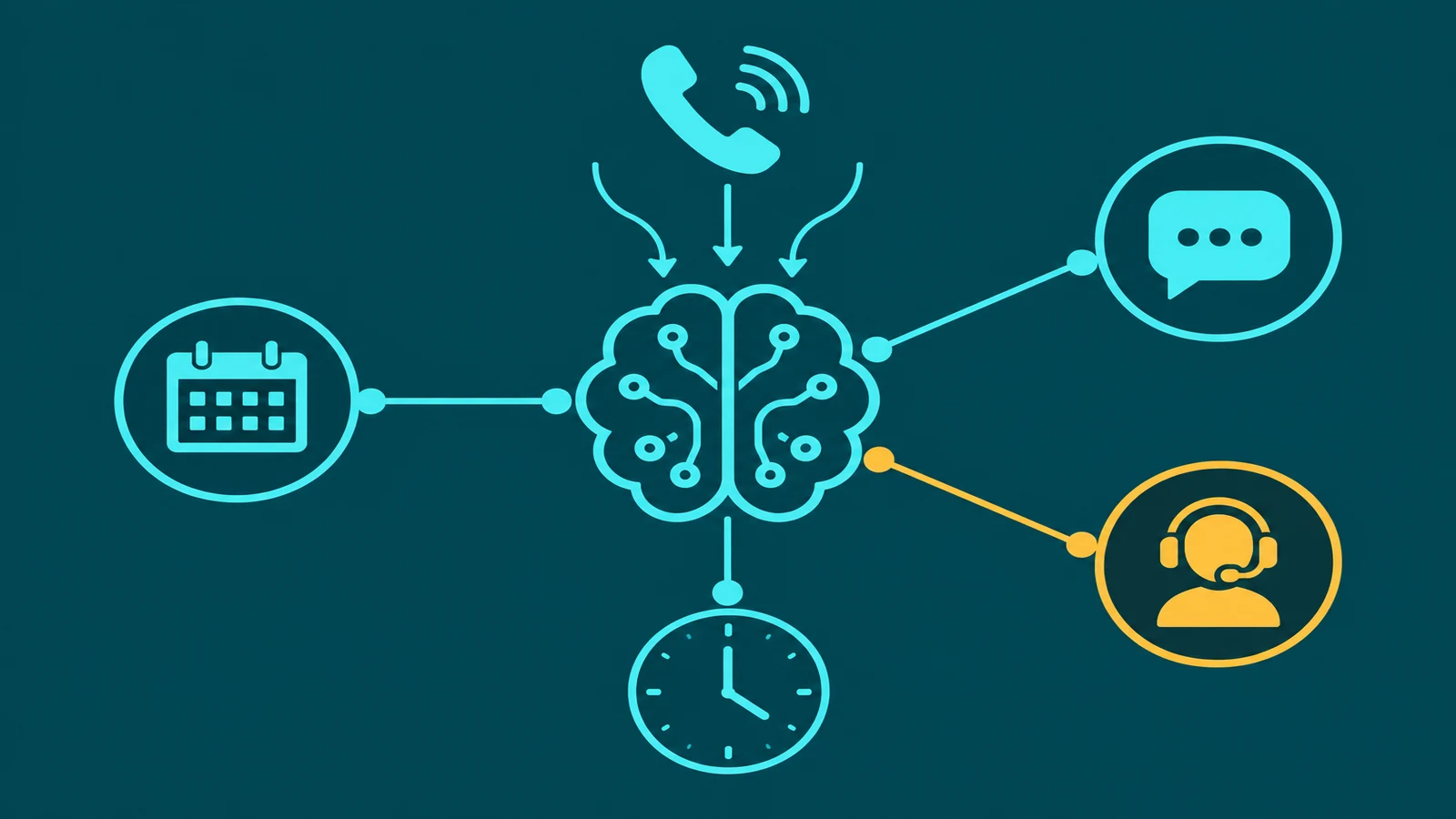
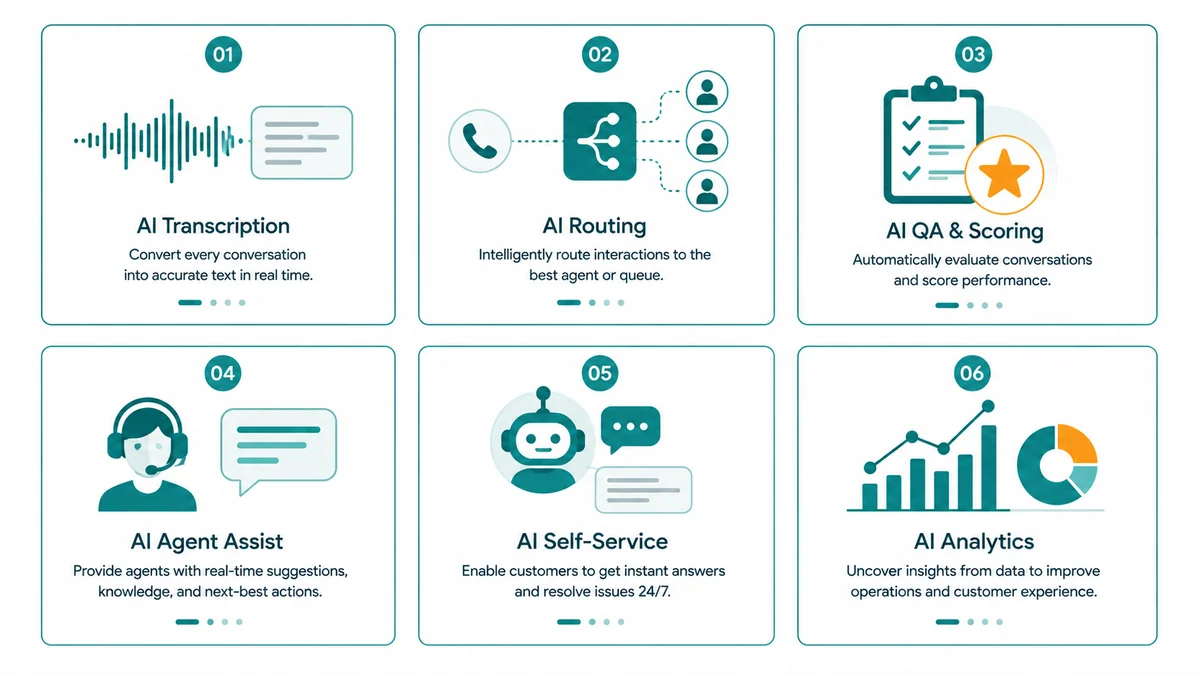
AI in contact centers refers to machine learning and natural language processing applications applied to customer interactions — including automated call handling, real-time agent guidance, post-call analysis, and workload forecasting. It is not a single technology but a category of tools applied across different parts of a contact center's operation.
The contact center vendor landscape in 2025–2026 uses "AI" to describe everything from a simple rules-based chatbot to a large language model processing call transcripts in real time. This guide separates the marketing from the technology: what AI applications in contact centers actually do, where they show measurable results, and where the claims outrun the current state of the technology.
The main AI applications in contact centers today
Conversational IVR and AI voice agents
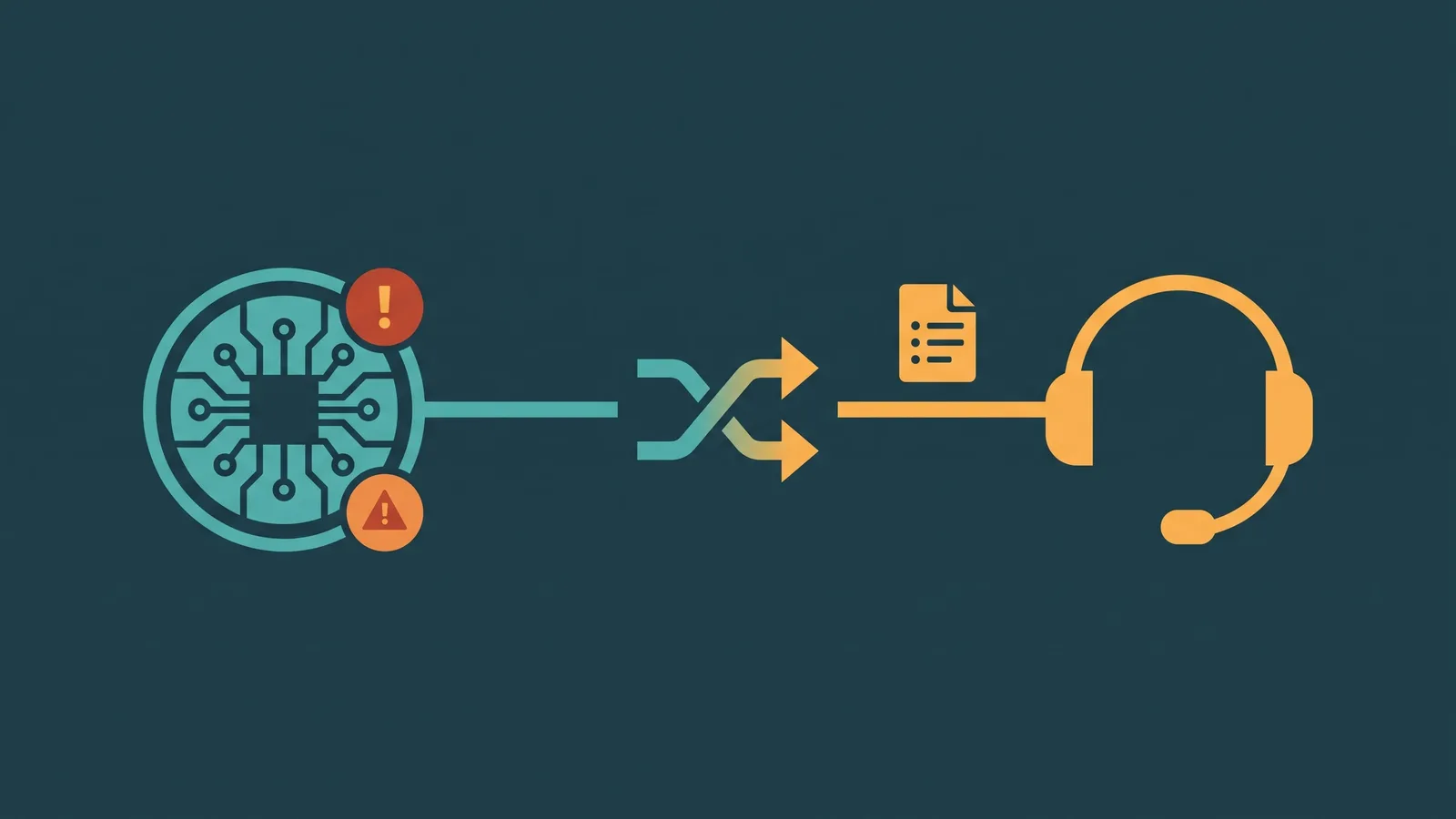
Traditional IVR presents a menu — callers press buttons. Conversational IVR replaces that with natural language: the system says "how can I help you today?" and routes based on what the caller says. AI voice agents go further: they conduct full conversations, complete transactions (appointment booking, balance inquiries, order status), and transfer to a human only when the situation exceeds their scope.
The realistic state: AI voice agents reliably handle structured transactions in well-defined domains. They struggle with ambiguous requests, heavy accents, and complex multi-step problems requiring judgment. Containment rates vary considerably based on use case and configuration quality. See the AI voice agent guide for a deeper look, and the comparison with traditional IVR for decision guidance.
Agent assist
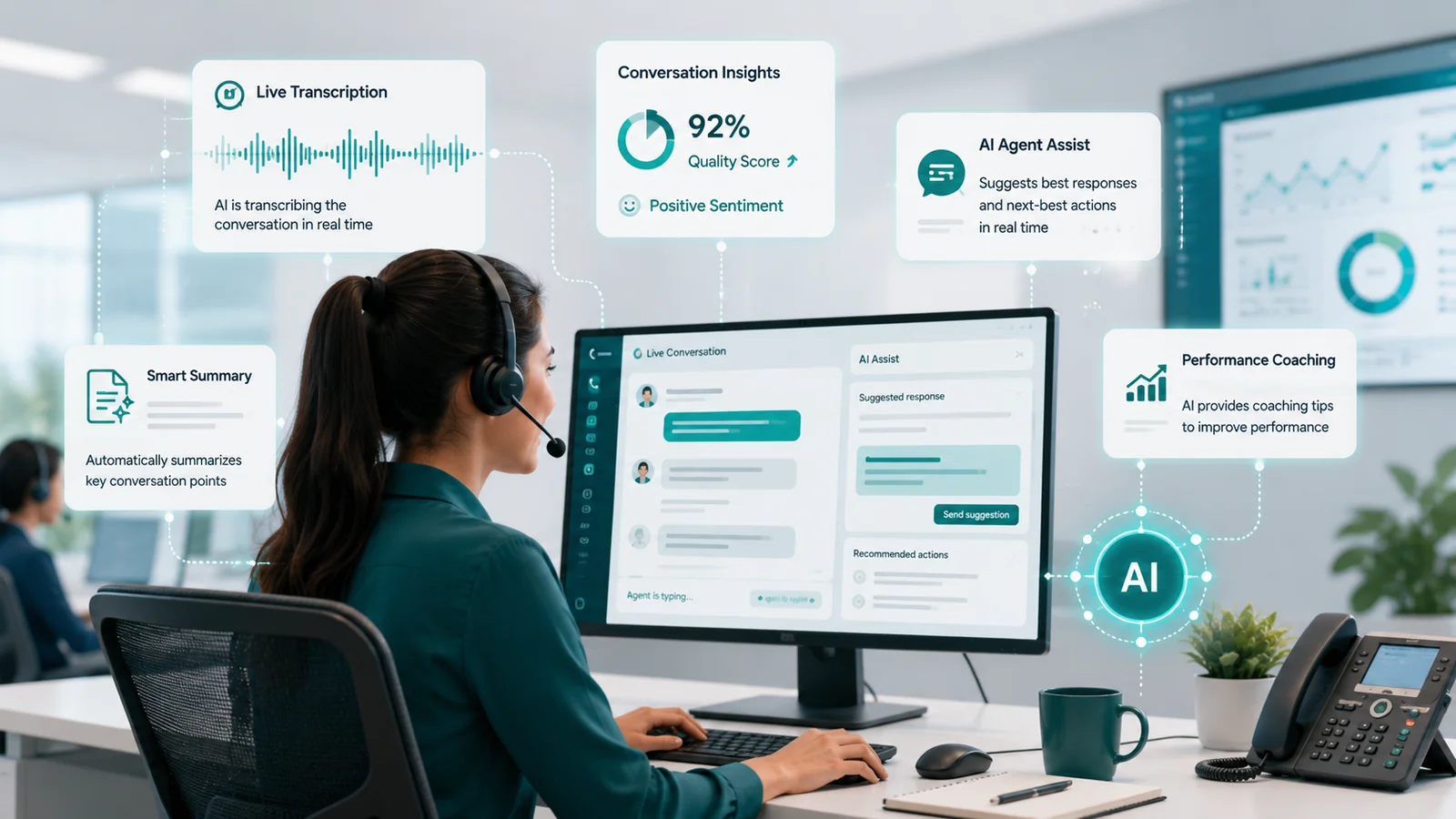
Agent assist systems listen to calls in real time and surface relevant knowledge base articles, suggested responses, compliance reminders, and warnings when a conversation is heading toward a common failure pattern. The value is reducing time agents spend searching for answers. The limitation: agent assist is only as useful as the knowledge base it draws from — outdated documentation means outdated suggestions.
Agent assist operates across three functional modes: knowledge retrieval (surfaces KB articles matching the current topic in real time), next-best-action prompts (suggests what the agent should say or do based on call stage and CRM context), and compliance monitoring (flags when a required disclosure hasn't been given or a prohibited phrase was used). The compliance monitoring layer is particularly valuable in regulated industries — manual QA sampling catches violations days after the fact; real-time monitoring catches them during the call.
Implementation consideration: evaluate whether the system processes transcription on-device or requires a cloud round-trip per turn. Cloud-dependent systems introduce screen-display latency on every agent prompt. Also: ROI on agent assist degrades quickly if the underlying knowledge base is not maintained — a regular content audit cycle is a prerequisite, not an afterthought.
Automated call summaries and after-call work
After-call work (ACW) — typing call notes and updating the CRM — is a significant contributor to average handle time. AI call summarization generates a structured summary and populates CRM fields automatically, reducing ACW from several minutes to seconds. This is one of the more reliable AI applications because summarization maps well to what large language models do well. Accuracy depends on transcription quality; agents should review summaries until accuracy is calibrated for your call types.
Automated quality management and AI scoring
Traditional QM samples 3–5% of calls for human review. AI QM analyzes 100% of calls, flagging those meeting specific criteria: compliance keywords missed, escalation patterns, silence indicating caller frustration, or deviations from scripts. This shifts QA from sampling to comprehensive monitoring. The limitation: automated scoring requires human calibration — a model scoring "professionalism" without validated examples will produce scores that correlate poorly with actual quality.
AI QM scoring operates at two layers. The first is transcription-based scoring: the call transcript is analyzed for required phrases (disclosures, greetings, sign-off language), prohibited language, topic coverage, and scripted flow adherence. This layer is highly reliable for deterministic compliance checks. The second is sentiment and behavior scoring: models evaluate tone, pacing, empathy signals, and engagement patterns — less deterministic and requiring ongoing calibration for your specific call population and agent demographics.
Automated scoring changes what QA reviewers spend their time on. Instead of reviewing a random sample, reviewers focus on flagged calls, borderline scores, and escalated interactions. The scorecard structure — criteria, weightings, what triggers a coaching conversation — remains a human judgment call that the AI scores against. See call center QA scorecards for how to structure evaluation criteria AI systems can score consistently. For the recording infrastructure that feeds AI QM, see call recording for contact centers.
Sentiment analysis
Sentiment analysis classifies the emotional tone of a conversation — positive, neutral, negative — and tracks how it changes over the call. Sentiment analysis on text is reasonably reliable. Detecting emotion from voice is harder; models trained on one demographic don't always generalize. Use sentiment trend data directionally rather than treating per-call scores as precise measurements.
Predictive routing
Predictive routing matches incoming callers to the agent most likely to produce a positive outcome, based on caller history and agent performance data. This works best with large call volumes and clean historical data. A contact center handling 10,000+ calls per day has enough signal for meaningful models. A 15-agent support team probably doesn't. See the call routing guide for context on where predictive routing fits.
Workforce management forecasting
AI-enhanced WFM improves demand forecasting by incorporating more variables than traditional Erlang models — seasonal patterns, campaign schedules, trend changes. The output is more accurate headcount forecasts with fewer overstaffing and understaffing days. This is an incremental improvement on existing WFM — the models are better, but they still depend on accurate historical data.
EaseDial AI
AI voice agents, agent assist, and automated summaries — on the same platform as your routing and reporting.
Where AI in contact centers is still immature
Complex problem resolution
AI voice agents handle well-defined transactions reliably. They struggle with problems requiring synthesis across multiple systems, judgment about policy exceptions, or emotional de-escalation. The right design is not to eliminate humans but to offload the routine so humans can focus on cases that actually require them.
Multilingual and multi-accent performance
Most commercial speech recognition performs best on clear, native-speaker English in quiet environments. Performance degrades on accented speech, code-switching, and noisy call environments. Test ASR accuracy specifically for your caller demographics before committing to an AI-heavy routing design.
Training and maintenance overhead
AI models require ongoing maintenance. A conversational agent accurate at launch drifts as products and policies change. Quality monitoring automation requires regular recalibration. The ongoing operational cost of keeping models current is real and frequently underestimated during procurement.
Data quality dependency
Every AI application in a contact center runs on data the contact center generates. If call categorization is inconsistent, if CRM data is incomplete, if recordings are noisy — the AI outputs reflect those inputs. Cleaning up the underlying data infrastructure is often the prerequisite to AI producing reliable results.
How to evaluate AI claims from vendors
- Is this from your own platform metrics or third-party measurement? Vendor-reported outcomes should be verified independently.
- What was the baseline? A 30% reduction from a poorly designed IVR differs from 30% from a well-optimized one.
- What call type and volume was this tested on? Results from high-volume e-commerce don't necessarily apply to a 20-agent B2B support team.
- What is the full implementation cost — including training, integration, and maintenance? The ROI calculation must include all of this.
- Can I run a pilot on a subset of calls? Any vendor confident in their technology should support a controlled evaluation.
Frequently asked questions
Deploying AI safely
The gap between marketing claims and production reality is still significant. Most enterprise deployments involve careful scoping, ongoing maintenance overhead, and human review for consequential actions. Start with use cases where the downside of a wrong answer is low, measure results carefully, and expand from there.
For specific AI applications, see: AI voice agents, AI voice agents vs traditional IVR, AI receptionists, AI chat agents, call sentiment analysis, speech analytics, and contact center analytics.
Related Articles
AI & Automation
What Is an AI Voice Agent?
Read article →
AI & Automation
AI Voice Agents vs Traditional IVR
Read article →
CCaaS & Contact Center
What Is a Cloud Contact Center?
Read article →
Quality Management
Call Center QA Scorecard
Read article →
Analytics & Reporting
Contact Center Analytics
Read article →