A number port moves a phone number from the losing carrier to the gaining carrier while the number keeps working. Under the FCC rules, a simple wireline or intermodal port must be completed within one business day, and a non-simple port within four business days, unless the new provider or the customer asks for a longer period. Those are deadlines, not a forecast. The date a buyer actually sees is often later, because a rejected request starts another validation cycle and each carrier publishes its own minimum intervals. This guide explains the steps, the rules behind them, and where ports usually stall.
The parties and the shared database
Three terms appear in every port. The gaining carrier is the provider that will serve the number after the port. The losing carrier is the provider that serves it now. The Number Portability Administration Center (NPAC) is the shared database that records which carrier serves each ported number, so that calls to that number reach the right network. The industry group North American Portability Management (NAPM) LLC manages the contracts for the portability administrators and oversees how NPAC data is used.
A port is therefore less like a single transaction and more like a conversation between two carriers, with a database update at the end. Your provider sends most of the messages, but the data in those messages has to match the losing carrier's records, and that match is where most delays start.
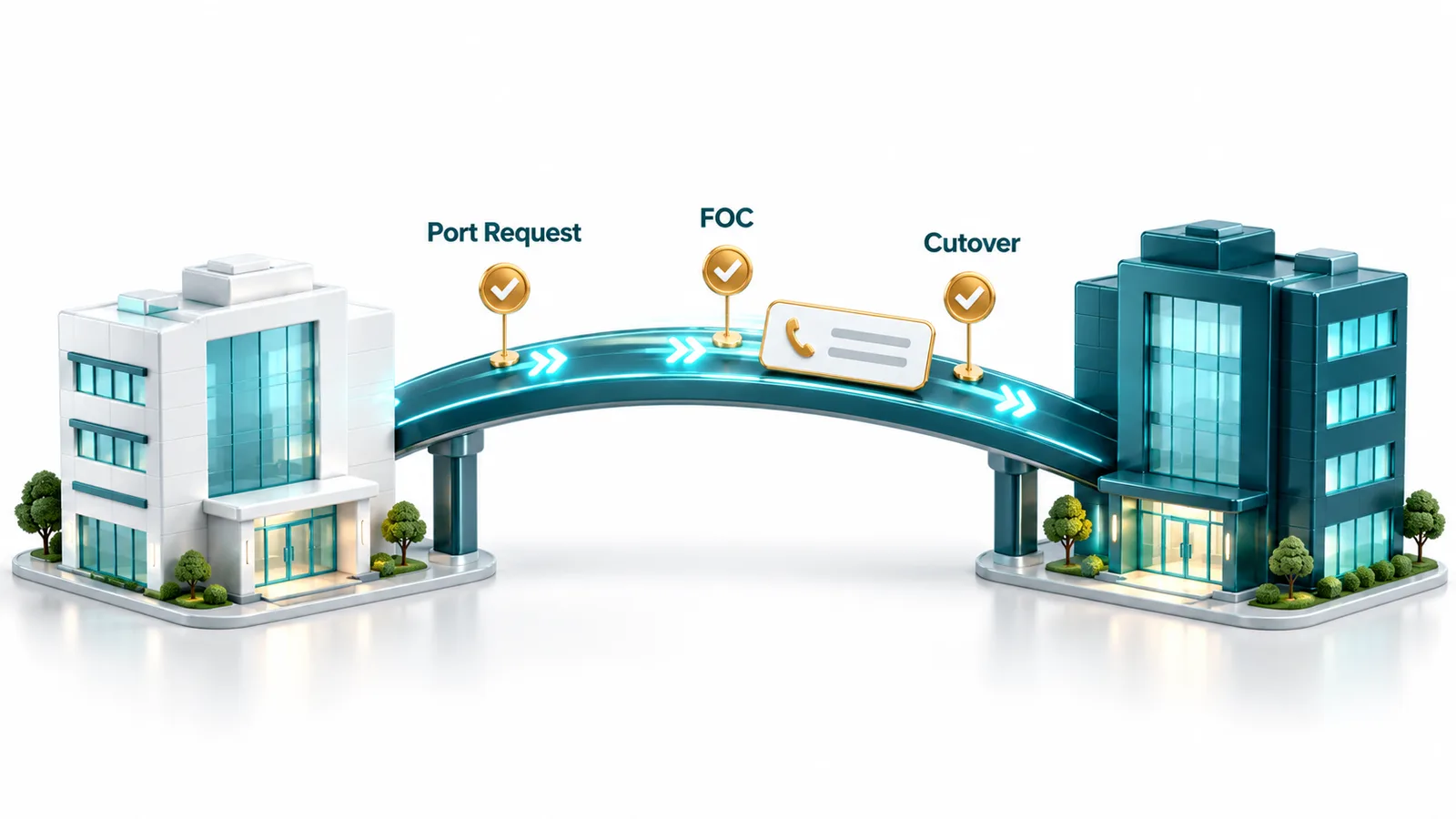
The steps in a port
The table below lists the usual order of events. The timing column is a planning guide. Where a specific carrier publishes a figure, the table uses that carrier's figure and says so.
| Step | What happens | Timing to plan for |
|---|---|---|
| 1. Authorization | The gaining provider obtains a signed Letter of Authorization (LOA) from the account holder. AT&T's published procedures require an LOA before a request is submitted. | Before submission. Allow extra time if the signer is hard to reach. |
| 2. Port request | The gaining carrier submits a Local Service Request (LSR) listing the numbers, the account data, and a requested due date. | Same day. Under the simple-port rule, a request received between 8 a.m. and 1 p.m. local time can be activated at midnight that day. |
| 3. Validation | The losing carrier checks the request against its customer record: account number, name, service address, and the status of each number. | Hours to a few business days. AT&T's page gives a 48-hour window for a reject response. |
| 4. Reject or supplement | A mismatch returns a reject with a reason. The gaining side corrects the data and resubmits, or files a supplement if the request is already in progress. | Each cycle adds time, and a due date that was already set can move. |
| 5. Firm Order Commitment (FOC) | The losing carrier accepts the request and confirms the due date and the cutover window. This is the point where the port becomes a commitment. | AT&T's page gives 24 to 48 hours after submission, depending on service type. |
| 6. Pre-cutover trigger | Some carriers place a routing trigger ahead of the due date so the new network can take over cleanly. | AT&T applies its trigger 24 hours before the port date, unless a coordinated cutover is needed. |
| 7. Due date and cutover | The number is activated on the gaining carrier's network and routing moves to it. | The due date and window stated in the FOC. |
| 8. Clean-up | The losing carrier releases its routing and ends the old service. Records and billing are closed out. | After cutover. Keep the old service active until the port has completed. |
Step 5 is the one to watch. Before the FOC, the request is still a proposal that the losing carrier can reject. After it, the due date is fixed, and a change usually needs a supplement. On AT&T's published procedures, a supplement can be filed until four hours before the confirmed due date.
What the FCC rules say
Several sections of 47 CFR Part 52 govern porting, and they are easy to confuse. The official text is on eCFR at the link in the sources list below. The sections summarized here were checked against the codified text published by the Cornell Law School Legal Information Institute, which mirrors the regulation.
- 47 CFR 52.35 (porting intervals). A simple wireline-to-wireline or intermodal port must be completed within one business day, unless the new provider or the customer requests a longer period. A non-simple port has a four-business-day interval with the same exception. Intermodal ports include wireline-to-wireless ports and ports that involve interconnected VoIP service. For simple requests, the rule uses a receipt window: a request received between 8 a.m. and 1 p.m. local time is eligible for activation at midnight the same day, and a later request counts as received the next business day.
- 47 CFR 52.36 (standard data fields). For a simple port order, a carrier may require only a defined set of data fields. These include the number, the account number, the ZIP code, the new provider, the desired due date, and the purchase order number. The passcode is optional unless the end user has requested one and it has been assigned.
- 47 CFR 52.34 (interconnected VoIP and TRS providers). Interconnected VoIP providers must facilitate valid port requests to or from a carrier "without unreasonable delay or unreasonable procedures," and they may not agree to terms that keep a customer from porting. Telecommunications carriers have the same obligation for port requests to or from those providers. This is the section that matters most when a port moves between a traditional carrier and a wholesale VoIP provider.
- 47 CFR 52.33 (cost recovery). This section covers how incumbent local exchange carriers recover their costs of providing number portability, through tariffed charges. It does not set porting steps or deadlines, so it is not the section to check for timing.
Why the rule and the calendar differ
The federal interval is a deadline the carrier has to meet, and the new provider can ask for a longer due date. Carriers also publish minimum intervals for the due dates they will accept. AT&T's procedures, for example, list a minimum of three business days from purchase order submission to the requested FOC date for some business services, and five business days for a different service type. For that carrier, the published minimum is what sets the earliest due date it will accept.
That gap is why a one-day simple port can still take a week in practice. The rule governs what the carriers must do once a valid request is in hand. The steps before that point, including validation and any rejects, have no fixed clock in the rule.
A worked example (illustration)
The following is a hypothetical example, not a quote from any carrier. A business asks to move twelve numbers from one account at a losing carrier. The request is a simple port, and it asks for a Thursday due date. It is submitted on a Monday at 10 a.m. local time, which is inside the receipt window.
The losing carrier validates the request that afternoon and rejects it. The billing name on the request reads "Example Dental Group," but the losing carrier's record reads "Example Dental Group LLC." The gaining side corrects the name and files a new request Tuesday morning. The losing carrier returns an FOC that afternoon with a Thursday due date and a cutover window, and the numbers move on Thursday.
If the same request had gone in at 2 p.m. Monday, it would have counted as received Tuesday. The buyer would then need to check whether the Thursday date still left enough room. The lesson is that the reject, not the regulatory interval, set the timeline. Matching the account data before submission removes the most common cause of this kind of delay.
Common rejection reasons
- Account data mismatch. The most common cause. The name, service address, or account number on the request differs from the losing carrier's record, sometimes by a suffix or a punctuation mark.
- Wrong billing telephone number (BTN). When several numbers sit on one account, the BTN must be identified correctly. AT&T's procedures say that when the BTN itself is ported, a new BTN for the remaining numbers must be named on the request.
- Missing or invalid authorization. No signed LOA, or an LOA signed by someone who is not authorized on the account.
- Account status issues. AT&T states that pending order activity on an account results in a reject of a port-away request. Open disputes or a suspended account can also block a port.
- Passcode errors. Where a passcode has been assigned to the account, a missing or incorrect one causes a reject.
- Mixed requests. A single request that ports some numbers and asks for others to be disconnected. AT&T states that such requests are no longer acceptable.
- Incomplete or inconsistent fields. Missing required fields, malformed numbers, or a requested due date shorter than the losing carrier's minimum interval.
Before you submit a port
- Get the exact account record from the losing carrier, or ask for it, and compare the name, service address, and account number character by character against the request.
- Identify the BTN and list every number on the account, including the numbers that are staying behind.
- Check for pending orders, open disputes, or service changes, and resolve them before you submit.
- Confirm whether a passcode or PIN has been assigned to the account, and have it ready.
- Collect a signed LOA from someone authorized on the account, and keep a copy with the request.
- Ask the provider whether the port is treated as simple or non-simple, and what due-date interval it will request.
- Write the routing plan: which numbers move, what happens to calls during the window, and how traffic returns if the port is rejected.
- Keep the existing service active until the FOC has issued and the port has completed.
When a provider quotes a port date, ask three follow-up questions. What date is the FOC expected by? What happens to the due date if a supplement is needed? Who tells you when the port has completed? Written answers to those questions are more useful than a verbal estimate.
Sources
Checked October 16, 2026. The FCC number portability page and the NPAC website returned access errors during checking and are not cited.
- Official text: eCFR, 47 CFR Part 52, Subpart C, Number Portability. https://www.ecfr.gov/current/title-47/chapter-I/subchapter-B/part-52/subpart-C
- 47 CFR 52.33, recovery of carrier-specific costs. https://www.law.cornell.edu/cfr/text/47/52.33
- 47 CFR 52.34, obligations for interconnected VoIP and TRS providers. https://www.law.cornell.edu/cfr/text/47/52.34
- 47 CFR 52.35, porting intervals. https://www.law.cornell.edu/cfr/text/47/52.35
- 47 CFR 52.36, standard data fields for simple port order processing. https://www.law.cornell.edu/cfr/text/47/52.36
- AT&T, Local Number Portability port-out procedures (carrier publication; the page does not show a date, and its intervals are carrier-specific). https://www.corp.att.com/lnp/att-lnp-port-out-procedures/
- NAPM LLC, industry organization for number portability. https://napmllc.org/
- TelcoBridges, Number Porting: What ISPs and Carriers Need to Know (vendor guide, undated). https://telcobridges.com/learning/sip-trunking/number-porting-isps-carriers/
Related reading
For a customer-level porting checklist, see the business phone number porting guide. For how DID numbers are assigned and routed, see what a DID number is. For the documents carriers ask for before they activate a wholesale account, see wholesale VoIP KYC onboarding. For toll-free numbers, see the toll-free numbers guide.