Most people think a phone number and a DID are the same thing. They are not — and the distinction matters the moment you are trying to decide how to give every person on a 40-person team their own callable number without buying 40 separate phone lines.
A DID is the mechanism that makes that possible. It is one of the most useful concepts in business telephony, yet it is consistently under-explained. This guide covers what a DID number is, how it differs from both a plain phone number and an internal extension, where DID technology came from, how it works over modern SIP/VoIP infrastructure, the types of DID numbers available, and how businesses actually use them in practice.
What Is a DID Number?
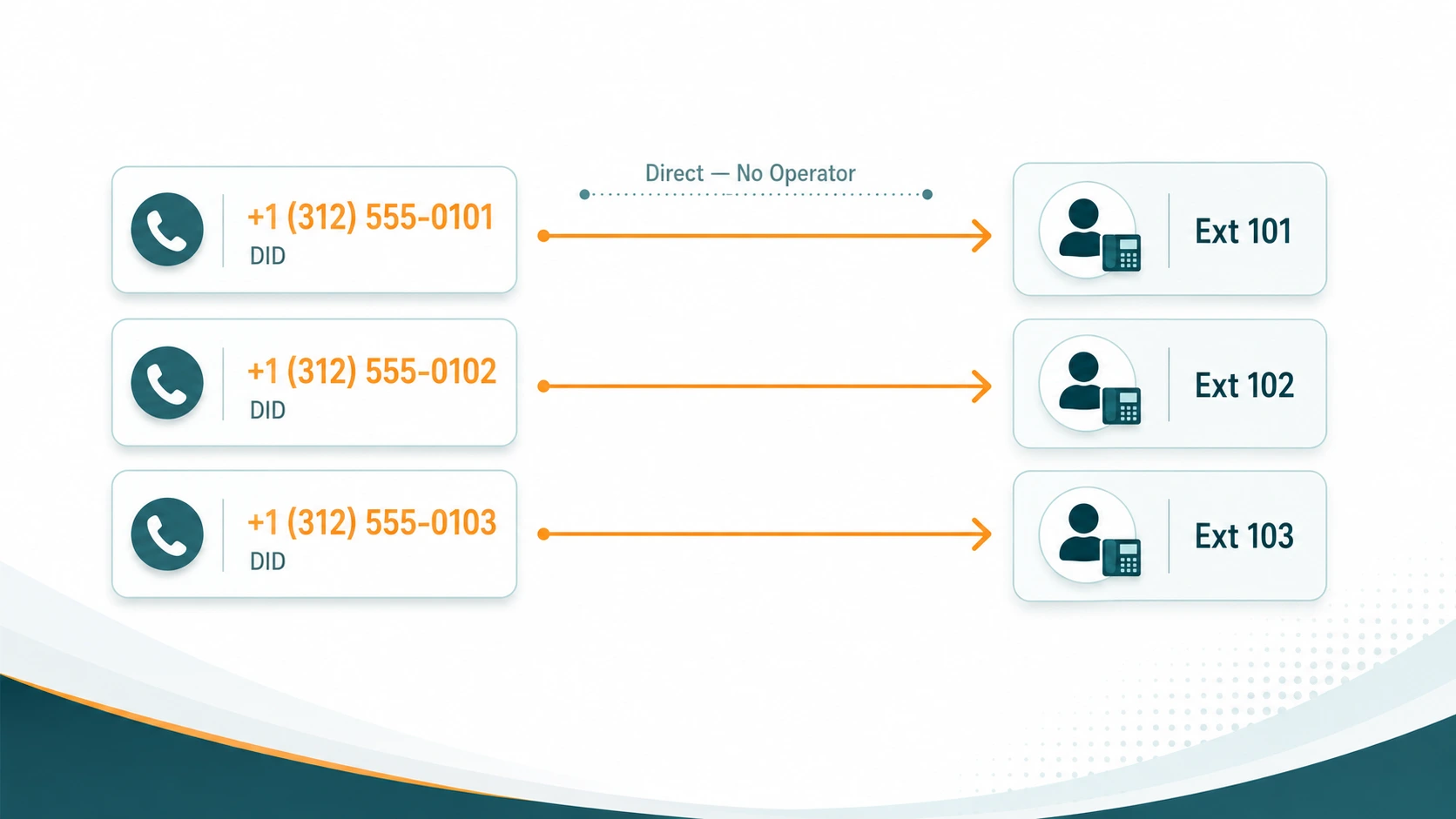
Definition: A DID (Direct Inward Dialing) number is a telephone number configured to route directly to a specific destination inside a business phone system — such as a particular person, department, call queue, IVR menu, or voicemail box — without the caller needing to go through a receptionist or dial an internal extension. The number exists in the public telephone network; the routing to the internal endpoint is managed by the carrier and the business's PBX or cloud phone system.
Before DIDs existed, reaching a specific person inside a large organization required calling the company's main number and being manually transferred by a switchboard operator. DIDs changed this: the carrier delivers a block of phone numbers to the business, each of which can be mapped to a different internal destination. A caller dials one specific number, and that number routes straight to the person or team they need.
The Three-Way Distinction: Phone Number vs. DID vs. Extension
These three terms get used interchangeably in casual conversation, but they are technically distinct. Getting the distinction right helps you design and explain your phone system clearly.
Phone number
A phone number is the E.164-formatted identifier that exists in the public telephone network — for example, +1 415 555 0100. It is what a caller dials. Phone numbers are assigned by carriers, allocated by numbering authorities (such as the North American Numbering Plan Administrator in the US), and are globally routable across the PSTN. A phone number on its own says nothing about where or how it connects — it is simply a routable address.
DID (Direct Inward Dialing number)
A DID is a phone number configured specifically to route into a private phone system — a PBX or cloud platform — and connect directly to a designated internal endpoint. The DID is still a public phone number in E.164 format; what makes it a DID is the routing configuration on both the carrier side and the business's system side. When someone calls +1 415 555 0147, the carrier's routing table maps that number to the company's SIP trunk, and the company's PBX maps it to Marcus in the billing department. From the caller's perspective, they dialed a number and got Marcus. The DID is the mechanism behind that experience.
Extension
An extension is an internal shortcode — for example, 1012 or 205 — that exists only within the business's PBX or cloud system. Extensions are not dialable from outside the system. A caller cannot dial extension 1012 directly from their phone; they would need to either call the main number and be transferred, or dial a DID that has been assigned to that extension. Extensions are administrative shortcuts inside the system; DIDs are the external entry points that map to those internal shortcuts.
A concrete example
Acme Corp has one published main number: +1 212 555 0100. It also has 40 DIDs assigned to individual staff — +1 212 555 0101 through +1 212 555 0140. Each DID routes to an employee's internal extension. Internally, each employee also has a three-digit extension (101 through 140) they use to call each other. A client calling +1 212 555 0118 reaches the sales manager directly. A colleague dials extension 118 from their desk phone. Both end up at the same person. The DID is the external entry point; the extension is the internal address; the phone number (+1 212 555 0118) is the public E.164 identifier that carries it all.
Where DIDs Come From: A Brief History
DID technology originated with physical PBX systems in the mid-20th century. Before DIDs, a business phone system required a dedicated physical line for every phone that needed to receive calls from the outside world. Forty employees meant forty lines into the building — expensive and impractical.
The solution came through trunking. Rather than running individual lines to each phone, a single T1 or PRI trunk could carry 24 simultaneous calls over one physical circuit. The carrier would associate a block of phone numbers — say, numbers ending in 0101 through 0199 — with that trunk. When a caller dialed any number in that block, the carrier would route the call to the business's PBX and send the dialed number (the DNIS, or Dialed Number Information String) along with the call. The PBX would read the DNIS, look up the internal mapping, and ring the right extension.
This meant a company could give 100 employees their own callable number while using far fewer physical trunks — the 24-channel T1 carried calls to all 100 numbers, with simultaneous capacity for 24 conversations at once. The individual numbers in the block were the DIDs. "Direct Inward Dialing" described exactly what they enabled: calls came in directly, without going through an operator.
How DID Works Today with SIP/VoIP
The principle is the same; the infrastructure is entirely different. Modern DID delivery uses SIP (Session Initiation Protocol) over internet connections rather than physical copper circuits.
Here is what happens when someone dials a VoIP DID today:
- The caller dials the DID number from any phone on the PSTN or another VoIP system.
- The call travels through the public telephone network and reaches the carrier (the DID provider) who owns that number block.
- The carrier's routing table identifies which business SIP trunk the number is assigned to and forwards the call via SIP to that trunk's IP address.
- The business's cloud phone platform or PBX receives the SIP INVITE. The INVITE contains the dialed number (the DNIS/To header) and the caller's number (the ANI/From header).
- The platform looks up the dialed DID in its internal routing configuration and finds the mapped destination — a user, a ring group, a call queue, an IVR, or a voicemail box.
- The platform routes the call to that destination. The destination rings. The caller and the recipient are connected.
The carrier does not need to know anything about the business's internal structure. It simply delivers calls to the SIP trunk for any number in the assigned DID block. The business's platform handles all internal routing. This separation is why DID works cleanly with cloud phone systems: the carrier provides the numbers and the PSTN connectivity; the platform provides the routing intelligence.
What a DID Can Route To
A DID is not limited to routing to a single person. Any destination the business phone system supports can be the target of a DID:
- Individual user endpoint — the most common use case. The DID rings one person's desk phone, softphone, or mobile app. +1 212 555 0118 rings Sarah in accounts.
- Ring group — the DID rings a group of users simultaneously or in sequence. +1 212 555 0130 rings all five members of the IT team.
- Call queue — the DID places callers into a queue that distributes calls to available agents based on a routing strategy. +1 800 555 0111 is the support DID that feeds the support queue. Learn more about how queues work in our guide to call queues.
- IVR / auto-attendant — the DID connects callers to an interactive menu. +1 212 555 0100 is the main company number that presents "Press 1 for sales, press 2 for support." See our guide to IVR systems for how these are structured.
- Voicemail box — less common but valid; some departments or individuals have a DID that routes directly to voicemail for after-hours or overflow handling.
- SIP URI or external number — a DID can forward to a mobile number, another SIP address, or an external party. This is how call forwarding rules work in practice.
Types of DID Numbers
Local DIDs
Local DIDs carry a geographic area code — +1 212 for Manhattan, +44 20 for London, +61 2 for Sydney. They signal local presence. A business operating nationally can purchase local DIDs in multiple cities so clients call a familiar local number. Local DIDs are the least expensive type and the most universally available.
Toll-Free DIDs
Toll-free DIDs carry 800, 833, 844, 855, 866, 877, or 888 prefixes in North America (and equivalent prefixes in other countries). The cost of the call is borne by the receiving business rather than the caller. Toll-free DIDs convey a professional, national presence and are standard for customer service and sales operations. They are more expensive than local DIDs and require specific provisioning from a toll-free service provider.
International DIDs
International DIDs are numbers registered in foreign countries, allowing a business to establish a callable local presence in markets where it may not have a physical office. A US company can purchase a +44 DID in the UK so London clients call a local number; the call routes via SIP to the US team. International DID availability and pricing vary significantly by country and are subject to local regulatory requirements — some countries require a local address or business registration to obtain numbers. For a complete guide to provisioning and using numbers across multiple countries, see international business phone numbers.
Vanity DIDs
Vanity numbers are DIDs chosen for their memorable spelling or pattern — 1-800-FLOWERS, 1-800-LAWYERS, or a number with a memorable digit pattern like 555-1234. They are marketed as easy-to-remember alternatives to generic numbers. Availability depends on what is unallocated in the carrier's number inventory.
| Type | Prefix/Format | Best For | Relative Cost |
|---|---|---|---|
| Local | Geographic area code | Individual staff, departments, regional presence | Lowest |
| Toll-Free | 800, 833, 844, 855, 866, 877, 888 | Customer service, national-brand inbound lines | Medium |
| International | Foreign country code (+44, +61, etc.) | Virtual local presence in overseas markets | Medium–High |
| Vanity | Memorable spelling or digit pattern | Marketing and brand recognition | Variable / premium |
How Businesses Use DIDs in Practice
Individual DIDs for sales and account teams
Each salesperson or account manager gets their own DID. Clients store that number directly in their contacts and call the person they know, bypassing IVR menus and hold queues entirely. The rep's DID rings their softphone or mobile app regardless of where they are working. When the rep is unavailable, the call rolls to voicemail or — if configured — forwards to a colleague. This setup also enables outbound caller ID matching: when the rep calls out, the client's phone displays the rep's DID rather than a generic company number, improving answer rates.
Departmental DIDs
The marketing department has one DID, billing has another, technical support has a third. Each DID routes to that department's call queue or ring group. Clients who know which department they need can call directly; everyone else uses the main number and IVR to self-select. Departmental DIDs also allow each department to have independent call recording, analytics, and routing configurations.
IVR option DIDs
A company's IVR might say "Press 2 for technical support" — but frequent callers can also be given the support DID directly, bypassing the IVR. The DID and the IVR option both route to the same support queue. This lets callers who already know the system skip the menu, while first-time callers still have a guided path.
Remote and hybrid worker DIDs
A DID assigned to a remote employee routes to their softphone application, not a physical desk. The employee's clients, colleagues, and the company's call routing system treat their DID identically regardless of whether they are in an office, at home, or traveling. Cloud phone systems make this straightforward — the DID is mapped to a user profile, and the user's app receives the call wherever they have internet access.
Campaign and tracking DIDs
Marketing teams use dedicated DIDs per campaign — one number on Google Ads, a different number on a radio spot, another on a print mailer. Call analytics show which DID received calls, enabling attribution by channel. All campaign DIDs can route to the same inbound sales queue; the tracking value is in knowing which source generated the call.
EaseDial
Local, toll-free, and international DID numbers — assign to users, queues, or IVR flows in minutes.
DID Pools and Block Provisioning
Carriers offer two models for DID provisioning. The traditional model is a DID block: a business purchases a contiguous range of numbers (e.g., +1 212 555 0100 through +1 212 555 0199), giving them 100 DIDs to assign as needed. Block pricing typically offers a lower per-number rate for larger commitments. This made sense when numbers were tied to PRI circuits with fixed channel counts.
The modern model, enabled by SIP trunking and cloud telephony, is on-demand provisioning: a business requests individual numbers from a carrier's inventory as needed, adding numbers one at a time without purchasing a contiguous block. This suits growing businesses who want to provision a DID for a new hire without pre-buying capacity for 20 more hires who have not yet started. Most cloud phone platforms — including EaseDial — support on-demand number provisioning directly from the admin console.
DID Pricing
DID pricing follows a per-number-per-month model. The rate varies by number type, geography, and carrier. As a general range, local DIDs in the US and major European markets typically run from under a dollar to a few dollars per month per number. Toll-free DIDs carry higher per-minute costs (because the receiving business pays for the call) in addition to the monthly line fee. International DIDs in some markets (Australia, UK, Germany) are well-provisioned and affordably priced; in others (certain Middle Eastern and Asian markets), regulatory constraints limit availability and raise costs considerably.
Inbound minutes are billed separately from the DID line fee in most carrier models — you pay for the number, and you pay per minute (or per channel) for calls that flow through it. Some cloud phone platform subscriptions bundle a DID and a set of included minutes per seat, making the per-DID economics easier to forecast.
DID and Number Portability
Number portability rules in most countries allow a business to move an existing DID from one carrier to another without changing the number. Porting preserves the number's public identity — clients and contacts retain the same number in their phones — while changing the underlying carrier delivering calls to your SIP trunk.
Porting timelines vary by country and number type. US local number ports typically complete within 3–10 business days; toll-free number ports can take longer. International number porting has widely varying timelines and is not available in all countries. During a port, the number remains active with the old carrier until the port completes — there is no gap in service when ported correctly.
Before initiating a port, verify that all DIDs you want to move are listed on the same account with the originating carrier, that there are no active contracts preventing a port, and that the platform you are moving to supports the number type in the relevant country. Most carriers require a Letter of Authorization (LOA) signed by the account holder to begin the port process.
DID and E.164: Understanding the Numbering Format
E.164 is the international standard for phone number formatting, defined by the ITU-T. An E.164 number includes the country code followed by the subscriber number, with no spaces, dashes, or parentheses — for example, +12125550100. The plus sign represents the international dialing prefix. All DIDs in global telephony systems are identified by their E.164 format, even when displayed with local formatting (like (212) 555-0100 in North America).
Why it matters for DIDs: when configuring routing in a cloud phone system, number matching is typically performed against the E.164 formatted number. If a DID is entered in local format in the routing table but the carrier delivers it in E.164 format (or vice versa), the lookup fails and the call hits a default destination — or drops. Ensuring consistent E.164 formatting across carrier configuration and platform routing configuration is one of the most common DID setup issues to verify.
Frequently Asked Questions
Use our free DID Number Cost Estimator to estimate monthly costs for local, toll-free, vanity, and international DIDs and compare against VoIP benchmarks — no email required.