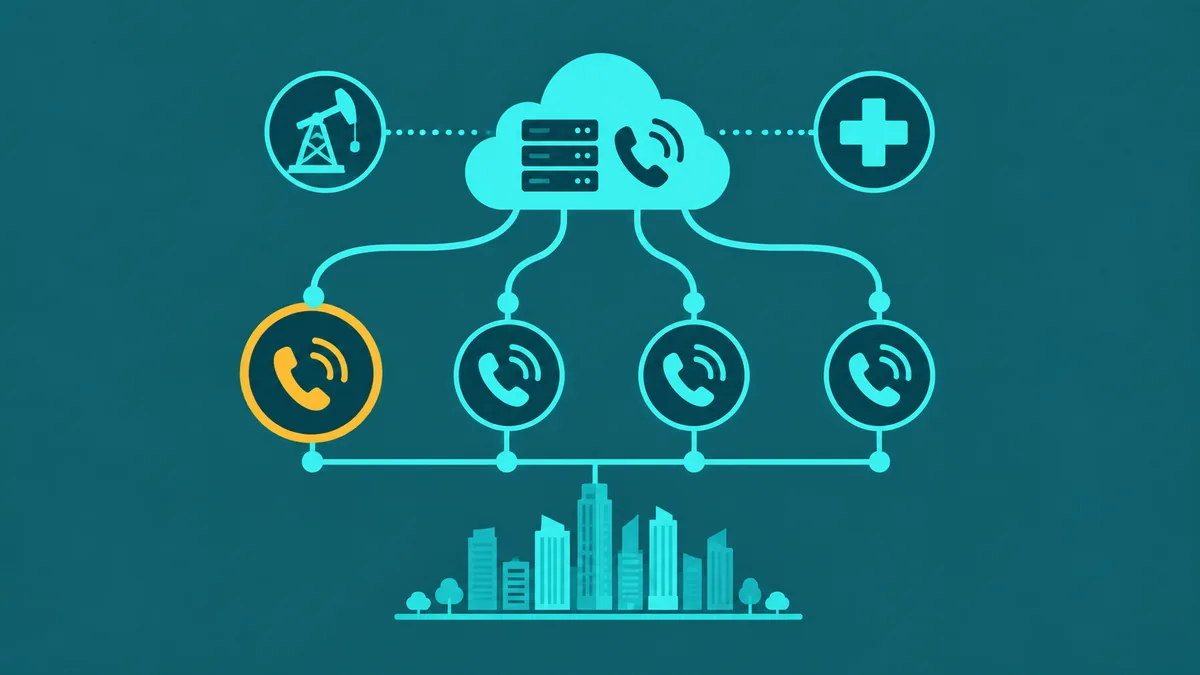
Houston's economy runs on energy, logistics, and the Texas Medical Center — industries where multi-site operations, 24/7 uptime requirements, and distributed field teams are the norm, not the exception. For energy companies coordinating across downtown offices, Gulf Coast field sites, and The Woodlands or Sugar Land support hubs, a cloud VoIP platform that can survive Gulf Coast weather events and maintain continuity across four active area codes (713/281/346/832) is a fundamentally different decision than simply switching to save money on phone lines.
For Houston businesses evaluating VoIP, the right question is not just whether to switch — it is which provider has the local DID inventory, the Texas-region infrastructure redundancy, and the weather-resilient failover architecture that fits an energy-sector or logistics operation specifically. This guide covers everything Houston businesses need to know.
Houston VoIP providers must deliver reliable service during Gulf Coast weather events, support four active area codes (713/281/346/832), and handle the multi-site topology common in energy and logistics firms — priorities that standard national VoIP packages often miss.
Why Houston businesses use VoIP
The cost comparison against legacy carriers is real — Houston businesses running AT&T or Spectrum Business landlines for 10–50 employees pay $60–$100 per line per month for basic dial tone with no cloud features. A hosted VoIP system for the same team runs $20–$40 per user per month and includes IVR, call recording, voicemail-to-email, mobile apps, and business SMS. But for Houston's energy and logistics sectors, the more compelling case is operational resilience and multi-site flexibility — not just cost reduction.
Three Houston-specific factors accelerate VoIP adoption beyond the generic cost case:
- Distributed workforce. Houston's geographic scale — the metro spans over 10,000 square miles — means teams routinely operate across The Woodlands, Sugar Land, Katy, Clear Lake, and downtown simultaneously. A cloud phone system with mobile apps eliminates the distance barrier that fragmented legacy phone deployments create.
- Weather and infrastructure resilience. Houston experienced significant telecommunications disruptions during Hurricane Harvey in 2017 and Winter Storm Uri in 2021. Cloud VoIP systems with failover to mobile numbers and geographically redundant infrastructure maintain call handling when local internet is disrupted — something a copper PBX in a flooded office cannot do.
- Industry mix. Energy, healthcare, logistics, legal, and real estate — all major Houston sectors — have specific call handling requirements (compliance recording, high inbound volume, multi-location routing) that legacy systems handle poorly and that cloud VoIP handles natively.
Houston area codes and DID availability
Houston is served by four active area codes. Local number identity matters for Houston businesses — customers and partners in the region respond better to a local number than a generic toll-free or out-of-state number.
- 713. The original Houston area code, in service since 1947. Associated with central Houston and carries the most established local presence. Numbers are available but inventory is tighter than the newer codes.
- 281. Introduced in 1996 to serve the Houston suburbs, including areas like Sugar Land, Pasadena, The Woodlands, and Pearland. Widely used by businesses in the outer metro.
- 346. An overlay code introduced in 2014 to handle number demand across the greater Houston area. New business numbers are routinely provisioned in this code.
- 832. Introduced in 1999 as an overlay for the 713 area. Serves both inner Houston and suburban areas; very common for business lines provisioned in the 2000s–2010s.
When evaluating VoIP providers, ask explicitly whether they can provision numbers in each of these four codes — and whether 713 numbers are available today or subject to a wait list. A provider without Houston DID inventory is not a viable option for a Houston business that needs local presence.
How to choose a Houston VoIP provider
Local number porting
Most Houston businesses have existing numbers with AT&T Business, Spectrum Business, Consolidated Communications, or Comcast Business. The ability to port those numbers to a new provider without disruption is non-negotiable. Ask prospective providers for their documented porting process for each of these carriers specifically, their typical porting timeline (2–4 weeks is standard), and their error rate on port rejections. A rejected port leaves your business unreachable on its existing number until the issue is resolved — sometimes for days.
E911 compliance
E911 for VoIP is governed by FCC rules requiring that every VoIP endpoint have an accurate dispatchable location registered with emergency services. For businesses with employees working from home or in the field across the greater Houston metro, this means each remote employee's address must be registered in the provider's E911 system and updated whenever they change locations. Houston's sprawling geography makes this requirement more operationally significant than it is in denser cities. Confirm that your provider supports per-user E911 address management and pushes location updates to the relevant PSAPs covering Harris, Fort Bend, Montgomery, and surrounding counties.
Redundant data centers in the Texas region
A provider with a single data center — or data centers concentrated outside Texas — will experience higher latency on Houston calls and will be more vulnerable to a regional outage affecting your service. Look for providers with points of presence in Texas (Dallas, Houston, or San Antonio) and geographically redundant failover to a second region. This is especially important given Houston's history of severe weather events that affect infrastructure regionally.
Support availability
Business VoIP issues do not keep business hours. A provider with 24/7 phone support is meaningfully different from one with email-only support with a 24-hour response SLA. For Houston businesses in healthcare, energy, or logistics — where phone communications are operationally critical — verify the support model before signing, not after a system failure.
Industries in Houston that benefit most from VoIP
Houston's industry mix creates specific VoIP use cases that are more pronounced here than in a typical metro:
- Energy and oil and gas. Field operations, offshore communication, and multi-site coordination across Texas and the Gulf Coast benefit from a phone system that works on mobile apps anywhere, records calls for compliance, and routes to on-call staff 24/7.
- Healthcare and Texas Medical Center. The TMC is the largest medical complex in the world. Healthcare organizations in Houston need HIPAA-compatible call recording, voicemail storage, and patient communication features — all standard in business VoIP plans.
- Logistics and port operations. The Port of Houston is one of the busiest in the US. Logistics companies managing freight, customs, and transportation require multi-location phone infrastructure, call routing to dispatchers, and real-time call analytics.
- Legal. Houston's large legal community uses call recording and voicemail-to-email heavily for documentation and client communication. Cloud VoIP provides both with lower overhead than legacy systems.
- Real estate. Houston's active real estate market — residential and commercial — drives high inbound and outbound call volume. VoIP with auto-attendant, mobile apps, and business SMS supports agents working across a large geography.
VoIP vs legacy landline: cost comparison for Houston SMBs
| Factor | Legacy landline | Hosted VoIP |
|---|---|---|
| Monthly cost | AT&T and Consolidated legacy lines run $45–90/line plus per-minute charges for calls across the four area code overlays | Typically $20–35/line for Houston businesses; no per-minute charges on local 713/281/346/832 calls |
| Scalability | New lines require physical installation; 2–4 week lead time with local telcos | Add lines same-day via portal; important for Houston's project-based energy firms that add/remove contract workers |
| Weather resilience | Physical lines go down with infrastructure damage; no automatic failover | Calls reroute to mobile automatically during outages; critical during Gulf Coast storm season |
| Features | Basic call features only; advanced features require costly PBX hardware | Auto attendant, voicemail-to-email, call recording included |
| Contract | Typically 2–3 year contracts with early termination fees | Month-to-month options available; no multi-year lock-in |
The monthly savings for a 10-person Houston business switching from legacy landlines to hosted VoIP typically run $400–$500 per month. The one-time elimination of PBX hardware replacement costs adds several thousand dollars more over a 5-year horizon.
Setup considerations specific to Houston
ISP options in the Houston metro
Houston is served by multiple business-class ISPs: AT&T Business Fiber, Comcast Business, Spectrum Business, and regional fiber providers in specific areas. For VoIP, a fiber connection is preferable to cable for its symmetrical upload and download speeds and lower latency variance. If you are in a Houston office park or commercial building, ask your property manager whether the building has dedicated fiber — many Houston commercial properties have structured cabling that allows for fiber termination directly to your suite.
Building infrastructure in office parks
Older Houston office buildings, particularly those built before 2000, may have Cat3 or older structured cabling that does not support modern SIP desk phones. New SIP phones require Cat5e or better to the jack. Before provisioning desk phones, have your IT contractor verify the cabling standard in your suite. In many cases, running new Cat6 drops is faster and cheaper than attempting to make VoIP work over degraded legacy wiring.