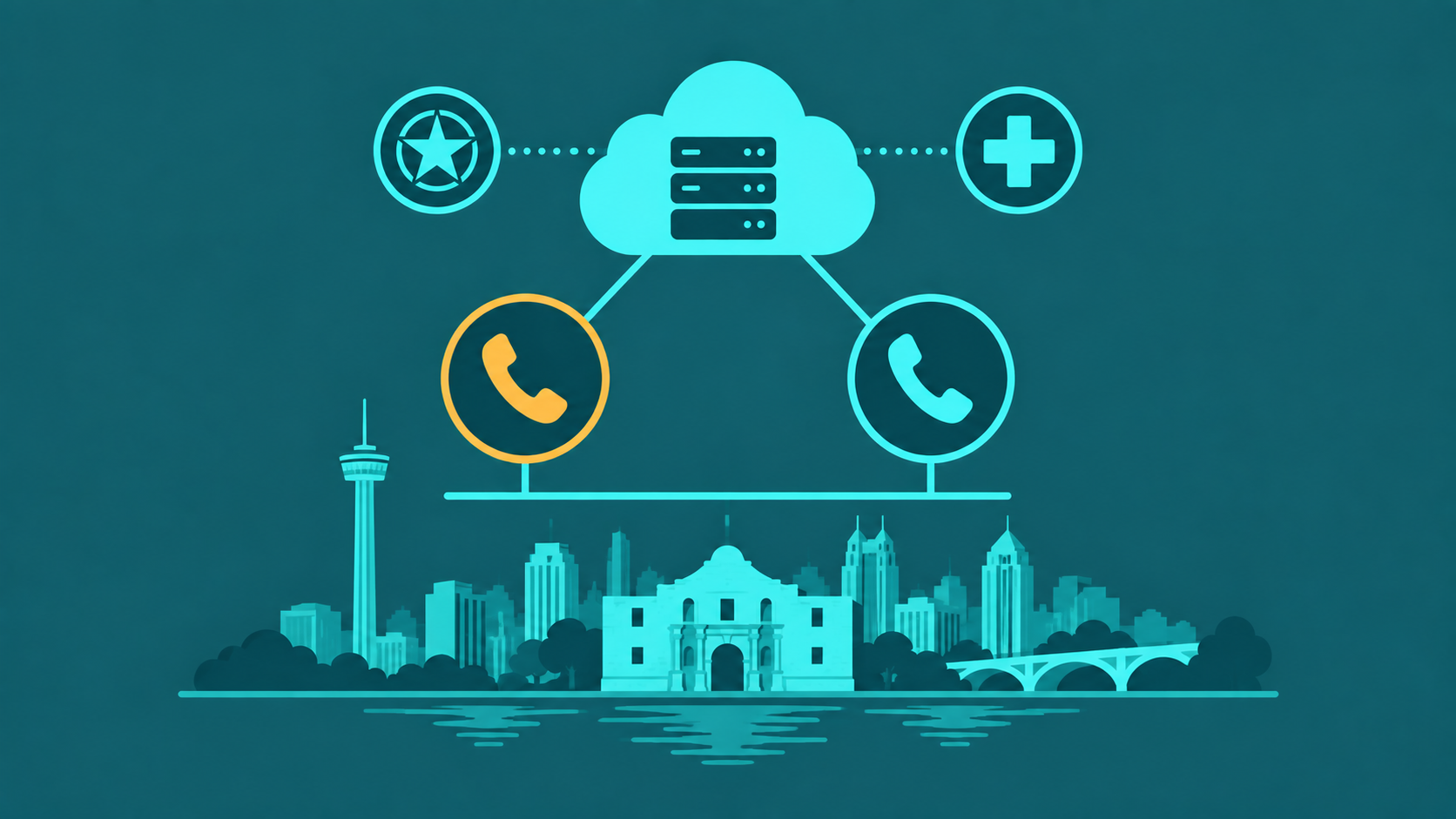
San Antonio's economy is defined by its military and government contractor base — Joint Base San Antonio encompasses Lackland AFB, Fort Sam Houston, and Randolph AFB, and the ecosystem of defense contractors, federal agencies, and government-adjacent businesses that surrounds JBSA creates a demand for VoIP platforms that go beyond basic cloud PBX. These organizations need call recording for compliance documentation, support for 210/726 area codes across Bexar County campuses, and platforms that can scale across the same multi-campus footprint that defense and medical organizations operate in. The South Texas Medical Center adds a healthcare and bioscience corridor with its own requirements around HIPAA-conscious call handling and multi-site routing.
This guide covers what San Antonio businesses need to know about VoIP providers, local number availability, porting existing numbers, and what to look for when choosing a provider for this market.
San Antonio's large military contractor and healthcare ecosystem demands VoIP platforms that can handle government-adjacent compliance requirements, support 210/726 area codes, and scale across the Bexar County campuses where defense and medical organizations operate.
Why San Antonio Businesses Are Switching to VoIP
San Antonio's business environment has several characteristics that make VoIP particularly compelling — and that make the choice of provider more consequential than in a generic market.
Military and government contractor requirements. Defense contractors and federal agency vendors near JBSA need VoIP platforms with full call recording, audit-ready call logs, and the ability to support distributed teams across multiple clearance-level environments. These requirements push San Antonio organizations toward providers with enterprise-grade compliance features — not consumer-grade cloud PBX tools that happen to be cheap.
Military and government presence. Joint Base San Antonio (JBSA) is one of the largest military installations in the country, encompassing Lackland AFB, Fort Sam Houston, and Randolph AFB. The cluster of defense contractors, federal agencies, and government-adjacent businesses that surround JBSA often require reliable multi-line communication, call recording for compliance, and the ability to support remote or hybrid workers — all capabilities that cloud VoIP handles natively.
Remote and hybrid work. Like most metros, San Antonio saw a permanent shift toward hybrid work after 2020. Cloud VoIP supports remote employees without any additional hardware: staff at home, on the road, or working from a satellite office use the same business phone system — same extension, same number, same features — via a desktop or mobile softphone app. Legacy landline systems have no equivalent capability.
San Antonio Area Codes: 210 and 726
San Antonio is served by two area codes. The original 210 area code covers the entire San Antonio metro and has been in use since 1992 when it split from the 512 area code. As 210 numbers became exhausted, the 726 overlay area code was introduced in 2017 and covers the same geographic territory — any number within the San Antonio metro can be assigned either a 210 or 726 number.
For businesses, both area codes are fully accepted and recognized as local San Antonio numbers. When choosing a VoIP provider, confirm that the provider can provision both 210 and 726 numbers directly — some providers have limited DID (Direct Inward Dialing) inventory in overlay area codes.
Number porting. Businesses switching to VoIP can port their existing San Antonio landline or legacy VoIP numbers to a new provider without changing their published phone numbers. Porting a San Antonio number typically takes 2–4 weeks from submission of the Letter of Authorization (LOA) to your current carrier. During the porting window, calls on existing numbers can be forwarded to temporary numbers on the new system to prevent any service gap.
VoIP vs Traditional Landline for San Antonio Businesses
The comparison between VoIP and traditional landline has become increasingly one-sided for business use, but the specific advantages vary by the size and nature of the business.
| Factor | VoIP | Traditional Landline |
|---|---|---|
| Monthly cost | Typically $20–35/seat; single bill covers all San Antonio locations and remote workers | SA landline rates $45–85/line; separate billing for each JBSA-adjacent or medical campus location |
| Compliance features | HIPAA-eligible plans available; call recording with encryption and audit logs for healthcare and government use | No built-in compliance features; call recording requires separate hardware |
| Multi-campus support | Single cloud PBX spans all San Antonio campuses; extensions shared across Fort Sam, downtown, and NW Medical Center | Each physical location is separate; inter-site calls are billed as local or long-distance |
| 210/726 availability | 210 and 726 numbers available instantly; port existing numbers in 5–15 business days | Physical line availability depends on telco infrastructure at each SA address |
| Contract | Flexible terms; government contractors can request annual contracts with predictable per-seat pricing | Multi-year service agreements; changing lines requires a field technician visit |
The cost gap widens significantly at larger user counts. A 25-person office paying $100/month per landline line pays $2,500/month before any advanced features. The same organization on a business VoIP plan at $25/user pays $625/month with a full enterprise feature set included.
Key Industries in San Antonio Using VoIP
San Antonio's economic mix creates specific VoIP use cases across several dominant industry sectors:
Military and government contractors. Defense contractors, staffing firms serving JBSA, and federal agency vendors need reliable multi-line communication, call recording for compliance documentation, and support for distributed teams across multiple clearance-level environments. VoIP provides the call recording and audit trail capabilities that defense contract compliance often requires, without on-site PBX hardware that creates security and maintenance headaches.
Healthcare and bioscience. San Antonio has a significant healthcare sector anchored by the South Texas Medical Center, a concentration of hospitals, specialty clinics, and research institutions. Medical practices require HIPAA-conscious call handling — call recording with appropriate access controls, voicemail-to-email for on-call staff, and the ability to route calls to providers regardless of their physical location. Cloud VoIP platforms with HIPAA-compliant configurations address these requirements directly.
Financial services. San Antonio has a substantial financial services presence, including insurance companies, credit unions, banking operations, and financial advisory firms. These businesses require call recording for regulatory compliance (FINRA, state insurance regulations), reliable uptime for customer-facing lines, and the ability to log and retrieve call records on demand.
Tourism and hospitality. San Antonio draws millions of visitors annually, driven by the River Walk, the Alamo, and a strong convention and events industry. Hotels, tour operators, restaurants, and event venues need high-call-volume handling, multilingual auto-attendant options, and the ability to route reservation and inquiry calls to appropriate staff — all standard VoIP features.
Real estate. San Antonio's sustained population growth has kept the real estate market active, and real estate brokerages, property management companies, and mortgage operations are heavy phone users. VoIP provides agents with mobile softphone access (calls ring on their cell phone under the business number), call recording for transaction documentation, and virtual extensions for a distributed agent workforce.
What to Look For in a San Antonio VoIP Provider
Not all VoIP providers are equally equipped to serve San Antonio businesses well. Evaluate providers on these five criteria:
- Local number availability. Confirm the provider can provision both 210 and 726 area code numbers directly from their DID inventory. Providers that rely on third-party number sourcing may have limited local number availability or slower provisioning timelines. Same-day number provisioning for local San Antonio DIDs is achievable with well-stocked providers.
- Uptime SLA. Look for a 99.99% uptime SLA backed by service credits. For San Antonio businesses with customer-facing phone lines, phone system downtime is revenue loss. Confirm that the SLA covers the full service — call routing, voicemail, and inbound delivery — not just platform availability.
- Number porting support. If you're switching from an existing carrier, the provider should manage the porting process on your behalf — submitting LOAs, tracking port status, and configuring the new system to handle ported numbers the moment they transfer. Providers that leave porting coordination to the customer create unnecessary risk and delay.
- Contract terms. Month-to-month contracts or short initial terms (3–6 months) allow San Antonio businesses to validate service quality before committing to a long-term agreement. Be cautious of providers requiring 24- or 36-month minimum commitments without a performance-based exit clause.
- Support hours. For customer-facing businesses, phone system issues outside of business hours are not acceptable to leave unresolved until the next morning. Confirm that the provider offers 24/7 technical support — not just 24/7 chat or ticketing, but live technical support for critical issues — and verify how that support is staffed for after-hours incidents.