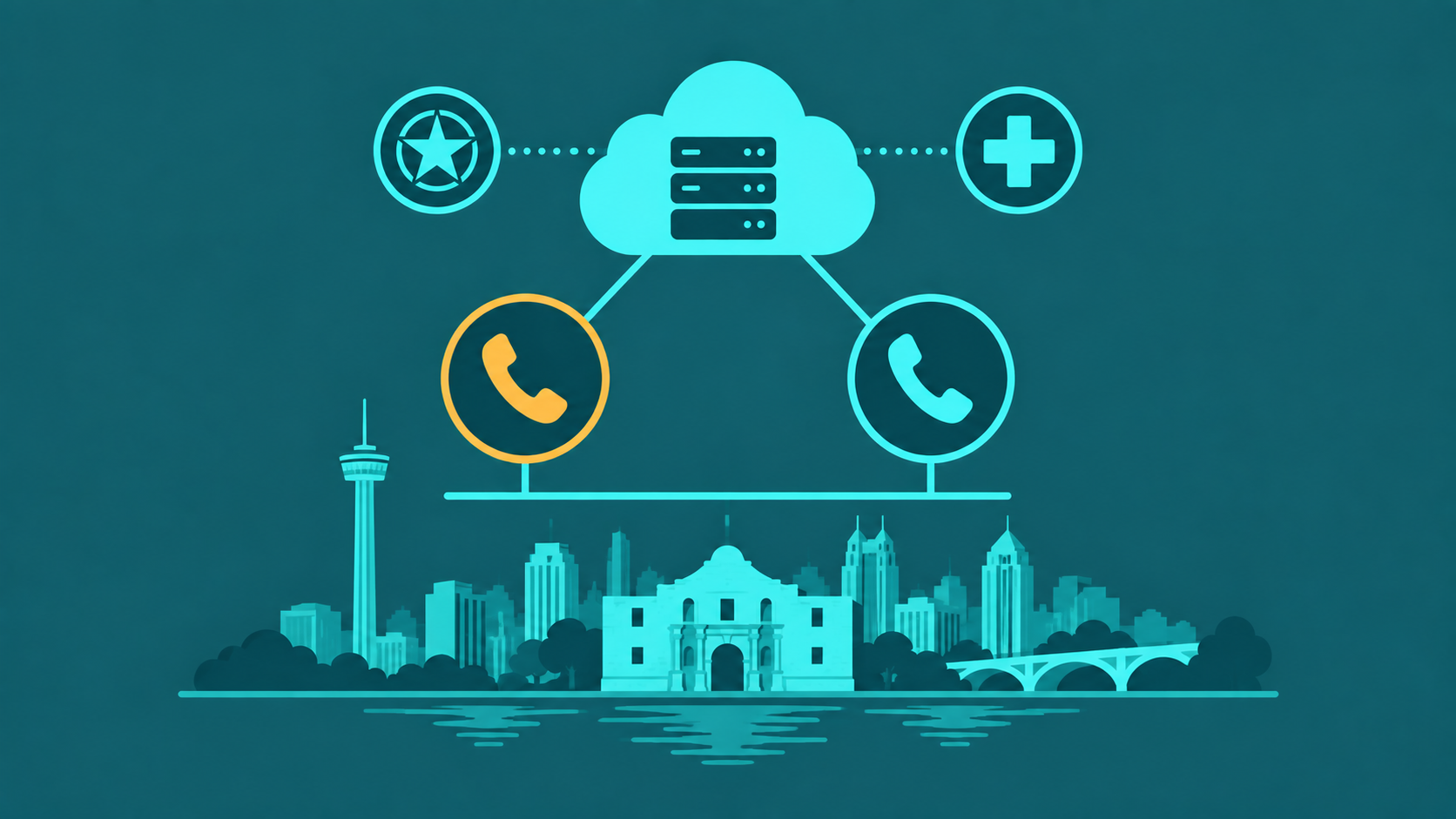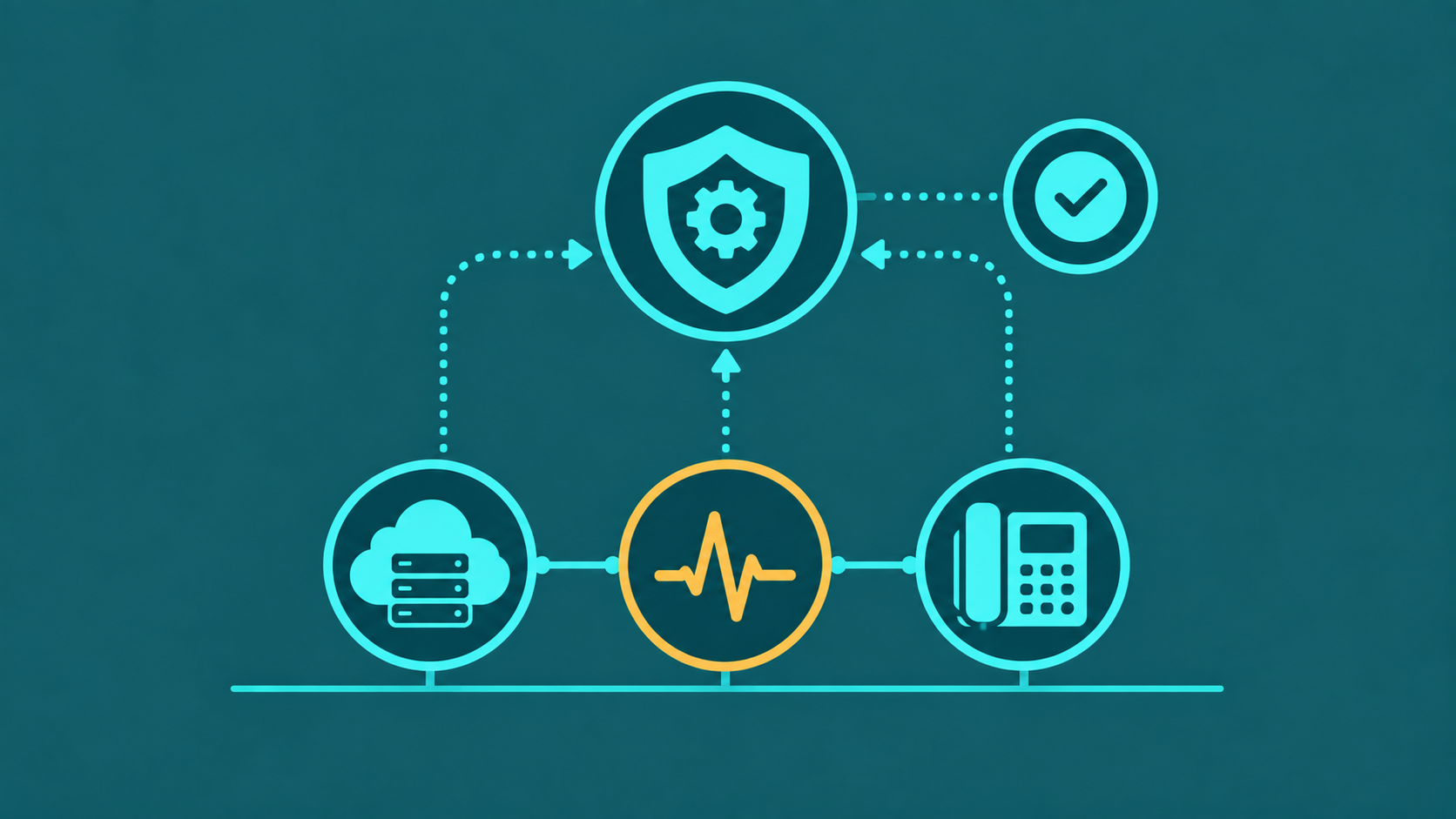

Business VoIP — Voice over Internet Protocol — is how the majority of companies now make and receive phone calls. Instead of analog copper circuits leased from the telephone company, a business VoIP system converts voice into data packets and routes them over the internet to a cloud-hosted switching platform. The result is a full-featured business phone system with extensions, auto-attendants, call queues, voicemail, SMS, and call recording, managed entirely from a browser — and accessible from any internet-connected device, whether that is a desk phone in the office, a softphone on a laptop, or a mobile app on an employee's smartphone.
Traditional landlines are disappearing from business environments for a straightforward reason: the cost and capability gap has become impossible to ignore. A hosted PBX on copper wiring requires significant upfront hardware investment, ongoing maintenance by a specialist, and manual effort to scale. Business VoIP eliminates all three constraints — you provision a new user in minutes, scaling costs are predictable, and the feature set available at entry-level pricing now exceeds what enterprise on-premise PBX hardware offered a decade ago. For businesses with remote employees, distributed offices, or any degree of call volume, the case for VoIP is overwhelming.
What is business VoIP? Business VoIP (Voice over Internet Protocol) is a phone service that routes calls over the internet rather than traditional copper telephone lines. Voice audio is digitized, compressed into data packets using a codec, and transmitted via IP networks to a cloud-based switching platform — typically a hosted or cloud PBX — that manages extensions, inbound call routing, outbound PSTN connectivity, voicemail, and features like IVR and call recording. Unlike consumer VoIP apps, a business VoIP service provides dedicated numbers, multi-user management, SLA-backed uptime, and integrations with business tools. For a broader overview of internet-based calling, see our guide to VoIP phone service.
How business VoIP works
When you make a call on a business VoIP system, several layers of technology work together in under a second. Understanding the key components helps you evaluate providers and troubleshoot problems when they arise.
SIP (Session Initiation Protocol) is the signaling standard that manages call setup and teardown. When you dial a number, your SIP-registered endpoint — a desk phone, softphone, or mobile app — sends a SIP INVITE message to the cloud PBX. The platform processes the request, checks routing rules, and either connects the call to another internal extension or routes it outbound through a wholesale voice carrier to the public telephone network (PSTN). SIP handles the "who is calling whom and what should happen" logic; it does not carry the voice audio itself.
RTP (Real-time Transport Protocol) carries the actual voice audio between endpoints once a call is established. Voice is sampled, compressed by a codec (G.711 for uncompressed toll-quality audio, G.729 for bandwidth-efficient compressed audio), and sent as a stream of UDP packets. SRTP (Secure RTP) adds encryption to that stream, protecting the contents of the conversation from interception in transit.
SBC (Session Border Controller) is the security and interoperability layer that sits at the edge of the provider's infrastructure. It authenticates SIP registrations, enforces access policies, normalizes SIP dialects between different equipment vendors, handles NAT traversal, and protects against toll fraud and denial-of-service attacks. When your phone connects to a business VoIP platform, it connects through the SBC first. Enterprise-grade providers maintain redundant SBCs across multiple data centers to eliminate single points of failure.
The cloud PBX sitting behind the SBC handles the call routing logic — extensions, ring groups, IVR menus, call queues, business hours rules, voicemail boxes, and recording. Our cloud phone system guide explains how the cloud PBX layer functions in depth.
Business VoIP vs. traditional landline
The comparison below covers the dimensions that matter most to a business evaluating whether to switch.
| Dimension | Business VoIP | Traditional Landline |
|---|---|---|
| Infrastructure | Cloud-hosted; no on-site PBX hardware required | On-site PBX hardware, copper wiring, carrier circuits |
| Cost per user | $15–$40/user/month all-in; per-minute wholesale tiers available | $50–$100+/line/month including circuits and hardware amortization |
| Scaling | Add users and numbers in minutes from a web portal | New lines require carrier provisioning, wiring, and hardware |
| Remote work | Built-in; any internet-connected device is a full extension | Requires VPN, call forwarding, or separate mobile contract |
| Feature set | IVR, queues, recording, SMS, analytics, CRM integrations | Basic call routing; advanced features require expensive add-ons |
| Reliability dependency | Internet connection and provider infrastructure | PSTN copper; can survive power outage with battery backup |
| Number porting | Full LOA-based porting; typically 5–15 business days | Porting away from landline carrier is possible but can be slow |
Business VoIP vs. SIP trunking: which do you need?
The two terms are related but serve different use cases, and confusing them leads to buying the wrong product.
Business VoIP is a complete phone system delivered as a managed service. The provider handles the cloud PBX, the PSTN connectivity, the admin portal, the mobile apps, the feature set, and the support. You add users, configure routing rules, and make calls. No telephony expertise required beyond basic system administration.
SIP trunking is a connectivity layer — it provides PSTN access (inbound and outbound calling) over SIP, but does not include a PBX. SIP trunking is the right answer when your business already has a PBX (on-premise or cloud) and needs to connect it to the telephone network, or when you want to replace expensive PRI circuits with cheaper IP-based carrier connectivity. The SIP trunk carries the calls; the PBX handles all the routing logic.
In practice: if you are starting from scratch or replacing an aging phone system, you want business VoIP. If you have an existing PBX that works well and you just want to cut carrier costs or add concurrent call capacity, you want SIP trunking. Many businesses run both — a cloud PBX (which is part of the VoIP service) connected to SIP trunks that provide the PSTN bridge. For a complete explanation of how trunking works, see our SIP trunking guide.
Key features in a business VoIP system
The following eight capabilities represent the core feature set you should expect from any credible business VoIP provider. Quality and configuration depth vary significantly between providers; treat this as a baseline, not a ceiling.
Auto-attendant / IVR. An automated voice menu that answers inbound calls and routes callers based on their input or spoken commands. A basic auto-attendant handles "Press 1 for Sales, press 2 for Support." A full IVR adds multi-level menus, speech recognition, database lookups (account balance, appointment lookup), and integration with CRMs or ticketing systems. IVR is one of the highest-leverage features for any business receiving inbound calls at scale — it deflects routine inquiries and ensures calls reach the right destination without a live receptionist. See our IVR system guide for a deep-dive.
Call queues. When more calls arrive than agents are available to answer, a queue holds callers and distributes them as agents become free. Call queues support configurable distribution strategies (round-robin, longest-idle, skills-based), hold music or on-hold messaging, queue announcements informing callers of their position or estimated wait, maximum queue depth, and overflow routing when the queue is full. For teams handling any inbound volume, call queues are essential.
Call recording. Inbound and outbound calls captured as audio files, typically stored in the cloud and accessible from the admin portal. Recording supports quality assurance, agent training, compliance documentation, and dispute resolution. Business VoIP platforms should offer per-user or per-number recording controls, configurable retention periods, and beep tone or announcement compliance options for two-party consent jurisdictions.
Business SMS / 10DLC. Two-way SMS messaging on business phone numbers, allowing teams to text customers from the same number they call from. In the United States, business SMS requires 10DLC (10-digit long code) registration with The Campaign Registry to achieve reliable delivery. Your VoIP provider should handle 10DLC registration support and maintain relationships with mobile carriers to maximize deliverability. SMS is now a primary communication channel for appointment reminders, order updates, and support interactions.
Desktop & mobile apps. Softphone applications that turn a laptop, desktop, or smartphone into a full VoIP extension — making and receiving calls, accessing voicemail, transferring calls, and joining conference bridges without a physical desk phone. For remote teams and mobile workers, app quality is often the most important factor in day-to-day user experience. Evaluate call stability, background operation behavior, push notification reliability, and whether the mobile app supports the same feature set as the desktop client.
Number management. The ability to provision new local or toll-free phone numbers on demand, port existing numbers from other carriers, set routing rules per number, and manage caller ID presentation for outbound calls. Good number management tools let you assign a number to a user, a queue, an IVR, or a ring group in seconds from the admin portal.
Analytics & reporting. Call volume by time period, answered vs. missed calls, queue wait times, average handle time, agent activity, and call outcome tracking. Analytics are what separate a managed phone system from a commodity voice line — they let you identify capacity problems, coach agents on performance, and justify headcount decisions with data. Look for real-time dashboards as well as historical reporting with export capability.
CRM integrations. Native connectors or open APIs that link the VoIP system to Salesforce, HubSpot, Zoho, ServiceNow, or other CRM and helpdesk platforms. Screen pop (automatically opening the caller's CRM record when an inbound call arrives), click-to-dial from within the CRM, and automatic call logging eliminate manual data entry and give agents full context on every call. Integration quality is one of the sharpest differentiators between VoIP providers at the mid-market level.
What business VoIP costs — the complete picture
Provider marketing typically leads with the per-user seat price. That number rarely reflects what you will actually pay. Here is the full cost structure.
Base plan. Most business VoIP providers price at $15–$40 per user per month for a mid-tier plan that includes unlimited domestic calling, core features, and app access. Entry plans ($10–$20) typically strip out recording, advanced IVR, and analytics. Premium plans ($40–$65) add AI features, deeper integrations, and dedicated support. Per-minute wholesale pricing is available from carriers like EaseDial for businesses with high outbound volume, and can significantly reduce costs compared to per-seat unlimited plans.
Taxes and regulatory fees. Universal Service Fund (USF) contributions, state and local telecom taxes, E911 surcharges, and regulatory recovery fees typically add 15–25% to the base invoice. A $25/user plan often becomes $30–$31 after taxes. Always ask for a fully-loaded sample invoice before signing. For more on realistic cost expectations, see our VoIP phone service cost guide.
E911. Emergency 911 service is a regulatory requirement for VoIP providers serving businesses. Most providers include a monthly E911 fee per physical location or per user. When employees work remotely, E911 address management becomes a compliance responsibility — you must ensure each user's registered address is current so emergency services can locate them correctly.
Number porting. Porting your existing numbers from another carrier typically involves a one-time fee of $5–$25 per number, depending on provider. The process requires a signed Letter of Authorization (LOA), and takes 5–15 business days for standard numbers. Toll-free numbers can take longer. Factor porting costs and timeline into your switching plan.
International calling. If your business makes calls outside the US and Canada, international per-minute rates apply. These range from under $0.01/minute for major English-speaking destinations to $0.10–$0.50/minute for some regions. Review rate decks carefully if international calling is a significant portion of your volume.
Add-ons. Common additional-cost items include toll-free numbers ($5–$15/month each), dedicated short codes for SMS, call recording storage beyond included limits, advanced AI or transcription features, and priority support. Build a realistic total cost model using your actual user count, number inventory, and anticipated call volume before comparing provider quotes.
VoIP call quality: network requirements
Voice over IP is sensitive to network conditions in a way that downloading a file or loading a webpage is not. A web request can tolerate packet delays and retransmission without user impact; a voice call experiencing the same conditions produces echo, choppy audio, one-way sound, or dropped calls.
Jitter is variation in packet arrival timing. Voice packets need to arrive at a consistent interval to be reconstructed into smooth audio. Jitter above 30–40ms becomes perceptible as choppy or robotic speech. A jitter buffer on the receiving endpoint absorbs minor variation, but excessive jitter overwhelms it.
Latency is the round-trip delay between endpoint and the VoIP platform. One-way latency above 150ms starts to affect conversational naturalness; above 300ms one-way, conversations feel like satellite calls. Latency is primarily determined by geographic distance to the provider's infrastructure and network routing hops.
Packet loss above 1–2% causes audible dropouts and distortion. G.711 codec (used on most business VoIP systems) has no loss concealment — missing packets create silence gaps. Some codecs (Opus, G.722) have better loss resilience, but network quality is the correct fix, not codec substitution.
Bandwidth requirements per call are modest — approximately 100 Kbps per concurrent call using G.711, or around 32–64 Kbps with G.729. A 10-user office with 5 simultaneous calls needs around 500 Kbps–1.6 Mbps dedicated to voice, which is negligible on a modern business broadband connection. The risk is contention: voice packets competing with large file uploads, video conferencing, or software updates on the same connection without traffic prioritization.
QoS (Quality of Service) configuration on your router solves the contention problem by tagging VoIP packets with a high-priority DSCP marking and ensuring they are processed before bulk data traffic. Most modern business routers support DSCP-based QoS. Configuring it is a standard step in any VoIP deployment — particularly important in offices with shared internet connections and mixed workloads.
Reliability and uptime: what to look for
Business phone systems are mission-critical infrastructure. A provider's uptime commitment — expressed as an SLA percentage — determines how much downtime is contractually acceptable per year.
99.9% uptime allows approximately 8.7 hours of downtime per year. Most mid-market VoIP providers advertise this level. For businesses where phone downtime has moderate impact — a professional services firm that also communicates by email — 99.9% is generally acceptable.
99.99% uptime allows approximately 52 minutes of downtime per year. This tier typically requires geographic redundancy — the provider runs identical infrastructure in multiple data centers, so a failure in one region fails over to another automatically. For businesses where every minute of phone downtime has direct revenue or compliance impact (contact centers, financial services, healthcare), 99.99% SLAs and the architecture behind them matter.
Beyond the SLA percentage, evaluate: how the provider handles failover (automatic vs. manual), whether call forwarding to mobile can be configured as a failsafe if the VoIP platform has an outage, how quickly support responds during an incident, and whether there is a public status page with real-time infrastructure health. For a complete treatment of VoIP redundancy options, see our VoIP failover guide.
Internet failover at your location is equally important. If your primary internet circuit goes down, your VoIP phones go down with it regardless of provider uptime. A secondary broadband circuit (LTE/5G backup or secondary fiber) with automatic failover is the standard mitigation for locations where phone availability is critical.
Security
VoIP systems are a meaningful attack surface. Inadequately secured business VoIP accounts are exploited for toll fraud — attackers generate outbound international calls that accumulate thousands of dollars in charges before the business notices. Beyond fraud, unencrypted voice traffic can be intercepted on network segments it traverses.
TLS (Transport Layer Security) encrypts SIP signaling — the call setup and control messages. Without TLS, SIP traffic traverses the network in plaintext, exposing credentials and call metadata.
SRTP (Secure RTP) encrypts the voice media stream itself — the actual audio content of the call. TLS without SRTP protects signaling but leaves audio exposed. Reputable providers enable both by default.
Multi-factor authentication (MFA) on the admin portal and user accounts prevents credential-based takeover attacks. This is the most important access control measure and should be mandatory, not optional.
Toll fraud detection involves the provider monitoring call patterns in real time — flagging sudden spikes in international call volume, calls to unusual destinations, or activity outside business hours — and either blocking automatically or alerting you immediately. Ask specifically about what threshold triggers an alert and how quickly the provider responds.
SOC 2 Type II certification indicates the provider's security controls have been independently audited over a period of time, not just at a point in time. For businesses with security-conscious customers or contractual requirements, a SOC 2 Type II report is a credible baseline.
HIPAA BAA (Business Associate Agreement) is required when your VoIP system processes or stores patient health information (PHI) — for example, recording calls that include patient details. Not all VoIP providers offer HIPAA-compliant configurations or will sign a BAA; verify this before selecting a provider if your business operates in healthcare.
Switching to business VoIP: what to plan for
A VoIP migration is straightforward when planned properly. The following steps represent the standard go-live process for a business switching from landlines or a legacy PBX.
Number porting. Identify every phone number your business uses — main lines, direct-dial extensions, fax numbers, toll-free numbers — and confirm they are portable. Obtain your current carrier's account details and authorize the port with a signed Letter of Authorization. Porting a business phone number to VoIP takes 5–15 business days for local numbers; the timeline depends on your losing carrier's processing speed. Keep the existing line live until your VoIP provider confirms the port is active. Toll-free and complex multi-line accounts can take 3–4 weeks. Our number porting guide walks through the full porting process step by step.
Go-live timeline. Allow 3–6 weeks for a straightforward migration: 1–2 weeks to configure the new system (build IVR menus, set up extensions, configure routing rules, test apps), 1–2 weeks for number porting, and 1 week of parallel operation before final cutover. Larger organizations or those with complex IVR trees should budget 6–12 weeks.
Parallel run. Run both systems simultaneously for at least a few business days before cutting over entirely. Keep the old system active as a fallback. During the parallel period, test inbound calls on ported numbers, verify voicemail, test call recording, confirm that remote users' apps register correctly, and walk through your highest-volume IVR paths end to end. Fix any routing or configuration issues before decommissioning the legacy system.
Network preparation. Before go-live, configure QoS on your router, test internet connection quality with a VoIP readiness tool, and ensure your firewall allows SIP (typically UDP/TCP port 5060/5061) and RTP media (UDP port range 10000–20000 or as specified by your provider) without aggressive packet inspection that can corrupt SIP headers.
Provider evaluation checklist
Use this list when comparing business VoIP providers before committing:
- Uptime SLA. Is the published SLA 99.9% or 99.99%? What is the compensation structure if the SLA is missed? Does the provider publish a real-time status page?
- Fully-loaded pricing. Request a sample invoice that includes taxes, regulatory fees, E911 charges, and any mandatory add-ons. Compare this total — not the headline per-seat rate — across providers.
- Feature tier clarity. Confirm that the features critical to your operation (call recording, IVR depth, analytics, CRM integration) are included in your chosen tier, not reserved for a higher plan.
- Porting cost and timeline. Ask for the per-number porting fee and the expected timeline for your number types. Get this in writing before signing.
- Encryption defaults. Confirm that TLS signaling and SRTP media encryption are enabled by default, not optional add-ons requiring a support ticket to activate.
- Integration quality. If CRM integration matters to your team, test it yourself during a trial. Native integrations built by the VoIP provider tend to be more reliable than third-party connector apps.
- Support hours and channels. Verify whether 24/7 support is included or costs extra, what the average response time is for P1 (phone down) incidents, and whether support is provided by the vendor directly or outsourced.
- Contract terms. Note auto-renewal clauses, early termination fees, and price lock commitments. Month-to-month options cost slightly more but reduce switching risk during initial deployment.
- Pilot availability. A provider confident in their product should offer a trial or pilot period. Use it to test call quality, app stability, admin portal usability, and support responsiveness before committing.
Frequently asked questions
Use our free VoIP Savings Calculator to estimate how much your business saves by switching from legacy landlines — and our Business Phone ROI Calculator for a full 3-year TCO comparison. No email required.
For a broader look at how VoIP fits into the full stack of business telecommunications solutions — including data networking, video, and unified communications — see our practical guide to building a modern communications infrastructure.