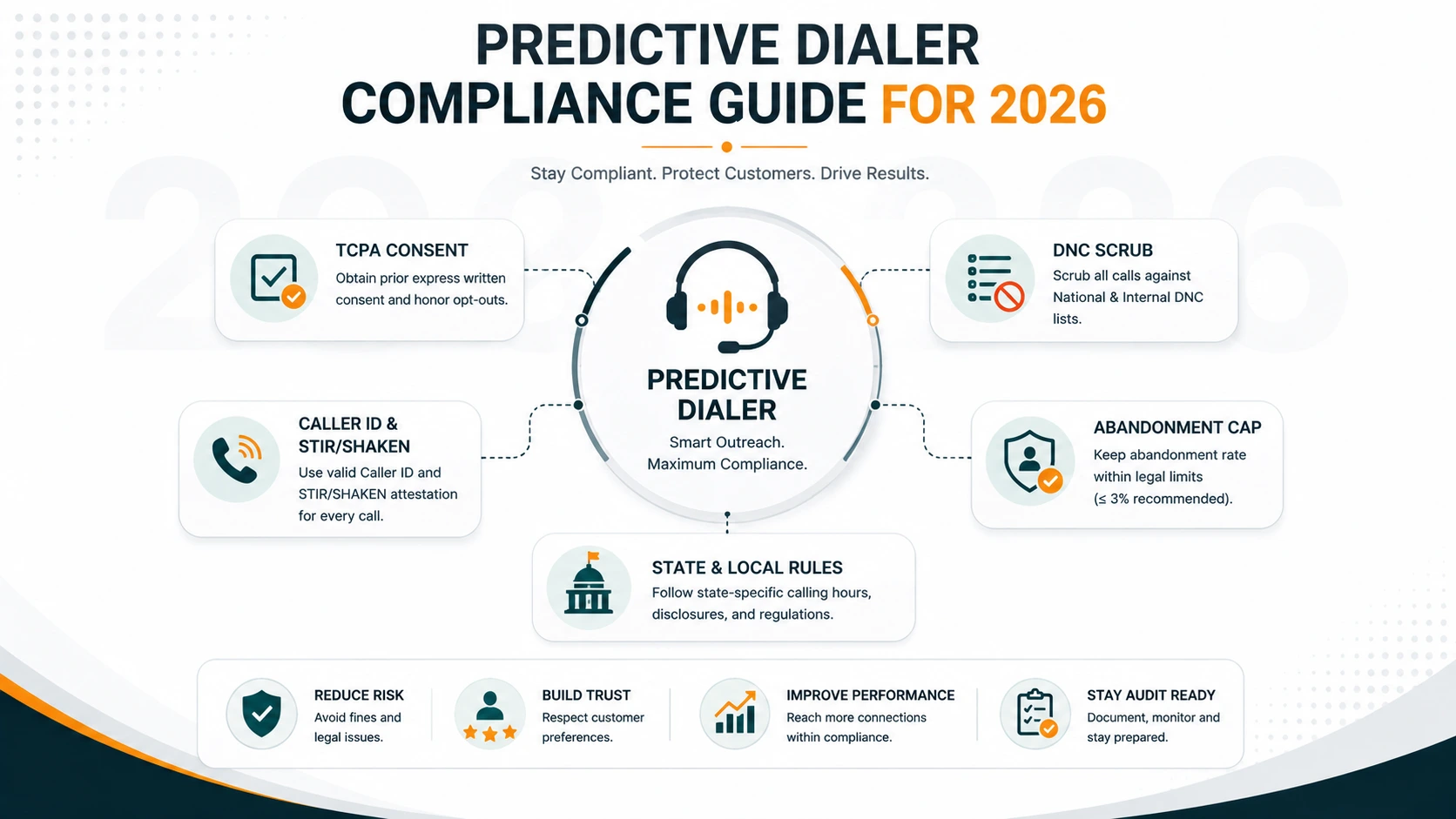
Running a predictive dialer in 2026 puts you at the intersection of two federal regulatory frameworks — the FCC's TCPA and the FTC's Telemarketing Sales Rule — and potentially a third layer of stricter state laws, depending on which states your campaign calls into. Each layer has different enforcement agencies, different penalty structures, and different compliance requirements. They can all apply simultaneously to the same campaign.
This guide maps the current regulatory landscape accurately, covers the 2025 developments that changed the consent picture, explains what the FCC's 2026 rulemaking proposes (but has not yet finalized), and provides an operational compliance checklist grounded in the rules as they actually stand today.
Legal Disclaimer
Laws and regulations change frequently. This guide provides general information about the regulatory environment as of 2026. Organizations should verify requirements applicable to their specific use case, calling program, and jurisdiction with qualified legal counsel before implementing an outbound calling campaign. Nothing in this article constitutes legal advice.
Three Regulatory Layers That Can All Apply at Once
The first thing to understand about predictive dialer compliance is that it is not one framework — it is three, and they stack on each other.
Layer 1 — TCPA (FCC). The Telephone Consumer Protection Act, 47 U.S.C. § 227, governs automated telephone calls, texts, and prerecorded messages. It restricts who you can call using an automatic telephone dialing system (ATDS) or prerecorded voice. Enforcement is primarily through private lawsuits — $500 to $1,500 per violation with class action exposure — plus FCC enforcement actions.
Layer 2 — TSR (FTC). The FTC's Telemarketing Sales Rule, 16 CFR Part 310, governs telemarketing calls — calls made for the purpose of selling goods or services. The TSR sets the 3% abandoned-call cap, calling hour restrictions, and DNC scrubbing requirements. Civil penalties run up to $53,088 per violation as of 2026. The TSR is enforced by the FTC (and state attorneys general under some provisions).
Layer 3 — State laws. Many states have enacted their own telemarketing laws with stricter definitions of automated dialing, broader private rights of action, and higher per-call penalties than federal law. Florida's Telephone Solicitation Act (FTSA) is the most prominent example. State laws apply based on where the called party is located, not where your organization is based.
Both the TCPA and the TSR can apply to the same campaign — a telemarketing call using a predictive dialer to a cell phone may need to satisfy both TCPA consent requirements and TSR operational requirements. State law may add a third set of obligations on top of both.
TCPA: What It Covers and When It Applies
TCPA in plain English: The TCPA restricts calls and texts made using an automatic telephone dialing system (ATDS) or using a prerecorded or artificial voice. For wireless numbers, prior express written consent is required for telemarketing calls using either method. Statutory damages: $500 per violation, up to $1,500 for willful violations. Class actions are common.
The TCPA applies when two conditions are met: (1) you are using an ATDS or a prerecorded/artificial voice, and (2) you are calling a wireless (cell phone) number for telemarketing purposes. Both conditions must be present for the written consent requirement to apply. The TCPA also imposes consent requirements for calls to residential landlines using artificial or prerecorded voice for telemarketing purposes.
What is an ATDS?
The definition of "automatic telephone dialing system" has been extensively litigated. The Supreme Court addressed it in Facebook v. Duguid (2021), holding that an ATDS must have the capacity to use a random or sequential number generator to store or produce phone numbers and then dial them. Under this standard, a predictive dialer that operates exclusively from a pre-loaded contact list — without generating numbers randomly or sequentially — likely does not qualify as an ATDS at the federal level.
However, the ATDS definition is not the end of the analysis. Several states apply broader definitions. And separately, TCPA's restrictions on prerecorded or artificial voices apply regardless of ATDS classification — which becomes important for AI voice applications (covered below).
What is prior express written consent (PEWC)?
For telemarketing calls to wireless numbers using an ATDS or prerecorded voice, the TCPA requires prior express written consent. Valid PEWC must: be in writing (paper or electronic signature meeting E-SIGN Act requirements), clearly authorize the specific seller to call or text the consumer, clearly disclose that the consumer may receive autodialed or prerecorded calls, disclose that consent is not a condition of purchase, and include the specific wireless telephone number being authorized.
"Written" under TCPA includes electronic consent captured via a web form, provided the form's disclosure language satisfies the requirements above and the consumer affirmatively checked or signed rather than having consent pre-selected for them.
The FCC's One-to-One Consent Rule: What Happened and Where Things Stand in 2026
This is the area where the most significant regulatory change occurred in 2024–2025, and it is important to understand accurately because a significant amount of content online states the one-to-one rule incorrectly.
In December 2023, the FCC adopted new "one-to-one consent" rules that would have required each consumer consent to name a single, specific seller rather than a broad consent authorizing calls from multiple companies through a lead generator's comparison shopping website. Under the proposed rule, a consumer checking a box to receive offers from "partners and affiliated companies" on a lead gen site would not have provided valid PEWC for each individual seller downstream.
In January 2025, the Eleventh Circuit Court of Appeals vacated this rule in Insurance Marketing Coalition v. FCC, holding that the FCC had exceeded its statutory authority in adopting it. The FCC subsequently stated it would not challenge the ruling.
On August 29, 2025, the FCC reinstated the pre-2023 TCPA prior express written consent standard — meaning the one-to-one rule never took effect, and the standard governing PEWC in 2026 is the pre-2023 standard, not the one-to-one framework.
Current status (2026): The FCC's one-to-one consent rule did NOT take effect and is not in force. The governing TCPA PEWC standard as of 2026 is the pre-2023 standard. Organizations should verify their consent language and documentation practices against the applicable standard with qualified legal counsel, particularly if they use purchased leads or multi-seller consent forms.
Even though the one-to-one rule is not in effect, the FCC's stated interest in the "lead generator loophole" scenario — where a single consumer consent form is used to authorize calls from many downstream sellers — means this area is likely to see continued regulatory attention. If your campaign uses purchased lead lists where consent was gathered through a comparison shopping site or lead aggregator, a review of your consent chain is advisable regardless of whether any current rule requires it.
FTC Telemarketing Sales Rule: Operational Requirements for Predictive Dialers
The FTC's Telemarketing Sales Rule governs calls made for the purpose of selling goods or services (telemarketing). The TSR's operational requirements for predictive dialers are specific and non-negotiable.
The 3% abandoned call cap
The exact rule (16 CFR § 310.4(b)(4)): Under the FTC Telemarketing Sales Rule's abandoned-call safe harbor, no more than 3% of all calls answered by a live person may be abandoned. For a single calling campaign lasting less than 30 days, the rate is measured over the duration of that campaign. For campaigns lasting 30 days or longer, the rate is measured separately over each successive 30-day period or portion thereof. A call is abandoned if a live sales representative is not connected to the person who answered within two seconds of that person's completed greeting (16 CFR § 310.4(b)(1)(iv)).
Note the measurement window: campaign duration (or successive 30-day periods for longer campaigns). This is not a per-day measurement. For a short campaign — say, ten days — the 3% rate is calculated across all calls answered during those ten days. For a campaign running three months, the first 30 days, the second 30 days, and the remaining days are each measured as separate windows.
When a call is abandoned, the TSR requires that a prerecorded message play within two seconds of the person's completed greeting. That message must state the seller's name and a phone number the consumer can call to be placed on the company's internal DNC list. A silent abandoned call — where no message plays — is a separate violation from the abandonment itself. A single call that is abandoned silently generates two TSR violations: one for the abandonment and one for the missing identification message.
Calling hours
The TSR restricts telemarketing calls to the period between 8:00 a.m. and 9:00 p.m. local time of the called party. This means you must apply the called party's time zone, not your organization's time zone. A call center in California calling a Georgia number must respect Georgia's local time. Most compliant dialer platforms include time-zone enforcement that automatically applies this rule; verify it is configured correctly and based on the called party's state, not your originating location.
DNC compliance under TSR
The TSR requires that telemarketers scrub their call lists against the National Do Not Call Registry before calling numbers on that list. Scrubbing must be done at least every 31 days. Calling a number that is on the National DNC Registry (and that has not given specific prior express permission to be called) is a TSR violation. Penalties are up to $53,088 per violation as of 2026.
Beyond the national registry, the TSR also requires that companies maintain their own internal DNC list and honor requests to be added to it within 10 business days. A consumer who says "do not call me again" during any call must be added to the internal list and not called again — across all campaigns under the same seller.
The 3% Cap and Predictive Dialer Operations: How Compliant Systems Work
The abandoned call cap is the operational constraint that drives predictive dialer design. A well-tuned predictive dialer maintains the 3% cap through real-time pacing — the algorithm continuously adjusts the dial ratio based on live metrics including number of ready agents, average handle time, current connect rate, and rolling abandonment rate for the current campaign window.
The practical challenge: when fewer agents are available, the algorithm must dial more conservatively to avoid abandonment spikes. When multiple calls connect simultaneously and no agent is immediately available, the abandoned call count rises fast. This is why most compliance-focused practitioners set a minimum of eight to ten agents for predictive dialing — below that threshold, statistical variance in simultaneous-answer events makes the 3% cap very difficult to maintain reliably.
| Risk factor | Effect on abandonment rate | Mitigation |
|---|---|---|
| Agent count below 8 | High variance — single burst of connects can exceed 3% instantly | Switch to progressive/power dialing at this team size |
| AMD false positives | Live humans misclassified as voicemail count as abandoned calls | Tune AMD conservatively; audit accuracy regularly |
| Connect rate drop | Algorithm dialing on stale rate assumptions over-dials live answers | Ensure algorithm recalibrates frequently (every 5–15 seconds) |
| Agent breaks or drop-offs | Sudden reduction in ready agents while dials are in flight | Stagger break schedules; alert when ready-agent count drops below threshold |
| No real-time monitoring | Compliance breach not caught until after it exceeds 3% | Set alert at 2.0–2.5% to allow time to throttle before breach |
Compliant predictive dialing requires real-time abandonment monitoring with an automatic throttle — or a supervisor who can reduce the dial ratio the moment the rate approaches 2.5%. Do not rely solely on post-campaign reporting to discover compliance breaches.
The FCC's 2026 FNPRM on Abandoned Call Rules
In 2026, the FCC issued a Further Notice of Proposed Rulemaking (FNPRM) examining whether the current abandoned call cap and ring time requirements should be revised. Specifically, the FNPRM asks whether the 3% abandoned-call cap should be lowered and whether the 15-second minimum ring time requirement should be changed.
Important: This is a proposed rulemaking — not a final rule. No changes to the abandoned call cap have been enacted as of this writing. The FTC's 3% cap under the TSR remains the governing standard. Monitor FCC rulemaking activity if you operate predictive dialing at scale, as final rules could impose stricter requirements.
Separately from the FCC's FNPRM, the FTC's TSR has its own rulemaking activity on predictive dialer requirements. The FTC's 3% cap and the FCC's current requirements are distinct regulatory tracks under different agencies.
DNC Compliance: National Registry, Internal Lists, and Penalties
Do-Not-Call compliance operates on two tracks simultaneously: the National DNC Registry (managed by the FTC) and your organization's own internal DNC list.
National DNC Registry. Numbers registered on the National DNC Registry cannot be called for telemarketing purposes unless the consumer has given specific prior express permission to your organization or has an existing business relationship with you (and within the applicable time windows). You must scrub your call list against the registry at least every 31 days. Data from the registry access system must be current as of the most recent scrub date before each campaign.
Internal DNC list. Separately from the national registry, you must maintain your own do-not-call list. When a consumer asks to be added to your DNC list during any call, you must honor that request within 10 business days and ensure that number is suppressed from all future campaigns under the same seller. The internal list is perpetual — it does not expire.
Penalties. FTC civil penalties for DNC violations run up to $53,088 per violation as of 2026. With automated dialing, a single campaign run against an un-scrubbed list can generate hundreds of violations quickly. State DNC laws may add separate penalty tracks.
For a comprehensive treatment of DNC compliance, including how to build an internal DNC list workflow and what "existing business relationship" means under the rules, see the DNC compliance guide.
EaseDial
Built-in DNC scrubbing, campaign pacing controls, and real-time abandonment monitoring — all in one platform.
STIR/SHAKEN: Caller ID Authentication and Why It Matters for Outbound Calling
STIR/SHAKEN is the FCC-mandated caller ID authentication framework that originating carriers must implement. When a call is originated, the carrier digitally signs it with an attestation level:
- Level A (Full attestation): The carrier knows the customer, the customer is authorized to use the number, and the call originated from the customer's account.
- Level B (Partial attestation): The carrier knows the customer but cannot confirm the call originated from the number being used.
- Level C (Gateway attestation): The carrier cannot verify the customer's identity or authorization for the number.
Why does this matter for outbound contact centers? Terminating carriers (the carriers on the receiving end) increasingly use attestation level as a signal to determine whether to deliver, flag, or block a call. Calls arriving without attestation or with Level C attestation are more likely to be flagged as potential spam or blocked by carrier-level robocall filtering. For outbound calling at scale, numbers that authenticate at Level A see better call delivery rates.
The practical implication: outbound contact center numbers should be registered with your originating carrier and configured to authenticate at Level A where possible. Numbers that appear inconsistently or that cannot be verified by the originating carrier will not achieve Level A attestation, and may face increasing delivery friction as carrier filtering capabilities expand.
AI Voice in Outbound Calls: FCC's Classification and Consent Implications
If your outbound calling program uses AI-generated voice — whether for fully automated AI voice agents making outbound calls or for AI-assisted audio in prerecorded messages — the FCC has addressed this directly.
The FCC has classified AI-generated voices as "artificial or prerecorded" voices under the TCPA. This means that outbound calls to wireless numbers using AI-generated voice are subject to the same TCPA prior express written consent requirements that apply to calls using traditional prerecorded voice — regardless of whether the system also qualifies as an ATDS.
AI voice and TCPA: Calls to wireless numbers using AI-generated voice for telemarketing purposes require prior express written consent under TCPA — even if the system making the call does not qualify as an ATDS under the Facebook v. Duguid standard. The ATDS and prerecorded/artificial voice are separate but overlapping TCPA triggers. An AI outbound calling program can trigger TCPA consent requirements through the artificial voice prong even if it avoids ATDS classification through the list-based dialing prong.
For a deeper look at how AI voice agents work and what they can do in outbound scenarios, see the AI voice agent guide.
State Laws: Florida FTSA and the Need for State-Specific Review
Federal TCPA and FTC TSR compliance is a floor, not a ceiling. Multiple states have enacted telemarketing laws with stricter requirements, and those state laws apply based on where the called party is located.
Florida FTSA (Florida Telephone Solicitation Act) is the most significant example. The FTSA differs from federal TCPA in several ways:
- Its definition of an automated system is broader than the post-Duguid federal ATDS definition — it captures any system that can automatically select or dial phone numbers, which means list-based predictive dialers that avoid federal ATDS classification may still be captured by FTSA.
- It includes a private right of action, meaning individual consumers can sue under the FTSA without waiting for state enforcement, creating significant class action exposure.
- It has its own consent requirements for automated or prerecorded calls to Florida numbers.
If any portion of your campaign list includes Florida cell phone numbers, Florida-specific legal review is necessary before running predictive dialing to those numbers. The FTSA's private right of action means exposure can materialize quickly through plaintiff-side litigation even without state enforcement.
Florida is not the only state with stricter requirements. State laws vary significantly and require separate review for each state your campaign will call into. Do not assume that federal TCPA compliance alone covers you in every state where you make calls.
Operational Compliance Checklist
The following checklist reflects the compliance requirements discussed in this guide. It is a starting framework, not a substitute for legal review of your specific calling program.
- Obtain and document prior express written consent before calling wireless numbers with an ATDS or prerecorded/artificial voice for telemarketing purposes. Consent documentation should include the consumer's identity, the number authorized, the consent language displayed, the date and method of consent, and how it was captured.
- Scrub against the National DNC Registry at least every 31 days before running campaigns against lists that include registered numbers. Maintain records of each scrub date.
- Maintain an internal DNC list. Honor requests to be added within 10 business days. Suppress those numbers from all campaigns under the same seller. The internal DNC list does not expire.
- Keep the abandoned call rate under 3% across the campaign measurement period. For campaigns under 30 days, the rate is measured over the full campaign. For longer campaigns, each successive 30-day period is measured separately. Set real-time alerts at 2.0–2.5% to provide throttle time before reaching the cap. Do not rely on post-campaign reporting alone to detect compliance breaches.
- Play the required identification message when abandoning a call. The message must identify the seller by name and provide a phone number the consumer can use to request internal DNC placement. A silent abandoned call is two violations.
- Call only between 8:00 a.m. and 9:00 p.m. local time of the called party. Apply the called party's time zone, not your organization's time zone. Verify your platform's time-zone enforcement is configured correctly.
- Authenticate caller ID for Level A STIR/SHAKEN attestation where possible. Ensure outbound numbers are registered with your originating carrier and configured for full attestation.
- Apply TCPA prior express written consent requirements to AI voice calls to wireless numbers, just as you would to traditional prerecorded voice calls.
- Review state requirements for each state your campaign will call into. Do not rely on federal compliance alone. Pay particular attention to Florida (FTSA) and any other states your legal counsel identifies as having stricter requirements.
- Maintain records of consent documentation for the duration your calling program is active, plus any applicable statute of limitations period for claims.
- Get qualified legal review before launching campaigns in new verticals, new states, or with new dialing modes or AI voice capabilities.
What EaseDial Provides vs. What Organizations Are Responsible For
There is an important distinction between platform capabilities and legal compliance obligations. EaseDial provides tools that support compliance operations — not a guarantee that any campaign run on the platform is legally compliant.
What EaseDial provides as platform capabilities: built-in DNC list integration (upload and scrub against suppression lists before dialing), campaign management with configurable pacing and dial ratio controls, real-time campaign monitoring including abandoned call rate visibility, time-zone enforcement to restrict calls to permitted calling hours, caller ID management for outbound numbers, call recording, and campaign analytics and reporting.
What organizations are responsible for: ensuring that the consent obtained before calls are placed satisfies the legal requirements applicable to their specific calling program; determining which regulatory frameworks (TCPA, TSR, state laws) apply to their campaigns; scrubbing lists against the National DNC Registry on the required schedule; reviewing consent chain documentation for purchased leads; establishing internal DNC list procedures and honoring opt-out requests; getting legal counsel to review their specific calling programs in the specific states they call into; and monitoring regulatory changes that may affect their compliance obligations.
Using a dialer platform with compliance features does not make a calling program compliant. The platform provides tools; compliance is the organization's legal responsibility. See the predictive, progressive, and preview dialer comparison guide for a full look at how each dialer type differs architecturally and which operational requirements each triggers.