Most outbound contact centers eventually face this choice: predictive dialing for maximum agent utilization, or progressive dialing for zero abandoned calls and simpler operations. Both automate the dial-out process. Both can work with AMD. But they are architecturally different in ways that matter for compliance, team size, list type, and campaign outcomes.
This article answers one specific question: should your team use predictive or progressive dialing? It is not a three-way comparison — for that, see the full breakdown in predictive vs progressive vs preview dialers. This article focuses on the two-mode decision that most outbound operations actually face.
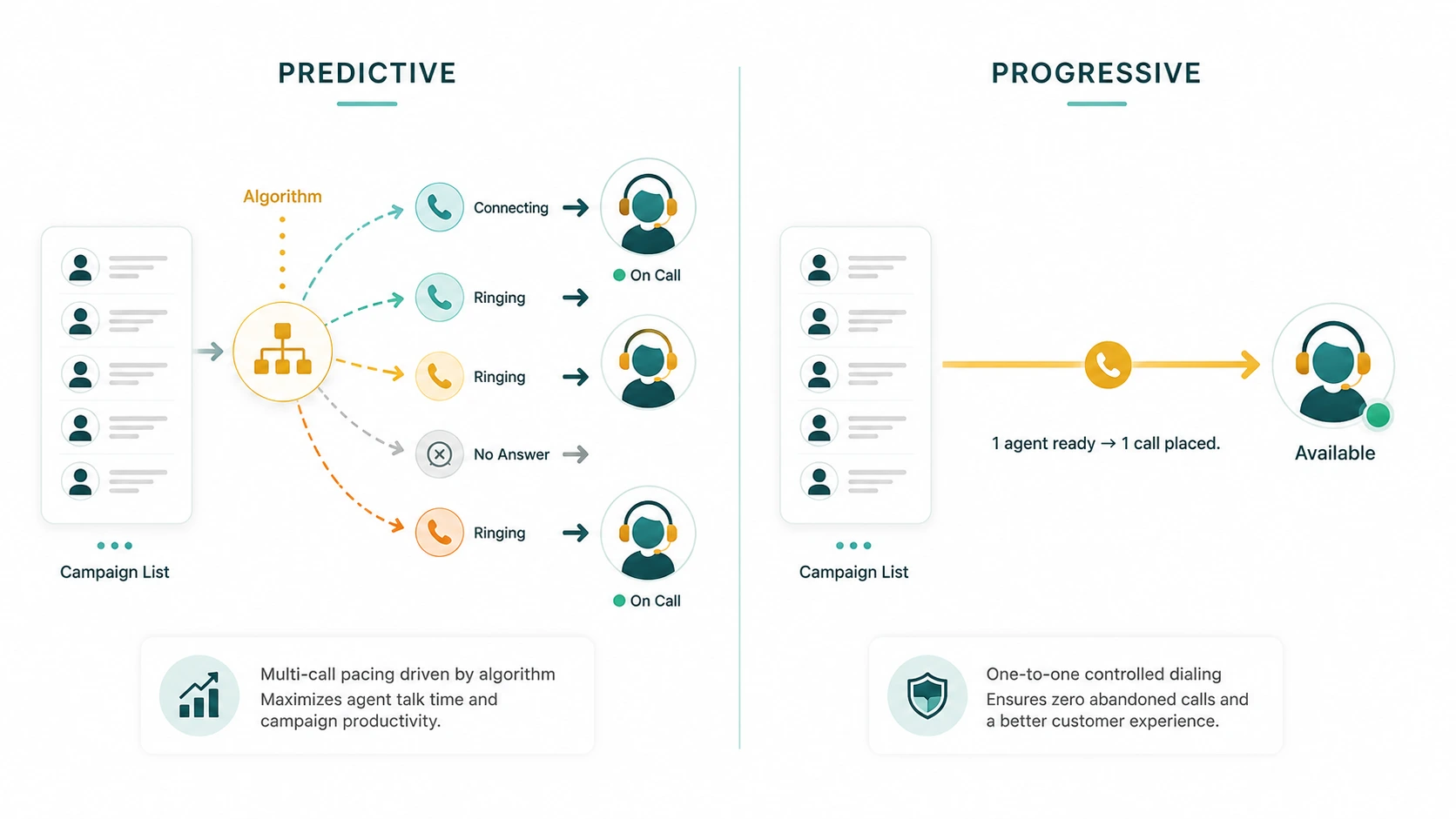
The core difference: A progressive dialer places one call per available agent and never dials without a confirmed-ready agent — producing zero abandoned calls. A predictive dialer places multiple calls per available agent using a pacing algorithm, accepts a calculated risk of occasional abandoned calls, and maximizes agent talk time at scale. Choose progressive when team size is small or compliance exposure must be minimal; choose predictive when team size supports it and throughput is the primary goal.
Architecture: What Each System Actually Does
Progressive dialing
When an agent finishes a call and becomes available, the system immediately places exactly one outbound call for that agent. Not two. Not 1.3. One. The call rings, passes through AMD (Answering Machine Detection), and connects to the waiting agent if a live person answers. If the call hits voicemail or isn't answered, the system waits for the no-answer timeout to pass and then triggers the next dial for that agent.
The invariant: at any moment, for any given agent, there is at most one active outbound dial in progress. No call is ever placed without an available agent already assigned to receive it. This is why abandoned calls are zero by design — there is no mathematical scenario where a live person answers and finds no agent.
Predictive dialing
A predictive dialer doesn't wait for agents to finish calls before dialing. It uses a real-time algorithm to estimate when agents will next be free and begins dialing ahead of that moment. If five agents are active and the algorithm predicts three will be available in 30 seconds, it initiates enough dials to produce approximately three live connections in that window — given the current answer rate.
The dial ratio (dials per available agent slot) typically runs between 2:1 and 5:1, depending on the current answer rate, team size, and campaign parameters. The algorithm recalculates every few seconds. When more live answers come in than expected, some callers find no available agent — those are abandoned calls. The goal is to maximize agent utilization while keeping abandonment within regulatory limits.
Direct Comparison
| Factor | Progressive | Predictive |
|---|---|---|
| Dial ratio | 1:1 (one call per ready agent) | 2:1 to 5:1+ (algorithm-controlled) |
| Abandoned calls | Zero — structural property | Inherent; must stay under FTC 3% cap |
| Agent talk time / hr | ~30–40 min | ~40–50 min |
| Minimum team size | 1 (works at any size) | Generally 7–10+ for stable pacing (varies by platform and ASR) |
| FTC TSR 3% cap | Not a practical concern | Active operational obligation |
| Operational complexity | Low — reactive, no pacing tuning | High — requires real-time monitoring |
| Caller experience (when AMD is wrong) | Only AMD false positives affect callers | AMD false positives + over-dialing abandons |
| Best list type | Warm leads, moderate volume, any quality | Cold, high-volume, 10–30% ASR |
| Real-time monitoring required | No | Yes — abandonment rate must be watched |
Agent Count: The Most Important Variable
If there is one factor that most clearly separates which dialer type to use, it is the number of agents simultaneously dialing. This is not a preference — it is a mathematical constraint.
Predictive dialing's pacing algorithm works by predicting when agents will be free across a pool. With 15 or 20 agents, the law of large numbers smooths out the variance in call answer timing and agent availability. The algorithm's predictions are accurate and the abandon rate stays stable.
Below 7–8 agents, that smoothing effect breaks down. When only 4 agents are dialing, two of them finishing calls at the same time cuts available capacity in half instantly. If the algorithm placed calls assuming three agents would be free in 30 seconds and two of them get into unexpectedly long calls, those answered calls find no available agent. The abandon rate spikes — and the algorithm cannot react fast enough to pull it back under 3% before the damage is done.
Progressive has no such constraint. A single agent running a progressive campaign produces exactly the behavior intended: one call, one agent, zero abandoned calls. Adding more agents scales the behavior linearly without any algorithm or compliance risk change.
Compliance: The FTC TSR Abandoned-Call Rule
In telemarketing contexts, the FTC Telemarketing Sales Rule's abandoned-call safe harbor (16 CFR § 310.4(b)(4)) caps abandoned calls at 3% of all calls answered by a live person. The measurement window is the full campaign duration for campaigns under 30 days, or each successive 30-day period for longer campaigns. An abandoned call is defined as one where a live agent is not connected within 2 seconds of the contacted person's completed greeting (16 CFR § 310.4(b)(1)(iv)).
Progressive dialing does not generate abandoned calls by design. The 3% cap is therefore not a material compliance concern in progressive mode — there are no abandoned calls to measure.
Predictive dialing does generate abandoned calls by design. Staying under 3% requires real-time monitoring, correctly tuned AMD sensitivity, sufficient agent count for statistical stability, and active dial-ratio management during campaign execution. When the abandon rate climbs toward 2.5%, supervisors must reduce the dial ratio before the cap is breached. Missing this costs $500 to $1,500 per TCPA violation per dropped call in worst-case enforcement scenarios.
DNC scrubbing, calling hours, and other compliance obligations apply to both dialer types. See what is DNC and the predictive dialer compliance guide for the full picture.
When to Use Progressive
- Team of fewer than 7–8 active agents. The statistical minimum for predictive reliability is approximately 7–10 agents. Below that, progressive is more appropriate regardless of other factors.
- Warm or higher-quality lists. When list answer rates are higher (30%+), the efficiency gap between predictive and progressive narrows. The compliance simplicity of progressive becomes more valuable relative to the diminishing throughput gain of predictive.
- Compliance-sensitive industries. Healthcare, financial services, debt collection with strict oversight — any vertical where even occasional abandoned calls create regulatory or customer-relationship risk that outweighs the throughput benefit.
- No real-time monitoring infrastructure. If your operation doesn't have a supervisor watching an abandonment rate dashboard during every campaign run, predictive is an unacceptable risk. Progressive removes that requirement entirely.
- Blended inbound/outbound agents. When agents handle both inbound queue calls and outbound campaigns, predictive's abandonment risk becomes harder to manage because agent availability changes unpredictably. Progressive adapts cleanly to variable agent availability without compliance consequences.
When to Use Predictive
- Team of 10 or more simultaneously dialing. Above this threshold, the pacing algorithm works as intended and the abandon rate is controllable within the 3% cap.
- High-volume cold lists. Where answer rates are low (10–25% ASR) and list size is large, predictive's efficiency advantage is most pronounced. It can deliver 2–3× more conversations per agent-hour than progressive under these conditions.
- Lower revenue-per-call campaigns. When call value is modest and volume is the key driver — appointment reminders, debt collection, insurance renewals at scale — predictive's throughput advantage justifies the compliance overhead.
- Real-time monitoring is staffed. A supervisor or automated alert system watching the abandonment rate dashboard throughout campaign execution.
- Campaign analytics are mature. You have historical data on your list's ASR, your agents' average handle time, and your wrap-up patterns. The pacing algorithm performs better with accurate baseline data.
A Decision Framework
Work through these in order:
- How many agents are simultaneously dialing? Under 7: use progressive. 10+: predictive is viable. 7–9: use progressive unless you have strong monitoring infrastructure and historical campaign data.
- What is your list's expected answer rate? Under 15%: predictive's dial ratio advantage matters. Over 30%: the gap narrows significantly. At high ASR, progressive may be only marginally slower than predictive while being substantially simpler to operate.
- Can you monitor abandonment in real time during every campaign? If no: use progressive. If yes: predictive is operationally feasible.
- Are you calling warm leads or cold lists? Warm leads with higher expected conversion rates benefit from zero-abandon architecture because each lead matters more. Cold lists at volume benefit from predictive's throughput advantage.
- Are you in a compliance-sensitive industry? Healthcare, financial services, insurance: the simpler compliance profile of progressive is valuable and reduces organizational risk.
EaseDial
Switch between predictive and progressive dialing per campaign — without changing platforms or retooling your team.