Pick the wrong dialer type and the cost shows up fast. A predictive dialer running below eight agents is nearly impossible to keep under the FTC's 3% abandoned-call cap. Cross that line and you're looking at $500 to $1,500 in TCPA exposure per dropped call — across a campaign that may have attempted tens of thousands of numbers. On the other side, a team capable of running predictive that instead uses preview dialing is leaving half their talk capacity on the table.
This guide covers every outbound dialing mode in plain technical language: what each type actually does architecturally, how the pacing algorithm behind predictive dialing calculates its dial ratio, what compliance obligations each mode triggers, and which type fits which operation. Start with the comparison table if you need the short answer, then work through the sections that apply to your situation.
Quick comparison: all five dialer types at a glance
"Auto dialer" is a marketing term that vendors apply to anything automated. The five types below are the actual architectural categories. The difference between progressive and predictive is not cosmetic — it determines your compliance exposure entirely.
| Dialer Type | Who initiates the call | Dial ratio | Abandoned calls | Min. agents | TCPA / FTC risk | Agent talk time / hr |
|---|---|---|---|---|---|---|
| Manual | Agent manually dials each number | 1:1 (agent-controlled) | None | 1 | Lowest — no automated dialing | ~15–20 min |
| Preview | Agent clicks Dial after reviewing record | 1:1 (agent-initiated) | None | 1 | Very low — agent initiates each call | ~20–28 min |
| Power / Progressive | System dials automatically when agent is free | 1:1 (system-controlled) | Near zero by design | 3+ | Low — 1:1 architecture prevents abandonment | ~30–40 min |
| Predictive | System dials multiple numbers simultaneously ahead of agent availability | 2:1 to 5:1 (algorithm-controlled) | Inherent — must stay below 3% | 8–10 minimum | Highest — FTC TSR 3% cap, ATDS classification risk | ~40–50 min |
The five dialer types: definitions and architecture
Manual dialing
The agent finds a number — in a CRM, a spreadsheet, or a physical list — and types or clicks it individually. No software initiates the call. There is no automated dialing component, so there is no regulatory exposure from an outbound-automation standpoint. Manual dialing is appropriate for very small teams, high-value accounts where preparation time is worth more than call volume, or contexts where legal counsel has determined automation creates unacceptable risk.
The constraint is efficiency. An agent who manually dials may complete 30 to 50 calls per day at most. The model doesn't scale.
Preview dialer
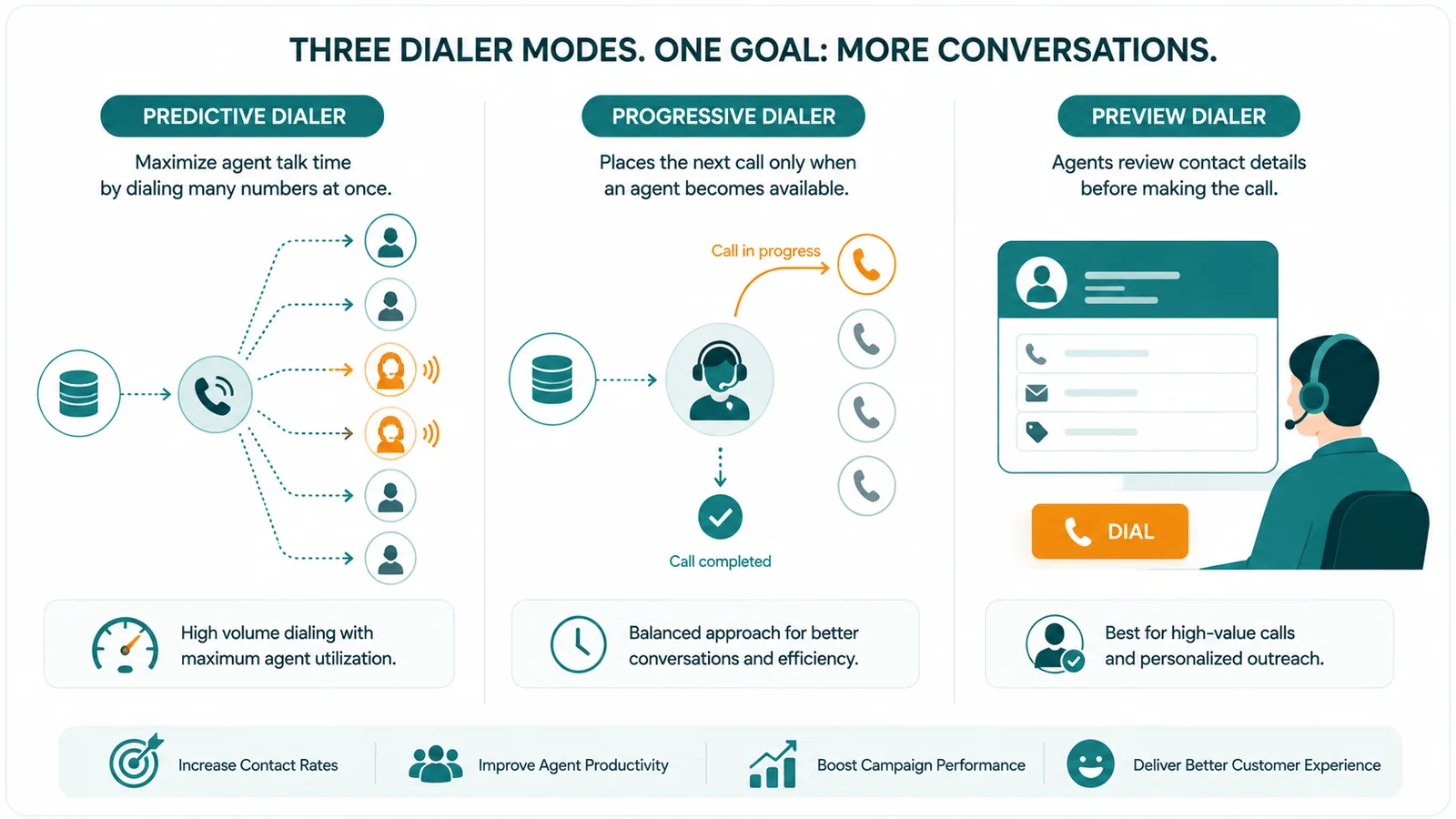
The system presents the next contact record to the agent before any call is placed: name, number, account history, prior interaction notes, whatever the CRM holds. The agent reviews the record, then clicks a Dial button — or physically dials the number — to initiate the call. The system does not place the call. The agent does.
That distinction matters legally. Because a human being deliberately initiates each call after reviewing the record, a preview dialer almost never qualifies as an ATDS (Automatic Telephone Dialing System) under the post-Facebook v. Duguid federal TCPA standard, which requires random or sequential number generation. It also produces zero abandoned calls because no call is placed until the agent is ready.
Most preview dialers include a configurable skip timer — the agent can pass on a record after a set number of seconds. Without management controls, agents will cherry-pick attractive contacts and skip difficult ones. This is the main operational challenge with preview mode, not compliance.
Power dialer
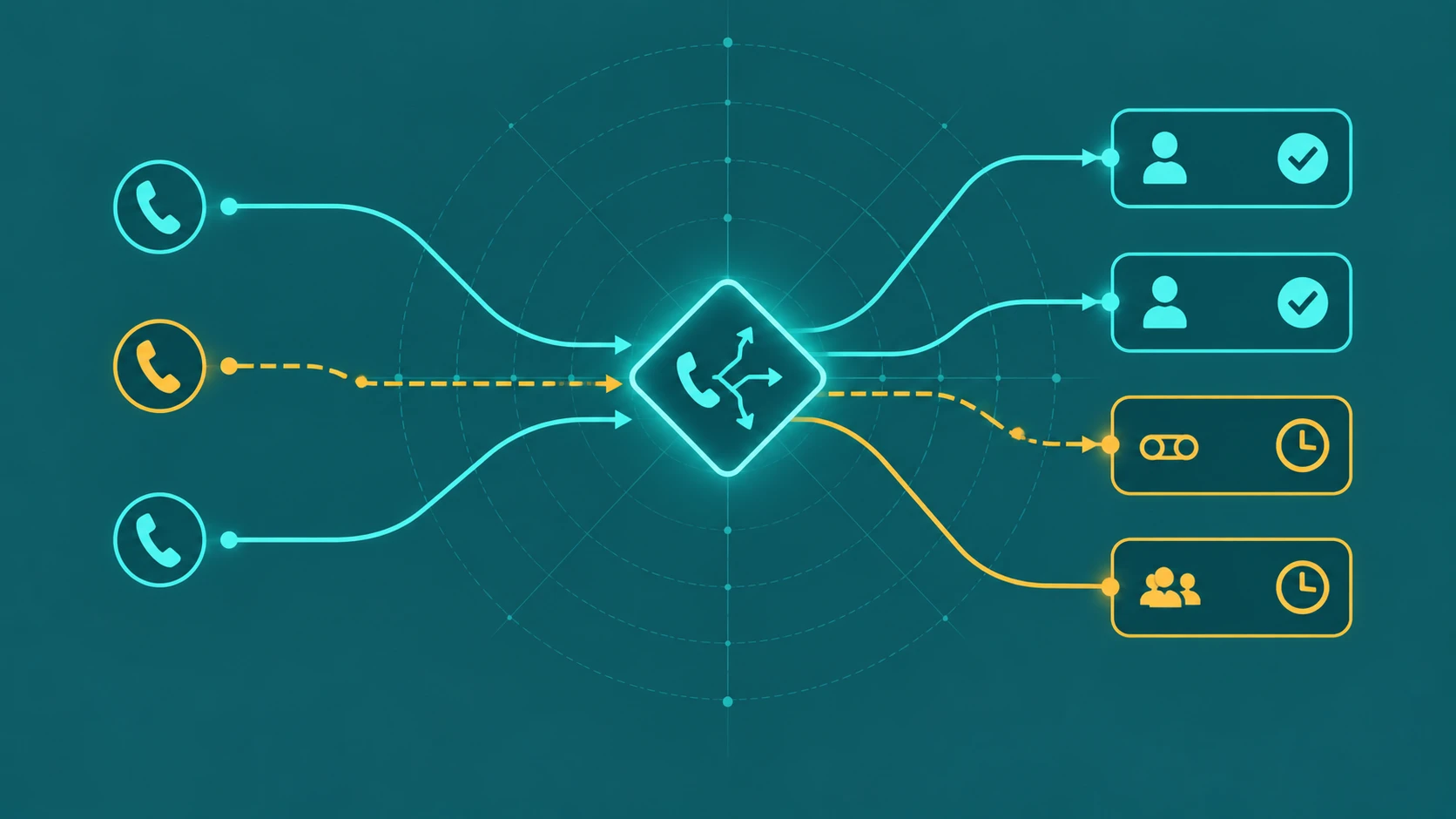
The moment an agent completes a call and hangs up, the system automatically dials the next number on the list. The agent does not click anything. There is always exactly one agent available per outbound call. The architectural invariant: no call is placed unless a confirmed-available agent is standing by.
Because of the 1:1 ratio, abandoned calls are theoretically impossible — no call connects without an agent already on the line. This makes power dialing substantially simpler to operate from a compliance standpoint than predictive, while still eliminating the manual dialing labor that costs agents 25 to 30 minutes of non-productive time per hour.
Progressive dialer
In most vendor documentation, "progressive" and "power" mean the same thing. When a vendor does distinguish between them, progressive typically refers to a pacing mode where the dial ratio is held at or near 1:1 but is system-managed rather than strictly binary — for example, dialing 1.1 to 1.3 calls per available agent to trim the gap between call completion and the next dial. The intent is still that an agent is confirmed available before any call connects.
For practical purposes: if a vendor offers both labels, ask them to describe the actual pacing architecture. What is the maximum simultaneous-calls-per-agent ratio? If the answer is 1:1 or close to it, abandoned calls should be negligible. If the ratio can reach 2:1 or higher, you are in predictive territory regardless of the label used.
Predictive dialer
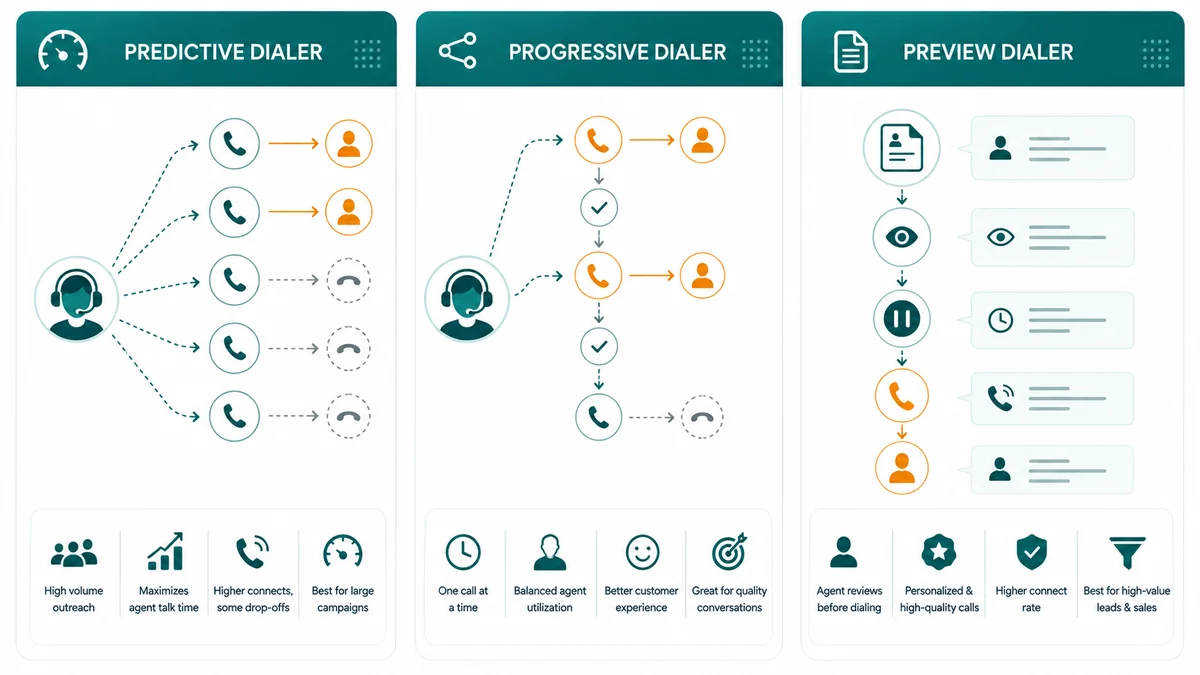
A predictive dialer uses a real-time statistical algorithm to dial multiple numbers simultaneously — typically two to five dials per available agent — so that by the time a contact answers, an agent is (usually) free to take the call. When the algorithm misjudges, more calls connect than agents are available. Those excess calls are abandoned: the contacted person hears dead air or a recorded disclosure message.
The trade-off is raw: agents spend 40 to 50 minutes per hour in actual conversation on a well-tuned predictive system, versus 15 to 20 minutes on manual dialing. The productivity gain is significant. So is the compliance overhead.
How each dialer works: step by step
Preview dialer — the sequence
System presents next contact record to agent. Agent reads account notes and prior call history. Agent clicks Dial (or waits for skip timer to expire and moves to next record). System initiates the outbound call. Agent hears ringing and is already on the line when the contact answers. Conversation begins with full context. Agent logs outcome. System presents the next record.
Power / progressive dialer — the sequence
Agent completes call and hangs up. System detects agent status change to "ready." System automatically dials the next number from the campaign list. Answering Machine Detection (AMD) classifies the answered call within one to two seconds. If live human: agent is already on the line and the conversation begins. If voicemail: system drops a pre-recorded message or terminates the call. Agent logs outcome. System immediately queues the next dial.
Predictive dialer — the sequence
Algorithm reads live metrics every five to fifteen seconds: number of ready agents, average handle time, current connect rate, rolling abandonment rate. Algorithm calculates the dial ratio (explained below). System places R simultaneous outbound dials per projected available agent. AMD filters answered calls. Live human answers — system checks agent availability. If an agent is free within two seconds of the contact's greeting: call connects. If no agent is available within two seconds: call is abandoned and counts against the 3% cap. Agent speaks with contact. On hang-up, algorithm re-reads all metrics and adjusts the ratio. Next dial batch is placed.
How the predictive dialer pacing algorithm works
The core calculation: The pacing algorithm solves a constrained optimization problem — maximize connected conversations while keeping the abandonment rate below 3%. It does this by estimating how many live answers will result from a given number of dials, then matching that expected answer volume to projected agent availability.
Every competitor article mentions that predictive dialers use an algorithm. None of them explain how the dial ratio is actually calculated. Here is the mechanism.
The inputs
The algorithm reads continuously: number of agents in "ready" state right now; current average handle time (talk time plus wrap-up time); live call connect rate (what percentage of dials are reaching a live person, not voicemail, busy signal, or no answer); time elapsed since each agent's last call ended; and rolling abandonment rate for the current campaign.
The dial ratio formula
The base ratio is approximately the inverse of the connect rate. If your campaign list connects at 25% — one in four numbers reaches a live person — the system needs to dial roughly four numbers to generate one conversation. The base ratio is 4:1. The algorithm then modifies this number based on how many agents are in ready state and how close the abandonment rate is to 3%.
A simplified version: if 10 agents are currently ready and average handle time is three minutes, the system projects that roughly three agents will complete their current calls in the next 30 seconds. It places enough simultaneous dials to generate approximately three connected calls in that window, accounting for the connect rate.
The adjustment cycle
Every five to fifteen seconds, the algorithm re-reads all live metrics and moves the dial ratio up or down. If the abandonment rate climbs toward 2.5%, the system automatically reduces the ratio to create a buffer before the 3% cap is reached. If agents are sitting idle for more than a few seconds, the ratio increases. This feedback loop runs continuously for the duration of the campaign.
Why team size matters for predictive dialing
With fewer than eight agents, the statistical variance in call answer timing is too unpredictable. A cluster of simultaneous answers — which happens randomly — can overwhelm available agents before the algorithm can react, spiking the abandonment rate above 3% in seconds. With fifteen or more agents, the law of large numbers smooths out those bursts. Most compliance-focused vendors set eight to ten agents as the hard minimum for predictive mode. Below that threshold, power/progressive dialing is the better choice.
How answering machine detection (AMD) works
AMD is what allows a power or predictive dialer to skip voicemails and only route live humans to agents. Without AMD, agents spend a significant portion of their time listening to voicemail greetings instead of speaking with people.
The classification process begins within milliseconds of call answer. The system captures the first one to three seconds of audio. It analyzes frequency patterns, pitch, speech cadence, silence duration, and audio clip length. A trained ML model — modern platforms use deep audio classification networks — categorizes the result as: live human, answering machine or voicemail, SIT tone (disconnected number), fax machine, or carrier announcement.
Live human: route immediately to an available agent. Voicemail: drop a pre-recorded message or terminate — see what is voicemail drop for how pre-recorded message delivery works and its compliance considerations. SIT or fax: mark the record and skip.
Accuracy benchmarks from 2024 testing show 96–98% classification accuracy on well-tuned systems. Leading platforms report similar figures based on billions of calls analyzed. The remaining 1–4% error rate has real consequences.
The compliance intersection
When AMD misclassifies a live person as a voicemail, that person hears dead air or a recorded message. Under FTC rules, if they don't hear a live agent within two seconds of their greeting, the call is classified as abandoned — and counts against your 3% cap. A false positive rate of even 2% can meaningfully erode your compliance buffer on a large campaign.
AMD sensitivity is configurable. Set it too aggressively toward voicemail detection and false positives increase. Set it too conservatively and agents end up listening to more voicemails. Most platforms let you tune the threshold, and it requires periodic recalibration as voicemail system audio patterns change over time.
Compliance framework: TCPA, FTC TSR, and ATDS classification
The FTC Telemarketing Sales Rule (TSR) — the 3% rule
The exact rule: Under the FTC Telemarketing Sales Rule's abandoned-call safe harbor (16 CFR § 310.4(b)(4)), a telemarketer using a predictive dialer may not abandon more than 3% of all calls answered by a live person. The 3% rate is measured over the duration of a single calling campaign if it lasts less than 30 days, or separately over each successive 30-day period for longer campaigns. An abandoned call is defined as one where a live sales representative is not connected within two seconds of the contacted person's completed greeting (16 CFR § 310.4(b)(1)(iv)).
This is the operational rule that makes predictive dialing non-trivial. The 3% cap is measured over the full campaign period — if your campaign runs less than 30 days, the measurement covers the entire campaign. If it runs longer, each 30-day window is measured separately. A persistent pattern of high abandonment across those periods accumulates compliance exposure.
The TSR also requires that any abandoned call play a recorded disclosure within two seconds of the contacted person's greeting, stating: the name of the seller, the seller's phone number (one the person can call to be added to a company-specific do-not-call list), and that the call was for telemarketing purposes. A silent abandoned call — no disclosure message — is a separate TSR violation on top of the abandonment rate breach.
The FTC enforces the TSR with civil penalties. The FCC is currently reviewing the 3% rule in a 2026 Further Notice of Proposed Rulemaking that may tighten the measurement window or lower the threshold. No final rule has been issued yet.
TCPA and ATDS classification
The TCPA (47 U.S.C. § 227) requires prior express written consent before making autodialed calls or sending automated texts to cell phones. The penalty is $500 per negligent violation and $1,500 per willful violation. With TCPA litigation running at approximately 4,000 federal lawsuits per year in 2025, this is an active enforcement environment.
The critical question for dialer operators is whether their system qualifies as an ATDS. The Supreme Court answered this in Facebook v. Duguid (2021): an ATDS requires the capacity to use a random or sequential number generator to store or produce phone numbers and then dial them. A predictive dialer that works exclusively from a pre-loaded contact list — without generating numbers randomly or sequentially — likely does not meet the federal ATDS definition.
The practical implication: list-based predictive dialers calling cell phones may not require TCPA written consent at the federal level, depending on how your system works. Get this analysis in writing from qualified legal counsel. Do not rely on vendor marketing.
Preview dialers almost never qualify as ATDS because a human being initiates each call after deliberate review — there is no automated dialing at all.
State mini-TCPA laws
Federal TCPA is a floor. Several states have enacted their own laws with stricter definitions of what triggers consent requirements, tighter calling hours, and per-call penalties that create significant private lawsuit exposure.
| State | Law | Autodialer definition | Calling hours | Attempt cap | Penalties |
|---|---|---|---|---|---|
| Florida | FTSA | Broader — automated selection OR dialing | 8 AM – 8 PM | 3 calls per 24 hrs per number | $500–$1,500 per call, trebled for willful |
| Oklahoma | OTSA | Broader — automated selection OR dialing | 8 AM – 9 PM | 3 calls per 24 hrs per number | $500+ per violation, treble damages |
| Virginia | State TCPA analogue | Similar to federal post-Duguid | 8 AM – 9 PM | None specified | Civil penalties, DNC scrub required within 31 days |
| Washington | CEMA | Broad — electronic means to contact | 8 AM – 9 PM | None specified | $500+ per violation |
| Maryland | State solicitation law | Automated calls without consent | 8 AM – 9 PM | None specified | $300 per violation |
Florida and Oklahoma are the highest-risk states for dialer operators because their autodialer definitions capture any system that can automatically select or dial — not just systems using random number generators. A list-based predictive dialer that avoids federal ATDS classification may still be fully captured by FTSA or OTSA. If any portion of your campaign list touches Florida or Oklahoma cell phones, get state-specific legal review before using predictive dialing.
Separate from state autodialer laws: the FCC's April 2025 consent revocation rule requires that opt-out requests be honored within 10 business days, regardless of dialer type. This applies to any outbound calling program.
2026 compliance developments
The outbound dialing compliance landscape has continued to evolve in 2026. Several developments require review with qualified legal counsel before or during campaign planning:
- FCC lead generation consent rules. The FCC has taken enforcement interest in "lead generator loophole" scenarios where a single consumer consent form is used to authorize multiple downstream callers. If your campaign uses purchased leads or lead aggregator lists, review your consent chain to ensure each calling party has independent authorization — not merely coverage under a blanket consent form signed for a different organization.
- FCC Know Your Customer (KYC) developments. The FCC has pursued rules requiring carriers and callers to take steps to verify the identity and legitimacy of outbound call originators as part of broader anti-robocall enforcement. Consult current FCC guidance or legal counsel for the current compliance requirements applicable to your calling program.
- FTC TSR review. The FTC has an open rulemaking that may tighten the 3% abandoned call measurement window or lower the threshold under the Telemarketing Sales Rule. No final rule has been issued as of this writing — monitor FTC rulemaking activity if you operate predictive dialing at scale.
This article reflects publicly available regulatory information and is not legal advice. Consult qualified legal counsel before making compliance decisions for your specific calling program.
Use case matrix: which dialer fits which operation
| Scenario | Recommended type | Why |
|---|---|---|
| Insurance agents (Medicare / AEP outreach) | Preview or progressive | Scope of Appointment requirements; agents need pre-call context; consent records are critical |
| Healthcare patient outreach / appointment reminders | Preview | HIPAA overlay; every call requires account context; personalization improves show rates |
| B2B SaaS sales development (SDR team) | Progressive | Business contacts expect personalized outreach; abandoned calls damage brand reputation; list quality is higher so connect rates are not the limiting factor |
| Warm lead follow-up (inbound-generated leads) | Preview or progressive | Lead has already expressed interest; context from the original inquiry increases conversion; speed to call matters but not at the cost of abandonment |
| High-volume consumer outreach (15+ agents, cold list) | Predictive | Connect rates are low on cold consumer lists; predictive's efficiency multiplier is most valuable here; team size is sufficient for stable abandonment control |
| Debt collection | Predictive (with strong compliance controls) | High volume, standardized scripts; CFPB and TCPA exposure is significant — requires rigorous consent records, real-time abandonment monitoring, and state-specific rules |
| Market research / surveys | Progressive or predictive | High dial volume needed; respondent experience matters less than in sales; TSR exemptions may apply for non-commercial research |
| Political campaigns (landlines) | Predictive | Certain TCPA autodialer restrictions do not apply to landline political calls; however, cell phones still require human-initiated contact or prior consent |
| Teams of 5 or fewer agents, any vertical | Preview or progressive | Predictive dialing below 8 agents creates statistical variance that makes the 3% abandonment cap extremely difficult to maintain |
| High-ticket B2B / enterprise sales | Preview | Deal size justifies pre-call research time; a context-rich opening line is worth more than an extra 10 dials per day |
EaseDial Campaign Dialer
Preview, progressive, and predictive dialing with built-in abandonment monitoring and DNC scrubbing.
Pros and cons of each dialer type
Manual dialing
- Pros: Zero compliance risk from dialing automation; full agent control; no minimum team size; no software integration required
- Cons: Extremely low call volume (30–50 calls per agent per day maximum); high cost per contact; no built-in DNC scrubbing or analytics; does not scale
Preview dialing
- Pros: Zero abandoned calls; very low ATDS classification risk; agents start each call with full account context; improves first-call resolution; works with teams of any size
- Cons: Lower call volume than progressive or predictive; agents can cherry-pick records without management controls; requires strong CRM integration to be useful; skip timer configuration requires tuning
Power / progressive dialing
- Pros: Eliminates manual dialing labor — agents spend 30–40 minutes per hour in conversation versus 15–20 for manual; near-zero abandoned calls by architecture; lower compliance overhead than predictive; works with teams of three or more agents
- Cons: On lists with low connect rates (25% or below), agents spend significant time waiting for non-answers to clear; slower list penetration than predictive at scale; requires CRM integration for context
Predictive dialing
- Pros: Agents spend 40–50 minutes per hour in actual conversation; 200–300% productivity increase versus manual dialing; most efficient option for high-volume consumer campaigns with large teams; AMD filters voicemails automatically
- Cons: Abandoned calls are inherent — must be managed in real time to stay below 3%; minimum eight to ten agents for stable compliance; AMD false positives create both customer experience problems and additional abandoned call risk; ATDS classification risk in Florida and Oklahoma regardless of list-based dialing; implementation and monitoring complexity is highest of all modes; switching platforms later is expensive due to CRM integration lock-in
Common mistakes
Choosing the wrong type
- Selecting predictive dialing for teams under eight agents. Variance in call-connect timing makes the 3% abandonment cap nearly impossible to maintain at that team size.
- Assuming "progressive" and "predictive" describe the same architecture. Ask every vendor: what is the maximum dial ratio your system can use? If the answer exceeds 1:1, you are looking at a predictive system.
- Choosing based on vendor marketing language rather than documented pacing architecture.
- Treating federal TCPA compliance as sufficient when calling Florida or Oklahoma numbers. State mini-TCPA laws apply different definitions and penalties.
Configuration errors
- Setting AMD sensitivity too aggressively. More voicemails caught means more live humans misclassified as voicemails — those show up as abandoned calls and TCPA complaints.
- Not configuring the time-zone engine correctly. You must respect the called party's state calling hours, not just your company's home state. A California operation calling Georgia must apply Georgia's calling hours to Georgia numbers.
- Not setting an abandonment rate alert at 2.0–2.5% so you have time to reduce the dial ratio before breaching the 3% cap.
- Omitting the required abandoned-call disclosure message. A silent abandoned call is two TSR violations: one for the abandoned call and one for failing to play the identification disclosure.
Operational mistakes
- Running predictive at high dial ratios during low-traffic windows when connect rates are unpredictable. The algorithm needs consistent input data to pace accurately.
- Not auditing AMD accuracy on a regular schedule. Voicemail system patterns change over time and accuracy degrades without recalibration.
- Failing to scrub call lists against the National DNC Registry within 31 days of use. Both TSR and most state laws require fresh scrubs.
- Not maintaining written consent records for autodialed cell phone calls. TCPA requires prior express written consent, and you must be able to produce it in litigation.
Vendor evaluation questions
When evaluating platforms: What is your maximum configurable dial ratio? What AMD false positive rates have you measured on comparable campaigns? Does your platform include a real-time abandonment rate dashboard with auto-throttle? What is your minimum recommended agent count for predictive mode? Do you provide state-level calling hours enforcement, and does it apply the called party's state — not just your location?
For the broader architecture decisions around outbound and inbound operations, see our guides on call routing, call queue management, and contact center analytics and KPIs. For a full view of the platform category these dialers live within, the CCaaS guide covers the complete software stack. If you are evaluating whether AI agents make sense for your outbound program, the AI voice agent overview explains how those systems work relative to traditional dialing. For workforce planning around outbound campaigns, see the workforce management guide.