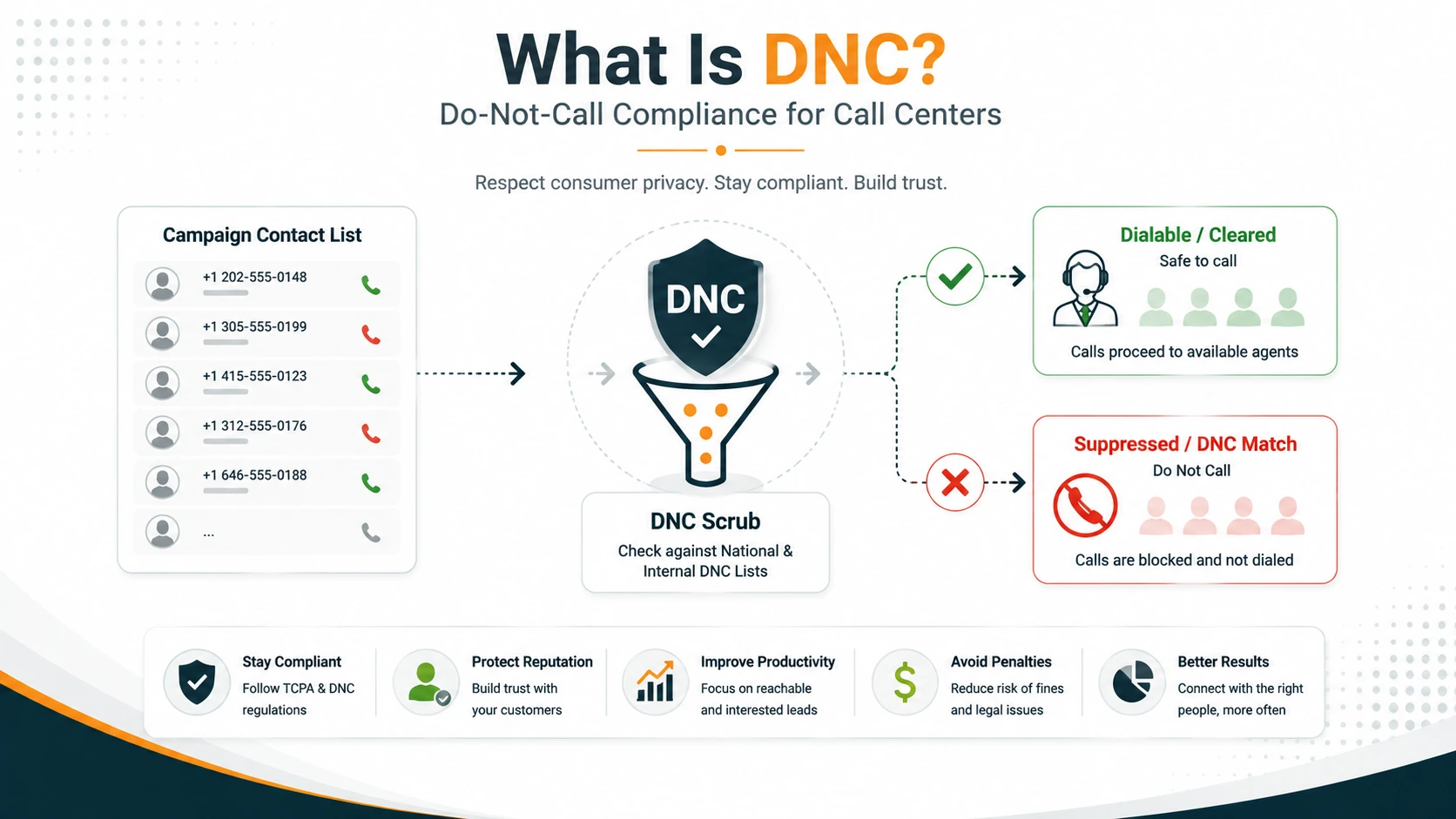
DNC definition: DNC stands for Do Not Call. It refers to any list of phone numbers that an organization is prohibited from contacting for telemarketing or solicitation purposes. Three types of DNC lists apply to outbound calling programs: the National Do Not Call Registry maintained by the FTC, company-specific internal DNC lists, and state-level DNC registries. Compliance requires managing all three.
If your organization makes outbound calls to consumers — sales, marketing, collections, or outreach — DNC compliance is not optional. Calling a registered number is a civil violation with penalties up to $53,088 per call under FTC rules. Under the TCPA, separate liability of $500 to $1,500 per call can also apply. With the National Registry holding over 258 million registered numbers as of the FTC's most recent biennial report, the question for most outbound programs is not whether any of their contact lists contain registered numbers — it is how many, and how recently those lists were scrubbed.
This article covers how the National Registry works, what the FTC and FCC rules require, how state registries add additional obligations, and how call centers manage DNC compliance operationally. It is intended to help you understand the regulatory framework and build better operational practices.
DNC rules and regulations change. Organizations should verify requirements applicable to their specific use case, jurisdiction, and the nature of their calling program with qualified legal counsel. This article is informational, not legal advice.
The Three Types of DNC Lists
Outbound calling compliance involves three distinct categories of DNC lists, each with different legal sources and operational requirements.
The National Do Not Call Registry
The National Do Not Call Registry is the federal consumer opt-out database maintained by the Federal Trade Commission. Consumers register their phone numbers at donotcall.gov. Once registered, the number is added to the registry within 31 days. Registration does not expire — a number registered in 2005 is still on the registry today unless the consumer actively removes it or the number is reassigned.
The registry was created under the Do-Not-Call Implementation Act of 2003 and is administered by the FTC under the Telemarketing Sales Rule (TSR). As of the FTC's biennial report, the registry contains over 244 million registered phone numbers. Telemarketers are required to check the registry and avoid calling registered numbers, subject to specific exemptions.
Company-specific internal DNC lists
A company-specific DNC list is separate from the National Registry. When a consumer tells a telemarketer not to call them again — during a call, in writing, or by any other means — the telemarketer must add that number to its own internal DNC list. The FTC's TSR requires this request to be honored within 10 business days and the list to be maintained indefinitely (or for a period specified by applicable law).
Internal DNC lists must be scrubbed against future campaigns the same way the National Registry is. A number on your internal list cannot be called even if it is not registered nationally.
State DNC registries
Multiple states maintain their own separate DNC registries, independent of the federal list. States with their own registries include Florida, Texas, Indiana, Wyoming, Louisiana, Oklahoma, Michigan, Missouri, Colorado, Tennessee, and others. State DNC rules frequently differ from federal requirements — stricter calling hours, different exemptions, different penalties, and sometimes different definitions of which types of calls are covered.
An organization calling consumers in those states must check both the National Registry and the applicable state registry. National Registry compliance does not satisfy state requirements. State penalties are also separate from federal penalties and can be significant — Florida and Oklahoma, in particular, are aggressive enforcement jurisdictions for outbound calling compliance.
How the National Do Not Call Registry Works
Consumer registration
Consumers register online at donotcall.gov or by calling 1-888-382-1222. The number is added to the registry within 31 days of registration. Registration is free for consumers and applies to residential phone numbers and mobile numbers. Business-to-business calls are generally not covered by the National Registry (see the FAQ section below for more on B2B coverage).
Telemarketer obligations
Telemarketers covered by the TSR must access the registry to scrub their contact lists before placing calls. Registry access requires registering with the FTC's Subscription Management System. The first five area codes per organization are free. Additional area codes beyond the first five are billed at a per-area-code annual fee.
As of fiscal year 2026, the FTC's access fee is $82 per area code annually, with a maximum charge of $22,626 for nationwide access regardless of how many area codes are covered. These fees are set by the FTC and updated periodically — organizations should verify current pricing directly with the FTC's registry subscription portal.
The 31-day scrub requirement
Telemarketers must scrub their call lists against the current registry at least once every 31 days. Scrubbing once at the start of a campaign and then running the campaign for three months is a common and costly mistake. New numbers are added to the registry continuously. A list scrubbed in January and used in April may contain numbers that were registered in February and March.
The 31-day window means a telemarketer may call a number that registered 30 days ago without violating the TSR. A number registered 32 days ago must have been removed from the calling list before any call is placed. This is not a technicality — it is how the rule operates, and it is the basis for the rolling scrub requirement.
Calling hours
The TSR restricts outbound telemarketing calls to between 8:00 AM and 9:00 PM local time of the called party. The relevant time zone is the time zone of the number being called, not the time zone of the calling center. A contact center in California calling a Florida number at 6:00 PM Pacific time is calling at 9:00 PM Eastern — the last permissible minute. At 6:01 PM Pacific, the same call is a violation. This is a frequent configuration error in dialer systems.
Who Is Exempt From the National Do Not Call Registry
Several categories of calls are exempt from National Registry restrictions. These exemptions are defined in the TSR and have specific conditions — they are not blanket permissions.
Existing business relationship
A telemarketer may call a number on the National Registry if the caller has an existing business relationship with the consumer. The TSR defines this as: a relationship with a customer who made a purchase, rental, or lease, or entered into a financial transaction, within 18 months prior to the call. For a consumer who has only made an inquiry or application but not yet completed a transaction, the exemption window is 3 months from the date of the inquiry.
The existing business relationship exemption is frequently misapplied. It is narrower than many organizations assume. The relationship must be with the specific entity making the call — not a parent company, subsidiary, or affiliate unless the consumer would reasonably expect to hear from that entity based on the original transaction. And once a consumer on the registry tells the caller to stop calling, the exemption ends, regardless of any prior business relationship.
Charitable solicitations
Calls made on behalf of non-profit organizations soliciting charitable donations are exempt from the National Registry under the TSR. However, if a for-profit telemarketing firm is making the calls on behalf of the charity, the firm itself is covered by TSR requirements. The exemption applies to the nature of the call, not to the firm placing it.
Political calls
Calls for political purposes — candidate advocacy, get-out-the-vote, political surveys — are not covered by the National Do Not Call Registry. However, calls to mobile phones for political purposes using an autodialer still require compliance with TCPA requirements. Federal DNC exemption does not mean unrestricted cell phone calling.
Surveys and informational calls
Purely informational calls that do not include a sales or marketing component, and genuine non-commercial research surveys, are generally exempt from the National Registry. The key qualifier is "purely informational" — a call that starts as a survey but includes a sales pitch is not exempt for the portion involving solicitation.
EaseDial Campaign Dialer
Built-in DNC suppression, contact list management, and campaign pacing in one platform.
FTC vs. FCC: Two Agencies, One Campaign
A common point of confusion in outbound calling compliance is that two federal agencies share jurisdiction over telemarketing — and both can apply to the same campaign at the same time.
The FTC enforces the Telemarketing Sales Rule (TSR) under the Telephone Consumer Protection Act implementation authority and the Do-Not-Call Implementation Act. The TSR covers telemarketers making outbound calls for the purpose of selling goods or services or inducing charitable contributions. It includes the National Registry requirements, calling hours, abandoned call limits for predictive dialing, and disclosure obligations.
The FCC enforces the TCPA (47 U.S.C. § 227) as it applies to the use of autodialers and prerecorded messages to call mobile phones. TCPA requires prior express written consent before placing autodialed calls or sending automated text messages to cell phone numbers. The FCC's jurisdiction extends to the calling technology — if an ATDS (Automatic Telephone Dialing System) or prerecorded voice is used to contact a cell phone, TCPA applies regardless of whether the call is for marketing or informational purposes.
Both frameworks can apply simultaneously. A predictive dialer campaign calling a consumer list that includes cell phone numbers may be subject to FTC TSR (for DNC scrubbing, calling hours, and abandonment rate limits) and FCC TCPA (for autodialer consent requirements on cell phones) at the same time. Neither exempts compliance with the other.
For deeper coverage of TCPA and autodialer rules including the compliance implications of different dialer types, see the dialer comparison guide. For a full walkthrough of current compliance requirements including the FCC's 2026 rulemaking activity, see our predictive dialer compliance guide.
DNC Penalties
The penalty exposure for DNC violations is significant, and it applies per call.
| Violation type | Authority | Maximum penalty |
|---|---|---|
| Calling a number on the National Registry | FTC / TSR | Up to $53,088 per violation |
| Failing to honor a company-specific DNC request within 10 business days | FTC / TSR | Up to $53,088 per violation |
| Autodialed or prerecorded call to a cell phone without prior express consent | FCC / TCPA | $500 per violation; up to $1,500 for willful violations |
| TCPA class action | Private right of action | Per-call damages multiplied across all class members — no statutory cap on total exposure |
The TCPA includes a private right of action, meaning consumers can sue organizations directly — without waiting for the FTC or FCC to act. Class action litigation under the TCPA runs at several thousand cases per year. A single campaign that made autodialed calls to cell phones without adequate consent can become a class action covering tens of thousands of class members, with per-call damages. This is not a theoretical risk; it is routine litigation in outbound calling verticals including financial services, debt collection, retail, and insurance.
How Call Centers Manage DNC Compliance Operationally
Registry subscription and list scrubbing
The foundational step is maintaining an active subscription to the National Do Not Call Registry and scrubbing every contact list against the current registry download before each campaign — and then re-scrubbing every 31 days during the campaign. This is not a one-time action. It is an ongoing operational process.
List scrubbing compares your contact list against the registry file and removes any matches before the campaign runs. Depending on list size and the scrubbing tools used, this can be a batch process run against a full registry download or an API-based lookup. The output is a suppressed list: contacts removed, contacts retained, and a timestamp of when the scrub was performed.
Pre-campaign scrub workflow
A standard pre-campaign scrub process looks like this: obtain the contact list; download the current registry file (or run lookups via API); compare the list against the registry, your internal DNC list, and any applicable state registry files; remove matched numbers; document the scrub date and record count; retain the scrub documentation for audit purposes. The documentation step matters — if a complaint is filed or a regulatory inquiry is made, you need to demonstrate that you scrubbed before the campaign ran.
Handling opt-out requests during calls
When a consumer tells your agent not to call again, that request must be processed within 10 business days. The operational question is how that request flows from the agent to your DNC list. In many organizations, the answer is: it doesn't, reliably, without a specific process.
Agents need a clear, low-friction way to flag opt-out requests during or immediately after a call. That flag needs to feed a suppression process that updates the internal DNC list and removes the number from active campaign queues — before 10 business days pass. An opt-out request noted in a call log but never translated into a list suppression is a TSR violation waiting to happen.
Record keeping and audit trails
The FTC requires telemarketers to maintain records of their DNC compliance processes: when lists were scrubbed, against what registry version, what was removed, and consent documentation for numbers called under an exemption. Maintaining these records is not just good practice — it is what you need to defend yourself when a complaint is investigated. Most contact center platforms generate scrub logs and compliance reports automatically; verify that your platform does before launching a campaign.
Agent training
Agents need to know what a DNC request sounds like, how to handle it during a call, and where to log it. This includes indirect opt-out signals — "I don't want any more calls," "take me off your list," "never call me again" — all of which must be treated as DNC requests. Training should also cover what agents may not do: they cannot offer to call back on a different number to avoid adding the requested number to the DNC list, and they cannot tell a caller that they've noted the request without actually processing it.
Third-party DNC scrubbing services
Organizations that lack the internal infrastructure to manage registry subscriptions, list scrubbing, and state registry compliance directly often use third-party DNC compliance services. These services handle registry subscriptions, automate the scrubbing workflow, check state lists in addition to the national registry, and provide audit documentation. Using a third-party service does not transfer legal liability — the organization remains responsible for its compliance — but it reduces the operational complexity and risk of manual error.
DNC Integration in EaseDial
EaseDial's campaign dialer includes built-in DNC suppression. When a campaign is configured, the platform checks contact numbers against your DNC lists before queuing them for dialing. Agents can flag opt-out requests during calls, which routes to the suppression workflow. Campaign managers can set scrub schedules and maintain their internal DNC lists within the same platform used to manage the campaign itself.
DNC integration in the dialer reduces the manual steps required to maintain compliance between your contact list, your calling program, and your suppression records. It does not replace the legal obligation to subscribe to the registry, maintain state lists, or apply the exemption framework correctly. Campaign operators are responsible for ensuring that their calling program complies with applicable law.
For information on how dialer types interact with compliance requirements, see Predictive vs Progressive vs Preview Dialers.
Common DNC Compliance Mistakes
Scrubbing once and running the campaign for months
The single most common DNC compliance error. A list scrubbed at campaign start becomes stale within 31 days. New registrations added to the registry during the campaign are not covered by the initial scrub. Running a campaign for 60 or 90 days without re-scrubbing creates penalty exposure for every registered number added after the initial scrub date.
Not maintaining an internal DNC list
Some organizations treat the National Registry as the only DNC obligation. It is not. Every opt-out request from a consumer — whether or not they are on the National Registry — must be honored and added to an internal company DNC list. A consumer can ask to be placed on your company's DNC list before their National Registry registration takes effect, and that request must be honored within 10 business days.
Applying the existing business relationship exemption too broadly
The existing business relationship exemption does not cover: contacts from a different division or subsidiary of your company; leads purchased from a third party; numbers where the relationship is older than 18 months (or 3 months for inquiries); or contacts where the consumer has already told you not to call. Treating any prior customer contact as an automatic exemption is a common error that creates real penalty exposure.
Not checking state registries
Federal registry compliance is not sufficient for calls to consumers in states with their own DNC lists. If your campaign calls consumers in Florida, Texas, Indiana, Oklahoma, or several other states, you must also check those states' registries. Missing state compliance is a separate violation under state law, with separate penalties.
Using unverified or aged contact lists
Contact lists purchased from third-party providers or compiled from older data sources may contain numbers that were registered after the list was created, numbers that have been reassigned (a previously consented number that is now held by a different person), or numbers with incorrect data that causes incorrect exemption application. Using unverified lists without current scrubbing and consent documentation creates liability that the organization cannot defend away by pointing to the list vendor.