When a customer calls a business phone number today, they might be talking to a software system that has never read from a script, never followed a menu tree, and never asked them to "press 1 for billing." They are talking to an AI voice agent — and for a growing number of businesses, the caller has no idea.
The phrase gets used loosely. Some vendors attach it to systems that are barely a step above the old press-1 menus. Others use it to describe genuinely conversational AI that books appointments, looks up order status in real time, and hands off to a human when the situation calls for it. The gap between those two things is wide.
This article explains what AI voice agents actually are, how they work technically, where they perform well, where they fall short, and what you should verify before committing your business phone traffic to one.
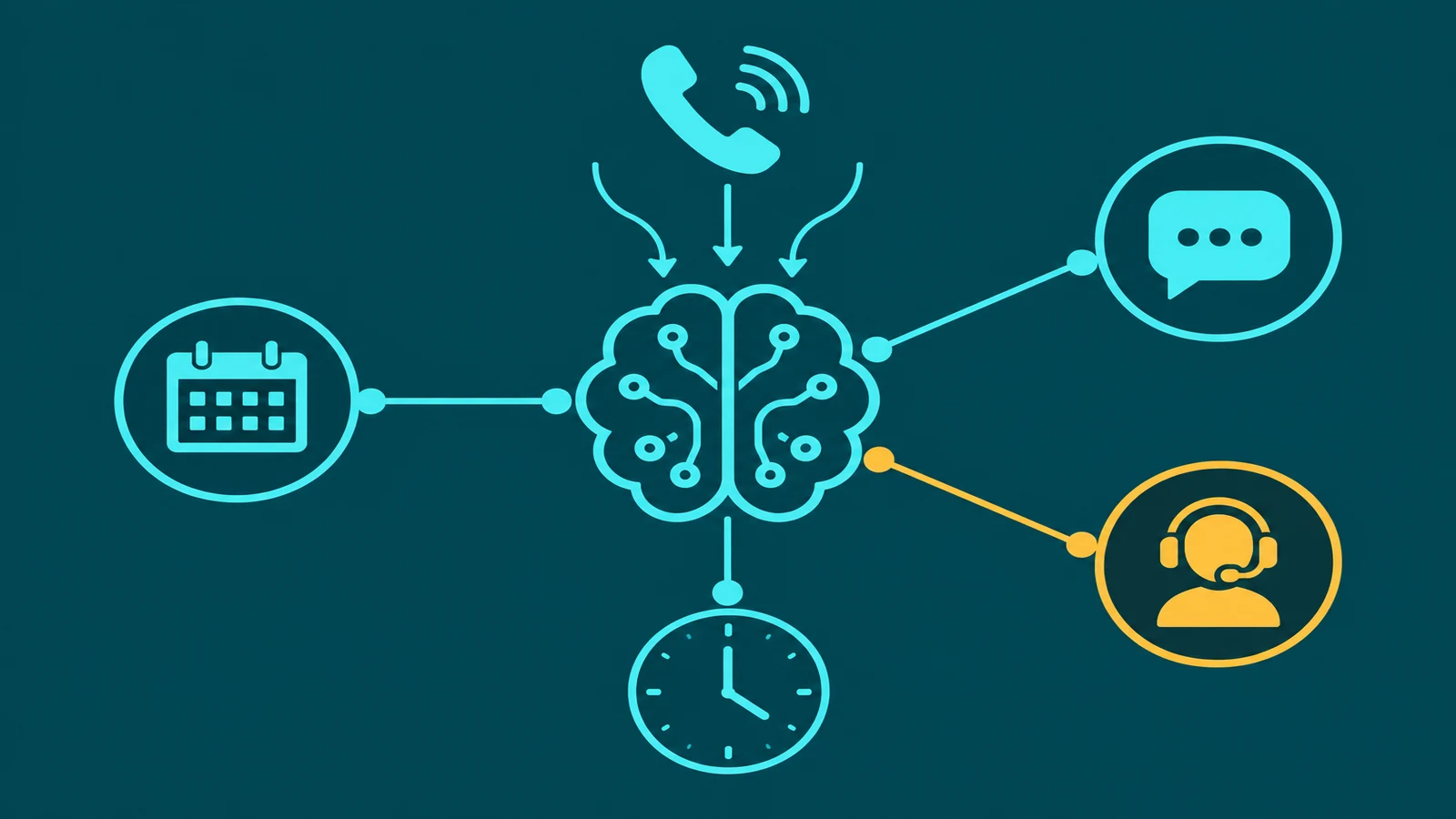
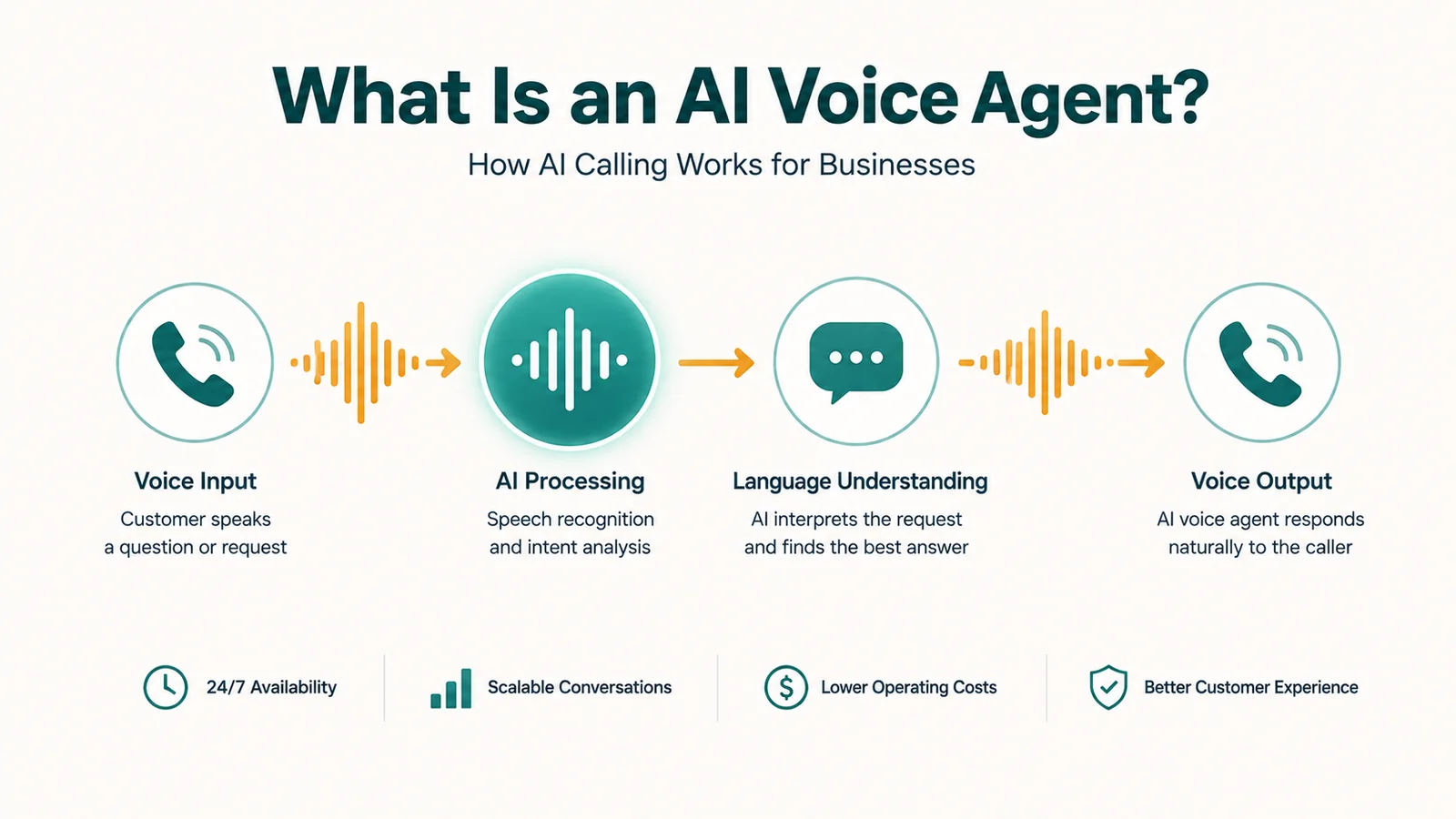
What is an AI voice agent? An AI voice agent is software that answers or places phone calls, understands spoken natural language, and takes real-time action — booking appointments, looking up orders, transferring to a human — without a pre-scripted menu. New to AI voice agents? The EaseDial glossary defines this and the other call automation terms. It works by chaining three AI components: speech-to-text (STT) converts caller audio to text, a large language model (LLM) generates a contextually appropriate response, and text-to-speech (TTS) converts that response back to lifelike audio. The full round-trip from end of the caller's utterance to the first syllable of the AI's reply takes between 400 and 1,200 milliseconds on a well-tuned production stack. Response delay and handoff to a person are covered in the latency guide and the human handoff guide.
AI Voice Agent vs. IVR: Why They Are Fundamentally Different
The most common point of confusion is with interactive voice response systems — the "press 1 for sales, press 2 for support" menus that have been a fixture of business phones for decades. The two technologies both answer calls automatically, which is where the similarity ends.
An IVR follows a fixed decision tree. Every possible path is defined in advance. The caller either hits a recognized input (a key press or a single spoken keyword like "billing") or the system does not understand them. There is no improvisation. The containment rate — calls the IVR resolves without a human — sits between 5 and 10% for most deployments, because the vast majority of callers have questions or needs that do not fit the pre-built branches.
An AI voice agent operates differently. It understands open-ended natural language. A caller can say "I need to move my appointment from Thursday to sometime next week, but not Monday morning" and the agent can parse that, check the calendar, and offer specific available slots. That conversation is not scripted. The agent reasons about it in real time.
| Dimension | AI Voice Agent | Traditional IVR |
|---|---|---|
| Input type | Natural speech — any phrasing | Keypad or single spoken keywords |
| Behavior | Probabilistic — adapts to conversation | Deterministic — follows a fixed script |
| Task completion | Books, looks up, updates — fully | Routes to a human |
| Call containment | 60–80% (well-tuned deployments; results vary by use case) | 5–10% typical |
| Setup complexity | High — prompt engineering, integration, testing | Low — menu tree configuration |
| Cost per minute | $0.05–$0.35+ (all-in) | $0.005–$0.02 |
| Caller satisfaction | High when working; low when it fails | Consistently poor |
AI voice agent vs. IVR covers the full comparison of these two technologies. For context on what traditional IVR systems do well, see IVR systems explained.
How an AI Voice Call Works: The Full Technical Stack
A single 3-minute call between a customer and an AI voice agent involves several distinct AI systems firing in sequence, repeatedly, across the entire conversation. Understanding how they connect explains both why the technology can feel natural and why it sometimes doesn't.
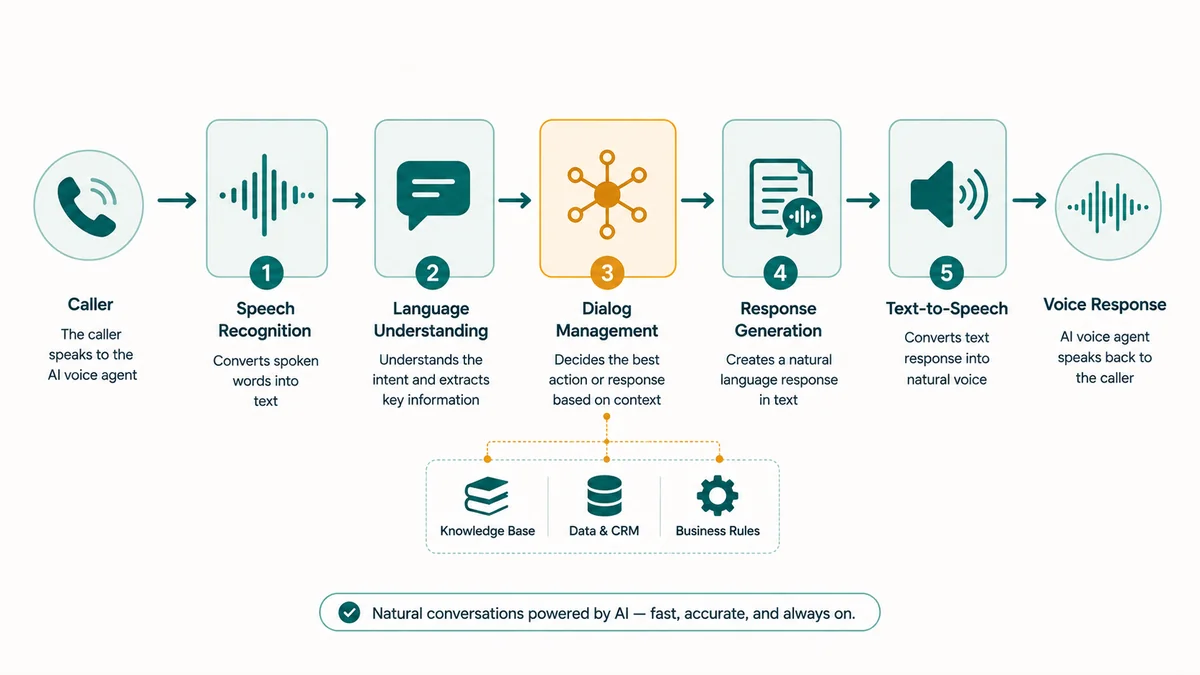
The real-time pipeline behind every AI voice call — each step has its own latency budget
Here is the sequence for a single caller turn:
- The caller's phone call arrives via the PSTN or VoIP network and is received by a telephony platform (via SIP trunk or WebRTC).
- Audio is streamed bidirectionally in small frames — typically 20 ms chunks — to an AI orchestration layer.
- Voice Activity Detection (VAD) runs continuously on incoming audio, classifying each frame as speech or non-speech.
- When VAD detects that the caller has finished speaking, the audio buffer is sent to a speech-to-text engine, which returns a text transcript — often within 200–300 ms of the last spoken syllable.
- The transcript, along with the conversation history and a system prompt defining the agent's behavior, is sent to a large language model.
- If the LLM needs live business data (an appointment slot, an order status), it issues a structured tool call. The orchestration layer executes the API call and feeds the result back to the LLM.
- The LLM generates a text response, streaming it token by token. The first complete sentence is immediately forwarded to the text-to-speech engine.
- The TTS engine converts the text to audio and streams it back to the telephony platform, which plays it to the caller.
- The caller hears the response. The loop restarts for their next utterance.
Everything between step 3 and step 8 is happening while the caller waits for the agent to respond. The goal is to complete that sequence in under 800 milliseconds — fast enough that the pause feels like a normal conversational beat rather than a noticeable delay.
The Core Components Explained
Speech-to-Text (STT / ASR)
Speech-to-text is the first AI layer. It converts the caller's audio into a text transcript that the LLM can process. Modern streaming ASR engines — like Deepgram's Nova-3 or AssemblyAI's Universal-3.5 — begin returning partial transcripts within 100–200 ms of the first spoken word. This allows the pipeline to start preparing a response before the caller has finished their sentence.
Accuracy matters here. A word error rate that looks acceptable in a benchmark — say, 7–10% — can cause real problems in practice. If a caller says "I need to reschedule my appointment with Dr. Reyes for next Wednesday" and STT mishears "Reyes" as "race," the LLM may search for the wrong provider record. Noisy environments, accents, and domain-specific vocabulary (medical terms, product names, account numbers) all stress STT accuracy.
Streaming STT also adds complexity at end-of-turn. The ASR engine must finalize the transcript and signal that the caller has stopped — but callers pause mid-sentence, say "um," and reformulate. Getting this wrong either cuts the caller off or makes the agent wait too long.
Voice Activity Detection (VAD)
VAD runs in parallel with STT, classifying each 32 ms audio frame as speech or silence using a lightweight neural classifier. It serves two purposes: detecting when a caller has finished their turn (triggering the STT → LLM chain), and detecting barge-in — when the caller starts speaking while the agent is still talking.
Barge-in detection is harder than it sounds. The system must distinguish a caller interrupting the agent from background noise, hold music, or a side conversation in the room. When the caller genuinely interrupts, the system needs to flush the TTS stream immediately — stopping mid-sentence — update the LLM context, and restart the response loop. A well-implemented barge-in makes the conversation feel natural. A poorly implemented one either ignores interruptions or fires constantly on noise, creating a chaotic experience.
Production systems in 2026 layer VAD with prosodic analysis (falling pitch signals a completed utterance) and linguistic completeness models (does the transcript form a complete thought?). The target is a false barge-in rate below 2–3%.
Large Language Model (LLM)
The LLM is where the conversation is understood and the response is generated. It receives the caller's transcript, the full conversation history, a system prompt that defines the agent's persona and rules, and any retrieved business knowledge. It then produces a text response — or a tool call if it needs live data first.
For voice applications, the critical LLM metric is time-to-first-token (TTFT): how long before the model starts streaming its response. A model with a 400 ms TTFT contributes less to perceived latency than one with a 1,400 ms TTFT, even if the final response quality is similar.
The system prompt is the most consequential configuration decision in an AI voice agent deployment. It defines what the agent knows, what topics it should decline to address, how it handles edge cases, when to escalate to a human, and what tone it uses. A vague system prompt ("be helpful and professional") gives the LLM too much latitude, which leads to off-brand responses, unsanctioned commitments, and occasional hallucinations. A specific prompt produces a more predictable, auditable agent.
RAG: How the Agent Knows Your Business
LLMs are trained on general text from the internet. They do not know your product catalog, your pricing, your specific policies, or your team's availability. That business-specific knowledge is provided through a technique called Retrieval-Augmented Generation (RAG).
In a RAG setup, your business documents — FAQs, product specs, service policies, pricing tiers — are indexed in a vector database. When the caller asks a question, the system searches the database for the most relevant chunks and injects them into the LLM's context before generating a response. The LLM then synthesizes an answer from the retrieved material rather than guessing from general knowledge.
RAG is not optional in production deployments. An ungrounded agent will eventually state incorrect prices, invent product features, or describe policies that do not exist. RAG substantially reduces this risk. It does not eliminate it — the LLM can still misinterpret retrieved content — but the failure rate is measurably lower than without retrieval.
Tool Calling: Taking Action During the Call
An AI voice agent becomes genuinely useful when it can do things during the call, not just talk about doing things. Tool calling (also called function calling) is the mechanism that enables this.
When the LLM determines that a question requires live data — checking appointment availability, looking up an order, verifying account status — it outputs a structured JSON instruction rather than a spoken response. The orchestration layer intercepts this, executes the appropriate API call against your actual systems (calendar, CRM, order management, payment processor), and feeds the result back to the LLM, which then incorporates the live data into a spoken reply.
From the caller's perspective, the agent simply said "I can see your order is scheduled for delivery this Thursday." From the system's perspective, a real API call was made, a real record was retrieved, and the caller received accurate information from a live source.
Text-to-Speech (TTS)
TTS converts the LLM's text response into audio. Neural TTS in 2026 has reached a quality level where most callers cannot reliably distinguish the AI's voice from a human's in controlled conditions. The differentiator between TTS providers is a combination of voice naturalness, emotional expressiveness, and — critically for voice agents — latency.
Time-to-first-audio (TTFA) measures how long before the caller hears the first syllable after the TTS engine receives text. Providers like Cartesia Sonic achieve around 80 ms; ElevenLabs Flash sits around 150 ms; slower options can push 300–400 ms. In a pipeline where every millisecond is cumulative, TTS latency is a significant variable.
The voice itself is configurable. Most platforms offer a library of pre-built voices; some support custom voice cloning so the AI speaks in a voice created specifically for the brand.
EaseDial AI Voice Agent
Answer every call instantly. Book appointments, look up orders, escalate when needed.
How the Call Sounds Natural: Latency, VAD, and Barge-In
The total delay a caller perceives — from the moment they stop speaking to the moment they hear the agent start responding — is the sum of every component in the chain: STT finalization time, LLM time-to-first-token, any tool call round-trips, TTS time-to-first-audio, and network transport time.
A typical well-optimized pipeline in 2026 looks something like this:
| Component | Typical latency |
|---|---|
| STT finalization | 150–300 ms |
| LLM time-to-first-token | 300–600 ms |
| TTS time-to-first-audio | 80–200 ms |
| Network transport | 20–100 ms |
| Total (no tool call) | ~550–1,200 ms |
When a tool call is required — fetching a calendar, pulling an order — add another 100–500 ms depending on the API's response time. This is why latency under load is a key vendor evaluation criterion. A platform that shows 500 ms in a demo may show 1,400 ms under production traffic, and the conversation starts to feel stilted.
Human conversations typically tolerate up to 500 ms of response latency before it feels like a pause. Beyond 800 ms, callers begin to wonder if the call dropped. Getting to p50 under 600 ms and p95 under 1,000 ms is the production target that separates a smooth experience from a frustrating one.
Human Escalation: How Warm Transfers Work
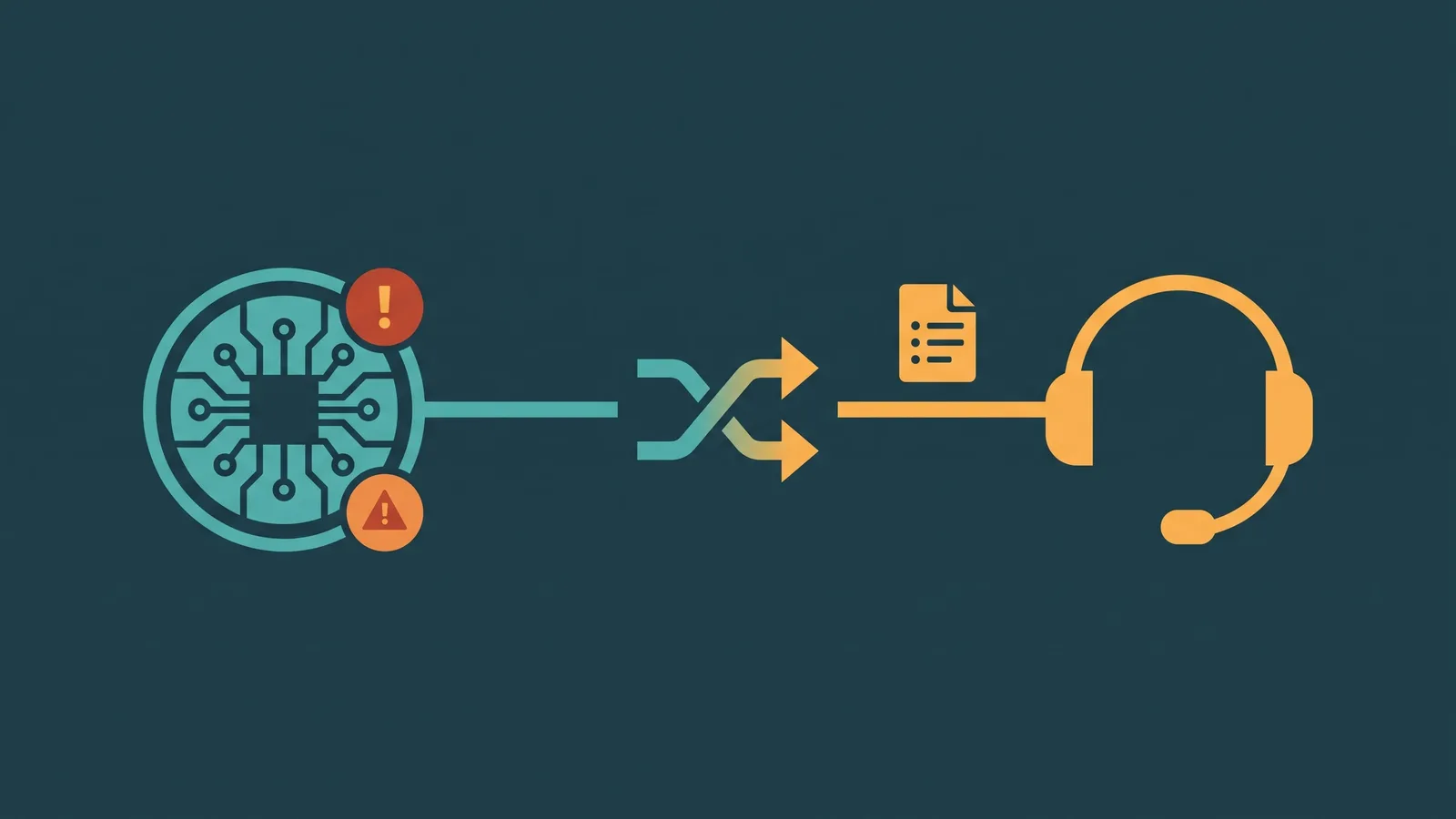
An AI voice agent that cannot hand off to a human is not production-ready. Some calls will always exceed what the agent can handle: a distressed caller, a complex account dispute, a question the knowledge base does not cover. The quality of the escalation path is as important as the quality of the AI conversation.
The standard in 2026 is a warm transfer, not a cold one. In a cold transfer, the caller is dropped into a new queue with no context — they must re-explain their situation to the human agent. In a warm transfer, the AI calls the target human agent first, plays a private briefing (a "whisper") summarizing the caller's name, their intent, any information already verified, and a conversation summary. The human agent hears this before the caller is bridged in. The caller holds for only a few seconds and never re-explains anything. The AI then drops off the call silently.
What gets passed in that briefing varies by platform, but a well-configured warm transfer includes: caller identification (if CRM-matched), the primary intent ("wants to reschedule appointment"), key verified fields (account number, location), detected sentiment ("frustrated; mentioned long wait time"), full call transcript, and any tool-call results already retrieved. That context allows the human agent to pick up the call feeling informed rather than starting from zero.
Compliance: Recording, Consent, GDPR, HIPAA
AI voice agents record calls, process voice data through third-party AI APIs, and sometimes store transcripts in cloud systems. That creates real legal obligations that vary by country, by US state, and by industry. This is not an area to review after deployment.
Call recording consent in the United States
Federal law (ECPA) requires one-party consent for call recording, meaning the business recording the call does not need to inform the other party. However, a number of US states require all-party (or two-party) consent — meaning every participant must be informed before the call is recorded. The specific states with all-party consent requirements change over time as legislatures amend their laws, so review current state law before deploying.
Violating all-party consent requirements carries both criminal and civil penalties in the states that require it. The standard practice — and the legally safe one — is to disclose recording at the start of every call, regardless of which state the caller is in, since the caller's location is unknown at the moment the call is answered.
Some states are also enacting requirements around AI caller disclosure. California, for example, has specific disclosure obligations for certain automated calling systems using prerecorded or artificial voices. The applicability and scope of these rules depend on the nature of the call, the jurisdiction of the caller, and the specific technology in use — consult legal counsel for guidance applicable to your deployment.
GDPR
Under GDPR Article 13, callers in the EU must be informed at the start of the call — the point of data collection — of the purpose of recording, the legal basis, the retention period, and their rights. Staying on the line after an initial greeting does not constitute consent under GDPR. If the agent records the call, that recording is personal data and must be handled accordingly: stored with AES-256 encryption, access-controlled, retained only as long as the stated purpose requires, and deletable on request.
Voice biometrics — using voice patterns to identify or authenticate a caller — qualify as special-category biometric data under GDPR, requiring explicit opt-in consent before the feature can be used.
HIPAA
Any AI voice agent that handles US patient information — appointment bookings, prescription inquiries, lab result follow-ups — is a Business Associate under HIPAA. The vendor must sign a Business Associate Agreement (BAA). Call recordings are Protected Health Information (PHI) and require AES-256 encryption at rest and in transit, role-based access controls, audit logging, and a breach notification process with a 60-day notification window.
Verify BAA availability before signing with any platform. Not all AI voice agent vendors offer them, and some that do have BAAs that exclude the AI processing layer.
Outbound calling (TCPA)
Outbound AI calling to US mobile numbers using automated dialing technology requires prior express written consent from the recipient. A 2024 FCC ruling confirmed that AI voice agents qualify as auto-dialers for TCPA purposes. Calling a mobile number without proper consent can result in per-call statutory damages of $500–$1,500.
Use Cases by Business Size and Industry
The same underlying technology covers a broad range of business applications. What changes is the complexity of the workflows, the compliance requirements, and the volume of calls.
Small businesses (under 50 employees)
The most straightforward wins for small businesses are inbound call handling when no one is available, and appointment scheduling that currently relies on back-and-forth phone tag. A dental practice, a law firm intake line, an HVAC dispatch operation — in each case, the AI handles the answering and booking while the human team focuses on the actual work. For a complete guide to AI answering services designed specifically for small businesses — including cost models, setup steps, and what to look for in a provider — see our guide to AI answering services for small business.
A realistic scope for a small-business deployment: the agent answers calls 24/7, identifies the caller's intent (appointment request, general question, emergency), books new appointments against live calendar availability, answers common FAQs from a configured knowledge base, and routes everything else to voicemail or a human callback queue. That scope is achievable, well-tested, and delivers clear value without requiring deep technical integration. If your business is also evaluating the underlying phone infrastructure, our guide to business VoIP covers how cloud calling works, what it costs, and how to choose a provider.
Mid-market (50–500 employees)
Mid-market deployments typically involve CRM integration and more structured call workflows. An insurance agency's AI agent can take first notice of loss, verify policy numbers against a live database, and create a claim record — all before a human adjuster is ever involved. An e-commerce operation can handle order status, returns, and exchange requests through the agent, routing only complex complaints to human agents.
At this scale, the agent's tool integrations become the differentiating factor. An agent that can only talk about your business is less valuable than one that can actually transact inside your systems during the call.
Enterprise and contact centers
At enterprise scale, AI voice agents are used primarily for Tier-1 volume deflection in cloud contact centers: handling the structured, repetitive inquiries that do not need human judgment, so human agents handle only escalations and complex cases. This changes the staffing math significantly. AI's role in contact centers extends well beyond the voice channel, but the phone remains the highest-volume queue for most enterprise customer service operations.
Benefits and ROI: Real Numbers
The business case for AI voice agents rests on a few specific metrics that are worth understanding before evaluating vendors.
| Metric | Benchmark | Context |
|---|---|---|
| Cost per AI-resolved interaction | ~$1.18 | vs ~$7.40 for human-resolved (widely cited industry benchmark) |
| Call containment rate | 60–80% | Well-tuned deployments; results depend on use case, knowledge quality, and escalation design |
| 24/7 availability | Zero missed after-hours calls | Human staffing covers 8–10 hrs/day at most |
| Concurrent call capacity | Hundreds to thousands simultaneously | Human center: one agent per active call |
| Call abandonment reduction | Up to 50% | Driven by elimination of hold queues |
| Average handle time | 1–3 min for structured queries | vs 4–8 min for equivalent human call |
These numbers come from industry aggregators and should be treated as directional, not contractual. Your actual results depend on call volume, how well the agent is configured, how tightly it integrates with your systems, and how well it handles your specific caller population. A deployment that achieves 70% containment with 90% resolution is producing real value. One that achieves 80% containment with 50% resolution — where half the calls nominally "contained" are actually abandoned — is producing churn.
What AI Voice Agents Do Not Do Well
The limitations matter as much as the capabilities. A business that understands them in advance will design a better deployment than one that discovers them in production.
ESTABLISHED limitations (present in every production deployment today)
Accent and dialect gaps. STT accuracy degrades on non-standard accents, regional dialects, heavy background noise, and non-native speakers. An agent that performs well in demo conditions with clean audio may fail noticeably on calls from elderly callers, callers in noisy environments, or callers with accents underrepresented in the STT model's training data. Test your STT pipeline on audio that matches your actual caller demographics before launch.
Hallucination risk. LLMs can generate plausible-sounding responses that are factually incorrect. RAG grounding reduces this substantially, but does not eliminate it. An unmonitored agent can quote wrong prices, describe nonexistent product features, or invent policies. Post-call monitoring of 100% of transcripts using AI-driven quality scoring is the only reliable way to catch these patterns before they compound.
Emotionally complex calls. Callers who are distressed, confused, or angry need more than an accurate answer. They need human judgment, empathy, and the flexibility to go off-script. An AI agent can detect frustration signals and escalate, but it cannot replace a skilled human agent on a call that genuinely requires one.
Domain-specific vocabulary and proper nouns. Medical terms, legal terminology, product names, and account identifiers are all harder for STT to transcribe accurately and for the LLM to handle correctly without explicit training and knowledge base preparation.
Integration complexity. Most platforms offer webhook support, but "integration" in a vendor demo often means "we can connect to anything with an API." The actual work of connecting a legacy CRM, a custom order management system, or a non-standard scheduling platform falls on your team. This is routinely underestimated at the buying stage.
EMERGING — present in some deployments, not yet standard
Real-time cross-language translation. A handful of enterprise platforms can translate mid-call — the caller speaks in one language, the human agent hears in another. This works in controlled conditions but remains unreliable for low-resource languages and code-switching (mixing languages within a single utterance).
Emotional-adaptive TTS. Some TTS providers are beginning to modulate delivery speed and tone based on detected caller sentiment. This capability exists in early-stage deployments but is not yet a reliable production feature across the major platforms.
SPECULATIVE — not yet production-ready
Fully autonomous multi-call workflows where the AI orchestrates sequences of calls without any human triggering — re-engagement sequences, complex negotiation chains — are technically demonstrated but not yet reliable enough for unmonitored production use. Treat vendor claims about autonomous agent "swarms" or fully unsupervised outbound campaigns with skepticism.
How Much Does an AI Voice Agent Cost?
Per-minute pricing is the number vendors lead with, and it is not the number that matters. The all-in cost of an AI voice agent deployment includes several layers that are often disclosed separately or in fine print.
The platform fee covers the orchestration layer and is typically charged per minute of call time. Published rates from major platforms in 2026 range from $0.05 to $0.12 per minute for the platform alone. On top of that, depending on how the platform is priced, you may be billed separately for:
- STT usage (typically $0.003–$0.01 per minute)
- LLM API tokens (varies significantly by model; GPT-4o costs more than GPT-4o mini by a factor of 5–10x)
- TTS synthesis (typically $0.003–$0.015 per minute)
- Telephony and carrier costs ($0.01–$0.02 per minute for PSTN)
- Concurrency slots (per-slot monthly fee for guaranteed parallel call capacity)
- Compliance add-ons (HIPAA BAA, SOC 2 certification tiers, recording storage)
A platform advertising $0.07/min may cost $0.20–$0.35/min all-in once every layer is included. Request a complete cost breakdown — not just the platform rate — before comparing vendors. For more on evaluating what a business phone system actually costs overall, see how to choose a business phone system.
For small businesses, the cost structure looks different: many platforms offer flat monthly plans starting around $50–$100/month for limited call volumes, which can be more predictable than per-minute pricing at low usage levels.
Choosing a Platform: What to Evaluate
The AI voice agent market in 2026 has dozens of vendors. The major categories are: full-stack platforms (Retell AI, Bland AI, ElevenLabs Conversational AI) that bundle STT, LLM routing, TTS, and telephony in one product; developer-first infrastructure platforms (Vapi, Twilio ConversationRelay, LiveKit Agents) that provide the building blocks without prescribing the AI stack; and business-focused products (like EaseDial) that integrate AI voice capabilities into a broader communications platform.
When evaluating, these are the questions that matter most:
| Criterion | What to ask |
|---|---|
| Latency | What is the p50 and p95 end-to-end latency under production load? Not averages — percentiles. |
| True all-in cost | Show me the itemized invoice including STT, LLM, TTS, telephony, concurrency, and compliance. |
| Integrations | Do you have a native connector for my CRM and calendar, or is this a webhook I need to build? |
| Compliance | Do you provide a HIPAA BAA? SOC 2 Type II? GDPR DPA? Recording consent management? |
| Number porting | Can I bring my existing business phone numbers? What is the timeline and cost? |
| Warm transfer quality | Show me what data is passed to the human agent. Can I configure what goes in the whisper briefing? |
| Analytics and monitoring | How do I monitor containment vs. resolution? Can I review transcripts? Are hallucination flags surfaced? |
| Uptime and failover | What is the contractual uptime SLA? What happens to my calls if the LLM API goes down? |
| Lock-in risk | Can I export my agent configuration? What does migration to another platform actually involve? |
Common Mistakes to Avoid
These are the failure patterns that repeat across first-time deployments.
Choosing based on demo quality. Demos are recorded or run under ideal conditions with clean audio and cooperative "callers." Request p95 latency data under realistic load, and ideally run a pilot with your actual traffic before committing to a contract.
Under-specifying the system prompt. Vague instructions produce unpredictable agents. Define the scope explicitly: what topics the agent handles, what it should not address, how it handles unknowns, when to escalate, and what commitments it is not permitted to make. The prompt is the agent's operating manual.
Skipping RAG. If you deploy an agent without a grounded knowledge base and rely on the LLM's general training to answer product and policy questions, you will have hallucination incidents. It is a question of when, not if.
Not testing the human escalation path. The agent's warm transfer to a human is not a secondary feature — it is the safety net. It must be tested and verified before go-live, including the whisper briefing, the context pass-through, and what happens if the target human agent does not answer.
Ignoring post-launch monitoring. An AI voice agent is not a set-and-forget system. Knowledge bases go stale, caller behavior changes, and failure patterns accumulate silently. Review transcripts, track containment and resolution rates separately, and audit fallback frequency monthly.
Not testing accent diversity. Test with audio that represents your actual callers: their regional accents, language backgrounds, age group, and typical environment (office, mobile, noisy retail). An agent that passes a clean-audio test may fail noticeably in production.
Getting to production: deployment approach
The organizations that have the smoothest AI voice agent launches treat the deployment as a phased process rather than a single cutover. The sequence is not universal — it depends on call volume, use case complexity, and staffing — but the underlying logic holds across deployments of any scale.
Define scope before building
The highest-leverage pre-build decision is choosing the right initial use case. The best candidates are high-volume, low-complexity contact types: appointment reminders, order status lookups, account balance inquiries, standard FAQ calls. These have well-defined intents, clear resolution criteria, and low stakes for errors. Avoid starting with calls that require nuanced judgment, sensitive customer situations, or complex multi-step processes — even if these represent the largest volume opportunity. Get the simpler use case working well first; the knowledge and tooling built there transfers to more complex ones.
Pre-production requirements
Before any live caller traffic reaches the agent, verify:
- Escalation path works end-to-end. Test the warm transfer manually, including the context handoff to the receiving agent, the whisper briefing, and the fallback if the target queue is unavailable. A broken escalation path means a caller who needs a human has nowhere to go.
- Knowledge base is accurate and current. Every product, policy, pricing, and process fact the agent will cite should be verified against current documentation. Stale or incorrect knowledge base content produces hallucination-adjacent failures — the agent is using grounded content, but the grounded content is wrong.
- Tool integrations are tested with realistic data. If the agent calls a booking API or order lookup system, test it with edge cases: cancelled orders, duplicate accounts, systems that return unexpected error formats. How the agent handles a tool failure is often more important than how it handles success.
- Disclosure language is in place. Callers must know they are interacting with an automated system where legally required. Verify the disclosure, where it appears in the call flow, and that it is legally adequate for your operating jurisdictions.
- Guardrails are configured and tested. Before go-live, run adversarial test calls that probe the boundaries of the system prompt: off-topic requests, attempts to elicit unsanctioned commitments, out-of-scope questions, ambiguous requests the agent might handle incorrectly. A systematic approach to guardrail design and testing is covered in the AI voice agent guardrails guide.
Phased rollout
Most successful deployments start with a controlled subset of live traffic rather than a full cutover. Route a fraction of the target call type to the AI agent and handle the remainder with humans, or restrict the AI agent to a specific time window or geographic segment initially. This limits the blast radius of any misconfiguration that did not surface in testing and allows you to validate real-world performance before scaling.
During the initial live period, review call transcripts actively — not a sample, but a significant share — to identify patterns the agent is handling poorly. Escalation frequency, fallback trigger rate, and the reasons callers end up in the fallback path tell you where the agent needs improvement. The monitoring layer is not optional here; the agent's failure modes in production will differ from those in testing.
Post-launch operations
An AI voice agent requires ongoing maintenance. Knowledge bases go stale when products, prices, or policies change and the agent's knowledge base is not updated in parallel. Call intent patterns shift over time, and the agent's scope definition may need to expand or contract as you learn what callers actually ask. Review containment rates, escalation rates, and transcript samples on a regular cadence — monthly at minimum — and treat declining performance as a maintenance signal rather than an inherent limitation.