
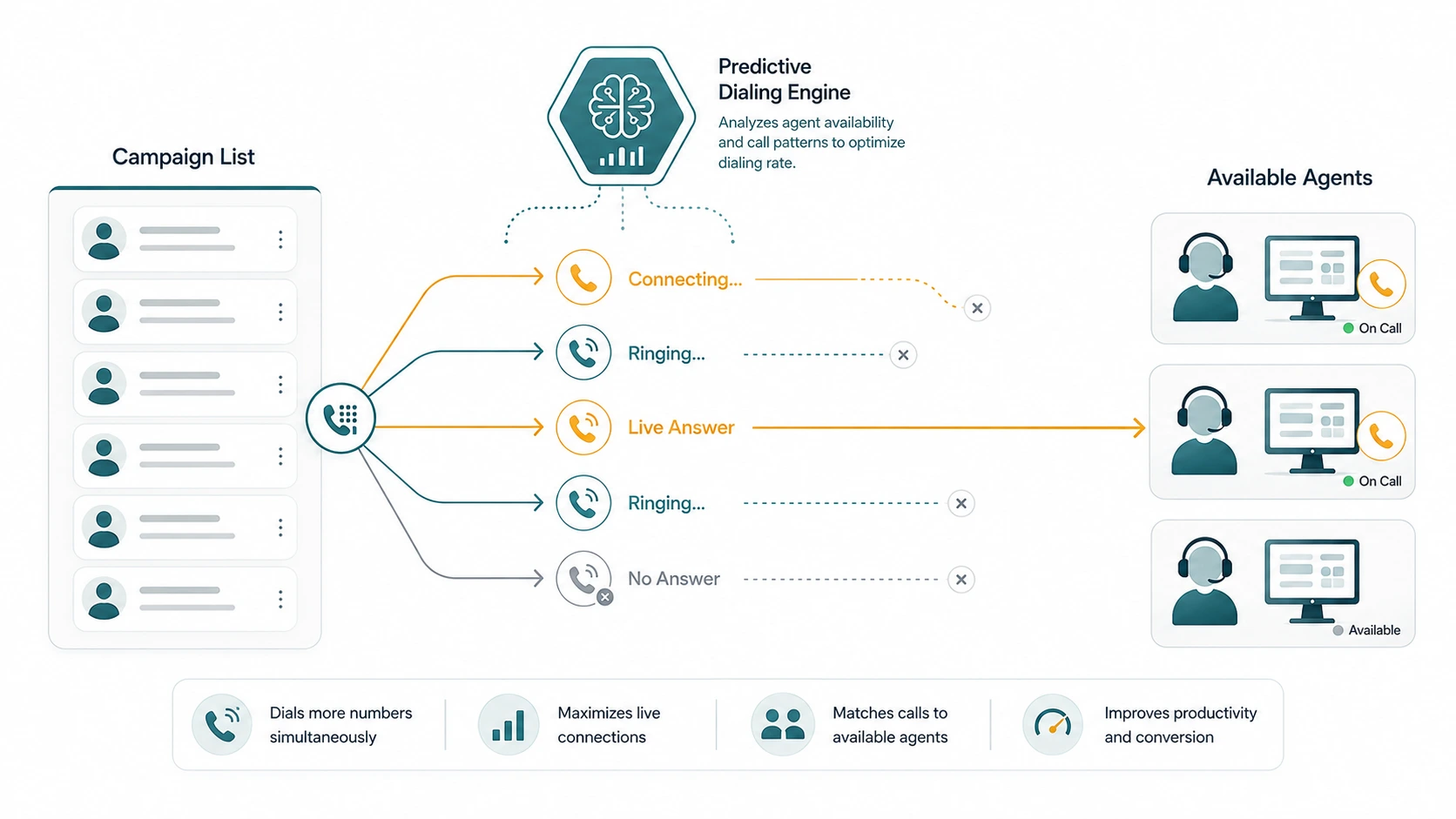
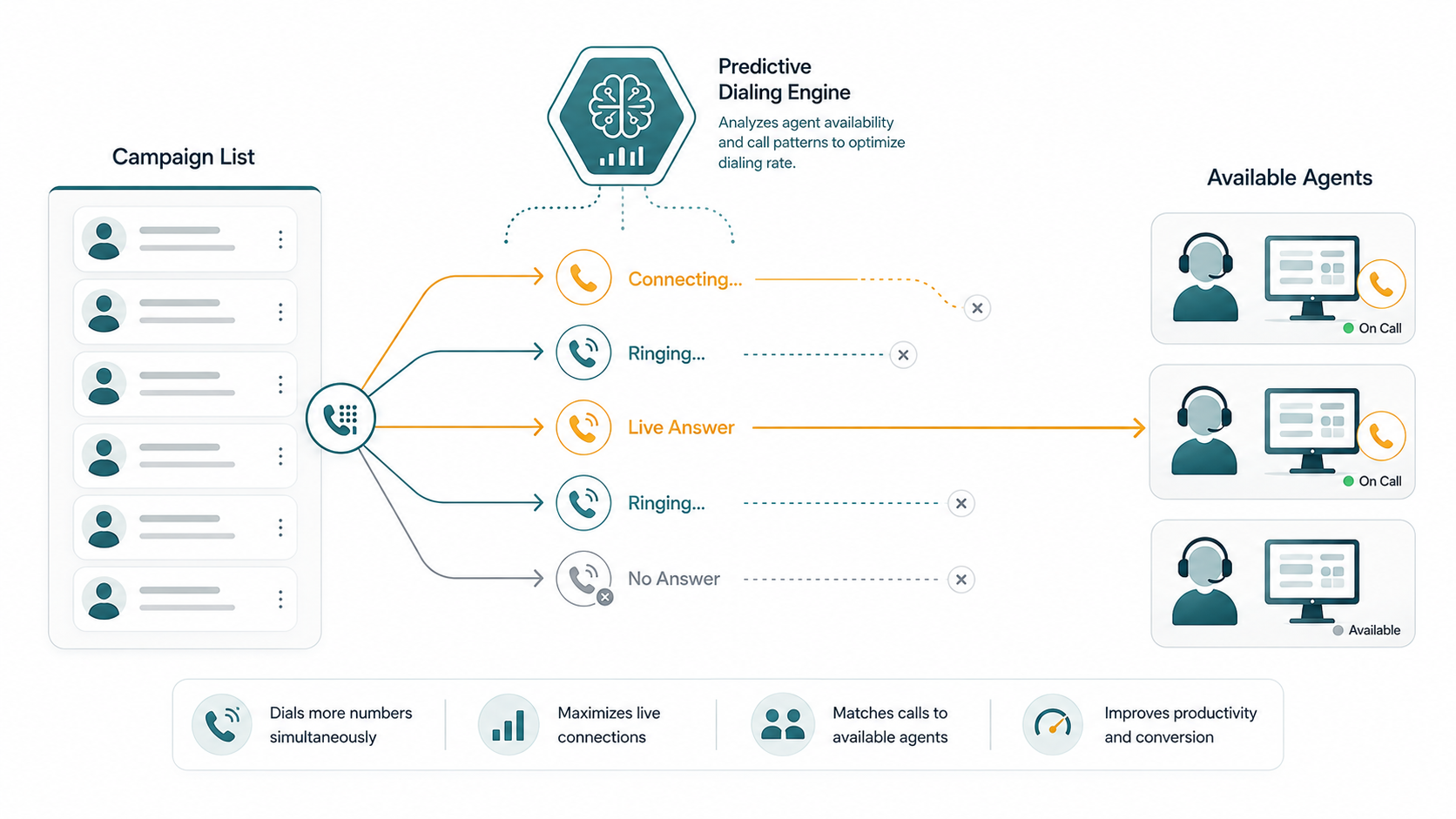
A predictive dialer dials multiple phone numbers simultaneously, screens the answered calls through AMD (Answering Machine Detection), and connects live human answers to available agents. The goal is that an agent finishes one call and immediately receives the next — no dead time spent waiting, no manual dialing. The mechanism that makes this possible is a pacing algorithm that continuously adjusts how many calls to initiate per available agent slot based on real-time campaign metrics.
This article covers how that pacing algorithm actually works, what AMD does and where it fails, the minimum agent floor below which predictive dialing becomes unreliable, and the situations where predictive dialing is and is not the right choice. If you want a side-by-side comparison of predictive, progressive, and preview dialing modes, that is covered in the companion article: predictive vs progressive vs preview dialers. For a dedicated deep-dive on how AMD actually works — detection mechanisms, false positives, and the latency trade-off — see what is answering machine detection?
Definition: A predictive dialer is an outbound calling system that automatically initiates multiple simultaneous calls per available agent, uses an algorithm to predict when agents will be free, and connects answered calls to agents with minimal gap between conversations. Unlike progressive or preview dialers, predictive mode dials ahead of agent availability — accepting a calculated risk of occasional answered calls with no agent ready — in order to maximize the proportion of agent time spent in active conversation.
How the Pacing Algorithm Works
The pacing algorithm is the core of what makes a predictive dialer different from any other automated calling system. It is not simply "dial three numbers per agent" — it is a continuously recalculating model that monitors live campaign conditions and adjusts the dial ratio in real time to hit a utilization target without exceeding an abandoned call threshold.
The inputs the algorithm monitors
The algorithm draws on several real-time metrics to make its decisions:
- Answer rate (ASR — Answer Seizure Ratio) — the percentage of dial attempts that result in a live connection. On a residential calling list in a typical outbound campaign, ASR might range from 10% to 35% depending on list quality, time of day, and whether numbers have been scrubbed recently. At 15% ASR, roughly 6–7 dials are needed to produce one answered call.
- Average handle time (AHT) — how long agents are spending on each call, including talk time and any immediate wrap-up. AHT determines when agents will next be available. An agent on a 3-minute average call will be free in roughly 3 minutes; the algorithm uses this to time when the next dialing burst should start.
- Agent availability — how many agents are currently in ready state (not on a call, not in wrap-up, not on break). This is the denominator in the dial ratio calculation.
- Wrap-up time — time spent after each call completing notes, logging outcomes, and selecting a disposition before returning to ready state. High wrap-up time reduces effective agent availability and changes the timing of when the next call should be placed.
- Current number of calls in progress — how many calls have been initiated but not yet answered, are ringing, or are being screened by AMD. This prevents over-dialing when active calls are already in the pipeline.
The dial ratio
The dial ratio is the number of simultaneous outbound calls initiated per available agent slot. If five agents are in ready state and the dial ratio is 3.0, the dialer initiates 15 calls simultaneously. The algorithm recalculates the dial ratio on a rolling basis — typically every few seconds — adjusting it up or down based on the current ASR and the predicted time until agents will be free.
When ASR is high (many numbers answering), a lower dial ratio is sufficient to keep agents busy. When ASR is low — typical on cold lists, early-morning calling windows, or lists that have been worked heavily — a higher dial ratio is needed to ensure that at least one call connects when the agent becomes available. At 12% ASR, the expected number of dials needed to produce one answer is approximately 8. If the dialer is targeting one call to connect per agent every 90 seconds, and AMD screening takes 2–3 seconds per answered call, the algorithm needs to place 8 or more calls simultaneously to achieve that timing.
The fundamental tradeoff
Higher dial ratios produce better agent utilization — agents spend more time talking and less time waiting. But higher dial ratios also increase the probability of placing more calls than there are available agents to handle them. When that happens, an answered call connects to a dialer with no agent ready: the call is either abandoned (hung up) or played an automated message. Both outcomes are undesirable, and automated abandonment has regulatory implications in telemarketing contexts.
Well-calibrated predictive dialers run dial ratios that push agent talk time to 45–55 minutes per hour (compared to 20–30 minutes on manual dialing), while keeping the abandon rate within acceptable limits. The dial ratio is never static — it rises when ASR drops, when more agents log in, or when handle times are shorter than expected, and it falls when ASR is high, agents are few, or handle times are running long.
AMD: Answering Machine Detection
AMD is the component that determines whether an answered call connected to a live human or a voicemail system. Without AMD, every answered call — human or machine — would be passed to an agent, and agents would spend a large fraction of their time listening to voicemail greetings before the beep. In high-volume outbound campaigns where list quality may produce 40–60% machine answers, AMD is what makes predictive dialing economically viable.
How AMD works
AMD operates through audio analysis of the first 1–3 seconds of speech after the call connects. The system looks for acoustic characteristics that distinguish a live human greeting from a recorded voicemail:
- Speech duration before silence — live humans typically say "Hello?" and pause briefly. Voicemail greetings are longer and continuous before the beep.
- Energy patterns and cadence — human greetings have irregular cadence; professional voicemail recordings tend to have more consistent energy profiles.
- Silence after initial speech — a live person who says "Hello?" and receives no immediate response will often say "Hello?" again. Voicemail systems proceed to the recorded message.
- Beep detection — some AMD systems include explicit beep tone detection as a fallback confirmation that a voicemail system has completed its greeting.
This analysis introduces detection latency. AMD needs to listen for long enough to make a confident classification — typically 1.5 to 3 seconds after the call connects. That delay means a live caller who answers and says "Hello" may hear silence for up to 3 seconds before being connected to an agent. This silence is the most identifiable characteristic of a predictive dialer call from the called party's perspective, and it is one of the reasons predictive dialing has a poor reputation with consumers.
False positives and false negatives
AMD accuracy is never perfect. Two error types matter:
False positive (live person classified as machine): AMD decides a live human is a voicemail system. The call is abandoned or sent to a voicemail drop instead of connected to an agent. The live person hears nothing and hangs up. From the campaign perspective, this is a wasted lead. From a compliance perspective, it may still count as an abandoned call under FTC Telemarketing Sales Rule metrics, depending on how abandonment is defined in your system.
False negative (machine classified as live): AMD passes a voicemail greeting to an agent. The agent hears a recorded message and has to hang up or leave a message manually. This wastes agent time but has no compliance implication.
AMD accuracy in modern systems ranges from roughly 85% to 95% under favorable conditions — a quiet environment, a clear audio path, and a calling list where voicemails follow relatively standard greeting patterns. Accuracy degrades with background noise on the called line, unusual greeting styles (very short or unusually long), VoIP connections with packet loss artifacts, and regional carrier audio processing. For high-value lists where a false positive means a wasted sales opportunity, some operations deliberately set AMD sensitivity lower, accepting more machine pass-throughs in exchange for fewer live call drops.
The Abandoned Call Problem
When the pacing algorithm places more calls than there are agents to handle the answers, some answered calls will find no available agent. The dialer must then either play an automated message to the called party or simply hang up. Both are described as "abandoned calls."
Abandon rate is calculated as the percentage of answered calls (live human connections, excluding AMD-detected machines) that do not connect to an agent within a defined time threshold — typically 2 seconds in North American regulatory frameworks. An abandoned call may play a recorded message, a hold queue, or simply disconnect.
The mechanics of why abandonment happens: at any given moment, the pacing algorithm is making a probabilistic bet that a certain number of calls will answer within the same window. At very low ASR, many calls are placed to compensate, and if ASR spikes temporarily above the expected rate, more calls answer than agents can handle simultaneously. This is not a system failure — it is an inherent consequence of probabilistic pacing. Well-designed systems minimize it; they cannot eliminate it entirely.
For detailed coverage of telemarketing compliance rules, FTC TSR abandon rate caps, and TCPA requirements, see the dedicated compliance article: predictive dialer compliance.
The Minimum Agent Floor
Predictive dialing is statistically unreliable below approximately 7–10 simultaneously logged-in agents. This is not a vendor limitation — it is a mathematical reality of how probabilistic pacing works.
The pacing algorithm's predictions improve in accuracy as the agent pool grows. With a large agent pool, call answer timing and agent availability tend to smooth out because you are averaging across many simultaneous events. Statistical variance decreases, and the algorithm can maintain a consistent dial ratio without large swings.
With a small agent pool — say, 3 agents — the situation is much more volatile. If two agents are simultaneously in longer-than-average calls, agent availability drops to one. The algorithm, expecting two or three agents to be ready, has already initiated calls. If those calls answer simultaneously, there is one agent for potentially three or four connected calls. The abandoned call rate spikes. When the algorithm responds by reducing the dial ratio, ASR variation means the adjustment may over-correct: now agents sit idle waiting for calls to answer.
Below 7 agents, maintaining a compliant abandon rate while also keeping agents productively busy is very difficult. The smaller the team, the more erratic the behavior. Small outbound teams — under 5 agents — almost always achieve better results with progressive dialing (which dials one call per ready agent and produces zero abandons) than with predictive. The talk time sacrifice is real but so is the compliance risk with predictive at small scale.
A Predictive Dial Session: Step by Step
Understanding the full lifecycle of a predictive dial session clarifies where each component contributes and where things can break down:
- Campaign configuration: a lead list is uploaded or integrated via CRM connector. The list is scrubbed against the DNC registry before any dialing begins. Scrubbing removes numbers that cannot legally be called in a telemarketing context.
- Agents log in and set their status to Ready. The pacing algorithm begins tracking available agent capacity.
- The dialer initiates the first batch of calls — the dial ratio multiplied by available agent count. These calls go out via the SIP trunk or telephony carrier.
- As calls connect, AMD listens to the first few seconds of audio. Calls classified as machines are either disconnected, sent to voicemail drop, or logged for callback, depending on campaign configuration.
- Calls classified as live humans are held briefly (the AMD latency window) then transferred to the first available agent. The agent's softphone rings and the call connects.
- The agent handles the call. The CRM screen pop shows the lead record, previous contact history, and campaign context. The agent talks, presents, and handles the interaction.
- The agent logs an outcome (disposition): answered, interested, callback requested, not interested, wrong number, DNC request, etc. DNC requests must be added to the internal DNC list immediately — this is a legal requirement, not a preference.
- The agent completes wrap-up and returns to Ready. The pacing algorithm registers this agent slot as available and adjusts the next dialing burst accordingly.
- The algorithm continuously recalculates: current ASR, average handle time over the last N calls, current agent availability, calls in flight. Dial ratio adjusts up or down. The cycle repeats until the lead list is exhausted or the campaign is paused.
CPS: Calls Per Second
CPS (Calls Per Second) is a measure of how many new call attempts the dialer can initiate every second. It is a capacity metric, not a quality metric, and it becomes relevant when predictive dialer campaigns operate at scale.
A dialer with 100 agents and a dial ratio of 4:1 may need to initiate 400 calls within a short burst window as the agent pool cycles through ready states. If the telephony platform or SIP trunk can only handle 10 CPS, those 400 calls take 40 seconds to initiate. By that time, agents who were ready at the burst start may have already been waiting longer than AHT predicts — and the pacing calculation is off.
For large outbound operations, CPS capacity must be matched between the dialer platform and the SIP trunk provider. A dialer capable of 50 CPS connected to a trunk capped at 10 CPS creates a bottleneck that undermines the pacing algorithm's effectiveness. For more on CPS and its role in VoIP capacity planning, see what is CPS in VoIP.
DNC List Integration
DNC (Do Not Call) compliance is not optional in telemarketing contexts, and it is not something to handle manually. A predictive dialer that is not integrated with DNC scrubbing before each campaign run is a liability.
Proper DNC integration in a predictive dialer works at two points:
- Pre-campaign scrubbing: Before the campaign starts, the lead list is compared against the national DNC registry, any state-level registries, and the organization's internal DNC list. Matching numbers are suppressed — they never enter the dial queue.
- Real-time internal DNC: When a called party during a campaign asks to be removed from calling lists, that number must be added to the internal DNC list immediately. The next time the system processes a list containing that number, it is suppressed. Many platforms do this automatically when an agent applies a "DNC request" disposition.
Internal DNC list management is entirely under the organization's control and responsibility. External DNC registry access requires a subscription (the FTC charges for national DNC data access). Failing to scrub against the national registry before calling a registered number is a TCPA/TSR violation regardless of whether the campaign is framed as informational rather than marketing. For full compliance detail, see what is the DNC registry and predictive dialer compliance.
Predictive vs Progressive vs Preview: The Short Version
These three modes represent a spectrum of how aggressively the dialer works ahead of agent availability. For a full technical comparison, see the dedicated article: predictive vs progressive vs preview dialers. The brief version:
| Mode | How it dials | Abandoned calls | Best for |
|---|---|---|---|
| Preview | Agent reviews record, then manually triggers dial | Zero | High-value prospects, complex sales, regulated industries |
| Progressive | One call per ready agent slot; dials automatically when agent is free | Zero | Small teams, moderate compliance sensitivity, reasonable list quality |
| Predictive | Multiple calls per agent slot; algorithm adjusts dial ratio continuously | Yes — must be managed within limits | High volume, 10+ agents, lower-sensitivity lists |
When Predictive Dialing Is the Right Choice
Predictive dialing is optimized for one thing: maximizing agent talk time when working through large lists at scale. These are the conditions where it delivers:
- Agent team of 10 or more simultaneously dialing. Below this threshold, the pacing algorithm's statistical assumptions break down. The smaller the team, the larger the swings in abandon rate and agent idle time.
- High volume campaigns with large lists. Predictive dialing's efficiency advantage is proportional to list size. On a list of 500 numbers with 5 agents, the efficiency gain over progressive is modest. On a list of 50,000 numbers with 25 agents, predictive can deliver 2x–3x more conversations per agent-hour than progressive.
- Lower average revenue per conversation. The economics of predictive work when the value of each call is lower and volume is the key driver — insurance renewals, debt collections, appointment reminders, survey outreach, political campaigns.
- List ASR that justifies the dial ratio. Very high-quality lists with 40%+ ASR provide less return from predictive dialing because agents are rarely waiting long enough for predictive pre-dialing to help. The efficiency gain from predictive is most pronounced at 10–25% ASR, where many calls are needed per answer.
- Compliance infrastructure is in place. DNC scrubbing, abandon rate monitoring, campaign logging, and agent training on regulatory requirements must all be functional before running a predictive campaign. Predictive dialing without these is a legal risk.
When Predictive Dialing Is Not the Right Choice
The efficiency argument for predictive is straightforward but there are real situations where it is the wrong tool:
- Teams under 7–10 agents. The math does not work at small scale. Use progressive dialing instead — it maintains compliance with zero abandons while still eliminating the manual dial step.
- High-value, low-volume prospects. When each lead took significant marketing spend to acquire, or when the sale requires careful preparation, AMD false positives and the 2–3 second connection delay create a poor first impression that can cost the deal. Preview mode lets agents prepare before the call connects.
- Regulated verticals with strict false positive tolerance. Healthcare, financial services with high-value accounts, legal services — contexts where a live person being disconnected or hearing silence causes a genuine harm to the relationship, not just a wasted dial.
- Complex callback situations. Predictive dialers are optimized for first-contact outreach, not for managing nuanced callback schedules where a specific agent needs to reach a specific person at an agreed time. Preview or manual dialing is better for callback management.
- Very high list quality. If your ASR is above 50% because the list is warm leads who opted in recently, the efficiency gain from predictive versus progressive is small, and the abandon risk is not worth it.
EaseDial's Campaign Dialer
EaseDial's campaign dialer includes predictive, progressive, and preview modes in a single platform. Predictive campaigns include real-time abandon rate monitoring, automatic dial ratio adjustment, AMD with configurable sensitivity, DNC scrubbing against both the national registry and internal lists, and outcome disposition logging that feeds directly back into the CRM.
The same platform handles inbound contact center operations — call queues, routing, IVR, and agent management — so outbound campaigns and inbound service share agent capacity and supervisor visibility. Agents can move between inbound and outbound modes without switching tools, and supervisors get combined real-time analytics covering both channels.
See contact center analytics for more on the metrics that matter for outbound campaign management. For a feature overview of EaseDial's predictive dialer including use cases and compliance notes, see the predictive dialer feature page.
EaseDial
Predictive, progressive, and preview dialing — built into the same platform as your inbound contact center and DNC compliance tools.