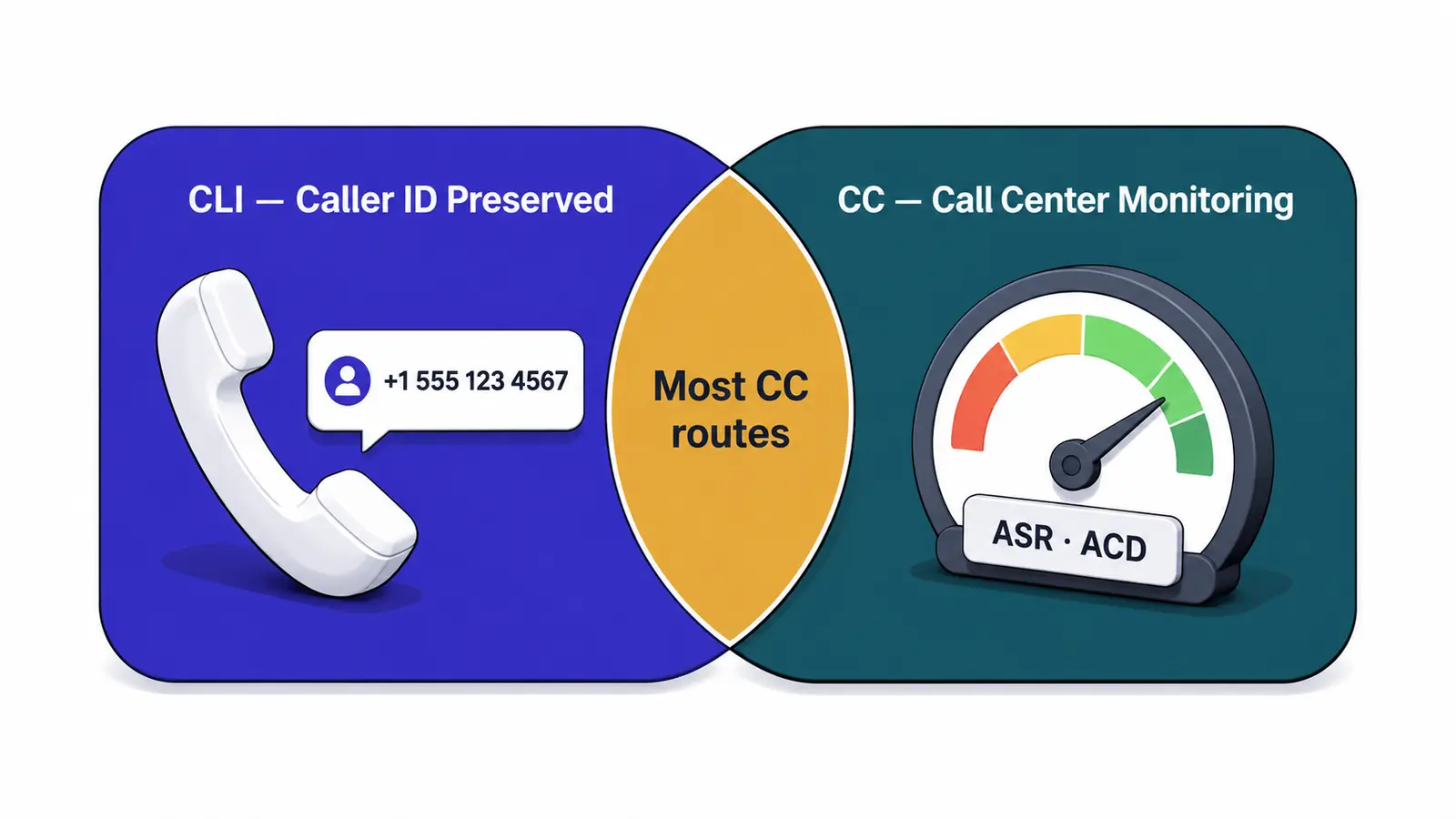
"CC route" and "CLI route" get used almost interchangeably in wholesale VoIP conversations, and that causes real confusion when someone is buying termination for the first time. They overlap heavily in practice, but they describe two different things: one is about what happens to the caller ID, the other is about how the route is selected and monitored.
What CLI actually means
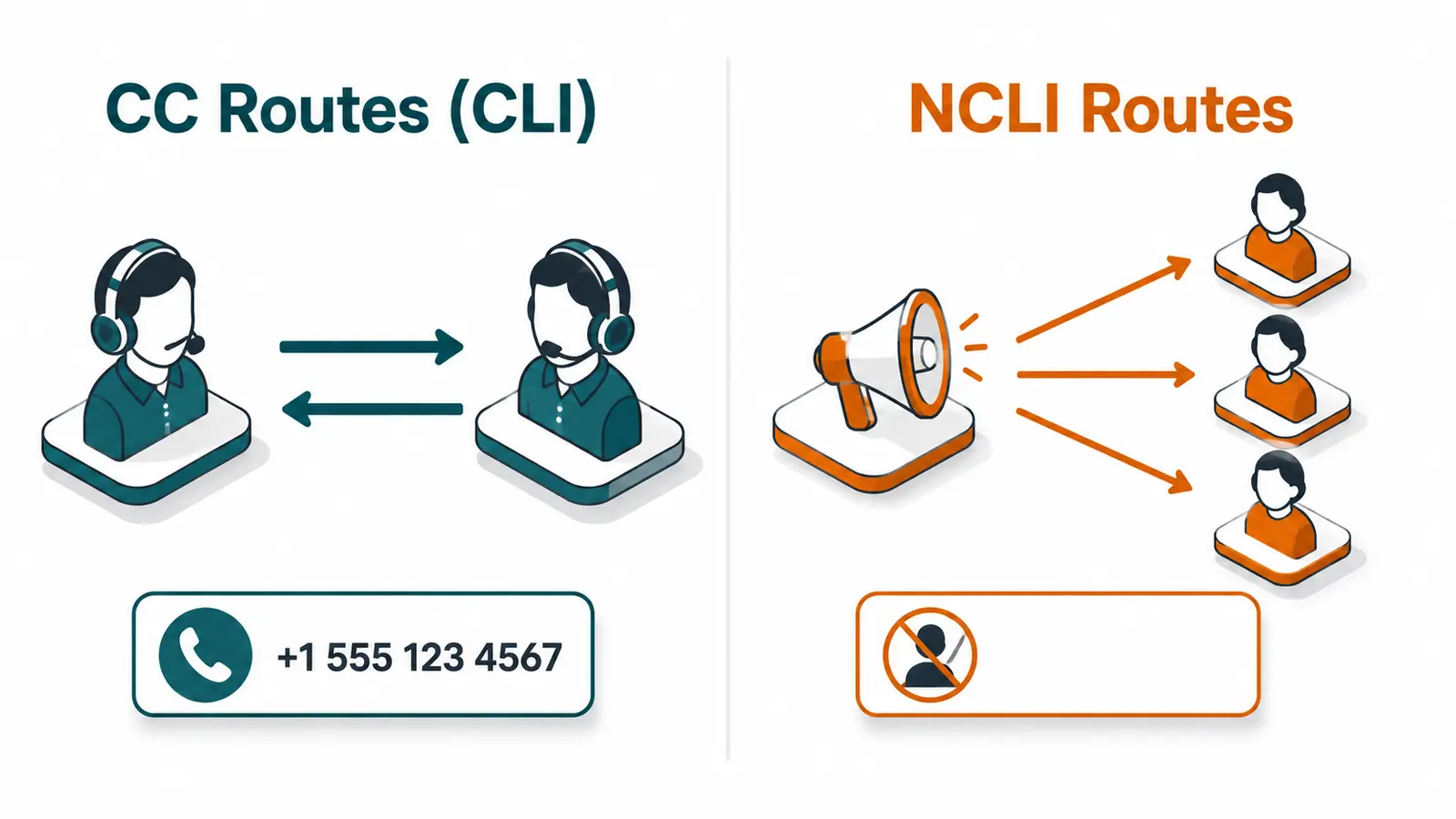
CLI stands for Calling Line Identification — the caller ID that shows up on the recipient's phone. A CLI route is one where that caller ID is preserved and passed through to the destination as a real, dialable number, rather than being stripped, replaced, or randomized somewhere along the path. If your CLI route sends a call showing a legitimate number, and that number would ring back if the recipient called it, the caller ID has been preserved correctly.
CLI matters for a few reasons that have nothing to do with call center volume specifically. Recipients are more likely to answer a call from a number that looks real and local. Increasingly, regulatory and carrier-level requirements expect outbound calls to present a legitimate, callable number rather than a blank or spoofed one. And if a recipient wants to call back, a working CLI number means they actually can.
What "CC route" describes instead
CC (call center) is a description of the traffic profile and how the route is monitored, not a statement about caller ID at all. A CC route is selected and tracked around the way call center dialers place calls: high calls-per-second attempt rates, low average call duration, and route quality metrics — ASR and ACD in particular — tracked on an ongoing basis because answer rate is directly tied to revenue for the buyer.
In other words, CLI describes what happens to one specific piece of signaling data (the caller ID). CC describes a monitoring and provisioning posture built around a traffic pattern. Those are different axes, which is exactly why a route can be CLI without being a CC route, and vice versa in theory.
Why they overlap so much in practice
Call center outbound almost always needs to preserve real caller ID. Recipients are more likely to pick up, and regulatory expectations around legitimate CLI presentation apply directly to call center dialing. So the practical result is that the large majority of CC routes are built on a CLI foundation — the caller ID is preserved — with the additional layer of call-center-specific monitoring stacked on top.
That's why a provider's "CC routes" product is usually described as CLI routes with tighter ASR/ACD tracking, high-CPS provisioning, and pricing built around bulk dialer volume. The CLI part covers what the recipient sees. The CC part covers how the route performs and gets maintained under dialer-style load.
| Term | What it describes | Primary concern |
|---|---|---|
| CLI route | Caller ID handling on the call | Recipient sees a real, callable number |
| CC route | Traffic pattern and monitoring approach | Route performance under high-CPS, low-ACD dialer load |
Where STIR/SHAKEN fits — and why CLI preservation alone isn't the whole story
There's a third axis that increasingly shapes whether a call gets answered, and it's separate from both CLI preservation and call center monitoring: caller ID authentication. Under the FCC's STIR/SHAKEN framework, the originating carrier cryptographically signs each outbound call with an attestation level — A (full), B (partial), or C (gateway) — that travels with the call and tells the terminating carrier how much of the caller's identity and number ownership the signer actually verified. Full "A-level" attestation means the originating provider has verified both who the caller is and that they are authorized to use the presented number; C-level (gateway) means the source could not be authenticated at all.
This matters because preserving a real, callable CLI is not the same as having that CLI signed with strong attestation. A route can pass through a genuine caller ID and still receive weak attestation if the calling party's number ownership isn't verified in the signing chain — and calls arriving with low or no attestation are more likely to be flagged or labeled "spam likely" on the recipient's handset, which suppresses answer rate regardless of how legitimate the number is. Compliance deadlines in the FCC's caller ID authentication rules have continued to tighten (for example, third-party signing rule changes that took effect in September 2025), so the attestation dimension is now a standing part of route quality, not an edge case. For the full mechanics, see what is STIR/SHAKEN.
The practical takeaway when comparing routes: CLI preservation, call-center monitoring, and attestation are three different questions. A route can be strong on one and weak on another. This is also part of why NCLI routes are a poor fit for live outbound — stripping the caller ID undermines both callback capability and the attestation the recipient's carrier uses to decide whether to trust the call. STIR/SHAKEN is a regulatory framework; confirm the current requirements that apply to your specific calling program with qualified legal counsel.
Why the distinction matters when you're buying
If a provider tells you they sell "CLI routes," ask whether those routes are also monitored and provisioned for call center attempt patterns — CPS capacity, ASR/ACD tracking, concurrency headroom. A CLI route built for general business traffic can still choke on dialer-level attempt rates. Conversely, if a provider only talks about "CC routes" without confirming caller ID handling, ask directly whether CLI is preserved end to end — and how calls are signed for attestation — since both affect answer rate and compliance posture. These are related but distinct questions, and a route that's strong on one axis isn't automatically strong on the others. The underlying transport for all of this is SIP trunking between your dialer and the provider.