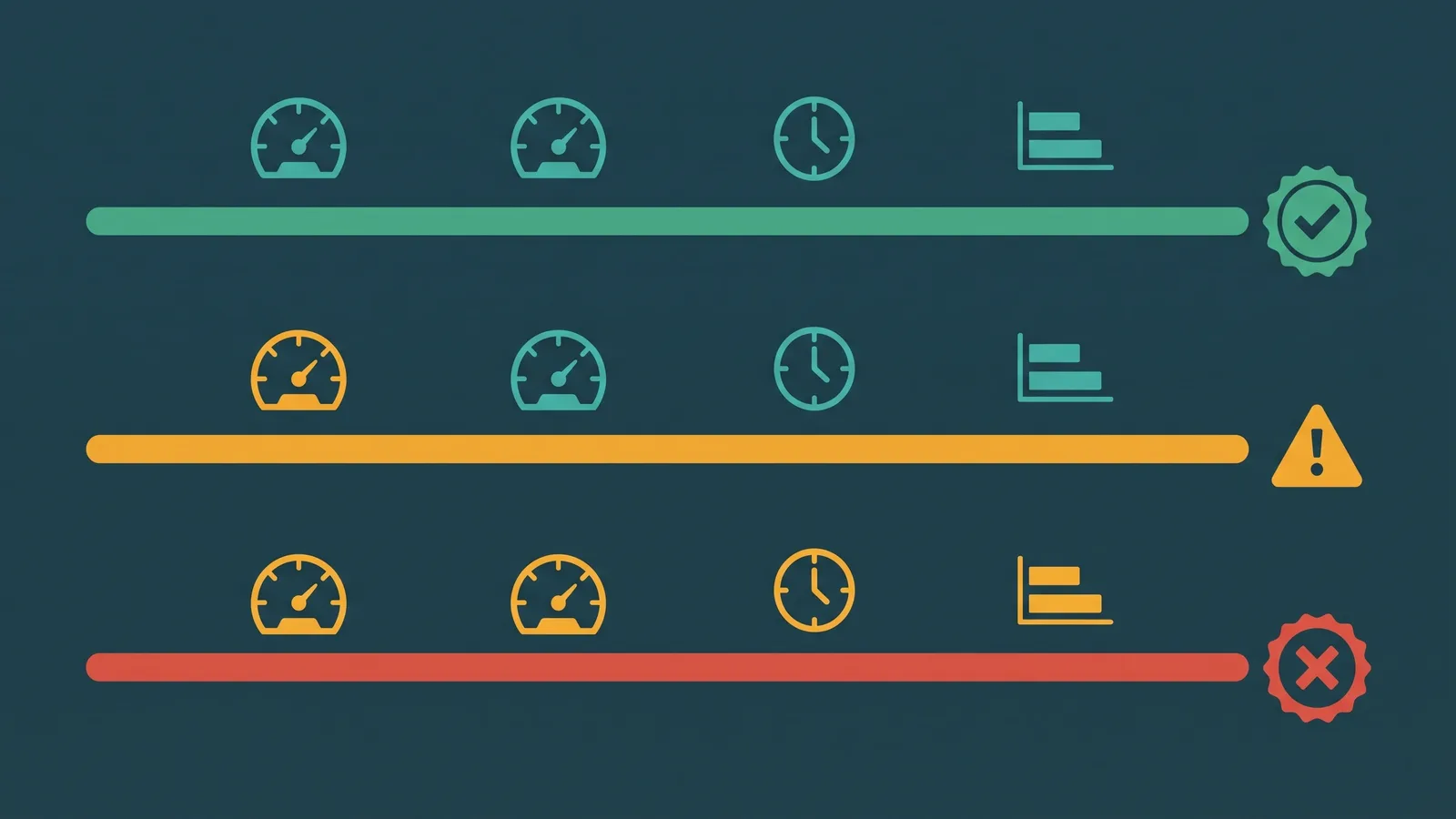

Least-cost routing (LCR) selects the cheapest available route for each destination prefix at the time of the call. Quality-based routing scores routes across multiple KPIs — ASR, NER, PDD, ACD, and CLI delivery — and selects by composite score rather than price alone. Both are legitimate strategies; the right choice depends on your traffic profile and how much per-minute cost you are willing to trade for answer rate and call experience.
Wholesale voice termination has always involved a trade-off between price and performance. LCR pushes that trade-off hard toward price: the cheapest route wins, and quality is either acceptable or dealt with after the fact. Quality-based routing moves the decision point — price remains a factor, but it competes with measurable performance indicators that affect real call outcomes.
Understanding how each model works, what the key metrics mean, and where each strategy creates risk helps you make deliberate routing decisions rather than inheriting the defaults your provider chose. For more background on route selection and traffic, see what are CC routes.
The five KPIs that define route quality
Before comparing routing models, it helps to have precise definitions. These metrics appear in every serious route quality discussion, and they measure different things — conflating them leads to misread CDRs.
| KPI | What It Measures | Acceptable Range | LCR Impact | Quality Routing Impact |
|---|---|---|---|---|
| ASR (Answer-Seizure Ratio) | Percentage of call attempts that result in an answered state. Formula: answered calls / total attempts × 100. Low ASR can mean the destination is not answering OR the route is dropping calls before delivery. | Varies widely by destination; typically compared relative to peer routes to same prefix | Not evaluated at selection time; issues surface in CDRs after the fact | Weighted into route score; routes with chronically low ASR are deprioritized |
| NER (Network Effectiveness Ratio) | Similar to ASR but counts user-busy and no-answer as successful delivery — only network-caused failures are failures. Formula: (answered + user-busy + no-answer) / total attempts × 100. Low NER means the network is losing calls; low ASR with high NER means calls reach destination but aren't answered. | Quality routes typically target NER above 90% | Not evaluated at selection time; low-NER routes can persist if they are cheapest | Key weight in composite score; separates network failure from destination behavior |
| PDD (Post-Dial Delay) | Time from call attempt to first ringback tone received by the caller. Long PDD frustrates callers; some interpret silence as failure and hang up before the call connects. | 3–6 seconds acceptable; above 6–8 seconds degrades caller experience | Not factored in; cheapest routes may add multiple transit hops that increase PDD | Weighted in score; routes with high PDD are penalized relative to low-PDD alternatives |
| ACD (Average Call Duration) | Average length of completed calls on the route. Very short ACD is a sign of FAS (False Answer Supervision) — calls connecting and immediately dropping — or destination quality issues. ACD is a trailing indicator; a sudden drop warrants investigation. | Depends on traffic type; call center traffic has inherently lower ACD than general voice | Not evaluated; FAS-afflicted cheap routes may go undetected until CDR review | ACD floor thresholds can disqualify FAS-prone routes from selection |
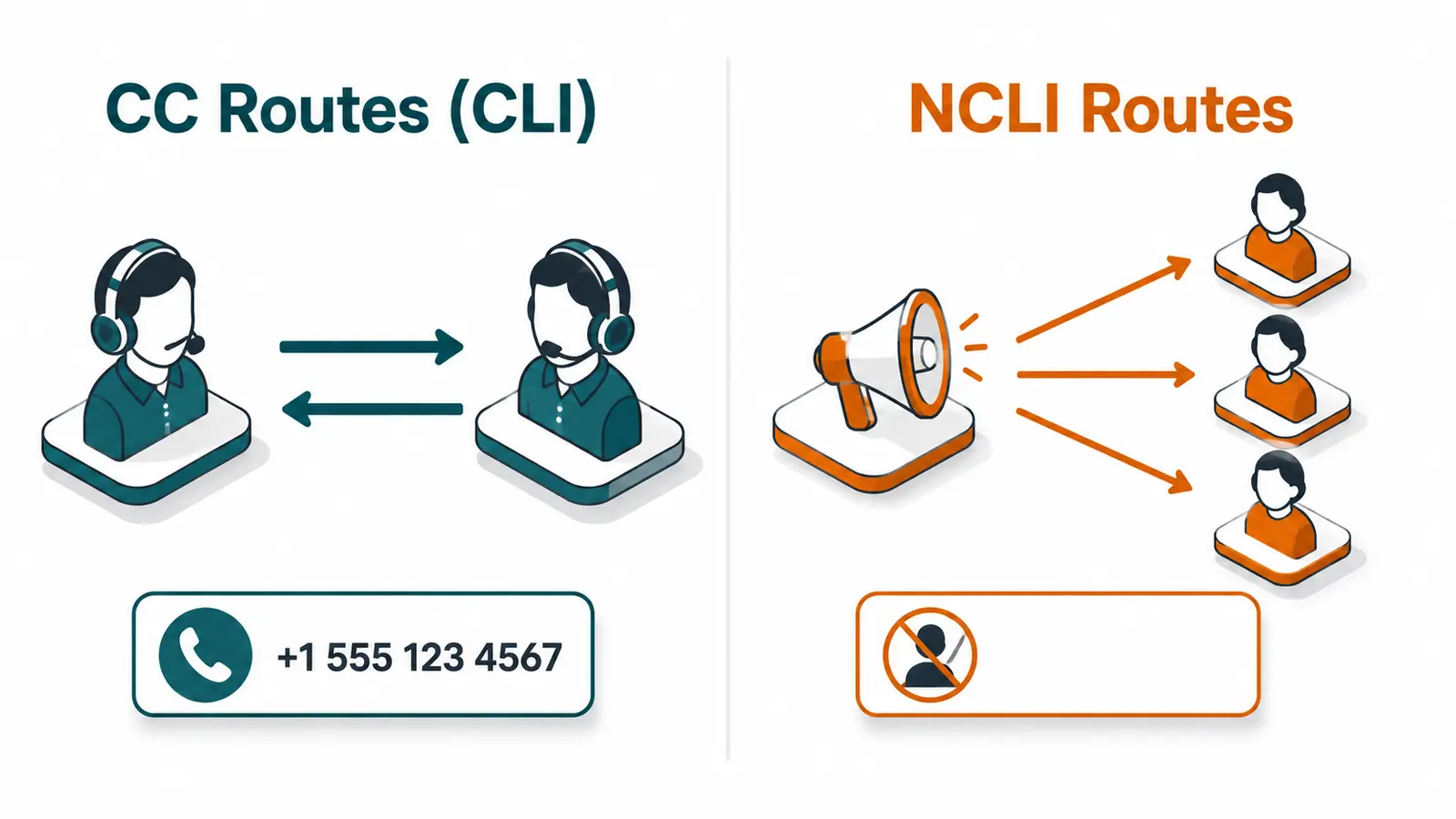
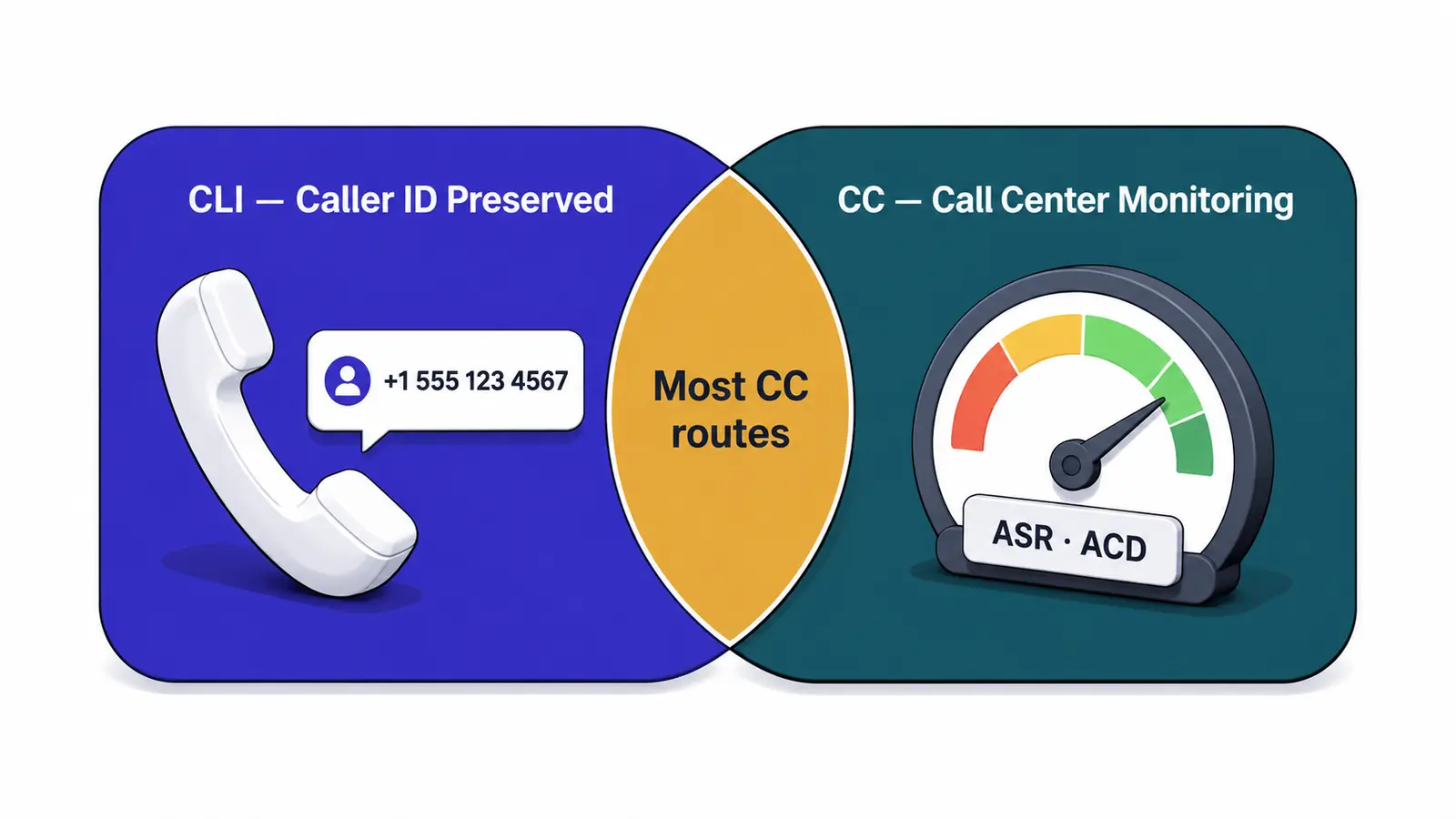
| CLI Delivery (Calling Line Identity) | Whether the caller's number is correctly delivered to the destination. Some routes strip or alter CLI, affecting ring-back, callbacks, and STIR/SHAKEN attestation. Matters most for international routes and outbound campaigns where caller ID affects contact rates. | 100% CLI delivery expected on CLI-designated routes; NCLI routes have none by design | Not evaluated; CLI stripping may only surface through customer complaints or low contact rates | Can be weighted or set as a hard requirement; routes that alter CLI are excluded or deprioritized |
For deeper treatment of individual metrics: average call duration explains ACD in the context of call center traffic patterns. The NER vs ASR distinction is covered in detail in the NER guide.
How least-cost routing works
LCR is the dominant model in wholesale voice for a straightforward reason: margins are thin and volume is high. Even a fraction of a cent difference per minute becomes significant at millions of minutes per month. LCR captures that savings mechanically.
The routing logic is simple. For a given destination prefix, routes are ranked by cost per minute. Route A at $0.003/min is always selected first. If Route A fails — congested, returns an error code, or is unavailable — the call fails over to Route B at $0.004/min, then Route C at $0.006/min. The cheapest option wins until it fails, then the next cheapest wins.
What LCR does not do is evaluate the quality of Route A before selecting it. A route that connects cheaply but with persistent PDD above 10 seconds, a NER of 75%, or systematic FAS behavior will still be selected because it is cheaper. Quality issues only become visible after the call attempt — in CDRs, in agent productivity data, or in customer complaints.
The risks that come with pure LCR
Three categories of risk are associated with LCR when price is the only selection criterion:
Floor-price traps. Routes priced significantly below market often carry hidden costs. They may traverse more transit hops (increasing PDD), use gray routes that lack proper interconnect agreements, or involve carriers with less oversight of their downstream routing. Very low-cost routes are worth scrutinizing before committing volume, not after.
Gray routes. A gray route routes traffic through interconnects without authorization from the destination carrier — typically cheaper because it bypasses proper termination agreements. Gray routes tend to have lower NER and create legal and compliance exposure. LCR has no built-in mechanism to identify or exclude gray routes; it only sees price.
FAS exposure. False Answer Supervision — where a route bills for ring time or fake-answered calls rather than genuine conversation — disproportionately appears on cheap, low-oversight routes. LCR will select a FAS-affected route every time if it is cheapest. The financial damage scales directly with call volume. See the FAS guide for CDR patterns that reveal this behavior.
Fraud risk from IRSF. International Revenue Share Fraud exploits high-cost international destinations. Routes with less carrier oversight — often the cheapest international options — are more frequently implicated in IRSF schemes. LCR pushing traffic to minimum-cost routes on international prefixes increases exposure.
For strategies to manage termination cost without accepting these risks, see reduce call termination costs.
How quality-based routing works
Quality-based routing replaces a single-variable sort (price) with a composite score that weights multiple KPIs. Routes are continuously measured across ASR, NER, PDD, ACD, and CLI delivery. Each route receives a score, and the highest-scoring route for each destination prefix is selected — not the cheapest.
Price remains a factor, but it enters as one variable in the score alongside quality indicators. A route that is slightly more expensive but delivers significantly better NER and PDD may score higher than the cheapest option and be selected instead.
A conceptual scoring formula shows how the weights interact (actual implementations vary significantly):
Score = (NER × 0.30) + (ASR × 0.25) + (1/PDD × 0.20) + (ACD_factor × 0.15) + (CLI × 0.10) − (price_weight)
Weights are illustrative. Real implementations tune weights by traffic type — a call center prioritizing answer rate weights ASR/NER more heavily; a campaign where caller ID drives contact rates weights CLI more heavily.
Quality-based routing is more complex to implement and maintain. It requires continuous real-time measurement of route performance — routes must be tested regularly because performance changes over time. A route that scored well last week may have degraded. The routing table must update dynamically as routes shift. This testing dependency is explored in the route quality testing guide (blog 136).
Time-of-day variation is another factor quality routing must account for. Route performance varies with destination country business hours and carrier congestion — a route that delivers excellent ASR at midday may perform differently at off-peak hours. Pure LCR ignores time-of-day variation entirely; quality routing platforms that account for it maintain time-windowed performance history per route.
Blended and scored routing: the practical middle ground
Most commercial contact centers operating at scale use neither pure LCR nor pure quality-based routing. They use a blended model: quality score determines route selection, but price discipline is enforced through floor and ceiling constraints.
Floor price. A minimum acceptable price per minute is set for each destination. Routes priced below the floor are excluded from selection regardless of their quality score. This single rule eliminates most FAS-prone routes and gray routes, which are typically characterized by anomalously low prices. The floor does not need to be a precise number — it just needs to be set at a level that screens out the bottom of the market where quality risk concentrates.
Ceiling price. A maximum acceptable cost is set to prevent quality scoring from selecting an unnecessarily expensive route when adequate-quality alternatives are available. Routes above the ceiling are excluded regardless of score. This controls spend and prevents the scoring algorithm from always gravitating to premium-priced routes.
Within the band between floor and ceiling, the quality score determines which route is selected. This design gives you price discipline without allowing price to be the sole criterion, and quality discipline without allowing unconstrained spend.
When choosing a CC routes provider, asking how they implement floor pricing and quality thresholds is a useful differentiator — see choosing a CC routes provider for a full evaluation framework.
LCR vs quality-based routing: direct comparison
| Dimension | LCR | Quality-Based Routing |
|---|---|---|
| Selection criterion | Lowest price per minute to destination prefix | Highest composite score across ASR, NER, PDD, ACD, CLI, and price |
| Implementation complexity | Low — sort routes by rate, select lowest | High — requires real-time KPI measurement, dynamic routing table updates, and defined scoring weights |
| Quality visibility | Reactive — quality issues visible in CDRs after calls complete | Proactive — quality data informs route selection before each call |
| FAS / fraud exposure | Higher — cheapest routes may include FAS-prone or gray routes with less oversight | Lower — ACD thresholds and NER floors naturally exclude many FAS-prone routes |
| Cost per minute | Minimized — always selects lowest available rate | Slightly higher on average — quality score may select a route that is not cheapest |
| Time-of-day adaptation | None — price does not change with time of day | Yes — performance history can be windowed by time of day; routing adjusts as congestion patterns shift |
| CLI / STIR-SHAKEN | Not factored in; CLI stripping may go undetected | CLI delivery can be a required threshold or scored variable; routes that alter CLI are deprioritized or excluded |
| Failover behavior | Failover to next cheapest route on error | Failover to next highest-scoring route; quality score prevents failing over to a low-quality backup |
| Best suited for | High-volume commodity traffic where quality requirements are flexible; machine-to-machine calls; price-sensitive wholesale resellers | Call centers where answer rate and audio quality affect agent productivity; customer-facing outbound where CLI affects contact rates; regulated industries requiring traceability |
When to use each model
The traffic profile is the deciding factor. LCR is not inherently bad — for the right use case, it is efficient. Quality-based routing is not inherently right for everyone — for low-sensitivity traffic, the added complexity may not justify the marginal quality gain.
LCR suits: High-volume commodity termination where human experience is not the primary concern. Machine-to-machine calls — notification systems, automated alerts, SMS delivery status calls — don't require low PDD or high NER in the way a live agent call does. Very price-sensitive wholesale resellers who are themselves absorbing route quality variance and managing it downstream. Internal traffic flows where the destination network is controlled.
Quality-based routing suits: Outbound call centers where agent talk time is the revenue driver. A route that connects calls with extra PDD, lower ASR, or distorted CLI directly reduces the number of productive agent conversations per hour. Customer-facing outbound campaigns where caller ID delivery affects whether a contact answers the phone — poor CLI delivery reduces effective contact rates regardless of the route's nominal ASR. Regulated industries where call traceability, proper interconnect agreements, and CLI accuracy are compliance requirements.
Blended routing is the practical choice for most commercial contact centers operating at scale. It imposes price floors that screen out the riskiest cheap routes, price ceilings that control spend, and quality scoring that selects intelligently within that band. The result is route selection that is neither blindly cheap nor unconstrained on cost.
STIR/SHAKEN and CLI delivery in routing decisions
US call authentication framework STIR/SHAKEN assigns attestation levels to outbound calls. A-level attestation requires that the originating carrier can verify the caller's right to use the calling number. B-level and C-level attestations indicate partial or no verification, and B/C calls are more frequently flagged as "Spam Likely" by terminating carriers and mobile operators.
Routes that strip or alter CLI before delivery cannot support A-level attestation — they have already broken the chain of custody on the calling number. Quality-based routing that factors CLI delivery as a scored variable naturally prefers routes that preserve CLI, which in turn supports better STIR/SHAKEN outcomes. LCR has no mechanism to account for this; CLI stripping is invisible until contacts report caller ID problems or contact rates decline without obvious cause.
This matters particularly for outbound campaigns in the US where labeled calls reduce contact rates materially. Choosing routes that support clean CLI delivery is a routing decision with direct impact on campaign effectiveness, not just a compliance exercise.
Frequently asked questions
Route quality decisions don't end at the routing model — they require ongoing measurement of the routes you are using. For a practical guide to testing route performance before and after onboarding, see testing a wholesale VoIP route. For the full evaluation framework when selecting a provider, see choosing a CC routes provider.