Choosing a CC routes provider on rate sheet price alone is how call centers end up with campaigns that look fine on paper and underperform once real volume hits the routes. Price matters, but it's one input among several that determine whether a provider can actually support a dialer campaign at scale. Here's what to dig into before committing volume.
Confirm the coverage actually matches your traffic
CC routes, by definition, are built for USA and Canada destinations. If a provider claims worldwide CC route coverage, that's worth questioning directly — it suggests either a misunderstanding of what makes a route "CC," or a repackaging of standard A-Z termination under a call-center label without the monitoring and provisioning that actually differentiates CC routes. If your campaign dials outside the US and Canada, ask how that traffic is handled separately, since it should be quoted and routed as standard A-Z termination rather than folded into a CC rate deck.
Ask how they monitor ASR and ACD, not just whether they do
Nearly every provider will say they monitor answer-seizure ratio and average call duration. The more useful question is how: Is it tracked per route and per destination, or as a blended average across their whole network? A more carrier-side metric worth understanding is Network Effectiveness Ratio (NER) — unlike ASR, NER counts busy and no-answer as successful delivery, so high NER + low ASR reveals whether low answer rates are a list quality problem or a network problem. How quickly does a degrading route get deprioritized or swapped — is that a manual review process, or does it happen close to real time? Can they show you route performance data, or is it something you only find out about after your campaign results already dipped? A provider who can describe their monitoring process specifically is a different signal than one who just says "yes, we monitor quality."
Understand their CPS and concurrency capacity
Predictive and progressive dialers generate call attempts in bursts, not a steady average rate. Ask what CPS capacity is available for your account, whether that capacity is dedicated or shared across other customers during peak hours, and how concurrency scales if your campaign grows. A provider who can only speak to average throughput, and not attempt-rate capacity specifically, may not have thought through what dialer traffic actually looks like on their network.
Verify dialer compatibility explicitly
CC routes connect to your dialer over standard SIP trunking, so compatibility with Vicidial, GoAutoDial, or an Asterisk-based dialer shouldn't require custom engineering on the provider's side. Still, it's worth confirming they've supported your specific dialer platform before, and whether they can walk through trunk configuration if your team runs into an issue during setup. A provider should be clear that they're supplying termination routes — not a dialer platform, not DIDs as a bundled product, not hosted PBX — so you know exactly what you're buying and what you're still responsible for running yourself.
Push for rate deck transparency
A rate deck broken out by destination lets you see exactly what you're paying per prefix and evaluate it against your actual calling pattern, rather than a single blended rate that obscures where your real cost sits. Ask whether pricing is quoted based on your traffic profile — expected CPS, ACD, and volume — or whether it's a flat, generic number that doesn't account for how your campaigns actually behave. Also ask about billing increment policy up front (full-minute, per-second, or hybrid billing), since that detail interacts directly with a low-ACD calling pattern and can materially change effective cost even at an identical quoted rate.
Test support responsiveness before you need it
Route issues in a live campaign are time-sensitive — a degrading route during business hours costs answered calls in real time. Before committing volume, ask how support requests are handled: is there a route engineer you can reach directly, or a ticket queue with no defined response expectation? A provider's answer to a pre-sale question is itself a small preview of what post-sale support looks like.
Ask how calls are signed for caller ID authentication
Answer rate now depends on more than a preserved caller ID — it depends on how the call is signed under the FCC's STIR/SHAKEN framework. The originating carrier attaches an attestation level (A full, B partial, C gateway) that terminating carriers read when deciding whether to trust the call, and calls arriving with low attestation are more likely to be flagged "spam likely," which suppresses answers regardless of route quality. Ask a prospective provider how outbound calls are attested, what's required on your side to support full attestation, and how they handle number verification. A provider who can speak to this concretely is a different signal than one who treats it as someone else's problem. For the underlying mechanics, see what is STIR/SHAKEN; broader outbound obligations are covered in predictive dialer compliance. Confirm current requirements for your program with qualified legal counsel.
Start with a defined allocation, not your whole campaign
Even after a provider checks every box above, it's reasonable to route a portion of your traffic through them initially and compare real ASR and ACD results against your existing routes before shifting full volume. Route quality claims are easy to make and harder to verify without live traffic data specific to your destinations and calling pattern.
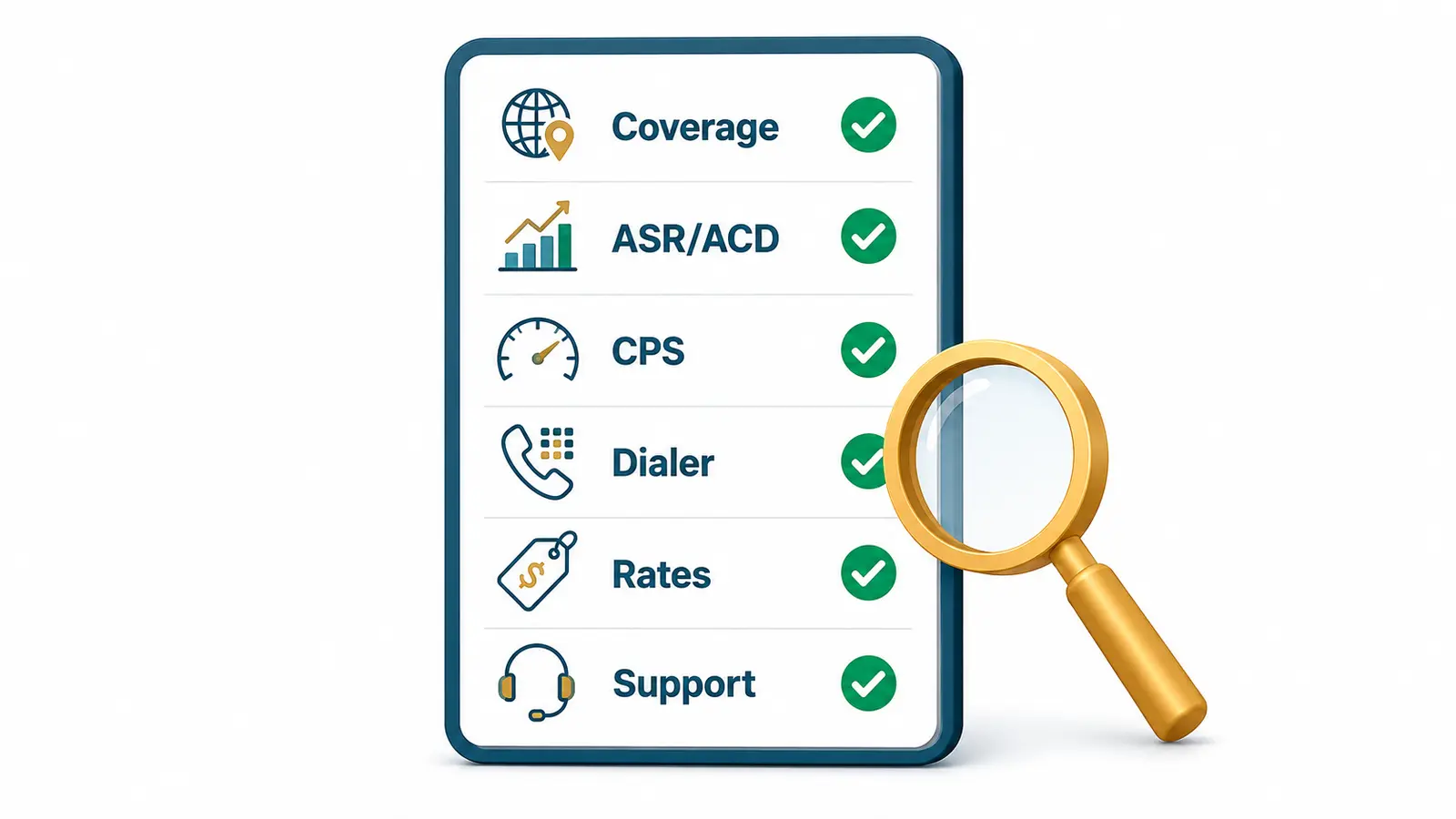
Provider evaluation checklist
Use this checklist before committing campaign volume to any CC routes provider:
- Coverage confirmed: USA and Canada destinations verified for your actual dialing prefixes
- ASR/ACD monitoring: Per-route, per-destination tracking confirmed (not blended network averages); rebalancing process documented
- CPS capacity: Dedicated CPS ceiling confirmed for your account; burst capacity for campaign start addressed
- Dialer compatibility: Your specific dialer platform (Vicidial, GoAutoDial, other) confirmed supported
- Rate deck transparency: Per-prefix breakdown provided; billing increment (per-second, 6-second, full-minute) confirmed
- CLI preservation: Confirmed throughout for all routes in the deck
- Caller ID authentication: STIR/SHAKEN signing and attestation posture explained; number verification requirements on your side clarified
- Support model: Route engineer contact confirmed; response expectation for live-campaign issues documented
- Initial allocation: Agreed to start with partial traffic and compare ASR/ACD before shifting full volume