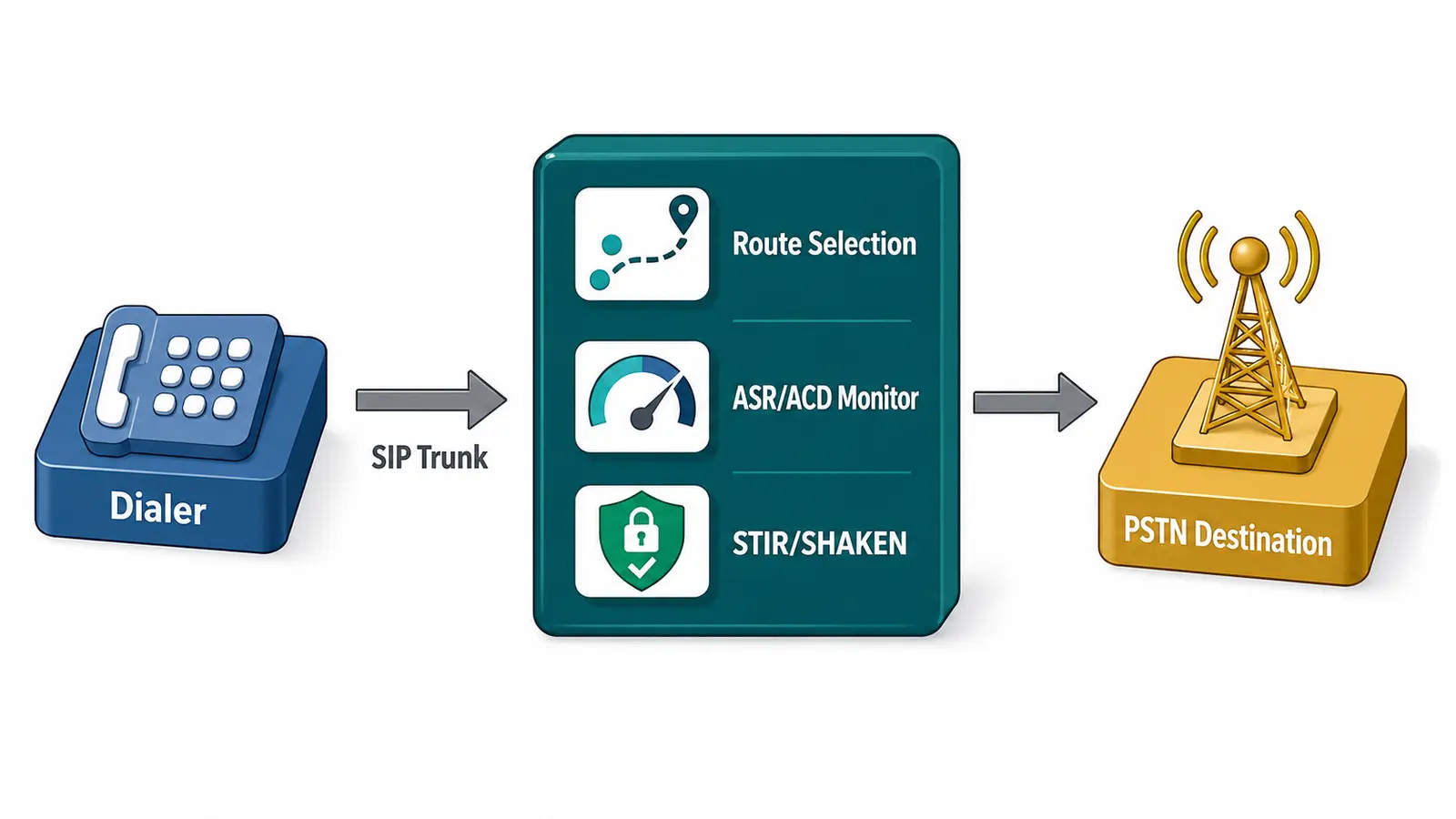
"CC routes" describes a category of termination, but it's easier to understand once you walk through the actual path a call takes, from the moment a dialer places an attempt to the moment it lands on the destination carrier's network. The infrastructure is standard wholesale VoIP — SIP trunking and carrier interconnects — but the way it's provisioned and monitored is what makes it a CC route rather than generic termination.
Step one: the dialer places the call
Predictive dialers like Vicidial, GoAutoDial, and various Asterisk-based platforms place outbound calls over a SIP trunk configured to a termination provider. This is a standard SIP registration or IP-authenticated trunk — nothing dialer-specific about the protocol. What's different from a single-agent softphone setup is volume and pace: a predictive dialer is attempting multiple calls per second across many simultaneous lines, dialing ahead of actual agent availability so a live answer is ready when an agent frees up.
That attempt rate — calls per second, or CPS — is the first place a generic route can struggle. A route sized around average concurrency, without headroom for burst attempt rates, can start rejecting or delaying call setup the moment a campaign ramps up. CC routes are provisioned with that attempt pattern as the baseline assumption, not an edge case.
Step two: route selection
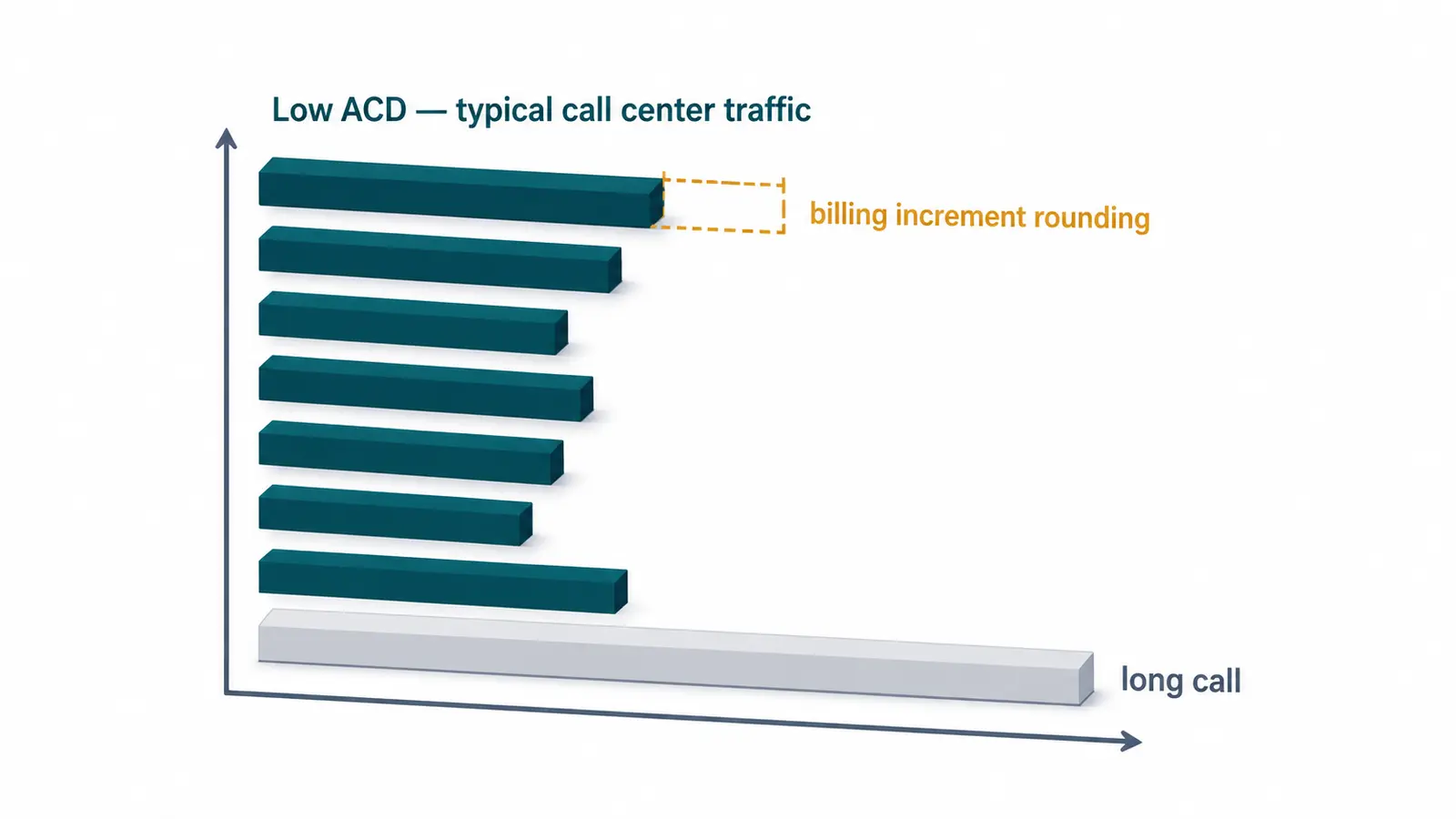
Once the call hits the termination provider's switch, it needs to be routed to a carrier that can complete it to the destination number. In a least-cost-routing setup, that selection typically weighs price alongside route quality metrics — ASR (answer-seizure ratio) and ACD (average call duration) chief among them. For CC routes, this selection logic is tuned specifically around call center traffic patterns: routes are chosen and continuously re-evaluated for how well they hold up under high-CPS, low-ACD load, not just for how they perform under average traffic conditions.
This is also where CLI handling matters. Call center outbound generally needs the caller ID preserved as a genuine, callable number, so route selection for CC traffic typically restricts the pool to CLI-preserving carrier paths rather than mixing in NCLI options that would suppress answer rate. The distinction between those two route types is covered in CC routes vs. NCLI routes.
Step three: caller ID authentication (STIR/SHAKEN)
Before or as the call leaves the originating side, it is signed under the FCC's STIR/SHAKEN framework — a step that's easy to overlook because it happens in the signaling layer, invisible to the agent. The originating carrier attaches an attestation level: A (full) when it has verified both the caller's identity and their authorization to use the presented number, B (partial) when it knows the customer but hasn't verified the number, and C (gateway) when it can't authenticate the source at all. The terminating carrier reads that attestation to help decide whether to trust the call.
For a CC route, this is directly tied to answer rate. A call presenting a legitimate, owned CLI is the precondition for strong attestation; calls that arrive with low attestation are more likely to be labeled "spam likely" on the recipient's handset, which suppresses answers no matter how well the rest of the path performs. FCC caller ID authentication requirements have continued to tighten, so a provider's signing posture is part of what you're evaluating when you assess a route. See what is STIR/SHAKEN for the full mechanics, and confirm the requirements that apply to your calling program with qualified legal counsel.
Step four: ongoing monitoring and rebalancing
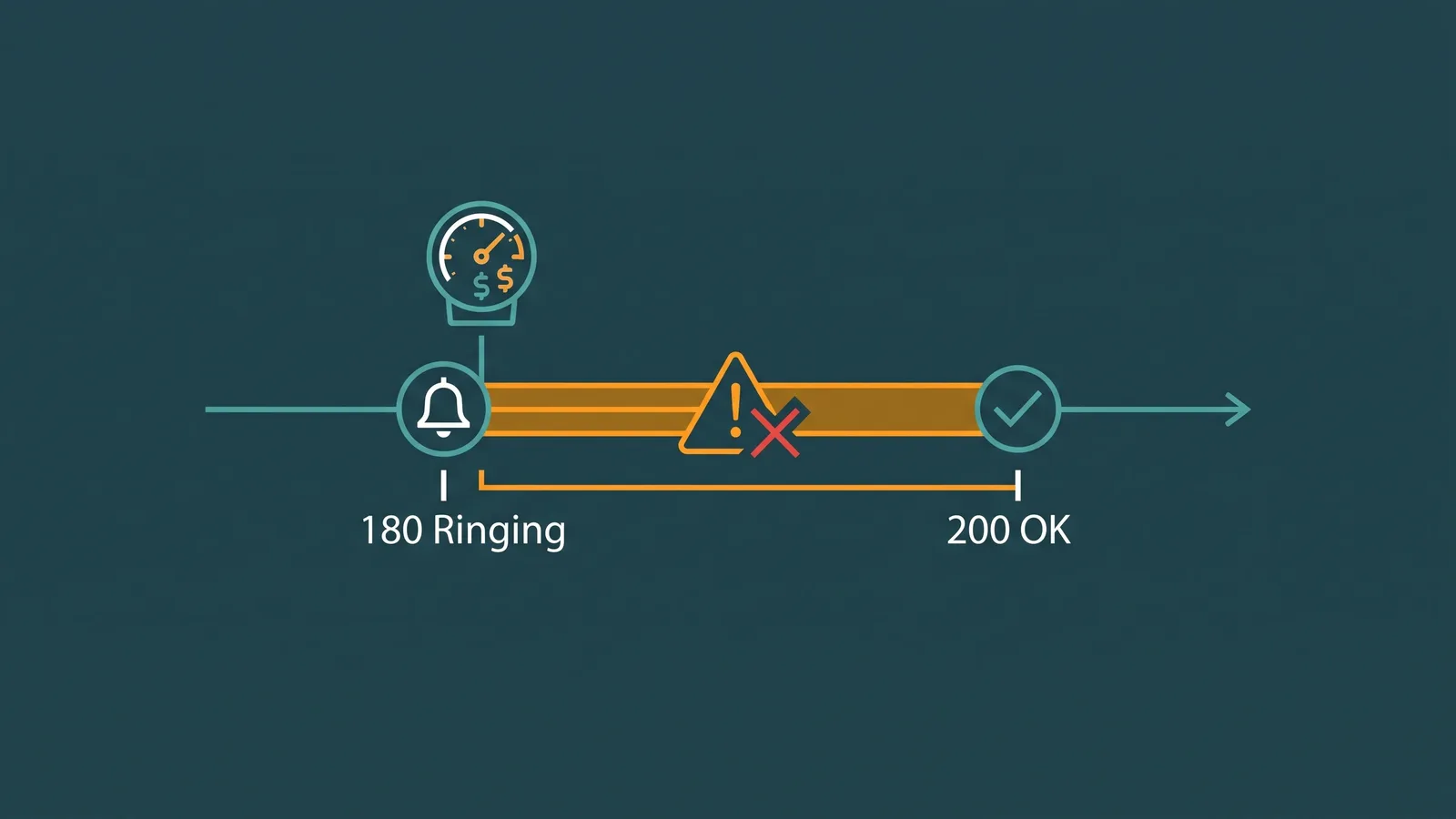
A route that looks good in a one-time test can degrade over time — a carrier's peering relationship changes, a destination gets congested, or a specific route starts introducing post-dial delay (PDD) — the gap between the dialer firing the SIP INVITE and the first ringback tone reaching the agent. Generic termination might catch this on a periodic review cycle. CC routes are meant to be monitored continuously: ASR and ACD tracked per route and per destination on an ongoing basis — alongside NER (Network Effectiveness Ratio), which counts busy and no-answer as successful delivery to isolate network failures from user-behavior outcomes — with underperforming routes deprioritized or swapped out of rotation rather than left running until someone notices a drop in campaign results.
This continuous monitoring is really what "tuned for call centers" means operationally. It isn't a different physical network — it's a tighter feedback loop between route performance and route selection, sized around the fact that call center revenue depends directly on answer rate holding steady call over call.
Step five: termination to the destination carrier
The call reaches the destination carrier's network and rings the called number. From here, standard call signaling applies: answer, no-answer, busy, or failure codes flow back up the chain, and — for CC routes specifically — that outcome data feeds back into the ASR/ACD tracking described above. A route that starts failing more often on a particular destination shows up in that feedback loop and gets adjusted, rather than continuing to absorb dialer attempts blind. One billing-layer concern at this stage is False Answer Supervision (FAS) — where a carrier starts billing before the call is actually answered — which inflates CDR duration without any real conversation taking place.
Where concurrency and CPS fit together
It's worth separating two capacity concepts that are easy to conflate. Concurrency is how many calls are active on the line at once. CPS is how fast new call attempts are being placed. A predictive dialer can generate high CPS in short bursts even when concurrency stays moderate, because it's attempting calls faster than it's holding them. CC routes are provisioned for both dimensions — enough concurrent channel capacity to hold a full campaign's live calls, and enough CPS headroom to absorb the attempt bursts a predictive dialer generates without call setup failures.
Frequently asked questions
For a plain-English definition of CC routes as a product category, see what are CC routes, or explore CC routes for USA and Canada destinations.