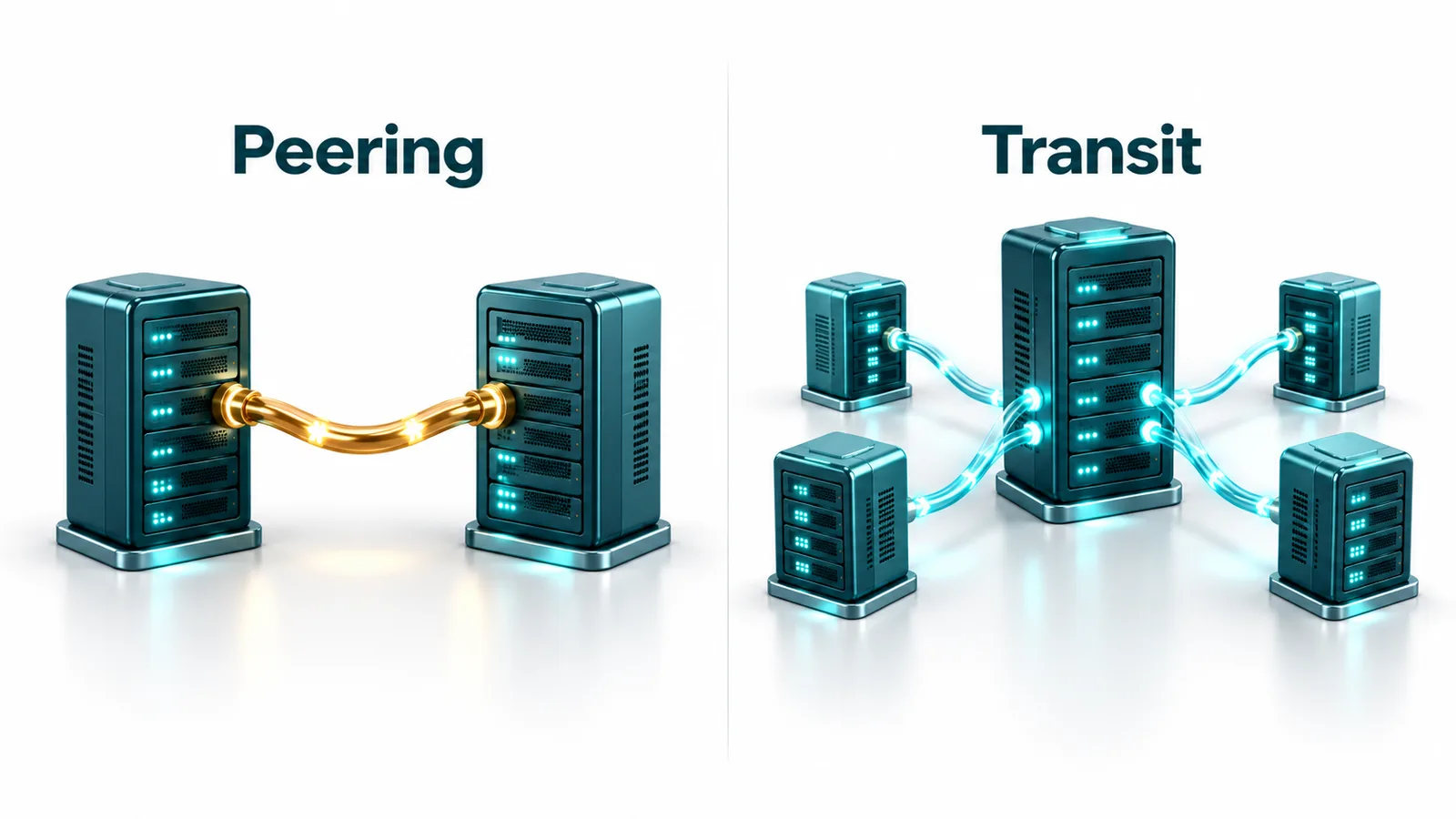
A wholesale voice provider has to hand each call to the network that serves the called number. It has two basic ways to do that. Transit is a paid route through an intermediary that can reach many networks. Peering is a direct link with one network, often exchanged without a per-minute charge. In short, peering suits steady traffic to a specific destination, and transit covers everything else. Many providers use both, and they choose between them one destination at a time.
The terms come from internet routing, and voice borrowed them. The mechanics differ, though. Internet peering exchanges routes, while voice interconnection exchanges calls. This guide starts with the internet definitions and then shows where voice changes them.
Transit and peering, defined
Transit means paying a network for reachability to the rest of the internet. The customer receives routes to every destination the provider can reach, and it pays for the traffic that crosses the link. Kentik describes transit as access to "the full internet routing table for a fee." In CAIDA's AS Rank model, every network in a provider's customer cone is assumed to pay for transit, directly or indirectly. That is why transit is a commercial relationship and not a handshake.
Peering means two networks exchange routes for their own networks and their own customers. The peer does not carry traffic to the wider internet on your behalf. Traffic that does not begin or end inside the peered networks does not cross the link. Peering often happens at an internet exchange point, where one connection can reach several peers.
The core differences
| Question | Transit | Peering |
|---|---|---|
| What it gives you | Reach to any destination the provider can reach | Reach only to the peer's own networks and customers |
| Who pays | The customer pays the provider | Often settlement-free, with no payment between the two networks |
| Cost pattern | A recurring charge that tracks traffic volume | Setup and port costs, with little or no per-unit charge for the exchange |
| Links needed for wide reach | One relationship can reach many destinations | One link per peer, so reach grows with the number of peers |
| Best fit | Lower or uneven volume spread across many destinations | Steady, large volume to one specific carrier |
Kentik notes that peering can require significant investment to implement, although it can lower ongoing costs for the traffic it covers. The table is a simplification. Real agreements add their own terms, and two networks that peer may still charge each other for some services.
What a call's path looks like under each model
The following is an illustration, not a measured route. Suppose a wholesale provider's switch receives a call from a dialer and must deliver it to a number that Carrier B serves. The provider's session border controller (SBC), the device that handles SIP at the edge of a carrier network, sends the call onward.
With direct peering, the call goes from the provider's SBC to Carrier B's SBC, and from there into Carrier B's network to the callee. There is one interconnect between the two carriers, and the call is handed over once.
With transit, the call goes from the provider to a transit carrier, which hands it to Carrier B, which delivers it to the callee. There are now two interconnects instead of one, and one more company is in the path. Each handoff is a place where the call can be processed again, where the caller ID can change if the route does not preserve it, and where a delay or failure can start. A real route can include more carriers than this example shows.
Signaling and media do not always follow the same path. The SIP messages that set up a call can pass through several proxies, while the audio can flow directly between the endpoints or through a media gateway. RFC 3261 makes the same point, stating that "the end-to-end media packets take a different path from the SIP signaling messages." So a provider that wants to know which hops affect audio has to check both paths, not only the one the setup message took.
Settlement-free and paid: how the money works
Settlement is the financial exchange between two carriers that send traffic to each other. A settlement-free arrangement means neither side pays the other for the exchange. Kentik describes peering as typically settlement-free or much cheaper than transit. Transit, by contrast, is a paid service in which the customer pays the upstream provider to carry its traffic.
Settlement-free terms vary by agreement. Some networks set conditions on traffic volume or location before they will peer, so a link that one carrier accepts may be refused by another. A paid peering arrangement is possible too, and it then behaves more like a transit contract with a different scope.
For a single destination, a provider can compare the two options with a simple break-even check. The fixed monthly cost of a direct link is divided by the per-minute difference between transit and the direct rate:
Break-even minutes = fixed monthly cost of the direct link ÷ (transit rate per minute − direct rate per minute)
Above that volume, the direct link costs less for the traffic it covers. Below it, transit is cheaper. The formula leaves out staff time to run the link and the risk of depending on one path, and both belong in the decision. The per-minute rates come from each commercial agreement, so the result is only as reliable as the rate deck behind it.
How voice interconnection differs from internet peering
Internet peering exchanges routing information over BGP, the protocol that tells networks which addresses they can reach. Voice interconnection exchanges call sessions. The link between two voice carriers carries SIP signaling, which sets up, changes, and ends a call, and it carries RTP media, which is the audio itself. A carrier can have a perfectly healthy BGP session and still fail calls because a SIP message is rejected or a codec does not match.
RFC 5486, the SPEERMINT terminology document for SIP-based interconnect, uses the term session peering for direct peering at the signaling layer. It describes transit as a form of indirect peering, in which a transit network routes the signaling, or the signaling and media, through one or more layers. The same terms therefore mean something slightly different in voice. Anyone reading a rate deck or an interconnect agreement should confirm which meaning the provider intends.
Voice interconnect can also be TDM rather than IP. TDM interconnect uses circuit-switched trunks, which is the older model. TelcoBridges describes the choice on the delivery side: a carrier reaches the destination either over an IP interconnect with the terminating operator, or, where that operator still runs legacy infrastructure, through a gateway onto the PSTN.
Caller ID is a voice-specific concern. A CLI route preserves the calling number from end to end. A non-CLI route strips or replaces it. TelcoBridges says non-CLI routes are cheaper but lower answer rates. Whether a destination is reached over a CLI or non-CLI route can depend on the carrier chosen, so caller ID belongs in the same questions as the peering question.
Interconnection also has a legal side in the United States. The Communications Act requires incumbent local exchange carriers to interconnect at any technically feasible point in their networks, and to negotiate in good faith (47 U.S.C. 251(c)). Those duties apply to incumbents. Other carriers choose their peering and transit relationships under commercial agreements.
What it means for call quality
Every carrier in a path processes the setup messages, and a slow or congested handoff shows up as silence before ringback. That silence is post-dial delay (PDD). Each added hop gives the setup more places to slow down. The post-dial delay guide covers the causes in more detail.
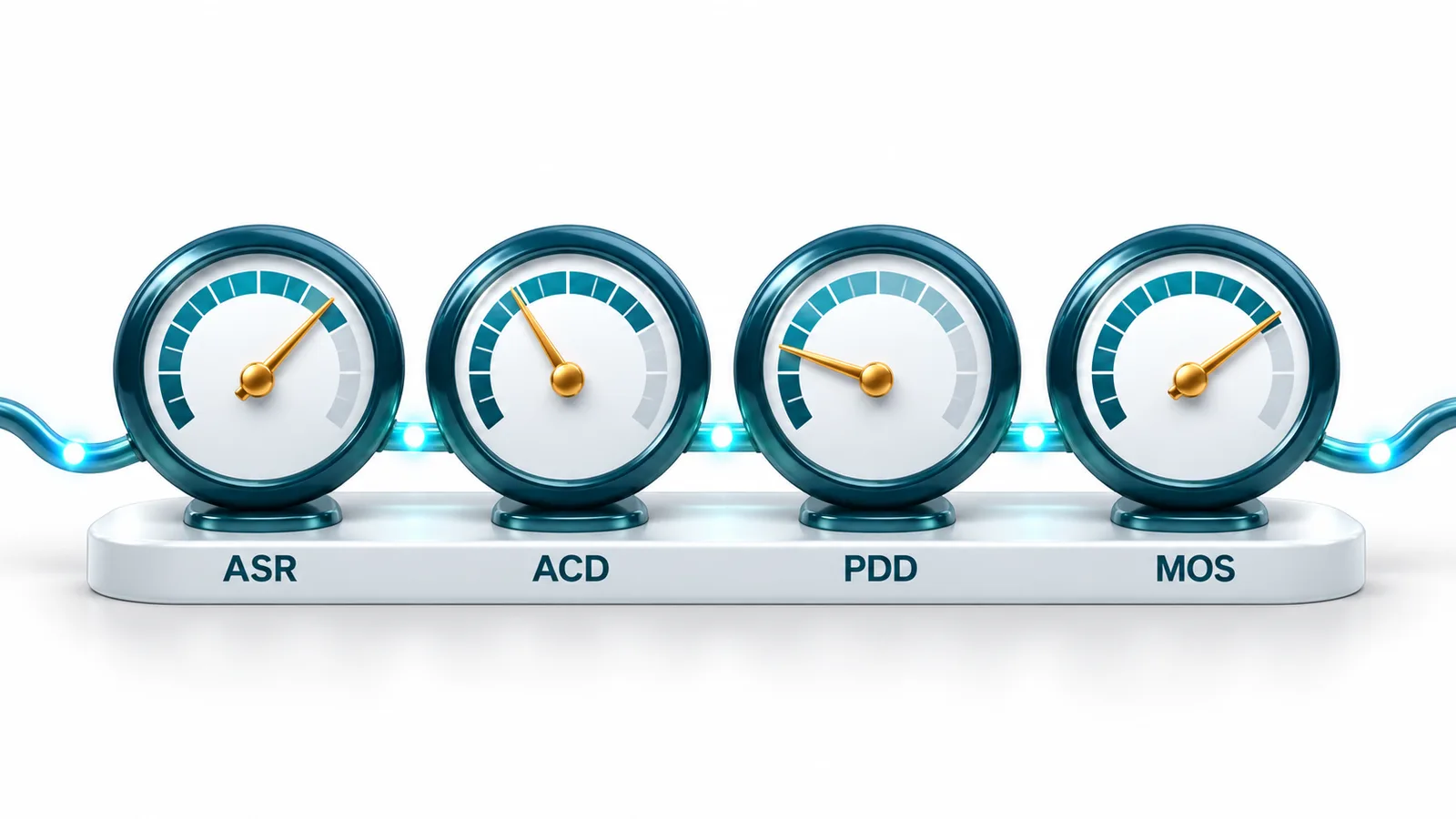
A direct peering link removes one handoff. That reduces the number of places where delay, codec conversion, or caller ID changes can happen. It does not guarantee better audio. The far network, the codecs in use, and congestion on the carrier's own network still matter. Route quality is best judged by measured results for each route, such as ASR, ACD, and PDD, rather than by the type of link alone.
Why route diversity matters
Route diversity means having more than one way to reach a destination. TelcoBridges describes carriers that hold many possible paths to most destinations, choose among them for each call, and move to the next route when the first one fails or degrades. The same guide recommends running more than one carrier so that routes can be compared and failed over for each destination.
A single direct peer gives a provider one path to a destination. If that link fails, the provider has no alternative for that destination unless it also has transit or another carrier there. This follows from how the setups work and is not a measured failure rate. Transit does not remove the problem on its own, because a transit route is also a path that can fail. Diversity comes from having more than one route in the plan.
When a voice provider uses each
Direct links multiply quickly. With n carriers in a full mesh, each pair needs its own link, which means n × (n − 1) ÷ 2 links. Five carriers need 10 direct links. Connecting all five to one hub needs only five. A hub trades a small per-minute cost for far fewer relationships to manage, which is one reason transit and hub carriers are common.
In practice, a provider tends to peer where a destination carries enough steady volume to justify the link, and to buy transit or use a hub where volume is small or uneven. That is a per-destination decision. One destination may be reached over a direct link in one country and over transit in another. Whether a direct relationship is possible at all depends on the other carrier's policy.
What does Tier 1 mean in voice?
In internet routing, a Tier 1 network is described as one that can reach the entire internet through settlement-free interconnection with other Tier 1 networks, without buying transit. Wikipedia notes that no authority defines these tiers, so the term is understood loosely. No standard voice definition could be confirmed. A provider that uses the term in a rate deck should say which meaning it intends, name the carriers involved, and show the data behind the claim.
Questions to ask an interconnect provider
- For each destination in your rate deck, is the route a direct peering link, a transit route, a hub, or a gateway onto the PSTN?
- How many carriers handle a call to a given destination, and which ones?
- Does the route preserve the calling number (CLI) for every destination, or only for some?
- If the primary route fails or degrades, what takes over, and how quickly does the switch happen?
- Can you show ASR, ACD, and PDD for each route, over a period I can check?
- Which traffic types are accepted on the interconnect, and what channel and calls-per-second limits apply?
- What route filtering and anti-spoofing controls apply on your IP interconnects?
- What does "Tier 1" mean in your rate deck, and what evidence supports it?
This article explains general industry practice. It does not describe the peering agreements, network, or interconnect arrangements of EaseDial or any other provider. Each provider should answer the questions above for its own routes.
Related reading
- ASR, ACD, PDD, and MOS: how route quality is measured
- Least-cost versus quality-based routing
- Post-dial delay in VoIP: causes and fixes
- CC routes vs. CLI routes
- What is SIP trunking?
- What is a CLEC?
Sources
- RFC 5486, Session Peering for Multimedia Interconnect (SPEERMINT) Terminology
- RFC 3261, SIP: Session Initiation Protocol
- PeeringDB, About
- Kentik, What Is Internet Peering (BGP Peering)?
- 47 U.S.C. 251, Interconnection (Cornell Legal Information Institute)
- Wikipedia, Tier 1 network
- TelcoBridges, VoIP Termination Providers: How Wholesale Voice Termination Works
- MANRS, Actions for Network Operators
- CAIDA AS Rank, About (customer cone)