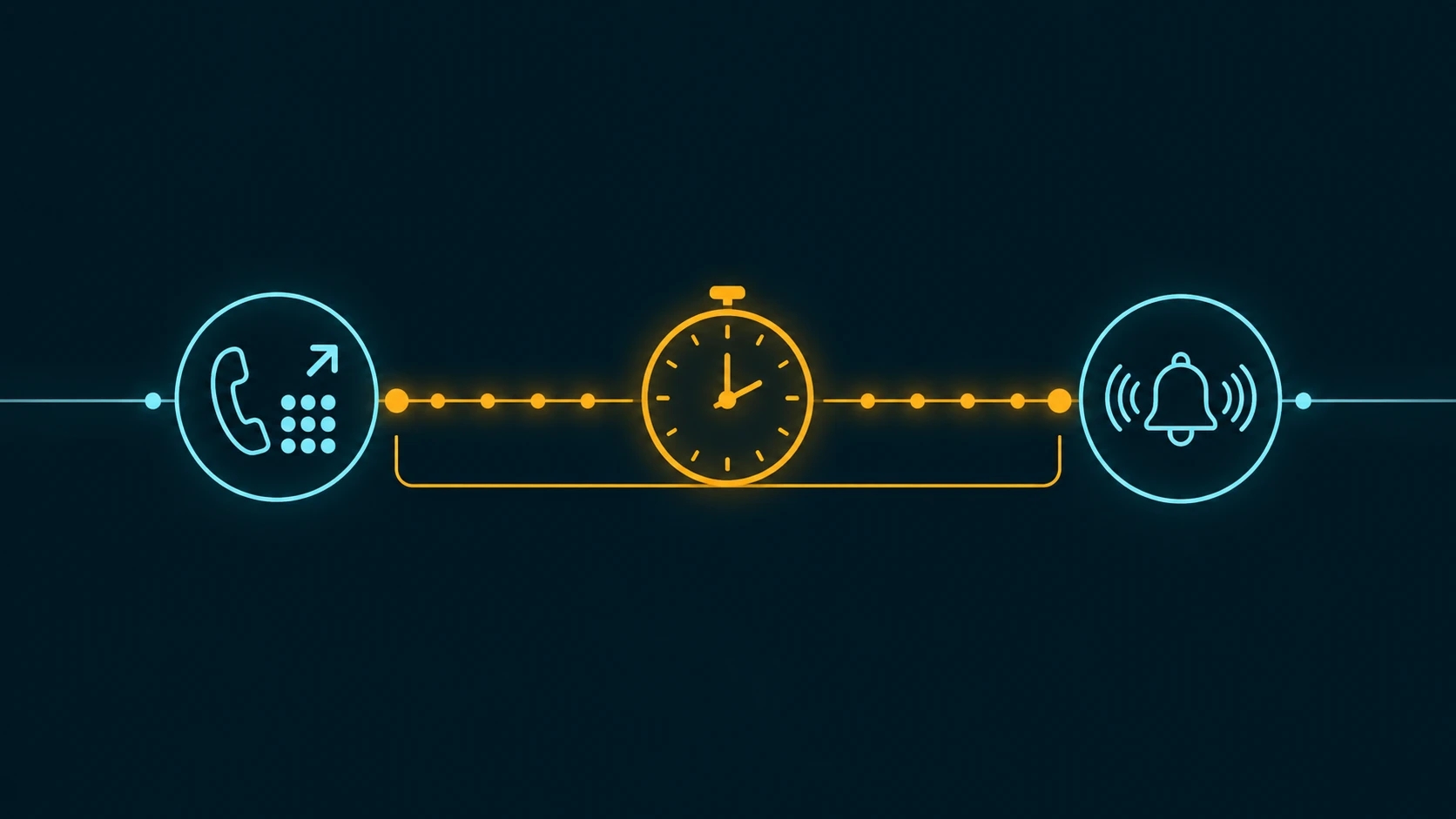
Post-Dial Delay (PDD) is the time elapsed from the moment the last digit is dialed — or, in VoIP, the moment the dialer fires a SIP INVITE — to the moment the caller first hears a ringback tone or early media from the far end. In SIP terms, PDD is measured from the INVITE being sent to the first provisional response received: either a 180 Ringing or a 183 Session Progress. Industry convention treats PDD under 7 seconds as acceptable; above that threshold, callers often assume the call has failed and hang up.
PDD is one of those call quality metrics that is easy to overlook until it becomes a problem. When a caller finishes dialing and hears nothing — no ring, no tone, no feedback — for several seconds, the experience deteriorates fast. Understanding what drives PDD, how it is measured in the SIP protocol, and what can be done to reduce it matters for anyone running outbound calls at scale.
How PDD is measured in SIP
In SIP-based VoIP, a call attempt begins with a SIP INVITE — a signaling message the originating side sends to the destination, initiating the call setup sequence. PDD is the time from that INVITE being sent to the first provisional response arriving back at the originating side.
Two provisional responses are relevant:
- 180 Ringing — the destination user agent is alerting (its phone is ringing). A 180 response does not carry early media. When the originating side receives 180, it generates a local ringback tone for the caller — an artificial signal produced by the calling system, not by the destination. The caller hears ringing, but it is locally generated, not the real ring at the destination end.
- 183 Session Progress — a provisional response that may carry early media, meaning a live audio path from the far end. With 183 and early media, the caller hears the actual destination ringback signal, network announcements, or IVR prompts in real time, delivered from the far end rather than synthesised locally.
Both 180 and 183 mark the end of PDD from a measurement standpoint — the caller is receiving some form of progress signal. The difference is what that signal contains and where it comes from.
180 Ringing vs 183 Session Progress: the practical difference
For short domestic calls over simple routes, the distinction between 180 and 183 is largely invisible. Both end PDD promptly and the caller hears ringback either way. The difference becomes meaningful on routes where signaling latency is higher — long international routes, calls traversing multiple carrier hops, or routes with slower number portability lookups.
On those routes, 183 with early media reduces perceived PDD even when actual SIP signaling latency is unchanged. The caller hears real far-end feedback — the destination country's ringback cadence, a carrier network announcement, or an IVR greeting — which feels more responsive than silence followed by a locally generated tone. The actual delay from INVITE to first response may be the same, but because the caller receives meaningful audio sooner, the subjective experience is faster.
For routes where 183 is not available, the originating side falls back to generating local ringback on receipt of 180 — which is perfectly functional, but offers no reduction in perceived PDD when signaling is slow.
The 7-second threshold
The widely cited industry threshold is 7 seconds. PDD under 7 seconds is generally considered acceptable for VoIP calls. Above that level, callers increasingly interpret the silence as a failed call and hang up before the destination even rings. Some studies put the effective abandonment point lower — around 4 to 5 seconds for mobile-accustomed callers who expect near-instant feedback — but 7 seconds is the conventional operational limit used by wholesale carriers when evaluating route performance.
A call that takes 8 seconds of silence before ringing is not broken in a technical sense — SIP signaling is simply slow — but from the caller's perspective it might as well have failed. The practical consequence is lost connections and, for outbound campaigns, failed attempts that never had a chance to become conversations.
Common causes of high PDD
PDD is not a single failure point. It accumulates across several stages of the call setup process, and more than one factor can compound at the same time.
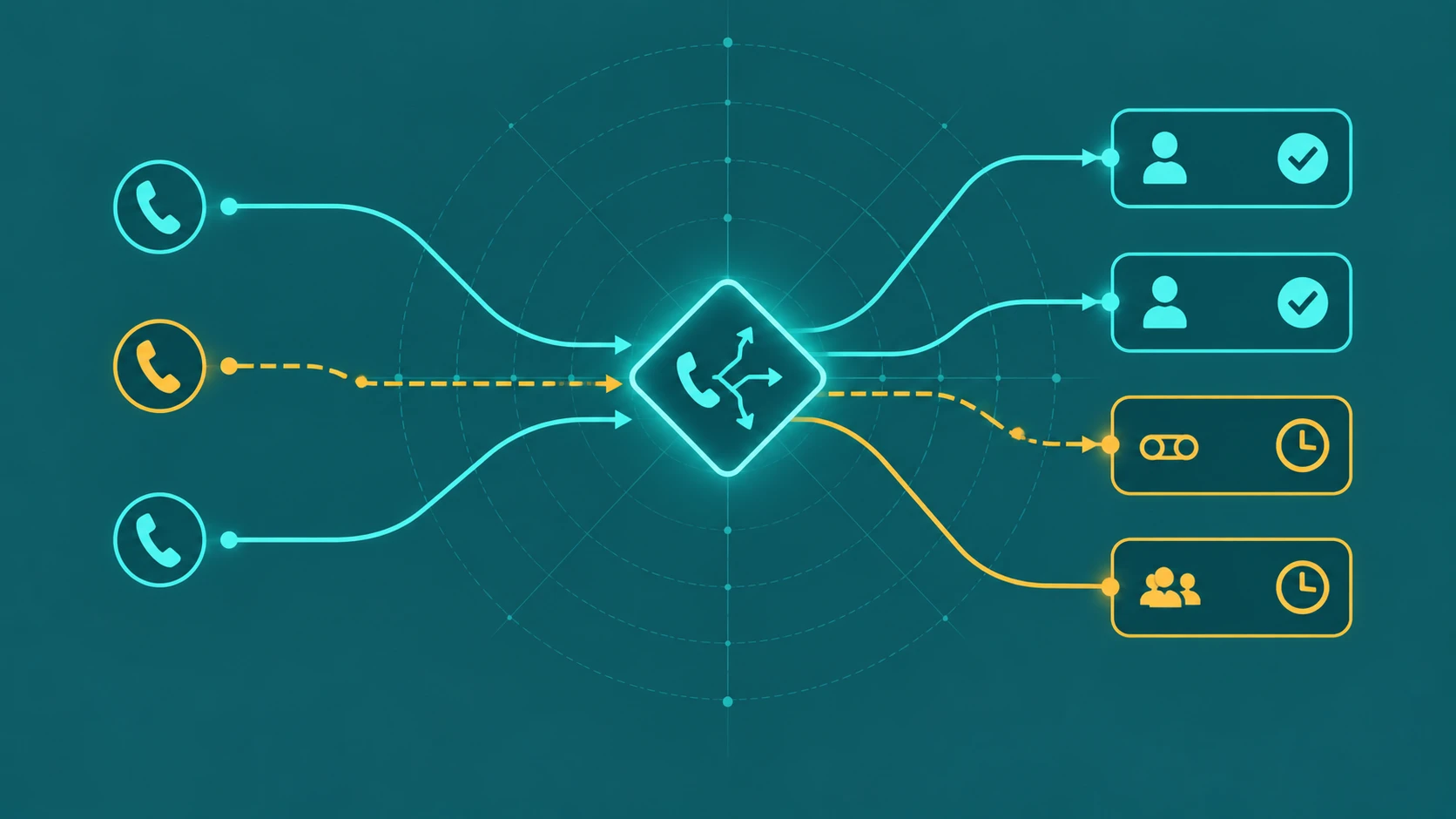
- Carrier route complexity. A call that travels through many intermediate hops — from originating carrier to broker to sub-broker to destination carrier — adds signaling round-trip time at each hop. Direct carrier interconnects produce lower PDD than broker chains because there are fewer nodes for the INVITE to traverse before the destination UA receives it and responds.
- DNS lookup latency. SIP proxies typically perform SRV and A record DNS lookups to resolve the next hop. If DNS servers are slow or uncached, that lookup can add hundreds of milliseconds to PDD per hop. Pre-caching SRV records eliminates this component from the call setup path.
- LCR decision time. Least Cost Routing engines evaluate multiple carrier options before committing the INVITE to a specific route. The time taken to query rate tables, check carrier health, apply routing rules, and select a path all adds to PDD before the INVITE is even dispatched downstream. On heavily loaded LCR platforms, this decision latency can become significant.
- Number portability lookups. In markets where number portability is common — including the United States, most of Europe, and a growing list of international markets — the originating carrier (or the LCR engine) often queries a Local Number Portability (LNP) database to determine where a ported number now lives before routing the call. LNP lookups that are not cached or that query slow databases add directly to PDD.
- Geographic distance. International calls carry inherently higher PDD than domestic calls because the round-trip time for signaling across greater physical distances is longer. A call from North America to Southeast Asia has more baseline latency than a domestic call before any other factor is considered.
- Absence of early media on long routes. On routes that only send 180 Ringing (no early media), the caller hears silence until the locally generated ringback starts. On a route with high signaling latency, this silence period is longer. Routes that support 183 with early media reduce perceived PDD by delivering far-end audio sooner.
How to reduce PDD
Not every cause of high PDD is within a buyer's control, but several are addressable through route selection and configuration choices.
- Use routes with fewer hops. Direct carrier interconnects produce lower PDD than broker chains. When evaluating termination providers, ask how many carrier hops separate you from the destination network. Fewer hops means less accumulated signaling round-trip time.
- Enable 183 early media on routes that support it. If the destination carrier or intermediate carrier supports 183 Session Progress with early media, enabling it reduces perceived PDD because the caller receives far-end audio feedback earlier than local ringback generation would allow.
- Pre-cache SRV and DNS results. Configuring SIP proxies to cache SRV records for known carrier endpoints removes DNS lookup time from the call setup path on repeated attempts to the same destination. This is a configuration-level optimisation that requires no changes to routes.
- Choose carriers with SLA commitments on PDD. Some wholesale carriers provide SLA guarantees on maximum PDD for premium route tiers — specifying, for example, that PDD will not exceed 5 seconds on a given destination. Where PDD consistency matters for call quality, carrier SLAs are a meaningful procurement criterion alongside ASR and ACD. For an overview of how the full call path works — from dialer to destination — see how CC routes work.
PDD in call center and predictive dialer contexts
High PDD is a nuisance for individual callers. In a call center or predictive dialer environment, it is a compound efficiency problem.
When an agent dials out — or when a dialer places a call on behalf of an agent — the agent is committed to that call from the moment it is placed. During PDD, the agent is on an open line waiting for the destination to ring. That wait time cannot be recovered. If PDD is 6 seconds and there are 1,000 outbound calls per hour, the cumulative time agents spend in PDD-related silence is 6,000 seconds, or roughly 100 agent-minutes per hour, added to handling costs without any conversation happening.
For predictive dialers specifically, the relationship is tighter still. A predictive dialer models expected connect times and agent availability to decide how many calls to place simultaneously. High PDD disrupts that model: if calls take longer to connect than the dialer anticipates, pacing calculations go off-balance, potentially causing either too many calls to connect simultaneously (generating abandoned calls) or agents sitting idle waiting for connections that are delayed. For context on how call attempt rates interact with these dynamics, see what is CPS in VoIP and what is ACD in VoIP.
Even 2 to 3 extra seconds of PDD per attempt compounds significantly at call center scale. Monitoring PDD per destination and per carrier is a worthwhile operational practice for any outbound team placing volume.
Frequently asked questions
How CC routes work covers the full call setup path that PDD sits within. For related call center signaling metrics, see what is CPS in VoIP (calls per second, the attempt rate metric) and what is ACD in VoIP (average call duration, the connected-call length metric).