
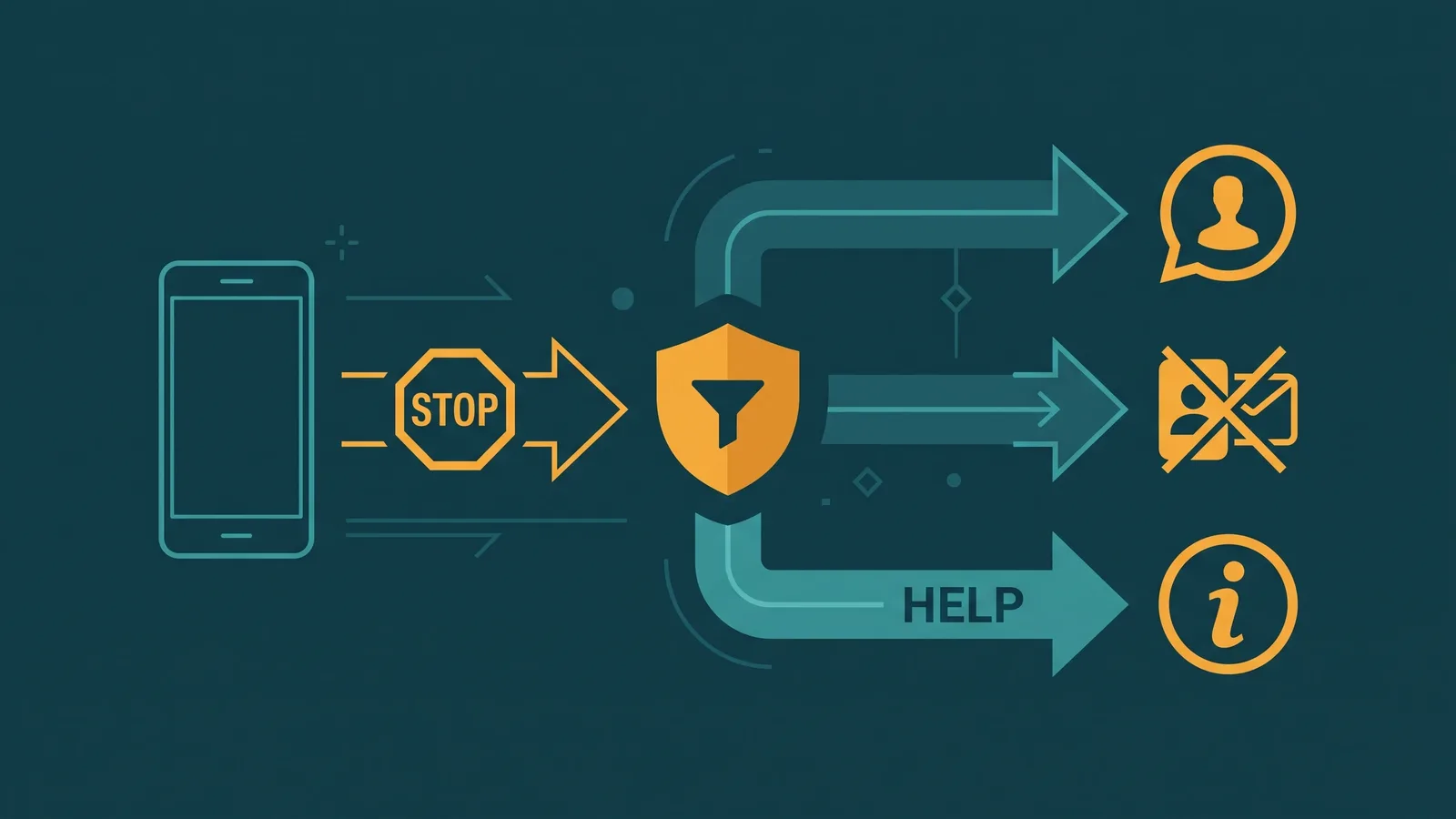
What are SMS opt-out keywords? STOP, HELP, CANCEL, and related words are carrier-mandated keywords that every A2P (application-to-person) SMS sender must recognize and act on. Required under CTIA Messaging Principles and Guidelines and the Telephone Consumer Protection Act (TCPA), these keywords give recipients a simple, standardized way to opt out of messages or request sender information — regardless of which platform or number type the sender uses.
Every business text messaging program — regardless of whether it uses a short code, a 10DLC long code, or a toll-free number — must handle opt-out and support keywords correctly. The rules are not optional guidelines: carriers enforce them at the network level for some number types, and TCPA enforcement actions and class action litigation have made ignoring them a significant legal risk.
This article explains which keywords are required, what confirmation messages must be sent, how suppression lists work, how resubscription is handled, and what happens with non-standard opt-out language that falls outside the defined keyword set.
TCPA rules and carrier requirements change. The information in this article is intended to describe how these mechanisms generally operate and does not constitute legal advice. Organizations should confirm applicable compliance requirements with qualified legal counsel before deploying a business SMS program.
Required Opt-Out Keywords
CTIA guidelines specify a defined set of opt-out keywords that every A2P SMS sender must honor. When any of these keywords is received — as the entire body of a reply message, or as the first word of a reply — the sender must immediately suppress the recipient's number and send a confirmation message. The required opt-out keywords are:
- STOP — the primary and most widely recognized opt-out keyword
- STOPALL
- UNSUBSCRIBE
- CANCEL
- END
- QUIT
Matching must be case-insensitive: "stop", "Stop", "STOP", and "sToP" must all trigger the opt-out flow. Matching must also tolerate common punctuation — "STOP." (with a trailing period) should be treated identically to "STOP". Most compliant platforms handle this normalization automatically, but it is worth verifying that your message processing layer does not reject a keyword because of trailing whitespace or punctuation.
The keyword must be matched regardless of whether the sender is using a dedicated short code, a shared short code, a 10DLC long code, or a toll-free number. There is no number-type exemption.
Required Opt-Out Confirmation Message
When a recipient replies with any of the recognized opt-out keywords, the sender must do two things immediately: suppress the number so no further messages are sent, and reply with a single confirmation message. That confirmation message is the last message the recipient will receive from that sender.
The CTIA guidelines prescribe the content of this confirmation. It must include:
- Confirmation that the recipient has been unsubscribed
- The sender's identity (brand name or program name)
- A statement that no further messages will be sent
- Instructions for how to resubscribe (typically: "Reply START to resubscribe")
A compliant opt-out confirmation looks like this: "You have been unsubscribed from [Sender Name] and will receive no further messages. Reply START to resubscribe."
After this confirmation is sent, no additional marketing, promotional, or informational messages may be sent to that number. The suppression must be immediate — there is no grace period. Sending a marketing message after receiving a STOP reply is a TCPA violation. CTIA guidelines reinforce this: the confirmation message is the final message, not a message followed by more messages.
The confirmation message itself is exempt from quiet hours and frequency caps — it must be sent even if the STOP reply arrives in the middle of the night, because the recipient initiated it.
HELP Keyword
The HELP keyword is the support counterpart to the opt-out keywords. When a recipient texts HELP to a sender's number, the sender must reply with a message that identifies the sender and provides a way to get support. This is required by CTIA guidelines.
A compliant HELP response includes:
- The sender's brand or program name
- A contact method — a phone number, an email address, or a support URL
- An opt-out instruction (e.g., "Reply STOP to unsubscribe")
A standard HELP response looks like this: "[Sender Name]: For help, contact us at [phone or email] or visit [URL]. Reply STOP to unsubscribe."
The INFO keyword is treated as equivalent to HELP by many carriers and platforms, and should trigger the same response. As with opt-out keywords, HELP matching must be case-insensitive.
HELP responses must be pre-configured for each sending number or campaign. A common compliance gap is launching a campaign with STOP handling in place but no HELP response configured — leaving recipients who text HELP with no reply, which violates CTIA guidelines and creates a poor recipient experience.
Suppression List Mechanics
The suppression list — the list of numbers that have opted out — is the operational record that makes opt-out handling work. Understanding how it is maintained, scoped, and applied is important for any organization running business SMS.
Immediate suppression is required
When a STOP reply is received, the number must be added to the suppression list immediately and all future sends to that number must be blocked. The TCPA technically allows up to 10 business days to honor an opt-out request (under the FCC's rules for certain communication types), but CTIA guidelines for SMS are stricter: opt-outs must be honored immediately. Carriers and messaging platforms enforce this at the platform level.
Practically, this means the opt-out must be written to the suppression list before the confirmation message is sent — so that even if a message is scheduled to go out seconds later, the opt-out is in place and the message is blocked.
Suppression scope: per sender, not per campaign
CTIA guidelines specify that opt-outs are per-sender, meaning an opt-out from one sender's number applies to all future messaging from that sender — not just from the specific campaign that sent the message that triggered the STOP reply. A recipient who texts STOP to a sender's 10DLC number is opting out of messages from that sender, not just from the current promotional campaign.
This is a critical operational point. Organizations that run multiple campaigns — promotional, transactional, alerts — from the same sending number or sender ID must apply the suppression list across all of them. A common mistake is campaign-level suppression that allows the same opted-out number to receive messages from a different campaign on the same number.
Suppression must survive system migrations
Suppression lists must be preserved when organizations switch messaging platforms, change campaign managers, or migrate CRM data. An opt-out recorded in Platform A is legally binding — migrating to Platform B does not reset the suppression obligation. Organizations planning platform migrations must include suppression list export and import in the migration checklist.
TCPA timing
The FCC's TCPA rules require that opt-out requests be honored within 10 business days. For SMS specifically, the CTIA standard and carrier enforcement require immediate suppression, making the 10-business-day window largely irrelevant for modern SMS platforms. However, the 10-business-day rule remains relevant for internal DNC list management in contexts beyond SMS — and for organizations that process opt-out requests through manual workflows rather than automated platform handling.
Resubscription via START Keyword
An opted-out recipient who changes their mind can resubscribe by texting START (or YES or UNSTOP) to the sender's number. When the platform receives one of these resubscription keywords, it removes the number from the suppression list and resumes message eligibility. A resubscription confirmation message must be sent and the event must be logged.
A compliant resubscription confirmation: "You have been resubscribed to [Sender Name] messages. Reply STOP at any time to unsubscribe."
Several operational points apply to resubscription:
- The resubscription keyword (START, YES, UNSTOP) triggers automatic removal from suppression — the sender does not need to manually review or approve it.
- The event must be logged with a timestamp, so there is an auditable record that the recipient opted back in after having previously opted out.
- Resubscription does not restore consent for a different program than the one the recipient originally subscribed to — if your TCPA consent documentation was for Program A and the recipient resubscribes via START, you have consent to resume Program A messaging, not to add them to Program B.
Non-Standard Opt-Out Language
Recipients sometimes reply with words that communicate a clear wish to stop receiving messages but fall outside the CTIA-mandated keyword set: "remove me", "stop texting me", "take me off this list", "don't text me anymore". Carriers do not enforce opt-out handling for these phrases — but ignoring them creates legal exposure under the TCPA.
TCPA case law has produced rulings and settlements against senders who continued messaging after receiving replies that clearly expressed an unsubscribe intent, even when those replies did not use the exact keyword. Courts and plaintiffs have treated these as expressions of revoked consent. A sender that receives "please remove me" and continues sending messages because the reply did not match a keyword filter is in a difficult legal position if the recipient pursues a TCPA claim.
Best practice for non-standard opt-out language: configure your platform or inbound message monitoring to flag replies that contain common opt-out phrases. Flag these for manual review. If the content clearly expresses an intent to opt out, treat it as an opt-out and suppress the number. Document the review and the decision. This adds an operational step but significantly reduces TCPA exposure from ambiguous replies.
Some platforms provide NLP-based (natural language processing) inbound message classification that can automatically detect opt-out intent in non-standard phrasing. If your messaging volume is high enough to make manual review impractical, evaluating platforms with this capability is worthwhile.
Short Code vs 10DLC vs Toll-Free: How Enforcement Differs
The opt-out keyword requirement applies to all A2P SMS sender types — dedicated short codes, shared short codes, 10DLC long codes, and toll-free numbers. However, how that requirement is enforced differs by number type.
Short codes
Short codes — five- or six-digit numbers used for high-volume A2P messaging — are subject to the most rigorous carrier enforcement. Shared short codes, in particular, are heavily monitored because multiple senders share the same number and any one sender's opt-out failure can affect the entire shared code's deliverability. Most shared short codes have been deprecated or restricted by major US carriers, with carriers requiring dedicated short codes or migration to 10DLC for most use cases. For dedicated short codes, the opt-out handling is validated as part of the carrier provisioning and compliance review process.
10DLC (10-digit long codes)
10DLC numbers are standard 10-digit phone numbers registered through The Campaign Registry (TCR) for A2P messaging. Carrier enforcement of opt-out handling on 10DLC relies primarily on platform-level compliance rather than carrier-side keyword inspection — carriers verify that the registered campaign type includes opt-out compliance attestations, but they do not inspect individual message content. This means that for 10DLC senders, opt-out handling is the platform's and sender's responsibility to implement and maintain correctly. Carrier filtering does apply if spam complaints are elevated, which correlates with poor opt-out handling.
Toll-free numbers
Toll-free SMS requires toll-free number verification through carrier verification programs. As with 10DLC, opt-out enforcement is primarily platform-level for toll-free numbers. Verified toll-free numbers have better deliverability than unverified numbers, and part of the verification attestation involves confirming that opt-out handling is in place.
For all number types, the practical consequence of failing to honor opt-out keywords is the same: TCPA exposure, potential carrier-level filtering or suspension, and the reputational risk of continuing to message recipients who have asked to stop receiving messages.
Frequently Asked Questions
Proper keyword handling — STOP, HELP, START, and the full set of required opt-out synonyms — is a foundational requirement for any business SMS program, not an optional feature. It applies across number types, across campaigns, and across message categories. For broader context on how business SMS programs are structured and what consent requirements apply before the first message is sent, see the business SMS guide. For concrete opt-in language and form examples across different use cases, see business SMS opt-in examples. For the related area of phone-based opt-out and Do Not Call obligations for voice programs, see the article on what the DNC list is and how it works. As with all TCPA-adjacent compliance topics, requirements should be confirmed with qualified legal counsel for your specific messaging program and jurisdiction.