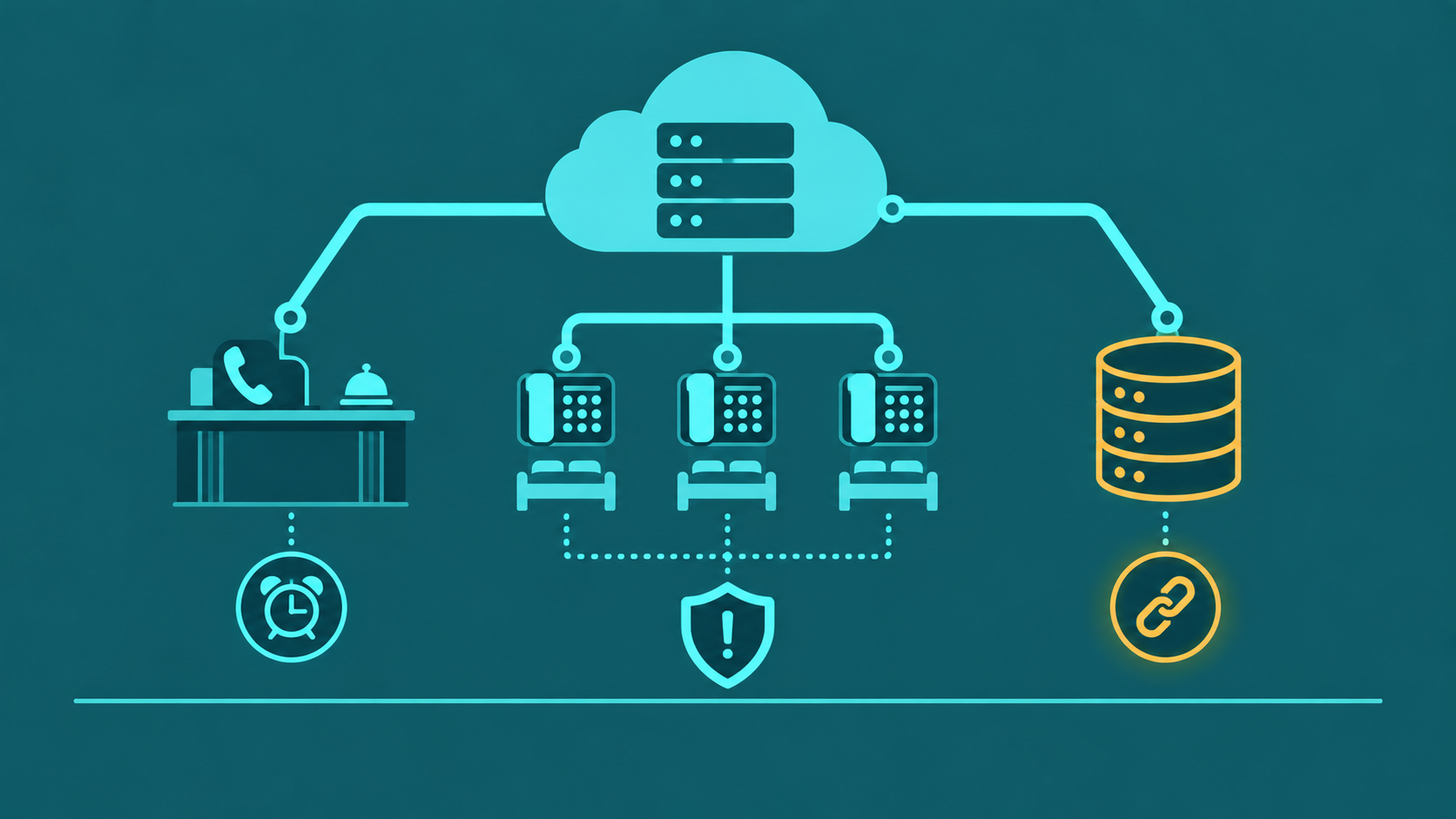
Hotel phone systems have requirements that no standard business VoIP platform addresses out of the box. A guest room phone is not a business extension — it needs to integrate with the property management system, deliver E911 with room-level location data, route to the front desk and housekeeping reliably, and support wake-up call scheduling. These requirements are specific to hospitality, and the wrong phone system creates both operational problems and compliance exposure.
This guide explains what hotel phone systems need to do differently from standard business VoIP, how cloud hotel phone systems compare to traditional on-premise PBX, and what to evaluate when choosing a system for a hotel property.
A hotel phone system must integrate with the property management system (PMS), support per-room E911 with room-level location data, enable guest-to-front-desk routing, and handle wake-up call scheduling — requirements that standard business VoIP platforms don't address out of the box.
What hotel phone systems need to do differently
A hotel's phone infrastructure serves two fundamentally different audiences simultaneously: guests in rooms and staff operating the property. Each has distinct requirements that a standard business phone system is not designed to address.
For guests, the phone system must:
- Provide a reliable in-room calling interface for reaching the front desk, concierge, room service, housekeeping, and external numbers.
- Support per-room E911 with the guest's current room number and address dispatched to emergency services — not the hotel's main address.
- Enable wake-up call scheduling, either through the front desk or an automated self-service option available to guests directly.
- Maintain guest voicemail that is cleared at checkout and reset for the next occupant.
- Handle do-not-disturb settings that can be toggled by the guest or overridden by the front desk for urgent calls.
For hotel operations staff, the system must:
- Integrate with the property management system so that room assignments, guest names, check-in and check-out status, and billing data are reflected in the phone system in real time.
- Route guest calls to the appropriate department — front desk, housekeeping, maintenance, food and beverage — based on the dialed code or menu selection.
- Allow front desk agents to view active guest calls, intercept or transfer calls, and manage wake-up call queues.
- Provide call accounting records that tie calls to guest folios for billing purposes.
Hotel PBX vs cloud hotel phone system
| Dimension | Traditional hotel PBX | Cloud hotel phone system |
|---|---|---|
| PMS integration | Proprietary middleware, often vendor-specific | API-based integrations with major PMS platforms |
| Per-room E911 | Available with proper configuration; requires on-site setup | Built-in with room-number-to-address mapping in cloud |
| Setup cost | $30,000–$200,000+ for hardware and installation | Lower upfront; hardware is desk phones and network |
| Scalability | Adding rooms requires hardware expansion | Add rooms or properties in software; hardware is standard SIP phones |
| Maintenance | On-site hardware maintenance; vendor support contracts | Provider manages platform; hotel manages phones and network |
The shift toward cloud-based hotel phone systems mirrors the broader hospitality industry move to cloud PMS platforms like Opera Cloud, Cloudbeds, and Mews. When the PMS is cloud-based, integrating a cloud phone system is architecturally simpler than connecting a cloud PMS to an on-premise PBX.
Seven must-have features in a hotel phone system
- PMS integration. Real-time synchronization with the property management system is the foundational requirement. The phone system must know which room is occupied, by whom, and when check-in and check-out occur. PMS integration enables guest name display on front desk phones, automated voicemail clearing at checkout, and call accounting tied to guest folios.
- Per-room E911. Federal law requires that a 911 call from a hotel phone deliver the guest's current room number and the hotel's address to the PSAP dispatcher. This is a per-room configuration requirement, not a property-level setting. Every room extension must have a discrete, accurate dispatchable location registered with the E911 system.
- Wake-up call automation. Automated wake-up call systems allow guests to schedule calls through the in-room phone or via a front desk request, deliver the call at the specified time, and retry if the call is unanswered. Manual wake-up call management is a reliability risk — automated systems reduce missed calls and eliminate staff error.
- Guest voicemail. In-room voicemail must be isolated per guest, accessible from the room phone, and fully cleared at checkout. A new guest should never encounter the previous occupant's messages. Most hotel phone systems handle this through PMS-triggered voicemail reset tied to the checkout event.
- Front desk ACD. Incoming guest calls need to route efficiently to the front desk with agent availability management. During peak periods, the system should queue calls with estimated wait announcements and route overflow calls appropriately rather than returning a busy signal to a guest trying to reach the desk.
- Do-not-disturb. Guest-controlled DND settings must be manageable from the room phone and visible to front desk staff. The system must support a DND override for emergency communications — a front desk or security staff member must be able to reach a room phone even when DND is active.
- Multi-property management. For hotel groups or management companies operating multiple properties, a single cloud platform that manages all properties — with separate configurations, reporting, and PMS integrations for each — is operationally far simpler than managing separate PBX systems at each site.
Kari's Law and RAY BAUM's Act compliance for hotels
Two federal regulations govern E911 requirements for hotels and multi-line telephone systems (MLTS) more broadly:
Kari's Law (effective 2020) requires that any multi-line telephone system allow direct dialing of 911 without first dialing an access code (such as 9 for an outside line). Hotels with legacy PBX systems that required "9-911" to reach emergency services were required to update their systems or configuration to enable direct 911 dialing. This applies to all MLTS in hotels, office buildings, campuses, and other multi-tenant environments.
RAY BAUM's Act (effective 2021 for fixed devices, 2022 for non-fixed) requires that 911 calls from MLTS systems deliver a "dispatchable location" — an address, floor, and room number or location identifier sufficient for a first responder to find the caller. For hotels, this means each room phone must deliver the specific room number, not just the hotel's street address. A 911 call that delivers only "123 Main Street, Hotel Name" is not compliant with RAY BAUM's Act if the responder cannot determine which of 200 rooms the call came from.
Cloud hotel phone systems that maintain room-level E911 records and deliver them via the carrier network to PSAPs satisfy both requirements when properly configured. Legacy PBX systems may require middleware or carrier-side configuration updates to deliver room-level dispatchable location data.
Cost considerations for hotel phone systems
Hotel phone system costs vary significantly based on property size, system type, and whether guest room phones are replaced or retained.
Key cost components to evaluate:
- Per-room licensing. Cloud hotel phone systems typically charge a per-room or per-extension monthly license fee. For a 200-room hotel, this is the primary recurring cost driver. Compare per-room rates across providers and clarify whether the license includes all features (PMS integration, wake-up calls, E911) or whether those are separately priced modules.
- Hardware: guest room phones vs softphone front desk. Modern SIP desk phones suitable for hotel guest rooms range from $80–$250 per unit. A 200-room hotel replacing all room phones faces a hardware cost of $16,000–$50,000 before installation. Front desk positions can often use softphone applications on existing computers, eliminating dedicated hardware cost for staff endpoints.
- Cloud vs on-premise total cost of ownership. On-premise PBX has higher upfront cost but potentially lower ongoing fees. Cloud systems have lower upfront cost, predictable monthly pricing, and no hardware maintenance responsibility — but the cumulative subscription cost over 5–10 years may exceed the capitalized cost of on-premise hardware at larger properties.
- PMS integration costs. Some cloud hotel phone providers charge separately for PMS integration setup or include it only in higher-tier plans. Verify integration cost with your specific PMS before comparing total system pricing.
Questions to ask a hotel VoIP provider
- Which property management systems do you have native integrations with, and how is the integration maintained when the PMS updates its API?
- How does your system deliver per-room dispatchable location to PSAPs for RAY BAUM's Act compliance?
- Does your wake-up call system retry unanswered calls, and how many retry attempts are configurable?
- How is guest voicemail cleared at checkout — automatically via PMS event or manually by staff?
- What happens to guest room calls if the cloud platform experiences an outage?
- Is multi-property management included, and can each property have separate PMS integration and reporting?
- What is the per-room monthly license cost and what features are included at that tier?