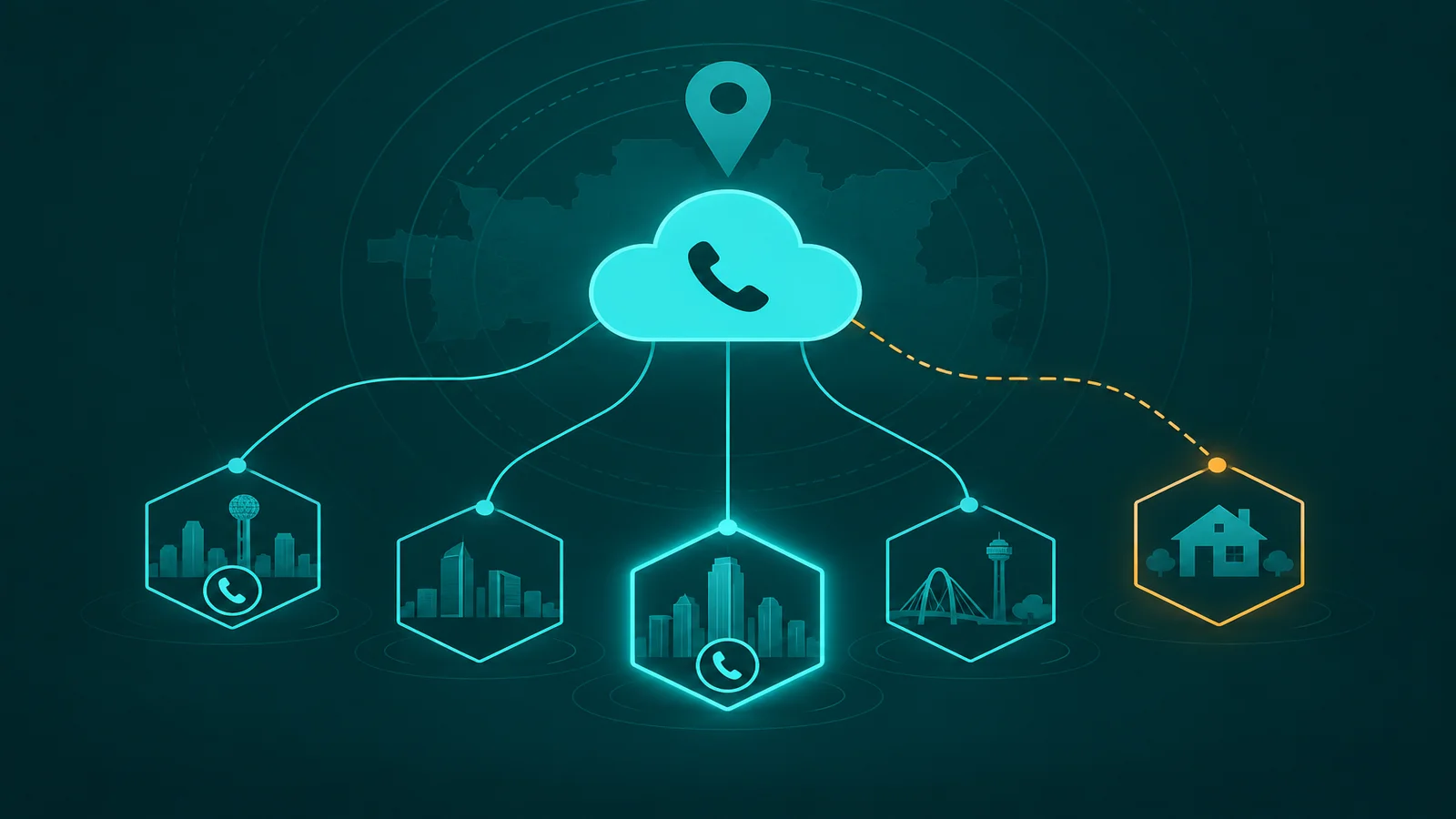
A VoIP phone in Dallas is not meaningfully different from a VoIP phone anywhere else — the technology works the same way. What differs is what Dallas businesses need from the number, the carrier, and the platform: local area code presence in a market where 214 still carries recognition value, reliability through a carrier environment that includes AT&T, Spectrum, and Frontier as incumbent options, and a system that handles distributed teams across a metro that sprawls across 9,000 square miles.
This guide covers how VoIP phones work for Dallas businesses, what to look for in a provider, and the practical questions Dallas companies face when switching from legacy phone service to cloud VoIP.
Key point: For Dallas businesses, the most important VoIP phone considerations are local number coverage (214, 469, 972, 945), porting reliability from DFW incumbent carriers, and a platform that works for distributed teams across the metro — not the location of the provider's office.
What a VoIP phone is and how it works
A VoIP phone is any device — desk phone, softphone app on a laptop, or mobile app — that makes and receives calls over an internet connection rather than a traditional phone line. The device connects to a cloud phone system (hosted PBX) operated by the VoIP provider. That system handles call routing, extensions, voicemail, IVR menus, and all other phone system features.
For a Dallas business, this means your phone number is cloud-allocated — it exists in the provider's infrastructure, not tied to a physical address or copper wire. A staff member in downtown Dallas, another in Plano, and a remote worker in Fort Worth all use the same phone system, same extension directory, and same features regardless of location.
VoIP phone types for Dallas offices
Softphone apps (laptop and desktop)
A softphone is an application installed on a computer or mobile device that functions as a full desk phone — dial pad, transfer, hold, conferencing, voicemail. For businesses without a need for physical desk phones, softphones eliminate hardware cost entirely. A staff member opens the app, signs in, and their extension is active from any internet-connected device.
IP desk phones
SIP-compatible IP desk phones (Yealink, Polycom, Cisco in SIP mode) connect to a cloud VoIP provider over ethernet or WiFi and operate identically to traditional desk phones. They are appropriate for reception desks, conference rooms, and staff who prefer a physical phone. Businesses upgrading from legacy PBX may already own SIP-compatible phones that can be reprogrammed for a new provider without replacement.
Mobile apps
VoIP mobile apps on iOS and Android let Dallas employees make and receive business calls on the company number from anywhere. This is particularly relevant in DFW — a metro where staff frequently commute between Plano, Irving, Fort Worth, and home offices across the suburbs. Mobile VoIP apps eliminate the need for call forwarding to personal numbers and keep all business communication on the company line.
Dallas-specific VoIP considerations
Local number coverage: 214, 469, 972, 945
Dallas businesses typically want a number in one of the four DFW area codes. The 214 code — original to Dallas since 1947 — carries the most local brand weight for central Dallas operations. The 469 and 972 codes cover the suburbs including Plano, Irving, Frisco, Garland, and Mesquite. The 945 overlay was introduced in 2021. Confirm the provider can provision your preferred area code before committing — inventory varies by provider and some codes have limited availability.
Porting from Dallas carriers
Most established Dallas businesses have existing numbers with AT&T, Spectrum Business, or Frontier. Porting those numbers to a VoIP provider is the critical path for any migration — the business cannot switch providers until its numbers have successfully ported. Confirm the provider's documented process for porting from each of these carriers, the expected timeline (typically 2–4 weeks), and what happens if a port encounters an error.
Internet quality in DFW
VoIP call quality depends entirely on the quality of the internet connection at each location. DFW has strong broadband infrastructure — AT&T Fiber, Spectrum Business, Google Fiber (parts of Dallas), and Frontier Fiber cover most business corridors with low-latency connections suited to VoIP. Businesses in areas with less reliable connectivity should consider redundant internet connections or a VoIP provider with PSTN fallback capability for critical lines.
Weather resilience
The 2021 Texas winter storm demonstrated the fragility of infrastructure during extreme weather events. For Dallas businesses whose phone system cannot go offline, a VoIP provider with multi-region failover routes calls through backup infrastructure when local internet is disrupted. Mobile VoIP apps that fall back to cellular provide an additional layer — staff can continue working from phones on mobile data even when office internet is down.
VoIP phone vs legacy business phone service in Dallas
| Factor | Legacy (AT&T/Spectrum/Frontier) | Cloud VoIP |
|---|---|---|
| Hardware | PBX + wired desk phones | None (or optional SIP phones) |
| Remote workers | Separate solution needed | Full parity on mobile/laptop |
| Moving offices | Re-wiring + hardware move | No change needed |
| Adding extensions | Hardware + technician visit | Add via portal in minutes |
| Monthly cost (10 seats) | $400–$700+ | $150–$350 |
Key features Dallas businesses use most
Based on the DFW business profile — professional services, healthcare, real estate, logistics — the features with highest day-to-day impact are:
- Auto-attendant. Routes inbound calls to the right person or department without a dedicated receptionist. Essential for any multi-department business.
- Mobile VoIP app. Non-negotiable for the DFW distributed work environment — lets staff answer calls on the company number from anywhere in the metro.
- Call recording. Standard in professional services, healthcare, and financial services for documentation and compliance.
- Business SMS on the same number. Customers text the main business number; staff reply from the same platform used for voice calls.
- Voicemail-to-email. Voicemail transcripts delivered as email or text so staff do not miss messages when away from the desk.
For a full overview of what cloud phone features are standard, see our guide to what a business phone system includes and our comparison of VoIP solutions for Dallas businesses.