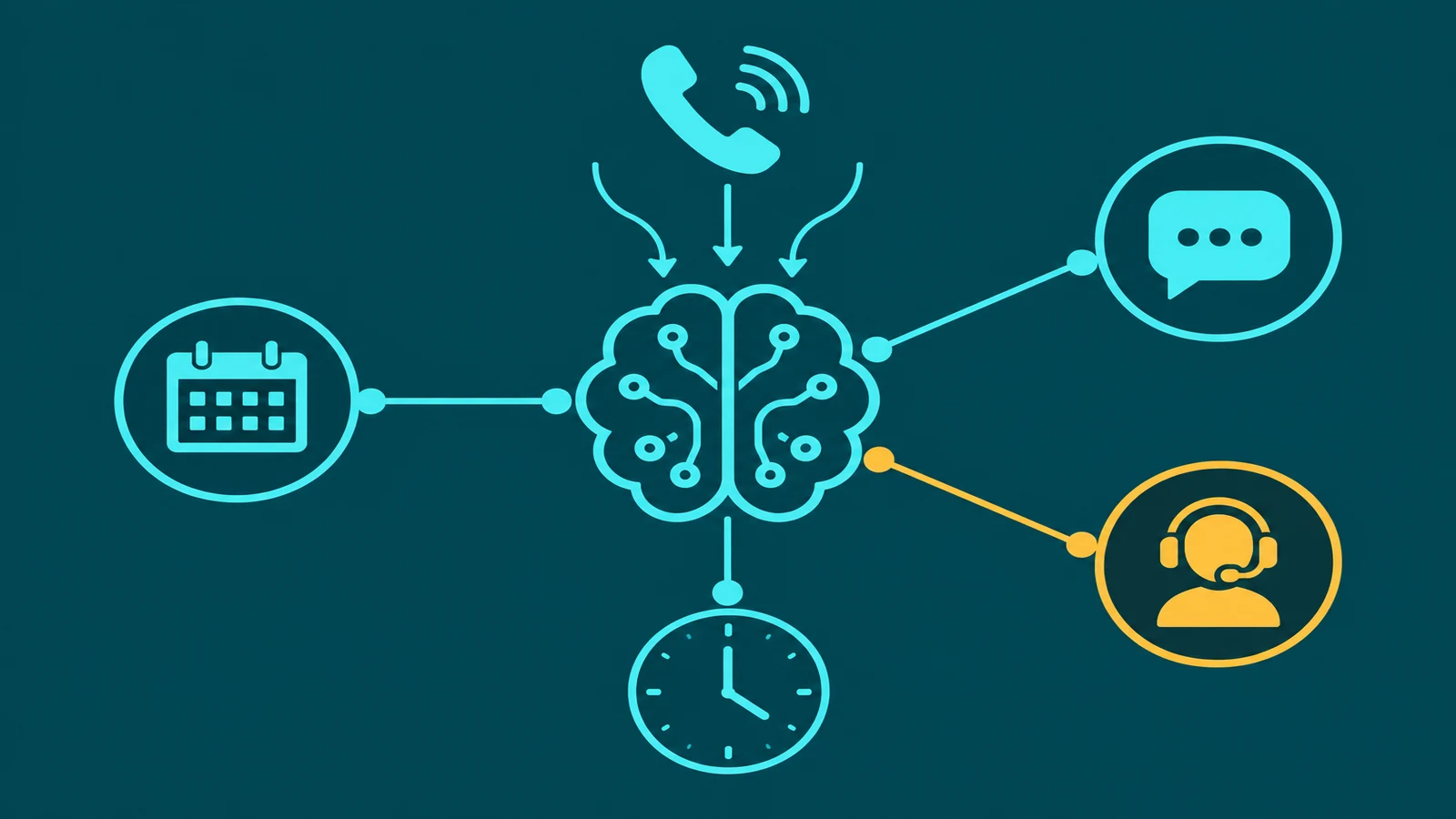
Deploying an AI voice agent is not like shipping a web form. A form either accepts your input or it does not. A voice agent is probabilistic: the same spoken sentence can produce slightly different model outputs on consecutive runs, tool calls have side effects on live systems, and real callers do not behave like your demo script. Testing an AI voice agent before launch requires a different mindset — one built around scenarios, evidence, and explicit pass/fail criteria rather than spot checks and gut feel.
This guide walks through every dimension of a production-grade AI voice agent testing checklist: speech variation, silence and pause handling, barge-in, intent coverage, tool action verification, transfer trigger testing, load and concurrency, recovery from failures, and the release gate criteria you should define before a single test call is made. It closes with guidance on the evidence package you should keep as a deployment record.
Why specialized testing matters. AI voice agents are probabilistic, latency-sensitive, and connected to systems that take real-world actions. Standard QA frameworks designed for deterministic software miss the failure modes that matter most in production telephony.
Set release gate criteria before you start
The most common mistake in AI voice agent testing is deciding what "pass" means after you see the results. Write your release gate before any test runs. Criteria should be concrete, not aspirational — something you can unambiguously mark as passed or failed after reviewing a call recording and log.
A minimal release gate covers four areas: intent handling, tool side effects, safety routing, and latency. Define thresholds for each. The table below shows an example structure — adjust the numbers to match your risk tolerance and call volume:
| Gate Area | Example Criterion | Block or Advisory? |
|---|---|---|
| Golden-path intents | Every documented intent resolves correctly on 3 of 3 runs | Block launch |
| Tool side effects | Zero writes to production data during test runs | Block launch |
| Emergency bypass | Emergency keywords route out of AI on 3 of 3 runs, no delay | Block launch |
| Transfer context | Human agent receives full context package on every tested transfer trigger | Block launch |
| Latency under load | Agent first-response delay stays below defined threshold during concurrent-call test | Advisory — fix before scale |
| Consent announcement | Recording notice plays within first 5 seconds on every recorded-call test | Block launch (if recording enabled) |
Test dimension 1 — persona and speech variation
Most development testing happens with a single tester speaking at a normal pace in a quiet room. Real callers look very different. Test explicitly across at least these input dimensions before you consider the agent ready:
- Accents and language variation: Include regional accents for your caller demographics and non-native speaker patterns. The agent's speech recognition layer may struggle with specific phoneme combinations that are common in your caller base but absent from your dev team.
- Speech rate: Fast talkers compress phonemes; slow talkers create pauses that can trigger voice activity detection (VAD) cutoffs prematurely. Test both extremes.
- Background noise: Office noise, car noise, and muffled audio from speakerphone all degrade the audio signal. Run tests with noise-injected recordings if you cannot source live noisy calls.
- PSTN vs. VoIP call quality: PSTN trunks introduce codec degradation that VoIP-to-VoIP calls do not. If your callers mix PSTN and VoIP, test on both path types.
- Phrasings per intent: For every intent the agent is designed to handle, test at least two alternative phrasings beyond your "canonical" phrasing — how a caller might actually say the same thing differently.
Test with real voices. Synthesized test inputs from TTS tools do not replicate real caller variability accurately enough to serve as your primary test corpus. Use recordings from actual humans wherever possible, even if those humans are colleagues rather than real callers.
Test dimension 2 — silence, pauses, and VAD behavior
Voice Activity Detection determines when the caller has finished speaking and when the agent should respond. Getting VAD behavior wrong produces two common failure modes: the agent cuts off the caller mid-sentence (VAD too aggressive), or it waits silently while the caller wonders if anyone is there (VAD too conservative). Both erode trust quickly.
Your testing checklist should include:
- Mid-sentence pause: Caller pauses for 1–2 seconds mid-sentence (searching for a word, checking a booking reference). Does the agent wait, or does it interpret the pause as end-of-turn and jump in?
- Long inter-turn silence: Caller goes quiet for 5+ seconds (distracted, put phone down). What does the agent do? Does it re-prompt? How many times before it terminates or transfers?
- Silence at call start: Caller answers but does not speak immediately. Does the agent greet and wait appropriately?
- Prolonged hold scenario: If the agent needs to look up information, does it fill the silence with a waiting message, or does the caller hear dead air?
Test dimension 3 — interruption (barge-in)
Barge-in is the ability for a caller to interrupt the agent mid-speech and have the agent stop, listen, and respond to the interruption. This is one of the most important interaction qualities for callers who already know what they want and do not want to wait through an explanation.
Test specifically: does the agent stop speaking when the caller speaks over it? Does it correctly process what the caller said during the barge-in? Does it get stuck in a loop where it re-starts its previous utterance after the interruption? Test barge-in at different points — beginning, middle, and near the end of an agent turn — because the underlying TTS buffering behavior can differ across those positions.
Also test the inverse: accidental barge-in from background noise. A dog bark or a TV in the background should not interrupt the agent's response or misroute the call. Your agent's VAD and barge-in sensitivity settings interact in ways that only emerge from real audio testing.
Test dimension 4 — intent coverage and edge cases
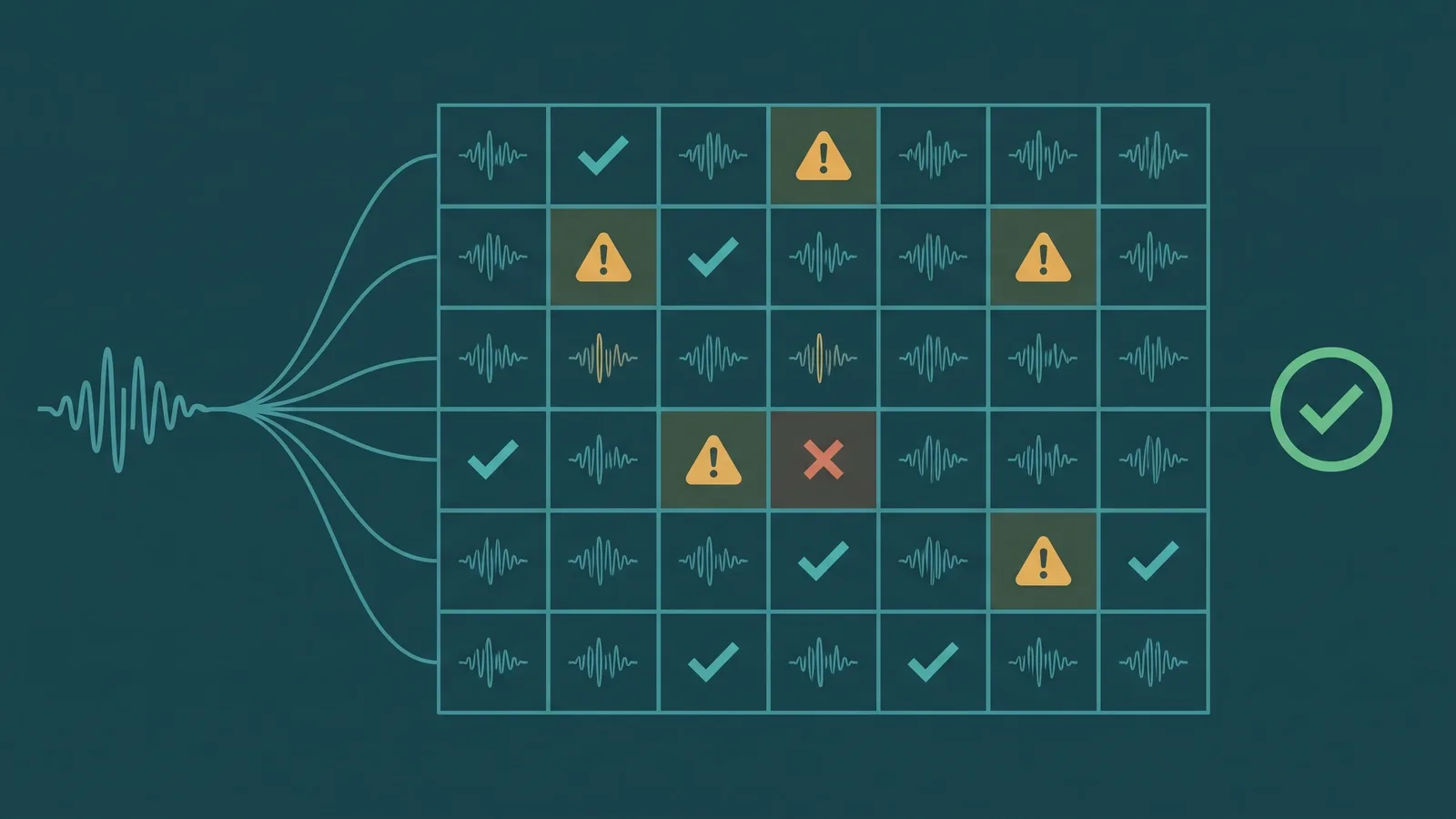
Map every intent the agent is supposed to handle, then build a test matrix that covers golden path, phrase variation, and out-of-scope handling for each. The full test dimension matrix:
| Test Type | What to Verify | Minimum Coverage |
|---|---|---|
| Golden path | Agent resolves the intent correctly from start to finish | 3 runs per intent |
| Phrase variation | Alternative phrasings of the same intent resolve correctly | 2+ phrasings per intent |
| Out-of-scope | Agent does not hallucinate an answer for requests it cannot handle | 5+ distinct out-of-scope inputs |
| Ambiguous input | Agent asks a clarifying question rather than guessing | 2+ ambiguous inputs per intent area |
| Multi-turn context | Agent retains context across 4+ turns without drifting | 2+ long-conversation tests |
| Context drift | Agent does not confuse caller details from earlier in the call with current request | Tested within multi-turn tests |
| Policy topic | Topics the agent is not authorized to discuss are declined or transferred | Every restricted topic tested once |
Multi-turn context drift is a specific failure mode worth calling out: as a conversation grows longer, LLMs can lose track of details established earlier. Test long conversations explicitly — not just short, two-turn interactions — because the failure often only appears after several exchanges.
Test dimension 5 — tool actions and API integration
If your agent calls external tools — booking systems, CRM lookups, payment processors, knowledge bases — those integrations need their own test layer. The key principle is test environment isolation: every tool call during testing should target sandbox or test credentials, never production data. Verify this before any test runs, not after.
For each tool action, run three paths:
- Success path: Tool call completes normally. Verify the agent correctly interprets the response and communicates the outcome to the caller. Also verify the side effect actually occurred — if the agent says "I've booked your appointment," check that the appointment exists in the target system.
- API error path: Simulate the tool returning an error (4xx or 5xx). Does the agent handle the error gracefully and tell the caller something meaningful? Does it offer a fallback — like transferring to a human who can help manually?
- Slow response path: Simulate latency from the tool (2–5 seconds). Does the agent fill the silence while waiting? Does it time out correctly if the tool never responds? Does a slow tool call cause the caller-facing latency to become noticeable?
Tool action testing connects directly to the broader theme of AI voice agent guardrails — restricting what actions the agent can take, under what conditions, prevents a misconfigured prompt from writing bad data to your CRM across hundreds of calls before anyone notices.
Test dimension 6 — transfer trigger testing
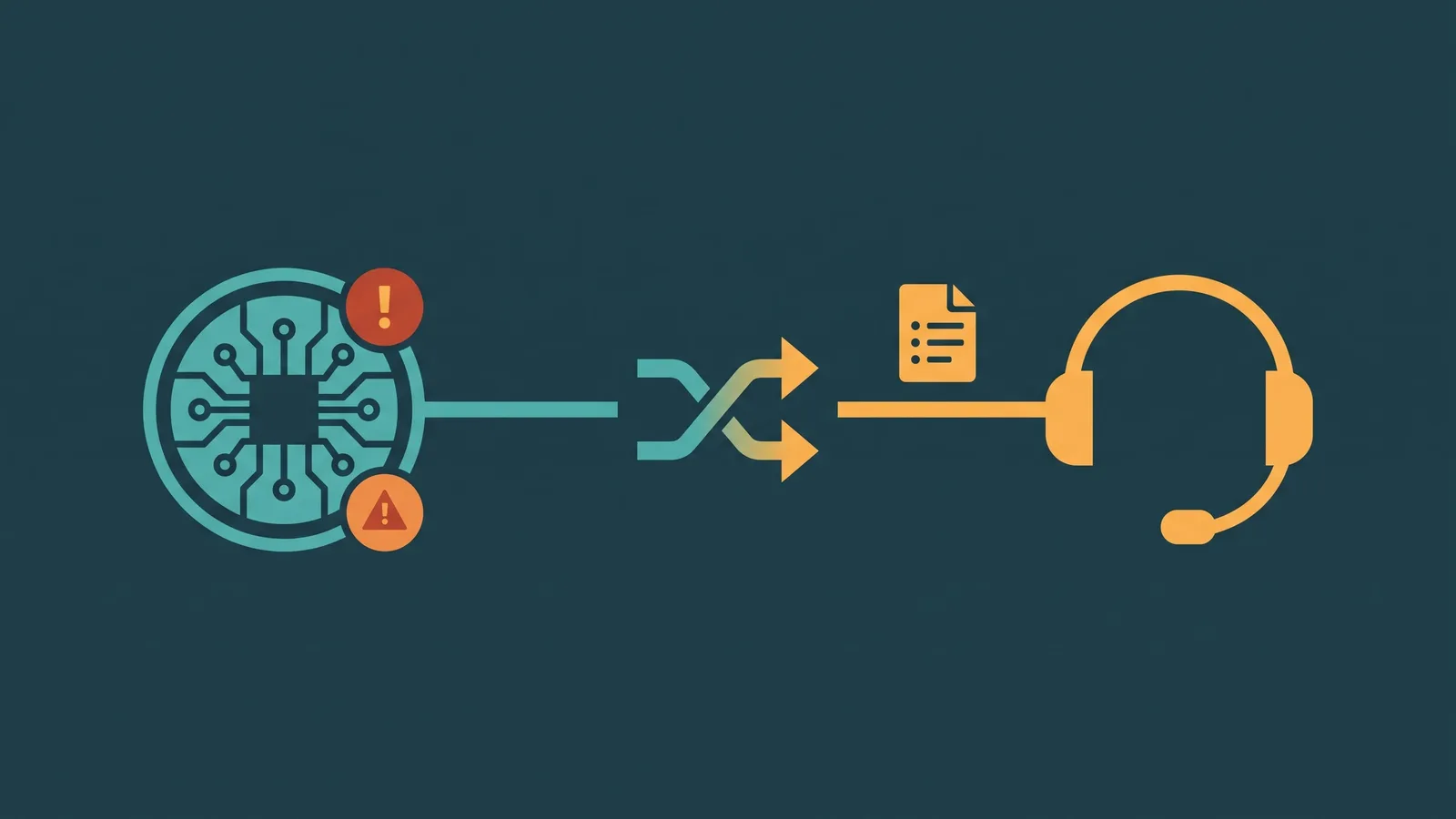
Every path that routes a call to a human agent needs to be tested independently. Do not assume that because one transfer trigger works, they all work — each trigger condition has its own logic and its own potential failure mode. See our full guide on AI voice agent handoff to human for the design layer; here the focus is testing.
Test each trigger condition in isolation:
- Confidence threshold: Simulate an ambiguous request the model cannot classify confidently. Does it transfer rather than guess?
- Explicit caller request: Caller says "let me speak to a person." Does transfer happen immediately?
- Sentiment trigger: If call sentiment analysis is wired to a transfer trigger, test a caller who expresses frustration escalating over two or three turns.
- Policy topic: A restricted topic the agent cannot discuss should route out of the AI, not produce a response.
- Repeated failure: The agent fails to resolve the same intent twice — does it offer to transfer rather than loop indefinitely?
For each trigger, verify that the context package — caller name, intent, conversation summary, sentiment signal — arrives at the human agent. A transfer that drops context is a failed transfer from the caller's perspective, even if the call technically connected.
Test dimensions 7–10 — load, recovery, safety, and consent
The final four dimensions are sometimes skipped under deadline pressure. Do not skip them.
Load and concurrency. Run a concurrent-call test that mirrors your expected peak volume. AI voice agent infrastructure is not infinitely elastic — LLM inference, TTS generation, and tool calls all consume compute, and response latency can degrade meaningfully under concurrent load. Measure agent first-response time at 1x, 5x, and peak concurrent calls. Verify that tool calls queue correctly and do not interfere with each other across simultaneous conversations.
Recovery testing. Test what happens when things go wrong mid-call: a partial tool failure (tool call starts but does not complete), a network interruption to the LLM backend, and a caller who drops and redials mid-conversation. The last one is important — if the agent has any session state, does the caller have to start over from scratch, or can the agent pick up context from the real-time call transcription of the previous leg?
Emergency keyword bypass. This is non-negotiable. Any keyword your organization defines as an emergency — or any jurisdiction-defined emergency phrase — must route the caller out of the AI pipeline immediately, with no LLM processing step in between. Test this on every test run, not just once. The bypass must be deterministic, not probabilistic.
Consent and PII redaction. If calls are recorded for QA, your platform must play a consent announcement before the recording starts. Verify the announcement plays within the first few seconds of every call in your recorded-call test set. Also test PII redaction in transcripts: phone numbers, credit card numbers, and account identifiers spoken by the caller should not appear in plain text in stored transcripts. Understand your jurisdiction's one-party and two-party consent rules before recording any test call with a real person on the other end.
Automated testing has limits. Scripted test runners can cover repeatable scenarios efficiently, but they cannot replace a human listener evaluating whether the agent sounds natural, whether the transfer felt graceful, or whether an edge-case response would confuse a real caller. Build a human review pass into your testing plan — especially for edge cases and every transfer scenario.
Evidence and the deployment record
Testing without documentation produces the same outcome as not testing at all when something goes wrong in production. Keep a deployment record for every AI voice agent launch. At a minimum it should contain: the release gate criteria document (written before testing began), the pass/fail matrix for every test run, call recordings for each test scenario, and a signed-off approval from whoever owns the agent in production.
This evidence package has practical value beyond the launch moment. When a caller escalates a complaint about how the agent handled their call, having the call recording and the original test log lets you determine quickly whether the behavior was within tested parameters or a new failure mode. When you change the agent — new intents, new tool integrations, updated system prompt — the existing record tells you exactly which test scenarios need to be re-run rather than requiring a full regression from scratch.
Regulators and enterprise customers increasingly ask for evidence that AI-automated systems were validated before deployment. A well-organized test record is that evidence. Build the habit of maintaining it from your first launch, not after the first audit request.
An AI voice agent that passes a rigorous pre-launch checklist is still a system that can drift after deployment — prompts age, caller demographics shift, connected APIs change their behavior. Treat launch testing as the baseline for ongoing monitoring, not as a one-time gate you clear and forget.
Frequently Asked Questions
How many test iterations are needed before a release gate passes?
There is no universal count. A common starting point is three consecutive successful runs per intent or scenario, but high-risk paths (emergency escalation, payment processing) may require more. The key is consistency across runs — a single pass after multiple failures signals instability, not readiness.
Should AI voice agent tests run on live PSTN calls or only VoIP?
Both. VoIP-only testing misses PSTN-specific behaviors such as DTMF tone detection differences, codec transcoding artifacts, and post-dial delay. At minimum, validate critical paths over a real PSTN leg before production deployment.
How do you test barge-in behavior reliably?
Barge-in testing requires simulating caller interruptions at different points in the AI's response — early, mid-sentence, and during silence gaps. Use both scripted (recorded prompt) and live-caller tests. Measure recovery latency: how long after the interruption the AI acknowledges the new input. Inconsistent barge-in handling is a common source of caller frustration.