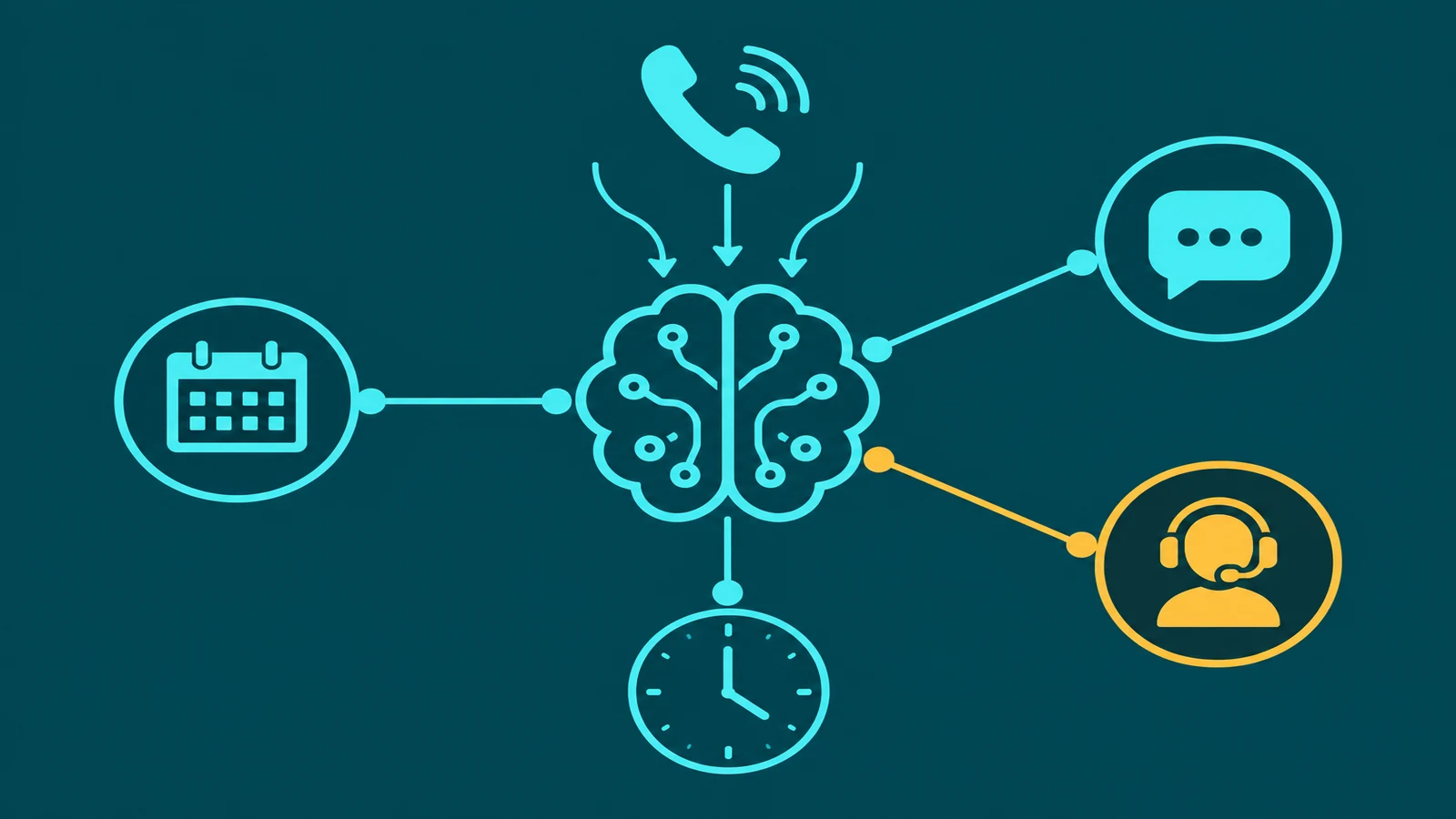
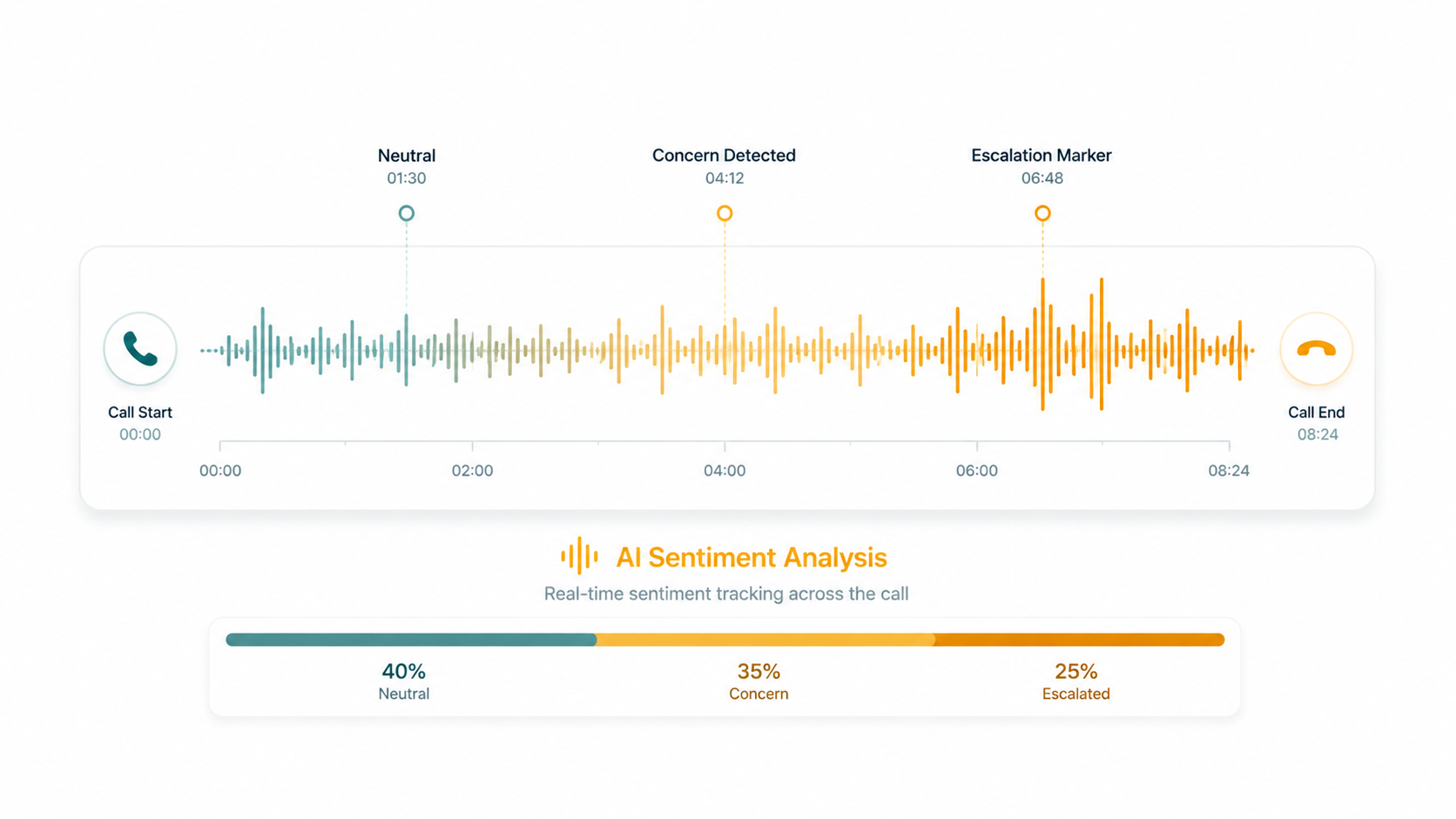
Call sentiment analysis is the automated process of classifying the emotional tone of a customer conversation — typically as positive, neutral, or negative — using natural language processing applied to transcripts or audio. It can operate at the whole-call level, producing a single score for an interaction, or at the segment level, tracking how sentiment shifts moment to moment throughout the conversation.
Sentiment analysis gives contact center teams a way to review more interactions than is possible through manual listening alone. Instead of a supervisor sampling ten calls a week, sentiment scoring can flag hundreds of conversations that warrant a closer look, surfacing patterns in customer frustration, escalation triggers, and agent communication styles that would otherwise go undetected.
Before going further: sentiment analysis provides probabilistic signals rather than objective measurements of a person's emotional state. A negative score means the system detected language or tone associated with dissatisfaction — not that the customer was definitively angry. Keeping that distinction in mind is essential to using sentiment data well.
How sentiment analysis works
From audio to text
Most sentiment analysis starts with transcription. Speech-to-text converts recorded or live call audio into a written transcript. Sentiment models then analyze that text to classify tone. This means transcription quality directly affects sentiment accuracy — poor transcription (heavy accents, cross-talk, background noise) produces unreliable sentiment scores. Live transcription enables real-time sentiment signals; post-call transcription enables sentiment at the analysis and reporting stage.
Some platforms also attempt acoustic sentiment detection — analyzing features of the audio signal itself (pitch, speaking rate, energy) to infer emotion without text. Acoustic-only approaches are generally harder to calibrate than text-based approaches and remain more experimental in commercial deployments. Text-based sentiment, working from clean transcripts, is currently the more reliable method.
The NLP classification process
Natural language processing models for sentiment are trained on large datasets of labeled text — conversations, reviews, social media posts — where human raters have tagged the emotional tone. The model learns which words, phrases, and patterns correlate with positive, neutral, or negative sentiment.
Common approaches include:
- Lexicon-based methods: Assign sentiment scores to individual words and aggregate them across the text. Fast and interpretable, but misses context and sarcasm.
- Machine learning classifiers: Trained models that evaluate phrases in context rather than word by word. More flexible, but dependent on the quality and representativeness of training data.
- Large language models (LLMs): Newer approaches using transformer-based models that understand conversational context more deeply. Better at nuance but computationally heavier.
Conversation-level vs. segment-level sentiment
A conversation-level score gives you a single label for the whole call: this interaction was negative, this one was positive. Useful for bulk sorting, report-level trend analysis, and flagging calls for QA review.
Segment-level sentiment maps tone across the timeline of the call — showing where sentiment shifted, when it spiked negatively, and whether a positive resolution came at the end despite a rocky middle. A call that started neutral, went negative at the three-minute mark when the customer was placed on hold, and recovered after the agent resolved the issue tells a different story than a call that was uniformly negative throughout.
Segment-level analysis is more computationally expensive and requires accurate transcript timestamps, but it provides the actionable detail that conversation-level scoring misses.
Agent sentiment vs. customer sentiment
In a two-party call, both speakers contribute to the interaction — and they do not always move in the same emotional direction. Sophisticated sentiment systems can differentiate between the agent channel and the customer channel, producing separate sentiment tracks for each.
This matters because the patterns can diverge meaningfully. A customer may arrive frustrated and soften by the end of the call as the agent resolves the issue. The agent may maintain a calm, professional tone throughout despite the customer's escalation. Or an agent's language may become clipped and dismissive partway through, which could itself be contributing to a customer's rising frustration. Separating the two tracks gives supervisors and quality analysts a clearer picture of what actually happened.
Agent sentiment is particularly useful for coaching: identifying calls where agent language patterns correlate with positive customer outcomes helps build best-practice playbooks for the whole team.
EaseDial Conversation Intelligence
Sentiment signals, transcripts, and AI summaries — on every call, in one platform.
Escalation detection
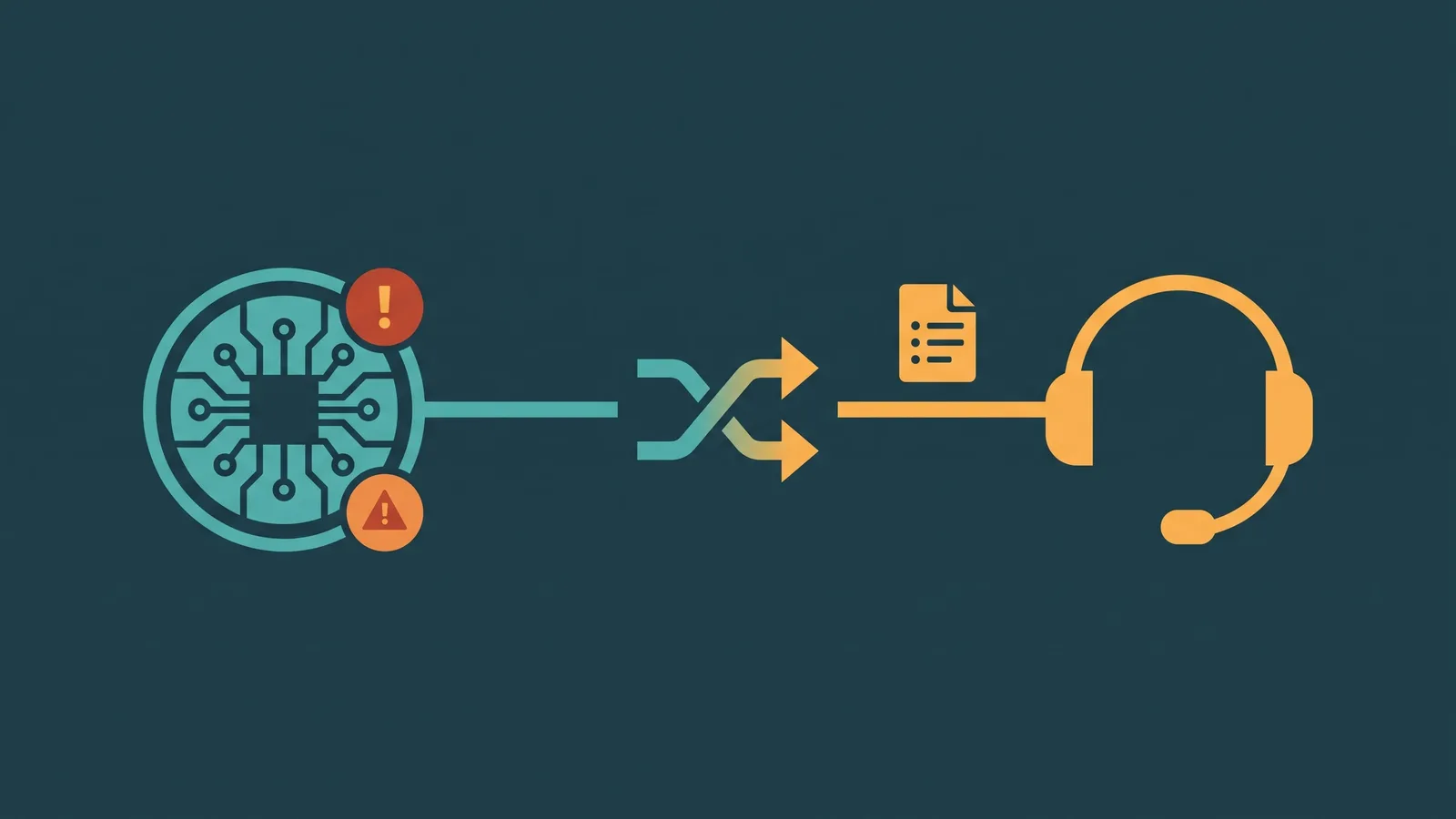
One of the highest-value applications of real-time sentiment is escalation detection — identifying calls that are deteriorating before they reach the point where a customer hangs up, requests a manager, or later submits a complaint.
Escalation signals typically include a combination of:
- Sustained or worsening negative customer sentiment over multiple consecutive segments
- Specific phrase detection — words or expressions associated with frustration or escalation intent
- Silences or interruptions that suggest the conversation has broken down
- Changes in speaking pace, raised volume in acoustic-aware systems
When these signals are detected in real time, the platform can alert a supervisor who can then decide to whisper-coach the agent, barge the call, or prepare to intervene. This is the live monitoring use case. For post-call analysis, escalation-flagged calls can be automatically queued for QA review rather than waiting for random sampling.
For more on supervisor intervention modes, see Listen, Whisper, Barge, and Intercept.
Quality assurance applications
Traditional QA involves a supervisor or quality analyst manually listening to recorded calls and scoring them against a rubric. The constraint is time: even large QA teams can only review a small fraction of total call volume.
Sentiment scoring changes the selection problem. Instead of random sampling, analysts can prioritize calls that were flagged as negative, calls where sentiment deteriorated sharply mid-call, calls where the agent's sentiment diverged from the customer's in concerning ways, or calls where specific trigger phrases appeared in the transcript.
This does not eliminate human review — it directs human attention to where it is most likely to surface quality issues. A sentiment flag is a reason to listen, not a verdict on the call.
Sentiment trends can also operate at the agent level: if one agent consistently produces calls with lower sentiment scores than their peers handling the same queue, that's a coaching signal worth investigating. If an entire queue's average sentiment declines following a product change or policy update, that's an operational signal about the change itself.
Using sentiment in customer experience programs
Sentiment analysis connects to customer experience programs in two ways. First, as a leading indicator: negative call sentiment can surface before a formal complaint is submitted or a customer churns. Second, as a complement to explicit feedback: pairing call sentiment scores with post-call CSAT surveys lets teams see where sentiment and explicit satisfaction align, and where they diverge — which is itself informative. A customer who gave a high CSAT score on a call that was scored negatively by the sentiment model may have been polite rather than genuinely satisfied, or the sentiment model may have mislabeled a complex interaction.
For more on formal satisfaction measurement, see What Is CSAT? and Contact Center Analytics.
Limitations you need to understand
The limitations of sentiment analysis are not footnotes — they are central to using the tool responsibly.
Sarcasm and irony
A customer saying "oh, that's just perfect" after a long hold may mean the opposite of what the words suggest. Sarcasm detection is one of the hardest problems in NLP. Most sentiment models assign the literal sentiment to sarcastic statements and score them incorrectly. The result is a false positive — a positive-looking score on a genuinely frustrated customer. Relying on sentiment scores without understanding this limitation can create misleadingly optimistic reporting.
Cultural and linguistic variation
Tone, expression, and communication norms vary significantly across cultures and languages. A customer from one cultural background may express dissatisfaction through formal restraint; a customer from another may express enthusiasm through emphatic language that a model could misclassify as negative. Models trained predominantly on one linguistic or cultural population often perform poorly on populations not well represented in their training data. If your contact center serves linguistically diverse customers, the accuracy of sentiment scores across different groups deserves scrutiny.
Non-native speakers
Non-native speakers may use phrasing that sounds unusual to a model trained on native speaker patterns, which can produce inaccurate sentiment classification independent of the customer's actual emotional state.
Voice-based acoustic detection
When sentiment is derived from acoustic features — pitch, energy, pace — rather than text, the model has less semantic information to work with. Acoustic sentiment is more prone to misclassifying based on a speaker's natural speaking style rather than their emotional state. A customer who naturally speaks quickly or at high volume may consistently score as negative even when they are not particularly dissatisfied.
Training data generalization
Sentiment models trained on one type of conversation (social media posts, product reviews, general customer service) may not generalize well to specialized contact center contexts — technical support, financial services, healthcare — where industry-specific language and communication norms differ from general consumer interaction patterns.
The fundamental limitation
Sentiment analysis provides probabilistic signals rather than objective measurements of a person's emotional state. A negative classification means the model found patterns associated with negative sentiment — not that the customer was definitively in a negative emotional state, and not that the call was definitely a poor experience. Treating sentiment scores as certainties rather than signals leads to incorrect conclusions and poor decisions.
Frequently Asked Questions
Putting sentiment analysis in context
Sentiment analysis is most valuable when treated as one layer of a broader quality and analytics program rather than a standalone score. Combined with transcripts, call summaries, CSAT data, and QA rubrics, sentiment signals help teams identify patterns at scale that would be impossible to find through manual review alone. The practical discipline is using those signals to direct human judgment — not to replace it.
For the transcription layer that underpins sentiment analysis, see Real-Time Call Transcription. For the broader analytics context, see Contact Center Analytics and AI in Contact Centers.