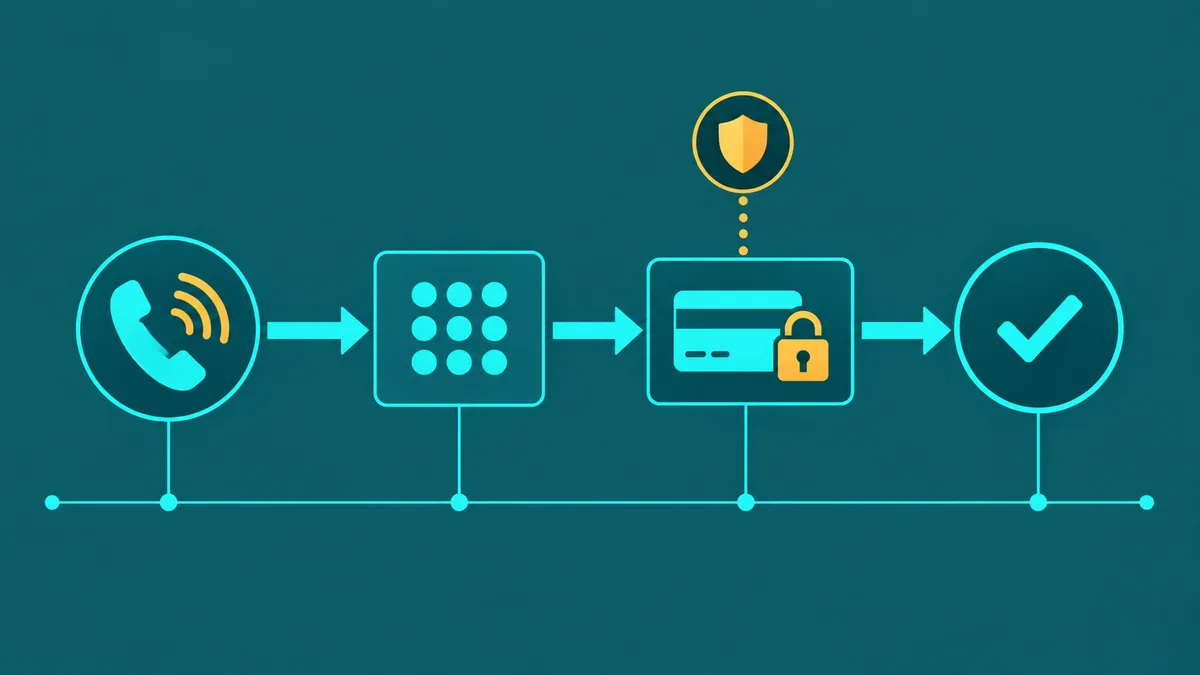
IVR payment processing lets customers pay bills, invoices, copays, and account balances over the phone without speaking to a live agent. The caller navigates a voice menu, enters payment details using their phone's keypad, and the IVR system securely transmits that data to a payment gateway — all without any human involvement in the transaction. For businesses that handle high inbound payment call volume, IVR self-service payment dramatically reduces agent handle time, extends payment availability to 24/7, and lowers the cost per transaction.
The model is particularly valuable in industries where payment calls are routine and predictable — utilities, healthcare providers collecting copays, financial services companies processing loan payments, and subscription businesses handling renewals. This guide explains how IVR payment processing works end to end, the PCI DSS compliance requirements it creates, when it makes operational sense, and how to evaluate a platform for deployment.
What is IVR payment processing
IVR payment processing is a phone-based self-service payment channel. When a customer calls the business's billing number, an IVR (Interactive Voice Response) system answers, presents a payment menu, prompts the customer to enter their payment details via DTMF keypad tones, transmits those details securely to a payment gateway, receives a transaction result, and plays a confirmation message to the caller — all without a live agent involved at any point in the payment flow.
The DTMF (Dual-Tone Multi-Frequency) input is the keypad entry mechanism. When a caller presses a digit on their phone, the phone transmits a specific audio tone combination that the IVR system interprets as that digit. Card numbers, expiration dates, CVV codes, and ZIP codes are all collected this way. The IVR encodes this input and transmits it to the payment gateway over an encrypted API connection. The gateway processes the transaction against the card network and returns an approval or decline, which the IVR converts back into a spoken confirmation for the caller.
Crucially, the payment data in a well-architected IVR payment system never touches the business's own infrastructure in readable form — it flows directly from the IVR to the payment gateway using tokenization or point-to-point encryption, which is the mechanism by which PCI DSS scope reduction is achieved.
What is IVR payment processing? IVR payment processing is a self-service payment system that lets callers pay by phone using their keypad — entering card or account details through DTMF tones that the IVR collects and transmits directly to a payment gateway for authorization. Because payment data flows from the IVR to the gateway without passing through agent-handled systems, IVR payment processing reduces PCI DSS compliance scope and allows businesses to accept payments 24/7 without agent intervention. See our full IVR system guide for background on how IVR technology works.
PCI DSS compliance for IVR payments
Accepting card payments over the phone creates PCI DSS (Payment Card Industry Data Security Standard) obligations. The scope of those obligations — how many systems and controls must be formally assessed — depends heavily on how the IVR payment system is architected. For a broader look at UCaaS security and compliance requirements that apply across your phone infrastructure, see our dedicated guide.
Scope reduction through hosted payment IVR. When a third-party hosted IVR payment platform handles the entire payment collection and transmission, the business's own systems may be fully out of PCI DSS scope for that payment channel. The payment data never enters the business's network in any readable form. The IVR vendor holds the PCI DSS compliance burden. This is the lowest-complexity compliance path for most businesses.
DTMF masking. DTMF masking suppresses the audio tones generated by the caller's keypad so that call recordings do not capture card digits. Without DTMF masking, a recording of an IVR payment call would contain the audible tones representing the card number — which would be a PCI DSS violation if those recordings are stored in the business's environment. Any IVR payment solution used in conjunction with call recording must implement DTMF masking as a baseline control.
Pause-resume recording. In agent-assisted payment scenarios — where an agent hands off to IVR only for the payment entry portion — call recording must pause before the caller enters card data and resume after the transaction is complete. The pause-resume control ensures the card entry segment is never captured in a recording. This is a standard capability in contact center platforms that support PCI-compliant agent-assisted payment flows.
P2PE (Point-to-Point Encryption). P2PE solutions encrypt cardholder data at the point of entry — in the IVR — before it traverses any network. Combined with a PCI-validated P2PE solution, this can significantly reduce the PCI DSS scope for the business's network and infrastructure. P2PE is most commonly deployed in card-present retail environments but applies to IVR payment channels as well when the payment solution supports it.
IVR payment processing flow step by step
The following is a standard IVR payment processing flow from the caller's first interaction to the final confirmation:
- Caller dials the billing or payment phone number. The call is answered by the IVR system. The main menu greets the caller and presents options including "Pay your bill" or "Make a payment."
- Caller authenticates. The IVR prompts for account identification — typically an account number, phone number on file, or last four digits of a social security number — to look up the account and confirm the caller is authorized to make a payment.
- IVR retrieves account balance. The system queries the business's billing database or CRM via a secure API to retrieve the outstanding balance and presents it to the caller: "Your current balance is $127.50."
- Caller confirms payment amount. The caller either accepts the full balance or enters a specific payment amount using the keypad.
- IVR collects payment method details. The caller enters card number, expiration date, CVV, and ZIP code via DTMF keypad. DTMF masking is active during this phase if call recording is in use.
- IVR transmits to payment gateway. The collected data is encrypted and transmitted via API to the payment gateway (e.g., Stripe, Braintree, Authorize.Net, or a bank-direct gateway) for authorization.
- Gateway returns authorization result. The payment gateway approves or declines the transaction and returns a result code and a confirmation or decline reason to the IVR.
- IVR plays confirmation message. On approval: "Your payment of $127.50 has been processed. Your confirmation number is 482917. Thank you." On decline: "We were unable to process that card. Please verify the information and try again, or press 0 to speak with an agent."
- Confirmation sent. Optionally, a payment confirmation SMS or email is triggered automatically to the customer's contact on file.
IVR payment vs agent-assisted payment
Both IVR self-service and live-agent payment collection are legitimate channels. The right mix depends on call volume, customer demographics, payment complexity, and compliance capacity.
| Dimension | IVR Payment Processing | Agent-Assisted Payment |
|---|---|---|
| Availability | 24/7 without staffing cost | Limited to staffed hours unless 24/7 center |
| Cost per transaction | Low — no agent handle time | Higher — agent time at fully-loaded cost per minute |
| PCI DSS scope | Reduced — card data handled by IVR/gateway only | Broader — agent workstation, headset, and recording environment in scope |
| Caller experience | Fast for simple payments; frustrating for complex billing disputes | Flexible — agent can address disputes, apply credits, or explain charges |
| Error handling | Limited — IVR can retry but cannot handle complex exceptions | Full — agent can override, escalate, or apply manual adjustments |
| Scale | Scales linearly without adding headcount | Requires proportional staffing increase for volume growth |
When IVR payment processing makes sense
IVR payment processing delivers the strongest ROI in situations where payment calls are high in volume, predictable in structure, and low in complexity. The following use cases represent the most common and highest-value deployments:
Utilities (electric, gas, water, telecom). Utility billing generates massive inbound payment call volume — monthly billing cycles produce predictable spikes. Payments are structurally simple (pay the current bill or a specific amount), and the caller already has their account number on the bill in front of them. IVR payment self-service containment rates of 70–85% are achievable in utility billing environments, dramatically reducing agent load.
Healthcare copay collection. Medical practices, hospitals, and health systems receive high volumes of payment calls from patients paying copays, deductibles, and outstanding balances. IVR payment is HIPAA-compatible when configured correctly (the payment portion is financial data, not PHI, but the authentication step — using account numbers rather than patient identifiers — should be designed carefully). Patients calling to make routine payments prefer self-service to waiting on hold for an agent.
Loan and mortgage payments. Financial services companies — auto lenders, personal loan providers, mortgage servicers — process high volumes of routine monthly payments. IVR payment allows customers to make payments at any time, including outside business hours when a significant portion of payment calls occur. ACH bank transfer integration alongside card payment expands the payment method options relevant to this sector.
Subscription renewals and past-due accounts. Subscription businesses with past-due account recovery workflows benefit from IVR payment because a customer willing to call in and pay is in active intent to resolve the balance — the self-service path should be as frictionless as possible. Outbound IVR campaigns that call past-due customers and offer an immediate payment option are a distinct but related application of the same technology.