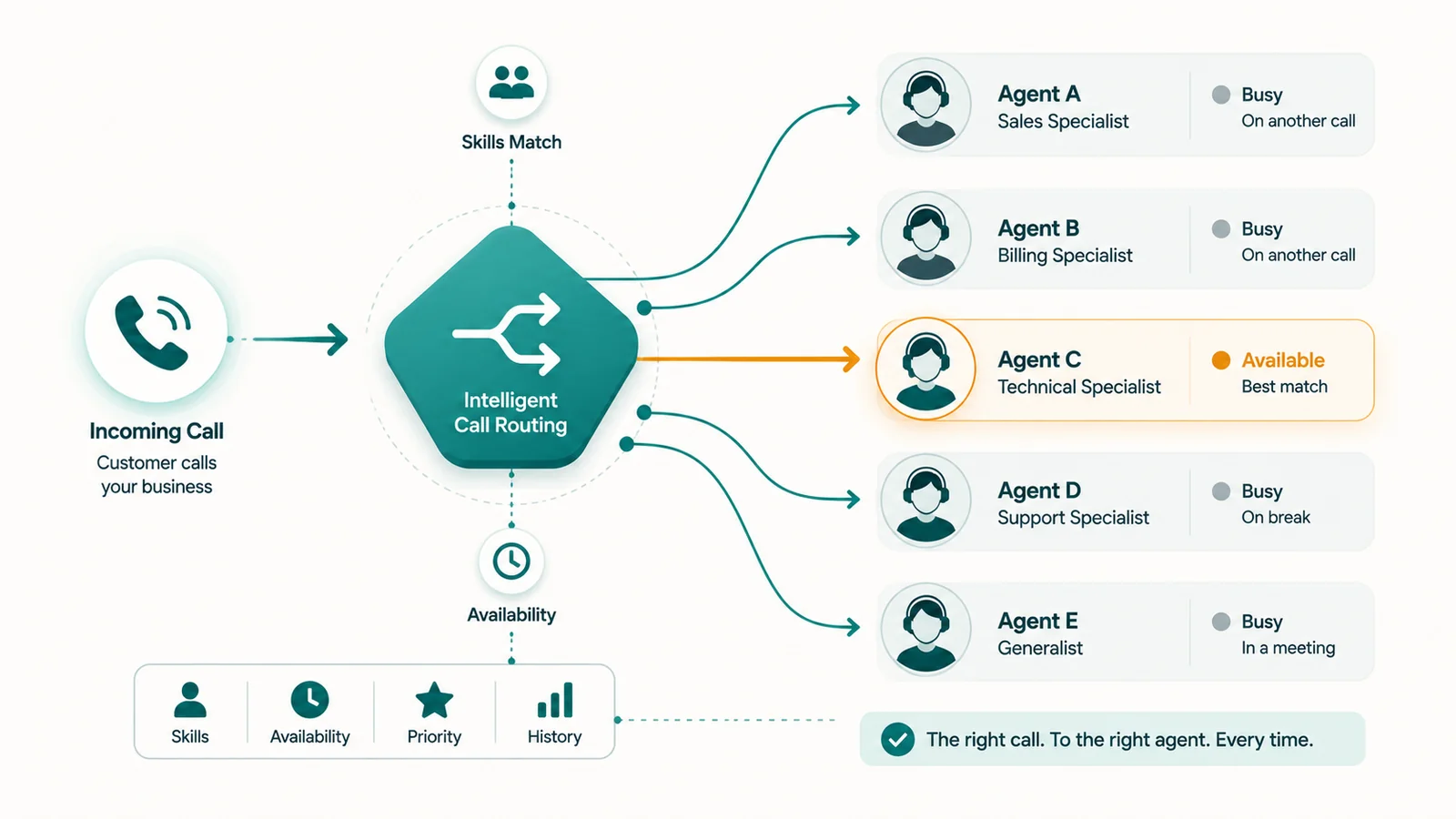
Every contact center routing decision is a bet — that the right agent will answer the right call at the right moment. When that bet pays off, first-call resolution climbs, transfers drop, and customers don't have to repeat themselves. When it fails, the signal is immediate: abandonment rises, transfer counts spike, and CSAT scores flatline despite headcount investments.
Routing strategy is the lever most operations teams underestimate. Changing from round-robin to skills-based routing in the right environment can lift FCR by several percentage points — and SQM Group's multi-year research shows that every 1% gain in first-call resolution reduces operating cost by 1% and raises customer satisfaction by 1%. For a mid-size contact center, a single percentage point of FCR improvement translates to roughly $286,000 in annual savings.
This guide covers the full picture: what call routing is technically, all the major routing strategies with honest trade-offs, a framework for choosing the right strategy, configuration requirements, what to measure, the most common mistakes, and where AI-powered routing is heading in 2025–2026.
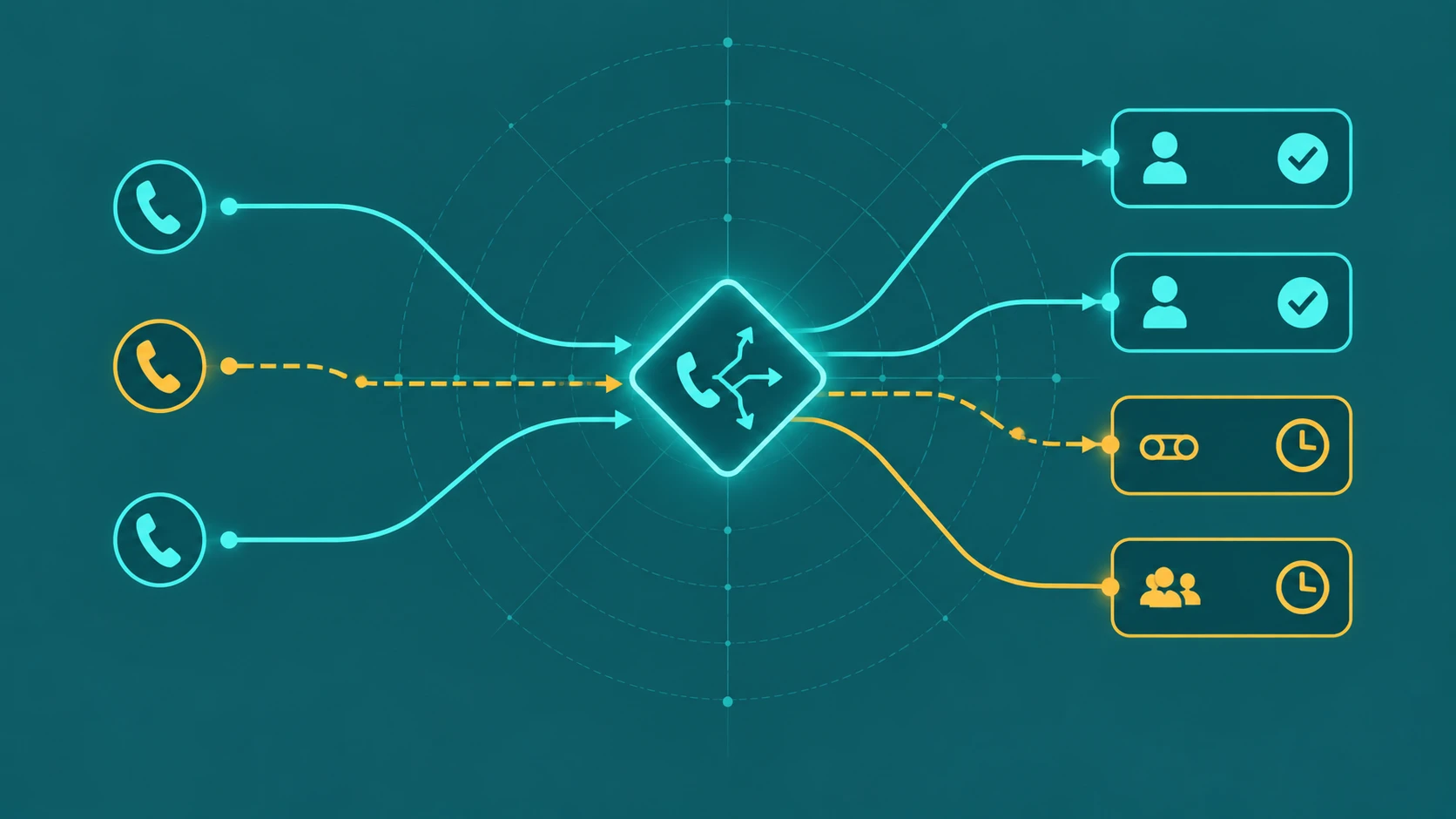
What is call routing? Call routing is the automated process of directing inbound phone calls to the appropriate agent, queue, or automated system based on predefined rules or AI-driven analysis. It relies on two core components: an IVR (Interactive Voice Response) system that collects caller intent, and an ACD (Automatic Call Distributor) that executes the routing decision and dispatches the call to the right destination.
How Call Routing Works: The Technical Architecture
Call routing is not a single technology — it is a chain of systems operating together. Understanding where each component sits helps when diagnosing problems or configuring new routing logic.
When a customer dials your number, the call travels from the PSTN (public switched telephone network) or a VoIP carrier through a SIP trunk to your contact center platform. From there, it passes through three stages:
- Qualification: An IVR or AI voice bot greets the caller and collects routing signals — menu selection, spoken intent, account number, language preference. A CRM lookup may run in parallel, pulling the caller's account tier, history, and open cases. Without this stage, the ACD has only the caller's phone number and the number they dialed to work with.
- Queuing: The ACD places the call in a logical queue and applies prioritization logic. High-value customers may jump ahead; callers who have been waiting longer may have their priority score increased over time.
- Distribution: When an agent becomes available, the ACD runs its matching algorithm — which algorithm depends on the configured routing strategy — and dispatches the call. A CTI (Computer Telephony Integration) system delivers a screen-pop to the agent's desktop so they see customer context before picking up.
A common misconception is that IVR and call routing are the same thing. They are not. The IVR is the input layer; the ACD is the execution layer. IVR feeds the signals; ACD makes the decisions. Confusing them leads to over-engineering menus when the real problem is distribution logic, or vice versa.
This separation also matters for troubleshooting. High abandonment during the IVR stage points to menu design problems — menus that are too deep, options that don't match caller needs, or no escape to a live agent. High transfer rates after connection point to ACD routing logic problems — mismatched skills, missing fallback rules, or outdated routing profiles.
The Complete Routing Strategy Taxonomy
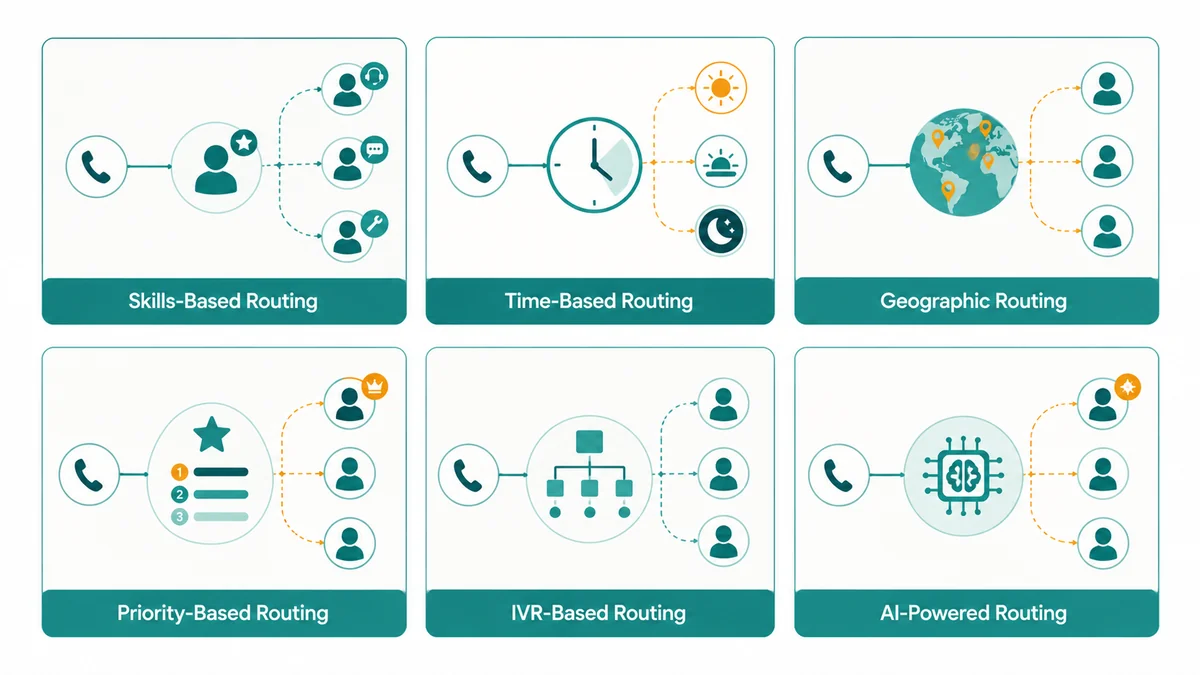
Modern contact center platforms support a wide range of routing strategies, from genuinely simple to highly sophisticated. They are not ranked by quality — each exists because it solves a specific operational problem. The right strategy depends on team size, call type, and what you're trying to optimize.
1. Ring-All (Simultaneous Ringing)
Every available agent in a ring group receives an alert at the same moment. The first agent to answer takes the call; all other alerts cancel immediately.
Best for: Small teams of 2–10 agents handling uniform call types; sales teams where speed of first contact is the priority. Ring-all minimizes time-to-answer — it is the fastest strategy available.
The trade-off: It bypasses any skill-matching logic entirely and creates a "race to answer" dynamic that rewards speed over competence. It also does not scale — alerting 50 agents simultaneously to find one who answers is disruptive and inefficient.
2. Round-Robin
The ACD maintains a rotating pointer and sends each new call to the next agent in the list. Agent A gets call 1, Agent B gets call 2, Agent C gets call 3, then back to Agent A for call 4. If an agent is unavailable, the pointer advances to the next available agent.
Best for: Teams with comparable agent capabilities handling uniform call types — IT helpdesks, appointment scheduling, order status. The goal is even call volume distribution.
The trade-off: Round-robin distributes calls equally regardless of agent expertise or performance history. A top performer and a new hire receive the same volume. It also does not account for wrap-up time — an agent who takes longer to complete after-call work may be marked "available" by the ACD before they are genuinely ready.
3. Linear / Sequential (Fixed Order)
Unlike round-robin, sequential routing always starts from position 1 for every new call. Agent #1 is tried first; only if unavailable does the ACD cascade to Agent #2, then Agent #3.
Best for: Primary-agent + backup scenarios — a dedicated account manager (position 1) who handles all calls from an account, with a backup (position 2) if they are occupied. Natural escalation paths where you want the most senior agent to handle calls whenever possible.
The trade-off: Severe workload imbalance. Agent #1 is continuously overloaded; agents in lower positions rarely develop expertise from lack of call volume.
4. Longest-Idle
The ACD tracks how long each agent has been idle since their last call ended. The next incoming call goes to whichever available agent has been waiting the longest.
Best for: High-volume centers with uniform call types where workload fairness matters and all agents are interchangeable. Good at eliminating idle-time disparity across shifts.
The trade-off: Ignores agent expertise and current workload beyond idle duration. In a multi-skill environment, "idle" is tracked globally — not per skill group — which can produce counterintuitive routing in specialized queues.
5. Least-Occupied
The ACD routes to the agent currently managing the fewest active interactions across all channels. In a voice-only environment, this is effectively equivalent to longest-idle. Its power emerges in omnichannel environments where agents simultaneously handle voice calls, chats, and emails.
Best for: Blended agents managing multiple channels concurrently. Prevents any one agent from becoming a bottleneck while others sit idle.
The trade-off: Requires accurate real-time interaction counting across all channels. If email drafts or chat sessions in wrap-up state are miscounted as active, routing decisions become unreliable.
6. Random
Each call is assigned to a randomly selected available agent with no sequential, workload, or expertise logic applied.
Best for: The smallest operations (2–3 people) where all agents are interchangeable and any fairness concern is moot. Also useful as a control condition in A/B routing experiments.
The trade-off: Offers no workload guarantee, no skill matching, and no performance optimization. Chance clustering (the same agent randomly selected multiple times in a row) is a real possibility at low call volumes.
7. Skills-Based Routing
Each agent carries a skills profile — a documented set of capabilities (languages, product knowledge, certifications, issue types) with a proficiency score, typically on a 1–10 scale. Each incoming call carries a skill requirement. The ACD matches call requirements to agent profiles and routes to the highest-proficiency available match.
This is the most impactful routing strategy for contact centers with diverse call types. SQM Group's research attributes 60% of first-call resolution failures to agents lacking the right data or resources — skills-based routing addresses this directly by ensuring the call reaches an agent equipped to resolve it.
Best for: Contact centers with product specialization, multilingual requirements, technical tiers, or regulated industries where expertise directly affects compliance outcomes. The threshold for justified implementation is roughly 25+ agents across at least three meaningful skill groups.
The trade-off: Highest configuration complexity of any rule-based strategy. Skills databases degrade silently — an agent trained in billing six months ago and moved to sales still appears as "billing specialist" in the routing profile until someone updates it. Erlang-C, the traditional staffing formula, breaks down under skills-based routing because agents are no longer interchangeable; operational simulation is needed for accurate workforce planning. Independent research also notes that poorly implemented SBR can produce worse outcomes than simpler routing methods — the gains require genuine maintenance commitment.
See also: IVR systems and how they feed intent signals to skills-based routing queues. For a full treatment of skills matrix design, proficiency scoring, fallback rules, and ongoing maintenance, see how skills-based call routing works.
8. Priority Routing
Each call is assigned a numerical priority score based on caller identity, account tier, urgency, or call purpose. Higher-priority calls are served before lower-priority calls, even if they arrived later. Calls of equal priority are handled first-in, first-out within their tier.
Priority signals typically come from: CRM account tier lookup via the caller's phone number, IVR input ("press 1 for urgent"), dedicated high-priority inbound numbers (DNIS), or time-in-queue decay (priority increases as wait time grows to prevent permanent starvation).
Best for: Tiered customer bases with contractual SLA obligations — enterprise vs. mid-market vs. SMB. Healthcare urgency triage. Any environment where certain call types carry legal or financial urgency.
The trade-off: Low-priority callers can wait very long during sustained high-priority volume. First-time callers without CRM history receive default (often low) priority — configure a reasonable default and a time-decay escalation to prevent indefinite queuing. For a deeper look at priority level configuration, aging mechanics, and starvation prevention, see call queue priority: how priority queuing works.
9. VIP Routing
VIP routing is about destination, not just queue position. A VIP customer — identified by phone number, CRM flag, or authentication — bypasses the general queue entirely and reaches a dedicated team or dedicated agent. They may encounter no IVR, or a streamlined one. They rarely wait.
This is distinct from priority routing, which speeds up queue position but keeps the caller in the same agent pool. VIP routing places the caller on a fundamentally different service path. For a deeper look at identification methods, queue bypass logic, and dedicated-agent pooling, see the VIP call routing guide.
Best for: Enterprise accounts, top loyalty tier members, strategic partners, high-net-worth customers in financial services. Any segment where relationship quality directly drives retention and revenue.
The trade-off: Dedicated agents serving VIP traffic reduce the available pool for everyone else. VIP lists must be actively maintained — phone number changes, new customers, lapsed customers. Over-designating VIPs (30%+ of your base) dilutes the experience and creates a bottleneck in the dedicated queue.
10. Time-Based / Schedule-Based Routing
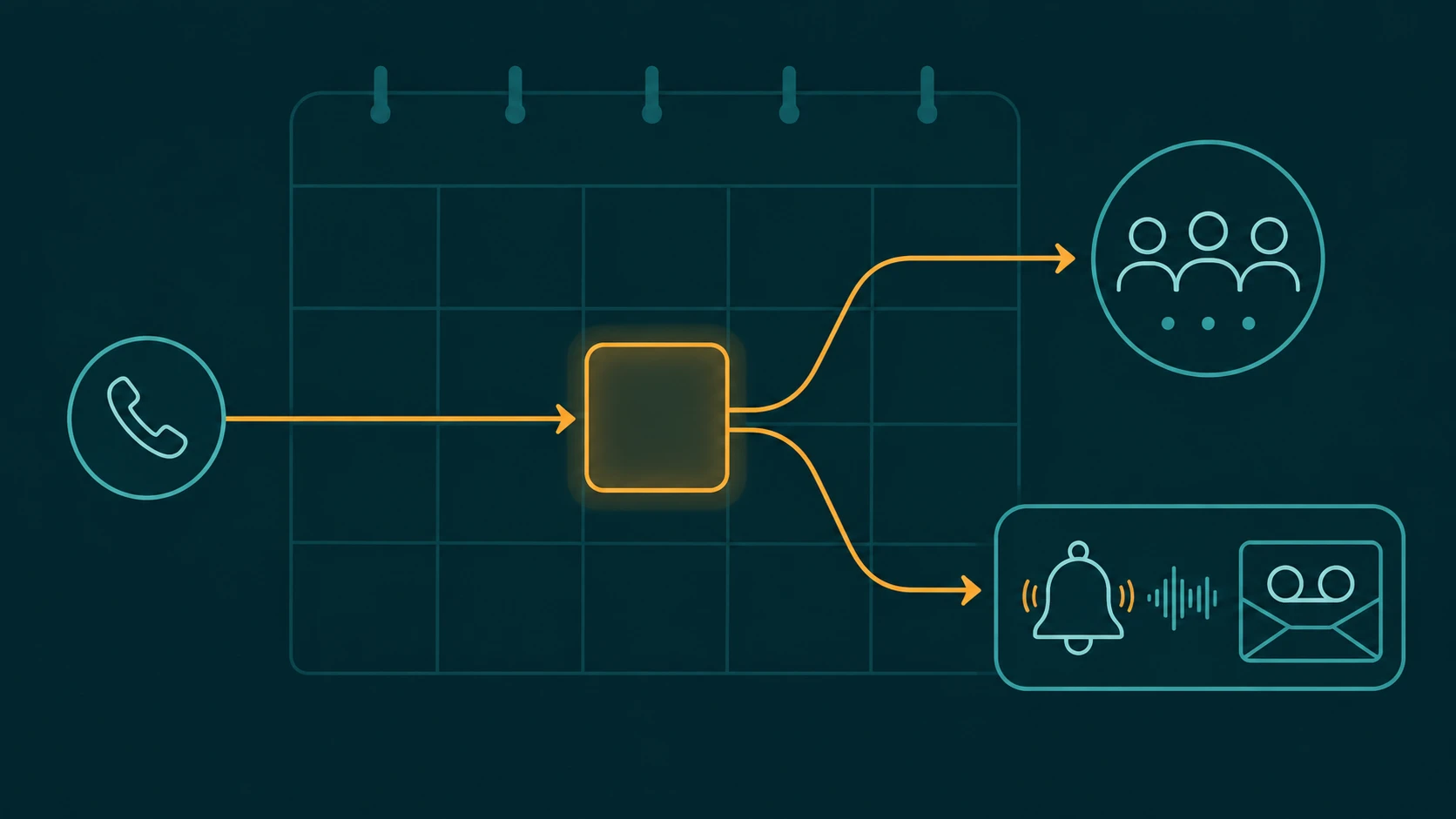
The ACD routes calls differently based on when they arrive — time of day, day of week, or specific calendar dates. A call arriving at 10am Monday goes to the main queue; the same call at 10pm Saturday routes to an after-hours IVR with a callback option.
"Follow-the-sun" is a time-based pattern where calls automatically transfer between regional contact centers as each location closes — maintaining 24/7 coverage without overnight staffing at any single site.
Best for: Any organization with defined business hours, multiple time zones, or seasonal patterns. Simple to implement; essential to get right.
The trade-off: Schedule-based routing cannot adapt to real-time events — an unexpected closure, illness-driven understaffing, or a sudden volume spike. It requires accurate schedule data; an unlogged public holiday routes callers to an empty queue. Configure a manual override for unplanned closures and test all schedule edge cases before go-live. For detailed time-of-day configuration including DST handling and multi-timezone support, see time-based call routing.
11. Geographic Routing
The ACD determines caller location — from area code, DNIS (the caller used a region-specific number), ZIP code entered in IVR, or GPS data from a mobile app — and routes to the team or office serving that region.
Best for: Multi-location businesses needing to connect customers to regional offices; franchise networks where service is location-dependent; dispatch operations routing field technicians; businesses with state-level licensing or compliance requirements (insurance agents, financial advisors).
The trade-off: Location takes priority over other variables. A caller in Region A who needs a skill available only in Region B will be misrouted unless fallback logic is configured. Area codes and VoIP numbers do not reliably identify physical location — a New York caller with a California VoIP number routes to the West Coast team. The geographic call routing guide covers location-detection methods and fallback strategies in detail.
12. Percentage-Based Routing
Traffic is split across multiple destinations — queues, contact centers, outsourcing partners — according to configured percentages. If Site A is set to 70% and Site B to 30%, the ACD distributes approximately 70 of every 100 calls to Site A over any large sample.
Best for: Multi-site operations of different sizes (the larger site gets proportionally more traffic); overflow management (primary site handles 80%, overflow BPO handles 20%); A/B testing routing changes on a portion of traffic before full deployment; gradual new-hire ramp (10% of calls to trainees initially).
The trade-off: Distributes volume, not expertise. At low call volumes, statistical convergence is slow — actual distribution can diverge meaningfully from configured percentages. A site receiving 10% of traffic may still be overwhelmed if the 90% site goes down.
13. Preferred Agent Routing (Sticky Agent)
When a returning caller contacts the center, the system identifies the specific agent they last spoke with (within a lookback window, commonly 30 days) and preferentially routes to that individual if they are available. If unavailable, the call routes to any available agent in the queue — or, in strict sticky mode, the caller waits exclusively for that agent up to a timeout.
Best for: Relationship-intensive industries — account management, health insurance case management, insurance claims, financial advisory. Operations where repeating context between calls wastes significant time and erodes trust.
The trade-off: Increases wait times when the preferred agent is occupied. The agent may no longer be the most skilled for the caller's current need (role changes, training gaps). Agents who leave the company must have their preferred routing reassigned — without a departure protocol, returning callers route to a vacant extension. In Genesys Cloud's implementation, preferred agent routing is also incompatible with certain WFM planning group configurations.
14. Bullseye Routing
Bullseye routing is a time-based expansion wrapper that sits on top of skills-based routing. The ACD targets the most ideally matched agents first (the inner ring). If no match is available within a configured timeout, the eligible pool expands — like concentric rings on a target — until a match is found or a final fallback triggers.
A typical configuration might look like: Ring 1 (0–60 seconds): agents with Billing + Spanish + Enterprise certification, proficiency 8+. Ring 2 (60–150 seconds): same skills, proficiency 6+. Ring 3 (150–300 seconds): Billing + Spanish, any proficiency. Ring 4 (300s+): general billing queue. The inner rings always retain priority — if a Ring 1 agent becomes available before a Ring 2 agent answers, Ring 1 takes the call.
Best for: Enterprise contact centers with mature skills-based routing where service levels cannot be sacrificed waiting for the perfect skill match. Particularly valuable during peak volume periods when ideal-match agents are all occupied.
The trade-off: Highest configuration complexity of any routing strategy. Ring structures require careful design — outer rings that are too broad defeat the purpose of skills-based routing entirely. Poorly designed rings produce unintended cascades. Requires regular maintenance as agent rosters and skill profiles change.
15. AI / Predictive Behavioral Routing
AI routing replaces static rule matching with machine learning. Rather than routing to the agent with the right skill tag, the system scores every currently available agent against the specific caller using a trained model — and routes to the agent predicted to produce the best outcome (highest FCR probability, lowest AHT, highest CSAT, or highest conversion).
The process runs in four stages. First, a speech recognition and NLU model classifies the caller's intent from their opening statement, achieving 90–95% accuracy in current deployments. Second, the CRM and interaction history are queried to build a customer profile. Third, every available agent is scored using historical performance data (FCR rate by call type, CSAT, AHT, time-of-day variation, current fatigue signals). Fourth, the call routes to the top-scoring available agent — the entire inference pipeline must complete in under 200ms to avoid perceptible added latency.
Outcome data (resolution, CSAT, escalation, handle time) feeds back into continuous model retraining. The system improves over time as it accumulates more outcome observations.
Best for: High-volume contact centers with 6+ months of historical call records and outcome data; operations where rule-based routing has plateaued and further FCR or CSAT improvement requires a more nuanced match; organizations with the technical infrastructure to support model hosting and integration.
The trade-off: Cold-start problem — a new platform with no historical data produces unreliable predictions initially. Data quality dependency — stale CRM records or inconsistent CSAT collection degrade model accuracy. AI routing is typically a premium add-on or enterprise tier, adding meaningful cost. Routing decisions become difficult to explain to agents or for compliance auditing. Analyst estimates of AI's long-term labor cost impact in contact centers vary widely, but any outcome depends on integration quality, not vendor marketing claims.
Related reading: AI voice agents and how they interact with intelligent routing in modern contact centers; AI in contact centers for broader context on where AI creates measurable value.
EaseDial Call Routing
Configure skills-based, time-based, and AI routing from a single platform — without enterprise complexity or pricing.
Strategy Comparison Table
The table below summarizes all 15 strategies across key selection criteria. "Complexity" refers to configuration and maintenance effort; "Skill-match" indicates whether the strategy uses agent expertise as a routing variable.
| Strategy | Best For | Team Size | Complexity | Skill-Match | Fairness |
|---|---|---|---|---|---|
| Ring-All | Speed of answer; sales teams | 2–10 | Minimal | No | Low |
| Round-Robin | Uniform call types; helpdesks | 5–100+ | Minimal | No | High |
| Sequential | Primary + backup; cascades | 2–20 | Minimal | No | Low |
| Longest-Idle | Workload fairness; uniform queues | 10–200 | Low | No | High |
| Least-Occupied | Omnichannel; blended agents | 10–200 | Low–Medium | No | High |
| Random | Tiny teams; A/B control groups | 2–5 | Minimal | No | Unpredictable |
| Skills-Based | Specialized queues; multilingual; tech tiers | 25+ | High | Yes | Medium |
| Priority | Tiered customers; SLA obligations | Any | Medium | Optional | Intentionally unequal |
| VIP | Enterprise accounts; high-value segments | Any | Medium | Optional | N/A (by design) |
| Time-Based | Business hours; follow-the-sun; after-hours | Any | Low–Medium | No | N/A |
| Geographic | Multi-location; regional compliance | Any | Medium | No | N/A |
| Percentage-Based | Multi-site load balancing; A/B testing | Any | Low | No | Configurable |
| Preferred Agent | Relationship continuity; case management | 25+ | Medium | Indirect | Low |
| Bullseye | Enterprise SBR with SLA protection | 100+ | Very High | Yes | Medium |
| AI / Predictive | High-volume; FCR/CSAT optimization | 100+ | Very High | Yes (ML-driven) | Model-dependent |
How to Choose the Right Routing Strategy
The goal is not to use the most sophisticated strategy available — it is to match the strategy to the actual operational problem. Over-engineering routing adds configuration cost and ongoing maintenance without proportional benefit.
By team size
For teams under 15 agents handling similar call types, ring-all, round-robin, or longest-idle cover 90% of needs. Add time-based routing for business hours and you have a complete, maintainable setup. Skills-based routing at this scale usually means two or three skill groups — and it is worth implementing if those groups genuinely matter for outcome quality.
For 25–100 agents, skills-based routing typically becomes worthwhile. Specialization is happening organically; routing should reflect it. Layer in priority routing if you have a tiered customer base, and preferred agent routing for any segment where relationship continuity drives retention.
Above 100 agents, bullseye routing becomes the practical architecture for balancing quality-of-match against service level. AI routing makes sense as a next layer if you have 6+ months of outcome data and the technical infrastructure to support it.
By call type
Inbound sales calls prioritize speed — ring-all or round-robin. Technical support with complexity tiers needs skills-based routing. Healthcare scheduling requires skills-based routing (triage, department) plus time-based after-hours routing. Financial services with account tiers uses priority routing plus VIP routing for top segments. Multi-location field service uses geographic routing combined with time-based coverage windows.
By performance goal
If your primary goal is reducing transfers, implement skills-based routing. Transfer rate is the leading indicator of routing failure — the industry benchmark is 19%, and anything above 25% signals misconfigured routing logic.
If your goal is reducing abandonment, focus on time-based routing (ensure after-hours calls have a valid destination), queue callback options, and IVR menu simplification. Industry average abandonment is around 6%; best-in-class centers achieve under 3%.
If your goal is improving CSAT, preferred agent routing and skills-based routing address the two most common sources of dissatisfaction: being transferred and having to repeat yourself.
If your goal is reducing cost per contact, conversational AI at the IVR stage — deflecting tier-1 interactions without a human agent — delivers the most significant unit cost reduction. IVR-handled calls cost approximately 100 times less than agent-handled calls, according to Twilio's routing data.
Routing Configuration Requirements
Each strategy has specific prerequisites. Skipping them is why routing implementations underperform.
| Strategy | What You Need Before Configuring |
|---|---|
| Ring-All / Round-Robin / Sequential | Agent group definition; no-answer timeout; fallback destination |
| Longest-Idle / Least-Occupied | Accurate real-time agent state tracking; defined after-call work states |
| Skills-Based | Skills taxonomy; proficiency scoring (1–10); IVR intent collection; CRM integration; overflow queue; monthly skills audit process |
| Priority | CRM account tier data; ANI lookup integration; priority score rules; time-decay escalation to prevent indefinite low-priority wait |
| VIP | CRM VIP flag; ANI lookup at call arrival; dedicated queue or ring group; dedicated agent assignment; maintained VIP number list |
| Time-Based | Schedule profiles (business hours, after-hours, weekend, holidays); fallback destination per window; manual override capability; time zone settings |
| Geographic | Location-to-destination routing table; DNIS/ANI lookup database or IVR ZIP capture; regional queue fallback |
| Percentage-Based | Weighted distribution algorithm; real-time admin adjustment access; reporting to verify actual vs. configured split |
| Preferred Agent | ANI-to-agent mapping in CRM; lookback window; unavailability handling rule; agent departure protocol to reassign preferred routing |
| Bullseye | Full SBR implementation first; ring structure design (2–6+ rings); timeout threshold per ring; expansion mechanism choice; overflow destination |
| AI / Predictive | 6+ months of historical call records with outcomes; CRM integration; ACD API access; NLU model; sub-200ms inference endpoint; CSAT/FCR data collection; MLOps infrastructure |
Call Routing Metrics: What to Measure
Routing quality is not visible in the call volume dashboard. These are the metrics that actually tell you whether your routing strategy is working.
Transfer rate is the most direct indicator of routing logic quality. The industry standard is 19%; strong operations achieve 15% or below. Anything above 25% means callers are consistently reaching the wrong agent on first routing.
First-call resolution (FCR) measures whether the caller's issue was resolved without needing to call back. Industry average is 70%; best-in-class operations achieve 80%+. FCR improvement is the most financially significant outcome of good routing — SQM Group's research shows each 1% FCR gain reduces operating cost by approximately 1%.
Abandonment rate reflects whether callers are giving up before reaching an agent. Industry standard is around 6%; best-in-class operations hold under 3%. Abandonment spikes during the IVR phase point to menu design problems; spikes during queue wait point to staffing or routing efficiency problems.
Average Speed of Answer (ASA) measures time from call arrival to agent pickup. Industry benchmark is 20–30 seconds; under 20 seconds is considered strong. ASA that deteriorates after a routing change suggests the new strategy is creating longer matching delays.
Average Handle Time (AHT) varies significantly by industry and call type — general customer service typically runs 4–7 minutes, while complex, regulated interactions (financial services, healthcare) can run 10–15 minutes. AHT should decrease when skills-based routing is working correctly, as properly matched agents resolve calls faster. If AHT increases after implementing SBR, the skills taxonomy may be misaligned with actual call complexity.
Queue-level FCR and CSAT by routing strategy is the most granular signal. If the Spanish billing queue has an FCR of 65% while other queues average 75%, the problem is in that queue's configuration — not the overall strategy.
Related reading: Contact center analytics and KPIs — a full guide to the metrics that matter and how to act on them.
Call Routing Best Practices
Keep IVR menus shallow
Research consistently shows that IVR menus with more than 3–4 levels significantly increase abandonment. The goal of IVR is to capture a routing signal, not to resolve the call — keep options focused and always provide a path to a live agent. Locking callers in automation without an escape option is one of the most reliable ways to destroy CSAT.
Build fallback routing for every queue
Every specialized queue — including skills-based queues and VIP queues — needs a defined fallback destination if all matching agents are unavailable. A queue with no fallback leaves calls unanswered. Configure timeouts and overflow paths explicitly; do not assume the platform default handles edge cases correctly.
Audit skills profiles regularly
Skills databases degrade without maintenance. Agents retrained, promoted, or reassigned to new roles retain stale skill tags until someone updates them. A monthly skills audit — checking profiles against current role assignments and training records — is the minimum cadence for skills-based routing to remain accurate.
Test schedule routing before every holiday
An unconfigured public holiday routes callers to an empty queue. Build holiday routing profiles at the start of each quarter, test them against current schedules, and configure a manual override capability for unexpected closures. Time-based routing is simple in concept but frequently misconfigured in practice.
Use percentage-based routing for A/B testing
Before deploying a new routing strategy to 100% of traffic, route 10–15% of calls through the new logic first. Measure FCR, transfer rate, and AHT against the control group. Percentage-based routing supports this natively and removes the risk of a full-scale routing failure affecting every caller.
Monitor transfer rate as a leading indicator
Do not wait for CSAT surveys to discover a routing problem. Transfer rate moves in real time. If your transfer rate rises from 18% to 26% after a configuration change, the routing logic is misdirecting calls — diagnose the cause immediately rather than waiting for the monthly quality report.
Related reading: Call queue management — what happens inside the queue between routing decision and agent pickup, and how to optimize it. Longest-idle vs. linear routing covers the comparison of those two strategies in full.
Common Routing Mistakes
These are the errors that appear most often in contact center routing audits — worth checking against your own configuration before investing in more complex strategy layers.
- Applying ring-all to a large team. Ring-all is effective at 5–10 agents; at 30+ it creates answering chaos and no meaningful workload fairness.
- Building IVR menus too deep. Four or more levels before a caller reaches a queue dramatically increases abandonment. Every menu level should serve a routing purpose, not organizational politics.
- No live-agent escape option. Every IVR flow must offer a zero-out or "speak to an agent" path. Some calls cannot be handled by automation, and trapping them there produces lost customers.
- Skipping off-hours routing configuration. Even one missing holiday entry routes callers to a silent queue. Test every schedule exception before go-live.
- Deploying skills-based routing with no overflow. A skills-based queue where all matching agents are occupied and no fallback is configured leaves calls in indefinite hold or silent abandonment.
- Confusing longest-idle with least-occupied. These are genuinely different metrics with different use cases. Longest-idle tracks time since last call ended; least-occupied tracks current active interaction count across all channels. Choose based on what you need to balance.
- Deploying AI routing without historical data. ML models need thousands of outcomes to generate reliable predictions. A cold-start deployment on a new platform produces effectively random routing until sufficient data accumulates.
- Never updating skills profiles. Skills-based routing configured at onboarding and never audited is worse than round-robin — it generates false confidence in a match that no longer reflects reality.
- Routing all complex escalations to senior agents only. This burns out senior staff and prevents junior agents from developing complex-call competency over time. Build graduated exposure into the routing design.
- Not measuring transfer rate separately from other metrics. Aggregate CSAT scores hide routing problems. Segment by queue, by strategy, and by agent group to find the specific failure points.
Call Routing Trends: 2025–2026
Several shifts are changing the routing landscape significantly — some proven, some still early-stage.
Conversational AI is replacing DTMF IVR in new deployments. Rather than pressing 2 for billing, callers describe their need in plain language and an NLU model classifies the intent. This produces better routing signals than menu selection and reduces the IVR abandonment that rigid menus create. Most enterprise CCaaS platforms now include conversational IVR as a standard capability, not a premium add-on.
AI voice agents are handling tier-1 interactions completely in healthcare scheduling, financial services, and retail. Gartner projected that 1 in 10 agent interactions would be automated by end of 2026, up from 1.6% in 2022. When an AI voice agent resolves the call fully, there is no routing decision to make — the call never enters the human queue. This changes workforce planning models significantly for high-volume operations.
Omnichannel ACD — routing voice, chat, email, and social in a single engine with a unified interaction view — is becoming the standard architecture for contact centers managing multiple channels. The shift from siloed channel routing to unified routing removes the "repeat yourself" problem at the channel level.
Real-time sentiment routing — automatically escalating calls where the AI detects a frustrated caller to a senior agent — is available in several enterprise platforms today. The value is clear; the adoption is still primarily at the enterprise tier.
WFM and routing integration is tightening. Schedule-aware routing — automatically adjusting strategy based on real-time adherence and forecast accuracy — reduces the manual adjustment burden on supervisors during unexpected staffing events.
Related reading: What is CCaaS — the platform category that delivers modern routing capabilities; omnichannel customer service — how routing extends across channels.
Frequently Asked Questions
Getting routing right over time
Call routing is not a set-and-forget configuration — it is an ongoing operational discipline. The strategy that fits a 10-person team will not scale to 100 agents. The skills taxonomy built at launch will not remain accurate through two rounds of hiring. The IVR menu designed for last year's product line needs updating when products change.
The payoff for getting routing right is significant and direct. Transfer rates below 15%, FCR above 75%, and abandonment below 3% are achievable benchmarks — they come from the right strategy for the actual call mix, maintained configuration, and measurement that isolates routing performance from other variables.
Start with the simplest strategy that addresses your actual operational problem. Build from there. More complexity is only justified when simpler routing has genuinely reached its ceiling. For a platform evaluation, see how to choose a business phone system.