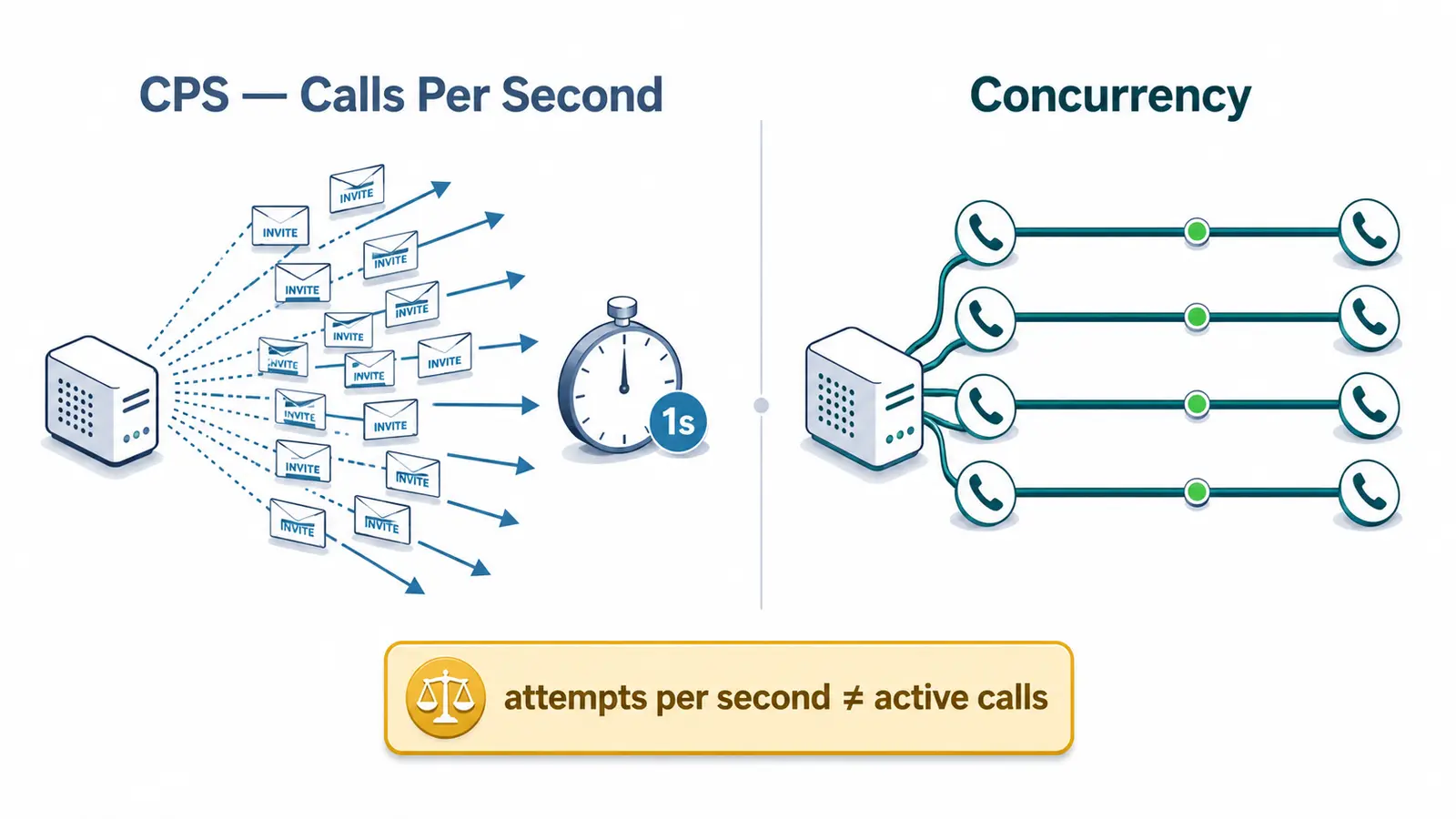
CPS (calls per second) is the rate at which a phone system or dialer initiates new call setup attempts per second. It measures attempt velocity — how fast SIP INVITE messages are generated — not the number of active concurrent calls. A predictive dialer generates high CPS in bursts; a route without enough CPS headroom will reject or delay call setup even if concurrency limits have not been reached.
CPS stands for calls per second — the rate at which a phone system or dialer attempts to initiate new calls. It's one of the most commonly misunderstood capacity metrics in wholesale VoIP, mostly because people conflate it with concurrency, which measures something different. Understanding the distinction matters if you're provisioning termination for call center or dialer traffic.
What CPS actually measures
CPS counts new call setup attempts over time, not calls in progress. If a system attempts five new outbound calls within one second, that's a CPS of five during that second, regardless of how many of those calls are answered, how long they last, or how many other calls happen to already be active. It's a measure of attempt velocity — how fast the signaling layer is generating SIP INVITEs (or equivalent call setup requests) — not a measure of call volume or duration.
This distinction matters because a switch or trunk can be well within its concurrency limits while still failing under CPS pressure, if call attempts arrive faster than the signaling infrastructure can process call setup, authentication, and routing decisions for each one.
Why predictive dialers generate high CPS
A predictive dialer's entire design goal is to keep agents talking as continuously as possible, which means it dials ahead of actual agent availability. Rather than waiting for an agent to finish a call before placing the next one, it fires off multiple attempts at once, predicting how many will go unanswered, hit voicemail, or get a fast busy, so that roughly the right number connect right as an agent becomes free. That prediction-driven, ahead-of-demand dialing pattern is what produces high CPS: many attempts fired in quick succession, most of which won't turn into a held conversation.
Progressive dialers generate CPS bursts too, though generally less aggressively than predictive dialers, since they typically dial closer to a fixed ratio of attempts per available agent rather than a continuously adjusted prediction. Either way, any dialer campaign running more than a handful of agents is producing attempt rates well above what a single-line manual dialing setup would ever generate.
How CPS differs from concurrency
Concurrency is the number of calls active on a trunk or channel group at the same moment — how many conversations, ring states, or connecting calls are simultaneously occupying capacity. CPS is how fast new attempts are being introduced into that pool.
Picture two campaigns with the same concurrency ceiling. One places calls steadily throughout the hour, staying well under a CPS spike at any given moment. The other bursts a large batch of attempts in the first few seconds after a campaign starts or resumes from a pause, then settles down. Both might average out to similar concurrency over the hour, but the second campaign needs meaningfully higher CPS headroom to avoid call setup failures during that burst, even though its total call volume is comparable.
This is also why CPS and channel count aren't interchangeable capacity numbers. A trunk provisioned with a large number of channels (high concurrency) but a low CPS ceiling can still choke the moment a dialer campaign ramps up quickly, because the bottleneck is attempt-processing speed, not the number of simultaneous calls it can hold once they're established.
Worked example: A campaign fires a burst of 10 CPS for the first 5 seconds after resume. Each call that connects averages 90 seconds of hold time before disposition. At peak, those 50 attempts (10 × 5 seconds) could produce up to 50 simultaneous calls in ringing or connected state — requiring 50 channels of concurrency just to absorb the burst. A trunk provisioned for 30 concurrent channels (which would comfortably handle the steady-state average) will reject up to 20 call setup attempts during that burst window, translating directly into missed connections.
Estimating the CPS your campaign needs
You don't need a precise number to have a useful conversation with a provider — you need a defensible range. CPS demand scales with how many attempts your dialer fires to keep agents busy, which depends on agent count, your connect rate, and how aggressively the dialer paces ahead of availability. A campaign with a low connect rate has to attempt many more calls per agent to keep them talking, so it generates higher CPS than a campaign with the same agent count but a higher connect rate. The safest planning input is the burst, not the average: measure (or ask your dialer vendor for) the peak attempts-per-second your setup produces in the seconds right after a campaign starts or resumes from a pause, because that spike is what a route has to absorb without rejecting call setup.
Because the burst is what matters, size CPS headroom above your steady-state need rather than at it. The attempt behavior differs by dialer type — a predictive dialer paces ahead of agents and bursts harder than a progressive dialer that dials closer to a fixed ratio. For how CPS interacts with concurrency and channel provisioning across a trunk, see SIP trunk capacity planning.
Why CPS capacity matters when sourcing termination
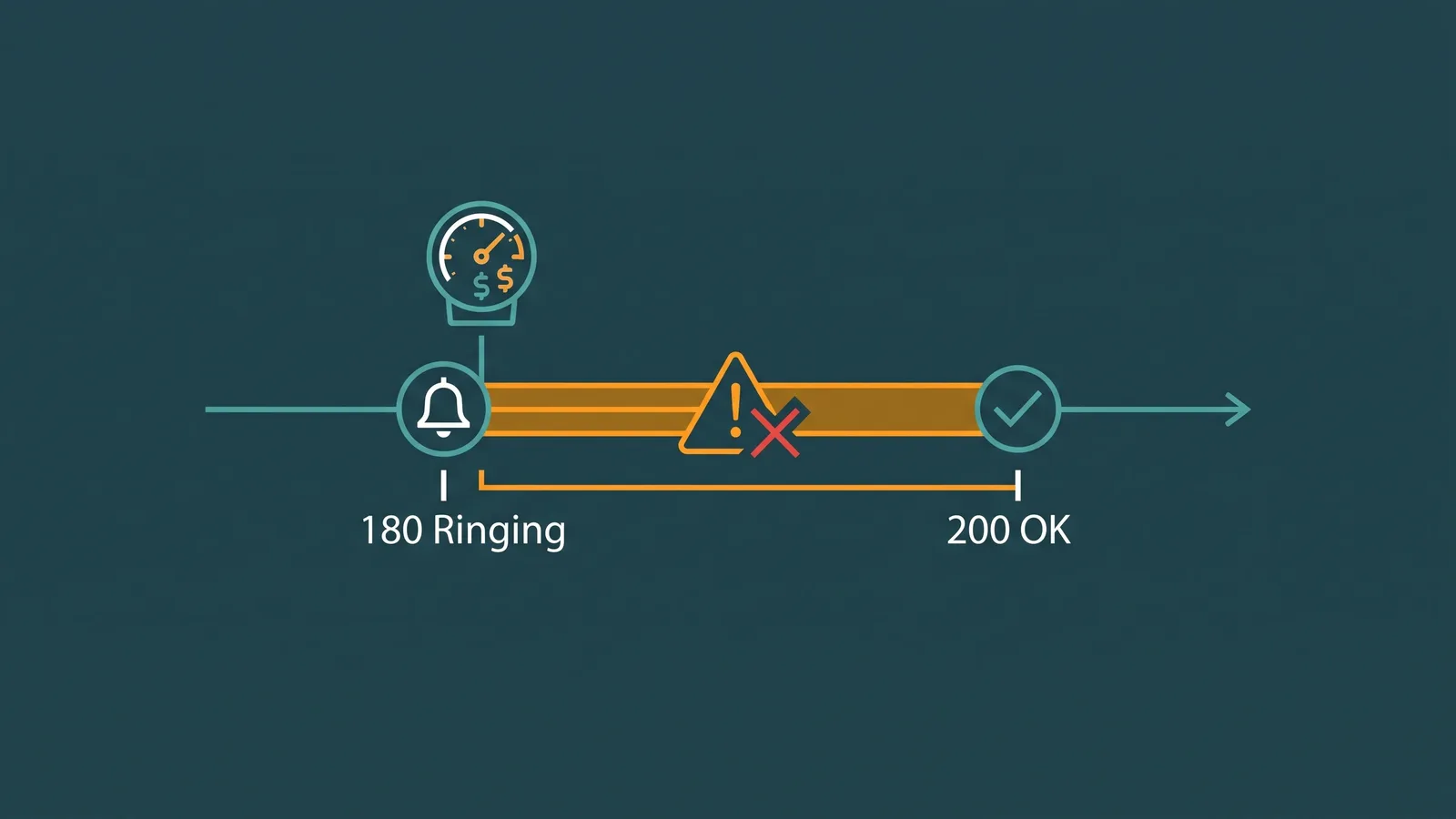
If a termination provider only quotes concurrency or channel limits without addressing CPS capacity, it's worth asking directly. A route that handles steady, moderate traffic well can behave very differently the moment a predictive dialer starts a campaign and fires off a burst of attempts in the opening seconds. Call setup failures, delayed ringing, or rejected attempts during a CPS spike translate directly into missed connections and, for a call center, missed revenue — even if the underlying route quality (ASR, ACD) would otherwise be solid. Another metric related to call setup speed is post-dial delay (PDD) — the gap from INVITE to first ringback — which compounds with high CPS in dialer campaigns where agent time is billable from the moment the attempt fires.