ACD in wholesale VoIP termination stands for Average Call Duration — the mean length of calls that connect and complete on a route, measured in seconds. It is a core route quality metric alongside ASR (answer-seizure ratio). Call center outbound traffic characteristically runs low ACD because many dialer-generated calls are short: quick agent interactions, voicemail drops, or abandoned calls. Low ACD in this context is normal, not a sign of route problems.
Note: ACD is an overloaded acronym in the telecommunications industry. In contact center routing, ACD usually refers to an Automatic Call Distributor — the system that queues and routes inbound calls to agents. In wholesale VoIP termination (the context of this article), ACD means Average Call Duration — the metric explained below. If you were looking for the contact center routing technology, see the call routing guide, which covers Automatic Call Distributors in depth.
ACD in VoIP termination stands for average call duration — the mean length of calls that actually connect and complete, measured over a route, a destination, or a campaign. It's one of the two metrics (alongside ASR, answer-seizure ratio) that wholesale voice providers track most closely to judge route quality, and it behaves very differently for call center traffic than it does for general business calling.
What ACD measures, precisely
ACD is calculated from completed calls only — calls that were answered and held for some duration before ending, however short. It doesn't include no-answer, busy, failed, or rejected attempts; those get captured separately in metrics like ASR. So a very low ACD doesn't necessarily mean something is broken. It can simply reflect the nature of the calls that connected: short, quickly resolved, or ended abruptly for reasons unrelated to route quality.
Why call center traffic runs low ACD
A meaningful share of dialer-generated call attempts that connect don't turn into long conversations. Some hit voicemail and get identified and disconnected quickly. Some connect to a live person who hangs up immediately, uninterested in an outbound call. Some are calls where the dialer itself drops the call within a second or two because it over-attempted relative to agent availability — a known behavior in predictive dialing sometimes called call abandonment, distinct from the recipient hanging up. Even calls that do reach an agent and get handled are often short by design: a scripted outbound call, a quick qualification question, a brief service update.
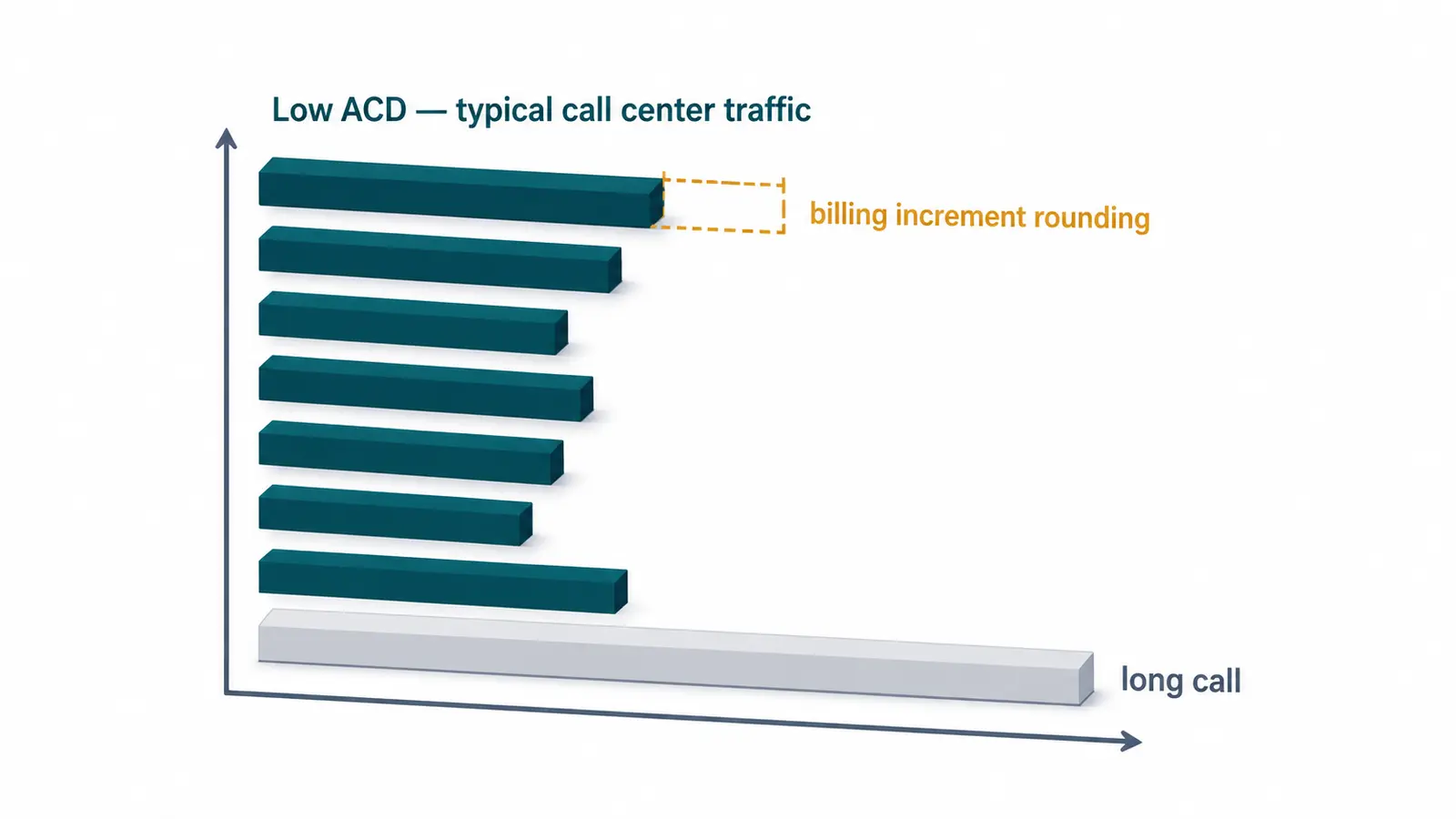
None of that is a sign of a failing route. It's the expected shape of call center outbound traffic. A route provider unfamiliar with call center patterns might see a low ACD number and assume something is wrong with the route, when in reality it's simply reflecting how the traffic behaves. This is exactly why CC routes are monitored with call-center-specific baselines rather than judged against ACD expectations built around longer-format business or consumer calling.
How ACD affects route selection and pricing
Route selection logic that weighs ACD alongside ASR needs to interpret both metrics in context. A route with low ACD but strong ASR (calls are being answered reliably; they just don't last long) is behaving normally for call center traffic. A route with low ACD and weak ASR is a different, more concerning signal — it suggests calls aren't connecting reliably at all, or worse, that something is truncating calls that should otherwise be running longer, which can indicate a technical routing problem rather than a normal traffic pattern.
Pricing is affected too, since termination costs are generally structured around minutes used. Low-ACD traffic means many short calls rather than fewer long ones, which shifts where the real cost sits in a rate deck and makes billing increment policy more consequential than it would be for longer-duration traffic. A complementary carrier-side metric is NER (Network Effectiveness Ratio), which counts busy and no-answer as successful delivery — high NER with low ASR points to a list or strategy problem rather than a network problem.
ACD and billing increment
Billing increment — how a call's duration is rounded for billing purposes — matters disproportionately for low-ACD traffic because the rounding overhead is a larger percentage of a short call than a long one. A provider offering full-minute billing, per-second billing, or a hybrid structure will produce meaningfully different effective costs on a large volume of short calls, even at an identical quoted per-minute rate. This is one of the more overlooked line items when comparing CC route providers, precisely because call center traffic's low-ACD profile makes billing increment choice matter more than it would for a business with fewer, longer calls.
Worked example: A campaign generates 10,000 calls per day at an ACD of 28 seconds, at a quoted rate of $0.008 per minute. Under per-second billing, each call costs 28 × ($0.008 / 60) = ~$0.0037. Under full-minute billing, each 28-second call rounds up to 1 minute, costing $0.008. Daily cost difference: 10,000 × ($0.008 − $0.0037) = $43 per day, or roughly $1,300/month — from nothing more than billing increment policy on the same quoted rate.
When low ACD becomes a carrier acceptance problem
There's an operational risk that follows directly from low ACD, and it catches teams off guard: some carriers set minimum-ACD thresholds and will throttle or reject traffic that runs below them, treating very short-duration traffic as a strain on their signaling infrastructure that generates little billable revenue. Normal call center outbound can trip these thresholds not because anything is wrong, but simply because dialer traffic is legitimately short. This is one of the concrete reasons a provider who specializes in call center routes matters — their network and acceptance policies are built around low-ACD traffic, whereas a generic termination provider may flag the same normal pattern as anomalous and start degrading your route.
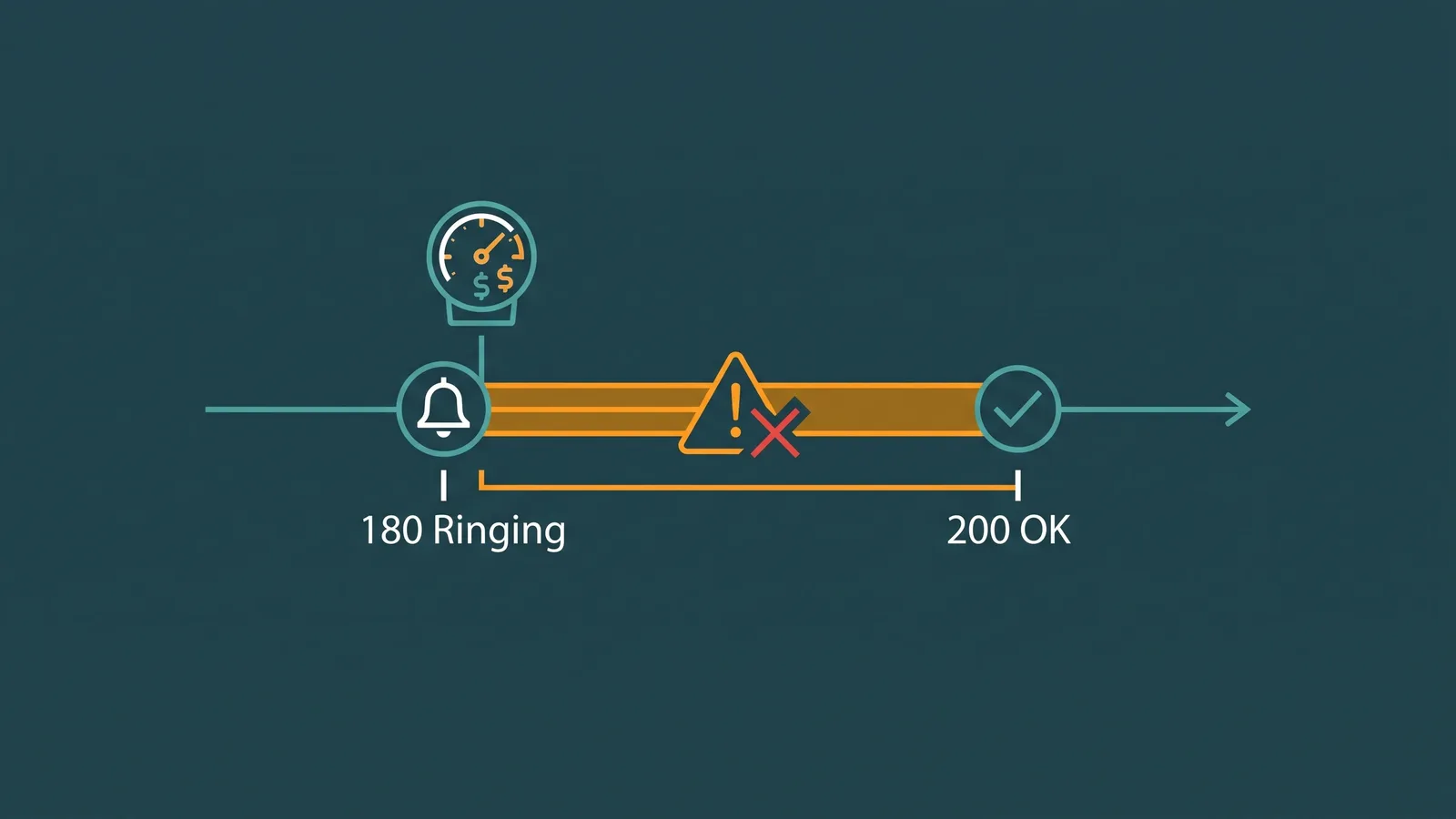
Two factors that push ACD down are worth understanding for exactly this reason: answering machine detection disconnects voicemail-bound calls quickly, and predictive-dialer over-attempting produces very short dropped calls. Also relevant is post-dial delay (PDD) — a route with high PDD wastes agent time between the INVITE and first ringback, reducing effective talk time per campaign hour independent of ACD. Both are normal, and both lower the ACD a carrier sees. The opposite problem — artificially elevated ACD — can indicate False Answer Supervision (FAS), where a carrier bills from ringback rather than actual answer. If you're weighing providers on how they treat this traffic, the buyer-side questions are covered in how to choose a CC routes provider.