SIP trunking is the technology that replaces physical phone lines — PRI circuits and ISDN connections — with logical IP-based channels that connect your business phone system to the public telephone network. Where a traditional T1 PRI gave you exactly 23 simultaneous voice channels over dedicated copper, a SIP trunk gives you a configurable number of concurrent call channels over your existing internet connection, with no physical line to install or maintain.
For businesses with on-premise PBX equipment, SIP trunking is often the most practical path to IP-based calling — it preserves the existing PBX investment while modernizing the carrier connection. For cloud PBX deployments, SIP trunks provide the upstream carrier connectivity that connects cloud infrastructure to the PSTN. Understanding how SIP trunking works, how to size concurrent channels correctly, and what to look for in a SIP trunk provider directly affects call quality, cost, and reliability.
SIP trunking is a VoIP technology that connects a business phone system to the public telephone network over the internet. It replaces physical phone lines (PRI/ISDN) with logical channels — called trunks — that carry voice, video, and data over a SIP-based IP connection.
How SIP Trunking Works
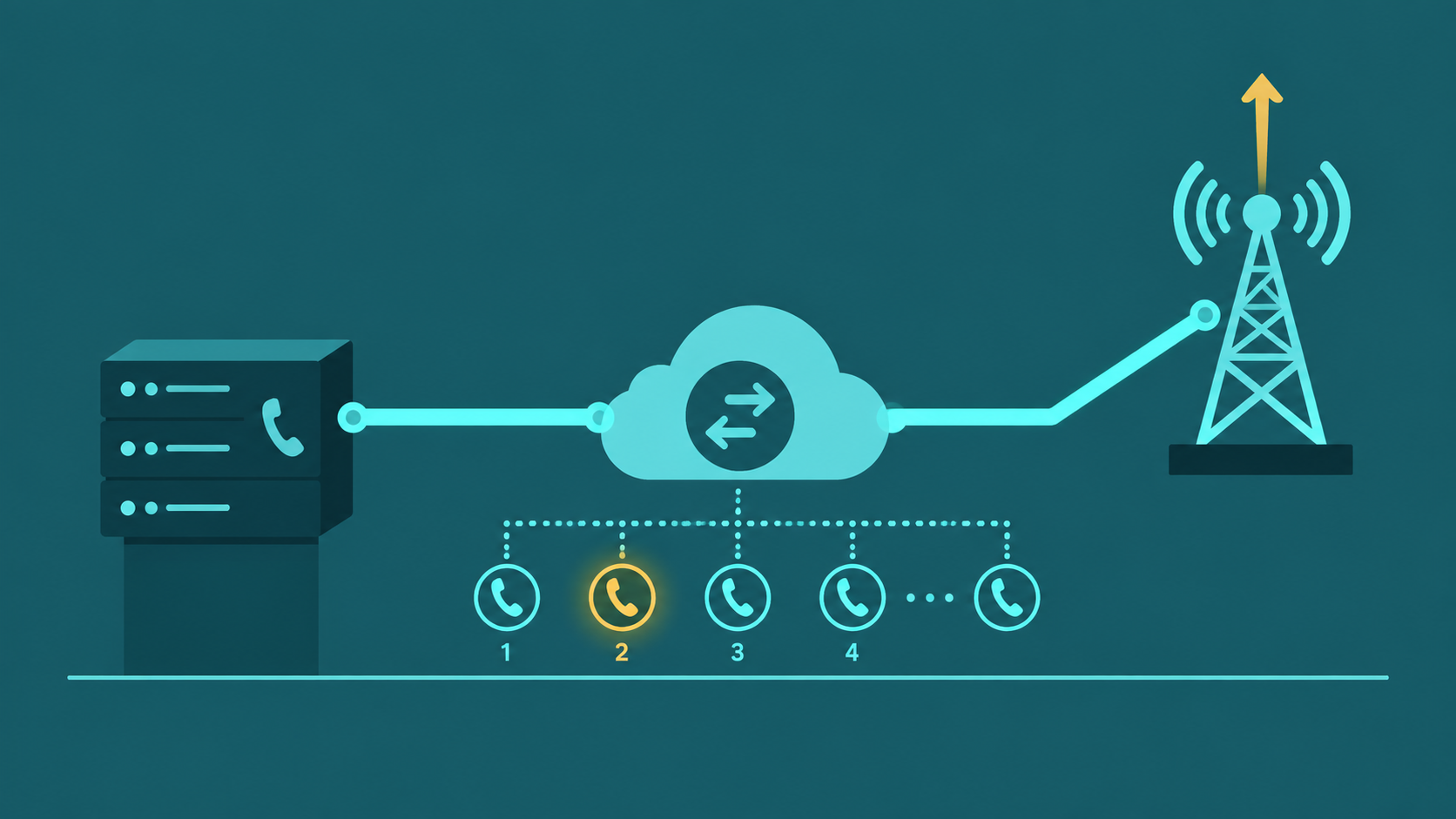
SIP trunking relies on two distinct protocol layers working together. SIP (Session Initiation Protocol) handles call signaling — the exchange of messages that set up, modify, and tear down calls. RTP (Real-time Transport Protocol) carries the actual audio stream once a call is established. A SIP trunk provider acts as the bridge between your phone system and the PSTN carrier network, terminating your SIP signaling and exchanging audio with traditional telephone infrastructure.
When an employee dials an external number, the call flow works as follows: your PBX sends a SIP INVITE message to the SIP trunk provider's SIP proxy. The provider authenticates the request, routes the INVITE toward the destination — either to another VoIP endpoint or across the PSTN gateway to a traditional carrier — and returns a SIP response. Once the called party answers (a SIP 200 OK response is received), RTP media flows directly between your PBX and the media server designated in the SDP offer, carrying the audio in both directions.
The number of simultaneous calls you can handle is determined by your concurrent channel count — the number of SIP trunks (call paths) provisioned with the provider. Unlike a PRI, which has a fixed channel count baked into the circuit, SIP trunk channel counts can typically be adjusted quickly through the provider portal, scaling up for peak periods and down when volume drops.
SIP trunk providers interconnect with the PSTN through carrier peering arrangements, purchasing wholesale termination from Tier 1 carriers and aggregating access for their SIP customers. The quality and breadth of these upstream carrier relationships directly affects call completion rates, audio quality, and geographic coverage.
SIP Trunking vs Hosted VoIP vs PRI
The three most common enterprise voice connectivity options each have different infrastructure ownership models, cost structures, and ideal use cases.
| SIP Trunking | Hosted VoIP | PRI (T1) | |
|---|---|---|---|
| Infrastructure | Customer owns or manages PBX; provider supplies trunk | Provider manages all PBX infrastructure in the cloud | Customer owns PBX; provider supplies physical circuit |
| Scalability | Add or remove channels on demand, often instantly | Add seats through portal; capacity is provider-managed | Fixed 23 channels per T1; adding circuits requires provisioning lead time |
| Cost model | Per-channel or per-minute; no seat licenses | Per-seat monthly subscription | Monthly circuit fee plus per-minute usage |
| Best for | Businesses with existing PBX, contact centers, enterprises needing flexible channel capacity | Businesses that want a managed, all-in-one cloud phone service | Legacy environments that have not migrated to IP; shrinking use case |
7 Things to Evaluate in a SIP Trunk Provider
1. Call Quality and Codec Support
Audio quality on SIP trunks depends on codec support, route quality, and network path. A provider that supports G.711 (uncompressed, PSTN-standard) and G.722 (wideband HD voice) gives you the best quality ceiling for on-net calls. More important than codec options is route quality: the upstream carrier relationships, how many route hops traffic traverses, and whether the provider monitors ASR (answer-seizure ratio) and MOS scores on their network. Ask for route quality SLA commitments, not just uptime SLAs.
2. Concurrent Channel Limits and Bursting
Confirm whether your channel count is a hard limit (calls beyond it receive busy signals) or whether the provider allows elastic bursting above your provisioned channels and how burst capacity is priced. For contact centers with variable inbound volume, hard channel limits create service problems during peak periods.
3. Failover and Redundancy
A SIP trunk provider should offer geographic redundancy across multiple data centers, with automatic failover to a secondary SIP proxy if the primary becomes unavailable. Ask specifically: what is the failover detection time? Is failover automatic or manual? Does the provider support dual SIP registrations so your PBX can maintain an active secondary path at all times? For high-availability deployments, verify that the provider has carrier-grade redundancy, not just a single-node setup with manual failover.
4. Number Porting
Confirm the provider supports number porting from your current carrier before signing. Get a specific estimate of porting timeline for your number types (local DIDs, toll-free, direct inward dialing blocks), ask about the process for porting out if you ever need to leave, and verify that porting fees are disclosed upfront. Number porting complications are one of the most common friction points in SIP trunk transitions.
5. Compliance and STIR/SHAKEN
STIR/SHAKEN is the FCC-mandated caller ID authentication framework that US carriers must implement. Your SIP trunk provider should support full STIR/SHAKEN attestation for calls originating on your numbers, which reduces the likelihood that your outbound calls are flagged as spam or show "Scam Likely" on recipient displays. For regulated industries, verify HIPAA-compatible call handling, call recording retention capabilities, and TCPA-relevant features for outbound dialing operations.
6. Pricing Model
SIP trunk pricing comes in several structures, covered in detail in the pricing section below. The key evaluation point is understanding fully-loaded costs: per-channel fees, usage charges, DID fees, porting fees, and any minimum commitments. A low headline per-minute rate can be offset by high monthly channel minimums or expensive DID provisioning.
7. Support Quality
For a business-critical communication infrastructure, support SLA matters. What are the support hours? Is there a dedicated account contact for troubleshooting call quality issues? How are SIP-level issues diagnosed — does the provider offer SIP trace access or CDR exports to help with debugging? Support quality is difficult to assess from a sales process; checking third-party reviews and asking for references from customers with similar use cases provides a more accurate picture.
SIP Trunk Pricing Breakdown
SIP trunk pricing structures vary significantly between providers. Understanding the model before committing prevents cost surprises.
Per-Channel (Per-Trunk) Pricing
You pay a monthly fee for each concurrent call channel provisioned, regardless of how many minutes you actually use. For example: $20/month per channel, with 20 channels provisioned = $400/month for capacity to handle 20 simultaneous calls. Usage beyond your channel count is either blocked or bursted at additional cost. This model suits businesses with predictable, consistent call volume — you are essentially paying for reserved capacity.
Per-Minute Pricing
You pay only for the minutes you use, typically in fractions of a cent per minute. The provider may charge a base monthly fee for the SIP trunk connection plus per-minute usage, or purely usage-based with no monthly minimum. This model suits businesses with variable or low call volume, and is common in wholesale VoIP for contact center traffic. For outbound contact centers with high minutes-per-agent volumes, per-minute pricing can be significantly cheaper than per-seat or per-channel models.
Metered vs Unlimited
Some providers offer unlimited calling plans — a flat monthly fee that covers unlimited inbound and outbound domestic minutes within a defined geography. These are common in hosted VoIP but less common in pure SIP trunking. Unlimited plans typically carry acceptable use policies that cap daily usage or prohibit contact center or predictive dialer traffic. If your use case is outbound call center volume, per-minute or per-channel pricing with explicit contact center route support is more appropriate than a consumer-grade unlimited plan.
Concurrent Channel Sizing: How Many SIP Trunks Do You Need?
Provisioning the right number of concurrent SIP trunk channels requires understanding your peak simultaneous call volume — not your total daily call count.
The standard sizing approach starts with your busiest hour of the day (the busy hour). Measure or estimate the average number of calls in progress simultaneously during that hour. This is your base channel requirement. From there, add a headroom buffer — typically 15–25% above peak simultaneous calls — to absorb unexpected spikes without calls hitting busy signals.
A practical formula: if your peak busy hour shows 18 simultaneous calls in progress, provisioning 22–24 channels provides approximately 20–30% headroom. For contact center environments with aggressive outbound dialing, peak simultaneous calls can far exceed agent count because predictive dialers maintain multiple live calls per agent at any given moment — size channels based on actual dialer-generated simultaneous call volume, not just agent headcount.
For detailed Erlang-based capacity planning methodology, see the guide to SIP trunk capacity planning, which covers the Erlang B and C models used to calculate channel requirements from call arrival rates and average handle times.
The cost of under-provisioning — calls blocked because all channels are in use — is customer-facing: callers hear busy signals. The cost of over-provisioning is purely financial. For most businesses, provisioning 20–30% above measured peak simultaneous calls provides the right balance.
Who Uses SIP Trunking
Businesses with On-Premise PBX
Any business running an on-premise Asterisk, FreePBX, Cisco Unified Communications Manager, Avaya, or similar PBX system can connect to the PSTN via SIP trunking rather than through a physical PRI circuit. SIP trunking typically delivers lower per-minute costs and more flexible capacity than legacy circuit-based connectivity, with faster provisioning times for adding capacity.
Contact Centers and Outbound Dialing Operations
Contact centers are among the largest consumers of SIP trunking, particularly for outbound dialing. High calls-per-second (CPS) tolerances, CC-route compatible trunks, and per-minute pricing without seat licenses make SIP trunking more economical than hosted VoIP for high-volume outbound operations. Providers that specialize in contact center traffic — sometimes called CC routes — maintain routes optimized for answer-seizure ratio and call center traffic patterns. For more on the distinction between general SIP trunk routes and CC-specific routes, see what are CC routes.
Enterprises Adding Cloud Connectivity
Large enterprises often use SIP trunking as the connectivity layer between a cloud-hosted contact center or UCaaS platform and upstream carrier infrastructure. In these deployments, the enterprise is not running a traditional PBX — the cloud platform serves that function — but the SIP trunk provides the PSTN gateway, DID inventory management, and number porting capability that the cloud platform requires.