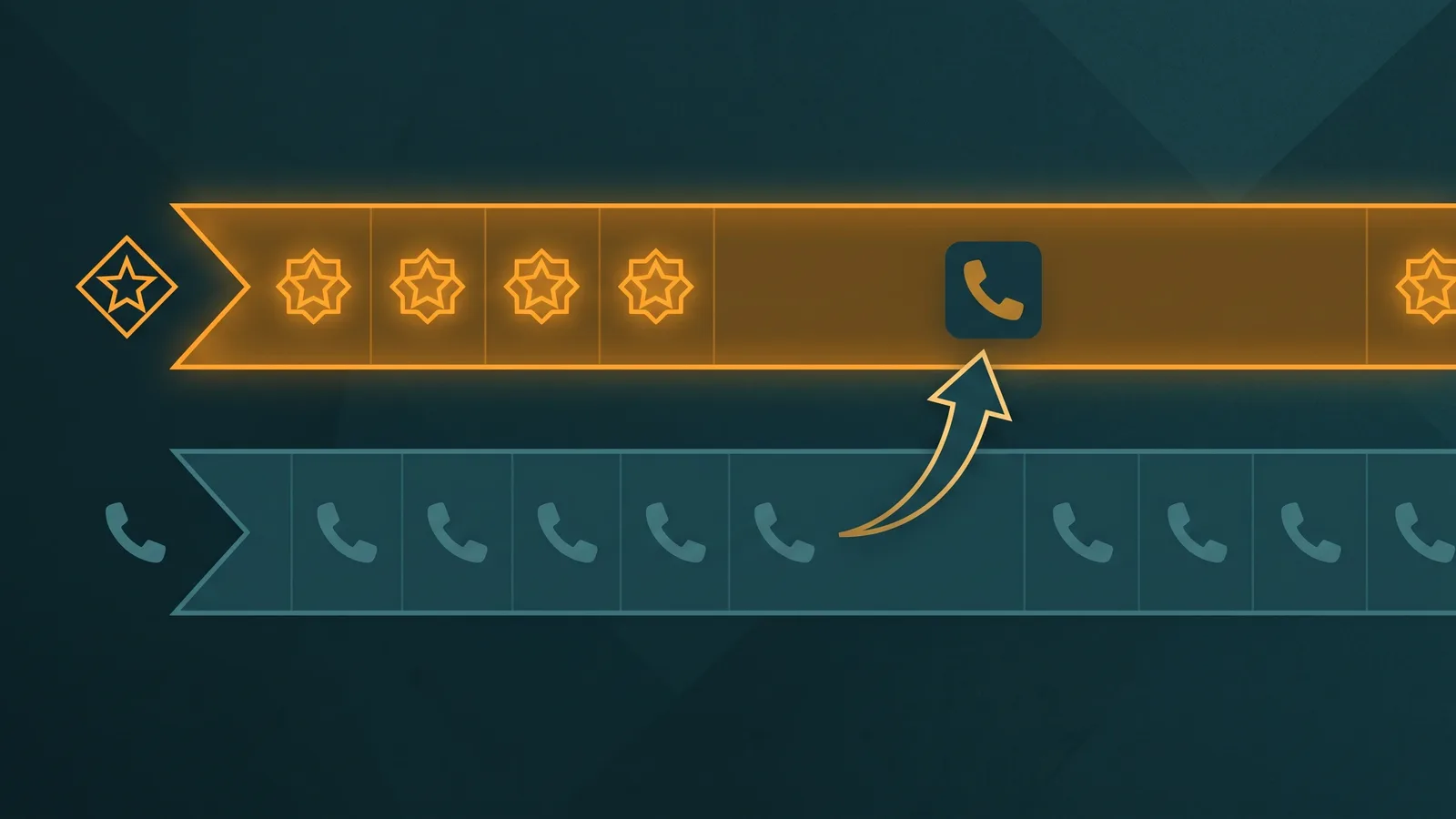
Not every caller is equal in business value, contractual obligation, or urgency — and treating them identically in the queue reflects none of that reality. A customer mid-renewal on a six-figure contract who hits a billing issue deserves a different outcome than a prospect browsing pricing. VIP call routing is the contact center discipline that maps that business reality into routing logic: identify who the high-priority callers are before or during the IVR, then route them differently from standard traffic. Done well, it protects SLA compliance, reduces churn risk on your most valuable accounts, and focuses your best agents where they generate the most impact.
It requires solving two distinct problems in sequence: how to identify a VIP caller reliably, and what different treatment to give them once identified. Both decisions have meaningful tradeoffs. This guide covers both from the mechanics up.
What Is VIP Call Routing?
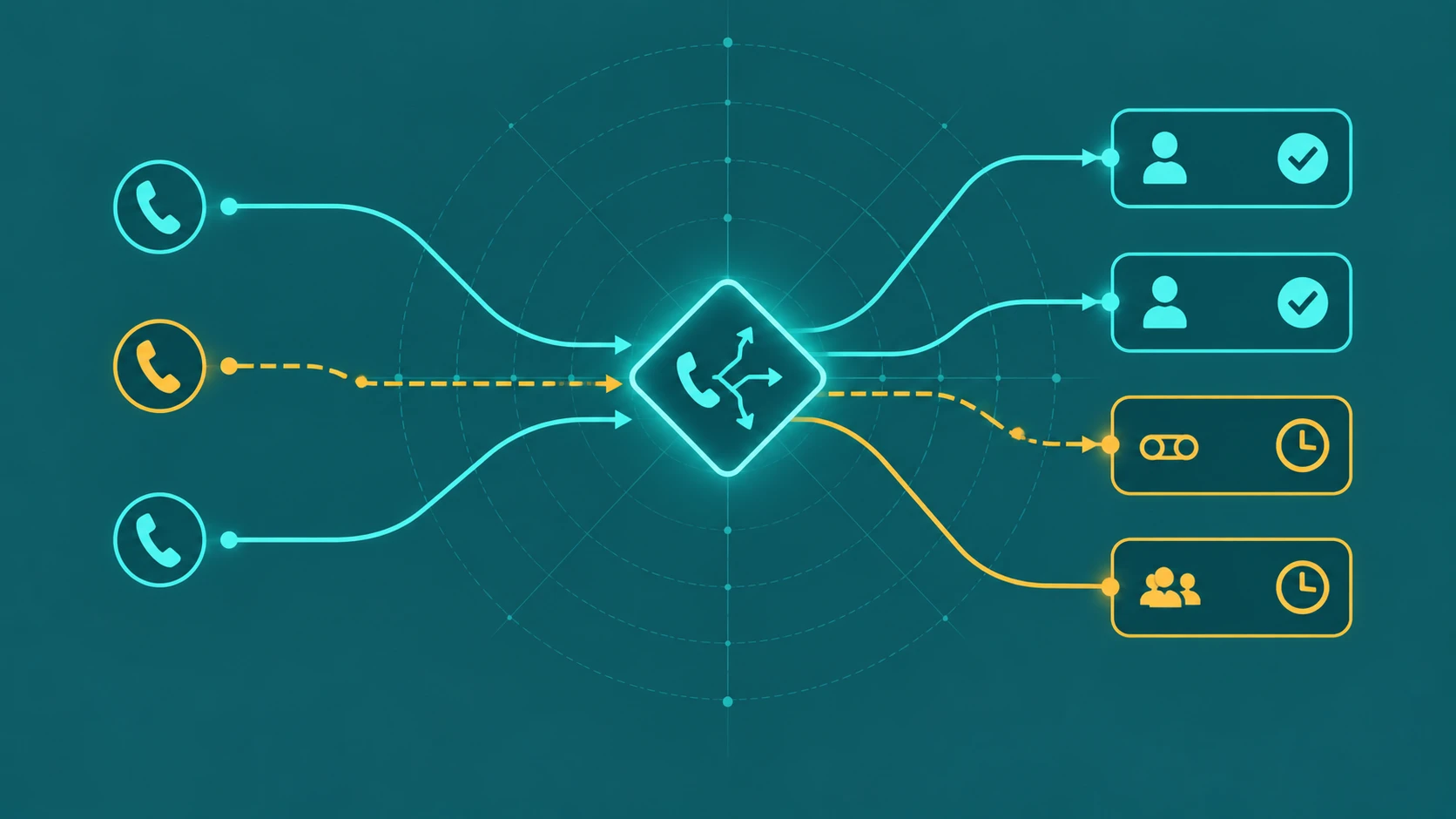
Definition: VIP call routing is a contact center strategy that identifies high-priority callers — based on caller ID, IVR input, authenticated web session, or CRM account tier — and routes them to a shorter queue, a higher priority position, or a dedicated pool of agents. The routing differentiation happens before or immediately after IVR completion, so VIP callers receive preferential treatment from the moment they connect, not after a general hold experience.
VIP routing sits within the broader architecture of call routing as a specialized layer. General routing determines which queue or team a call enters; VIP routing determines whether a caller bypasses or advances within that structure based on their identity and account standing. In most deployments, VIP routing is implemented as a combination of caller identification logic and call queue priority scoring, sometimes combined with a dedicated agent pool.
How to Identify VIP Callers
Identification is the harder of the two problems. Once a caller is flagged as VIP, routing them differently is straightforward configuration. Reliably determining which callers are VIPs — at the moment of call arrival, before significant IVR friction — requires choosing the right identification method for your environment.
1. Caller ID / ANI Lookup
The caller's phone number (Automatic Number Identification, or ANI) is matched against a CRM or internal database the moment the call arrives. If the number maps to a VIP account record, the call is flagged before IVR even starts. The caller experiences no additional friction: they dial in, the system silently identifies them, and they enter a priority path.
This is the most commonly deployed identification method. Its main limitation is number portability: customers call from mobile phones, office phones, and personal devices. The same person may call from five different numbers, only one of which is on file. ANI lookup misses anyone calling from an unregistered number, which can mean a meaningful fraction of your VIP customer base receives standard routing when they expected preferential treatment. You can mitigate this by prompting unidentified callers to enter an account number, but that adds friction for callers who assume they will be recognized.
A second concern is ANI spoofing. Caller ID can be manipulated, meaning a non-VIP caller could in principle spoof a VIP number and receive elevated routing. For most businesses this is a low-probability, low-consequence event, but for high-value service tiers it warrants a secondary authentication step in the IVR for any call that claims VIP status via ANI alone.
2. Account Number Entry in IVR
The caller enters their account number during IVR interaction. The IVR performs a real-time CRM lookup and sets the routing flag based on account tier before the call enters the queue. Because the account is explicitly stated rather than inferred from a phone number, this method is more reliable than ANI lookup — it identifies the customer regardless of which device they're calling from.
The tradeoff is IVR friction. Callers who expected to be recognized by their phone number find themselves entering digits before reaching anyone. For VIP customers specifically, that friction can feel like a poor experience — the opposite of what elevated routing is trying to achieve. If you use account number entry as your primary identification method, consider using ANI as a first-pass filter and only prompting for account entry when ANI lookup fails to find a match.
3. Authenticated Portal Click-to-Call
The caller initiates the call from inside an authenticated web or mobile application. Because the session is already authenticated, the system passes the customer ID alongside the call — typically via a SIP header or a DNIS parameter with an embedded session token. When the call arrives at the ACD, the customer identity is already attached, and routing is determined before any IVR plays.
This is the most reliable identification method. There is no number portability problem, no spoofing risk, and no IVR friction for the caller. The requirement is web or app integration: the click-to-call button must be able to pass a session-authenticated customer identifier through to your telephony layer. For SaaS products and financial services portals where customers are routinely logged in, this integration is natural. For businesses where most VIP contacts originate from cold outbound calls, it is less applicable.
4. Agent-Flagged Accounts
During or after a call, an agent manually marks an account as VIP in the CRM or contact center platform. Future calls from that account then receive elevated routing automatically. This is the least scalable identification method — it depends on agent action and CRM data quality — but it covers cases that automated methods miss, such as an account that recently expanded and deserves elevated treatment before a tier-change process has been completed, or a strategically important relationship not yet reflected in account tier data.
Agent-flagged VIP status works best as a complement to automated identification, not a replacement for it. It should have an expiry date or periodic review requirement to prevent VIP flags from accumulating on accounts that no longer warrant them.
Priority Queue Mechanics
Once a caller is identified as VIP, the routing system must give them materially different treatment in the queue. The most common mechanism is a boosted priority score within the ACD's queue ordering logic.
Most ACD platforms assign every call a numeric priority value when it enters the queue. Standard callers receive a baseline priority (say, 3). VIP callers receive an elevated priority (say, 1). When an agent becomes available, the ACD selects the highest-priority waiting call — so a VIP caller who arrived 30 seconds ago is dispatched ahead of a standard caller who has been waiting 8 minutes.
This works cleanly when VIP call volume is low relative to total traffic. The problem is anti-starvation: if VIP calls arrive continuously, standard callers may wait indefinitely. The standard fix is aging — a mechanism that increments a call's effective priority the longer it has been waiting. A standard caller at priority 3 who has waited 4 minutes might be escalated automatically to priority 1, making them equivalent to a VIP arrival. Aging guarantees that no caller waits indefinitely, regardless of how much high-priority traffic is flowing through. For a complete treatment of how aging and priority levels work mechanically, see the guide on call queue priority.
One important consequence of priority queuing: queue position announcements become misleading. A standard caller told they are "5th in line" may find themselves at 7th after two VIP callers are inserted. Framing queue position announcements in terms of estimated wait time rather than queue position avoids exposing this to callers in a way that feels unfair, even though the underlying system is operating correctly.
Dedicated Agent Pools vs Priority Lanes
Priority queuing within a shared queue is one model. Some organizations go further and dedicate a subset of agents exclusively to VIP callers — these agents never receive standard calls, and VIP callers always reach this pool first.
The dedicated pool model delivers the cleanest VIP experience: callers are answered by agents who know only high-value accounts, with no cognitive load from handling mixed-tier traffic. It also allows those agents to develop deeper expertise with the specific issues VIP customers face. The cost is utilization: during periods of low VIP call volume, dedicated agents sit idle while standard queues may be backed up. The higher your VIP tier's revenue concentration, the easier this tradeoff is to justify.
The hybrid model is typically more efficient: agents are VIP-preferred but spill to standard calls when no VIP calls are waiting. When a VIP call arrives and all VIP-preferred agents are busy, overflow routes to the best available standard agent. This captures most of the experiential benefit of a dedicated pool without the utilization penalty. The configuration requires careful overflow threshold-setting: overflow that triggers too quickly fails to protect the VIP experience; overflow that triggers too slowly holds standard callers when capacity is sitting idle.
Overflow and Fallback Design
Every VIP routing design requires an explicit answer to: what happens when all VIP-designated agents are occupied? This is not an edge case — it is a regular operational condition during peak hours for any business with meaningful VIP call volume. Leaving the overflow path undefined means the platform's default behavior determines the VIP caller's experience, which is rarely the right answer.
The main options:
- VIP caller waits in VIP queue: The caller holds with higher priority than standard callers, reaching the next available VIP-designated agent. Best when VIP SLA requires human answer, overflow is infrequent, and wait times are short even during peaks.
- Priority callback: The caller is offered a callback while retaining VIP priority — when a VIP-designated agent is next available, the callback is placed before standard callers receive service. This preserves priority without requiring the caller to hold. Requires a callback system integrated with queue priority logic; a simple callback that re-queues the call at standard priority defeats the purpose.
- Overflow to best available standard agent: When VIP agents are all occupied and the overflow threshold is hit, the call routes to the most qualified available standard agent. Fastest to answer; slightly dilutes the VIP experience. Appropriate when VIP SLA is time-bound and a capable standard agent is preferable to an extended hold.
- Supervisor-initiated outbound callback: For the highest-value tier, VIP overflow can trigger an alert to a supervisor or account manager who then calls the customer back personally. This is the highest-touch response and is operationally intensive — appropriate for a very small set of strategically critical accounts.
The right overflow path depends on how frequently VIP overflow occurs and how critical the SLA commitment is. If your VIP agent pool is properly sized for typical VIP volume with reasonable headroom, overflow events should be infrequent enough that options 1 or 2 are sufficient. If overflow is a regular occurrence, that is a staffing and pool-sizing problem that overflow routing design cannot solve — it just redistributes the impact. For a full treatment of overflow options, see the guide on call queue overflow.
Privacy, Consent, and Spoofing Risk
VIP call routing based on ANI involves storing and processing personal data — specifically, associating a phone number with an account tier and using it to make routing decisions. In the EU, this processing falls under GDPR; in California, it falls under CCPA. Neither regulation prohibits using caller ID for account identification, but both require that this use be disclosed — typically in your terms of service or privacy policy — and that data be handled securely.
The CRM lookup that powers ANI-based routing must be treated as a sensitive data access: the result (VIP status, account tier) should not be stated aloud to the caller in a way that reveals account tier details to anyone who may be listening. A VIP greeting should thank the caller and indicate priority service, not state "as a Tier 1 enterprise account holder." This is both a privacy consideration and a practical security measure.
ANI spoofing — manipulating caller ID to match a VIP number — is a real but low-prevalence risk. For most businesses, the cost of a spoofed VIP call (one caller getting elevated routing they didn't earn) is low enough that it doesn't warrant significant mitigation effort. For service tiers where a VIP call represents access to high-value resources — dedicated advisors, expedited service with financial consequences — requiring IVR account authentication as a secondary step for ANI-identified VIP calls reduces the spoofing risk substantially without eliminating the ANI-based identification benefit.
When VIP Routing Makes Business Sense
VIP call routing is worth the configuration complexity when there is clear, measurable differentiation in the value different customer segments represent, and when that differentiation warrants operationally different treatment. The scenarios where it consistently delivers return:
- Revenue stratification: Enterprise or high-ACV customers represent disproportionate revenue concentration. A VIP customer who churns because of a poor support experience carries a revenue impact far greater than a standard churn event. Routing investment scales with this revenue asymmetry.
- Contractual SLA commitments: If specific customers have signed service agreements that include response time guarantees, VIP routing is often the mechanism that makes those guarantees operationally achievable without dedicating agents exclusively to each account.
- At-risk account management: An account flagged as churn risk by the CRM can be temporarily elevated to VIP routing — ensuring their next contact experience is materially better at the moment it matters most.
- Regulatory requirements: In financial services, identifying and treating vulnerable customers differently is a regulatory obligation in several jurisdictions, not just a CX preference. VIP routing infrastructure is commonly repurposed for vulnerability flags.
VIP routing creates real fairness issues that should not be dismissed. Standard callers who experience longer waits during high VIP-volume periods are paying a real cost for a policy they may not know exists. This is generally acceptable when the revenue concentration warrants it — most businesses implicitly accept some customer service stratification — but internal fairness matters too. Agents who handle primarily VIP calls develop a narrow workload profile; standard agents absorbing overflow from a busy VIP pool experience increased pressure without increased recognition. Both dynamics require active management.
When VIP routing is not warranted: when customer value is relatively uniform, when the operational cost of maintaining identification and routing logic exceeds the SLA or churn benefit, or when VIP call volume is so low that priority queuing achieves the same result without dedicated infrastructure. In those cases, good queue management and appropriate staffing deliver equivalent outcomes without the complexity.