
Business phone service is one of the most competitive, most confusing, and most consequential purchasing decisions a company makes. The market is saturated with providers, the terminology overlaps deliberately, and the difference between a good fit and the wrong choice shows up on your invoice and in your customers' experience — not in a demo.
This guide cuts through the noise. It covers what business phone service actually is, how the major service models differ, what features matter, how pricing really works, what to look for in reliability and security, and how to evaluate providers before you commit. If you are in the middle of a buying decision, work through each section in order.
What is business phone service? Business phone service is any managed telecommunications service that handles inbound and outbound voice calls for a company — including the underlying call routing, number management, and associated features like voicemail, IVR, and call recording. Modern business phone service is almost universally delivered over the internet (VoIP) rather than traditional copper telephone lines, which means it can be provisioned in minutes, scaled without hardware, and accessed from any internet-connected device. Our guide on what a business phone system is covers how the full system fits together.
Service models: cloud VoIP vs hosted PBX vs SIP trunking
The term "business phone service" is applied to several distinct products that work very differently. Before evaluating any provider, understand which model you are actually buying.
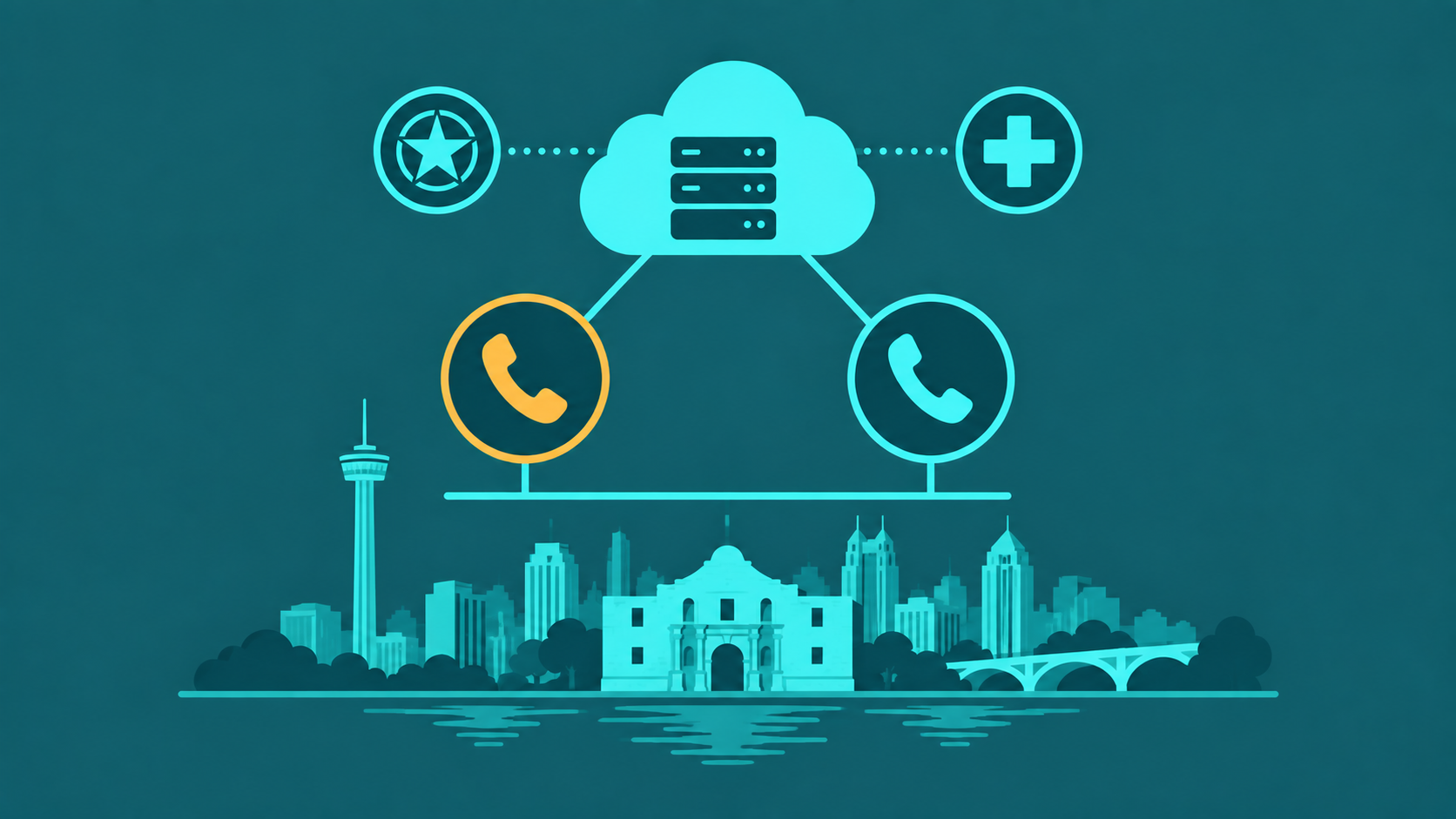
Cloud VoIP is the broadest category — any service that routes voice calls over the internet using the Voice over IP protocol. In practical terms, buying a "cloud VoIP service" usually means getting a hosted phone system: a set of phone numbers, a web-based admin portal, softphone apps for desktop and mobile, and a core feature set like voicemail and call forwarding. Providers market this as VoIP service, cloud business phone service, or cloud PBX interchangeably. The underlying technology is VoIP; the product is a managed phone system. Our cloud phone system guide breaks down how this infrastructure works.
Hosted PBX is the enterprise-grade version of cloud VoIP. A Private Branch Exchange (PBX) is the call-routing software that handles extensions, ring groups, IVR menus, call queues, and transfer logic. In a hosted PBX model, the provider runs this software in their data centers — you configure it through a portal without managing any hardware. Hosted PBX is what most SMBs and mid-market companies are actually buying when they purchase business phone service. It includes everything a traditional on-premise phone closet used to do, delivered as a subscription.
SIP trunking is a different product with a different use case. Instead of replacing your entire phone system, SIP trunking replaces only your physical telephone lines — the connection between your existing PBX hardware and the public telephone network — with an internet-based equivalent. If your business made a significant investment in on-premise PBX hardware recently and does not want to abandon it, SIP trunking lets you modernize the line costs while keeping the routing logic you have already built. It is not a substitute for a hosted system; it is a complement to an existing one.
| Model | What you're buying | Hardware required | Best for |
|---|---|---|---|
| Cloud VoIP / Hosted PBX | Complete managed phone system in the cloud | None required (optional IP phones) | SMBs, remote/hybrid teams, new deployments |
| SIP Trunking | Internet-based phone lines for an existing PBX | Existing PBX required | Businesses with a recent on-premise PBX investment |
| UCaaS | Hosted PBX + video + team chat + collaboration | None required | Teams consolidating multiple communication tools |
Features every business phone service should include
Not all business phone services include the same feature set — and marketing language makes it easy to miss what is and is not in a given plan. Before comparing pricing, confirm that each provider includes these capabilities at your tier.
Auto attendant (IVR). An automated greeting that answers calls and routes callers to the right destination without requiring a receptionist. At minimum, you need the ability to create a multi-level menu structure — press 1 for sales, press 2 for support — with custom recorded prompts. More capable systems offer time-based routing that switches menus between business and after-hours automatically.
Call queues with hold music and position announcements. When all agents are busy, callers should hear their position in queue and estimated wait time, not silence or an immediate busy signal. Queue configuration — maximum queue depth, overflow behavior, callback options — should be accessible to admins without vendor involvement.
Call recording. Required for compliance in many industries and valuable for training in all of them. Confirm whether recording is enabled by default or per-user, where recordings are stored, how long retention lasts on the plan you are evaluating, and whether pause-on-demand (for PCI DSS compliance during card entry) is supported.
Voicemail to email. Voicemail transcription and audio attachment delivered to an email address. This is table stakes for a business phone service. If a provider does not include it at the base tier, that is a signal about what else they treat as optional.
Business SMS. Two-way text messaging on the same business number used for voice calls. Most modern cloud business phone service providers include SMS, but confirm that it is included in your plan tier, that A2P 10DLC registration is handled by the provider (required for business texting since 2023), and that there is no separate per-message fee that was not disclosed. For more on how this works, see our guide on VoIP text messaging.
Mobile and desktop apps. Your team should be able to make and receive calls from a laptop or smartphone using their business number. This is not optional for any team with remote workers. Verify that the app supports full feature parity — not just basic calling — and that it works on the operating systems your team actually uses.
Number management and porting. You should be able to provision new numbers, manage extensions, and initiate number ports without opening a support ticket. Self-service number management in the admin portal is a measure of how mature a provider's platform is.
Analytics and call reporting. Call volume by time of day, missed call rate, average handle time, queue wait times. These metrics tell you whether your call routing is working and where it is not. If a provider's analytics require a paid add-on, factor that cost into the comparison.
Pricing: what you actually pay
Business phone service pricing is consistently misrepresented at the marketing level. The advertised per-user rate is a floor, not a ceiling. Here is what actually builds the total monthly cost.
Base plan per user. Most cloud business phone service providers charge $15–$40 per user per month at the entry tier. This number is what appears on the pricing page and in most comparisons. It is the starting point.
Regulatory taxes and fees. Federal and state telecommunications taxes, the Universal Service Fund (USF) surcharge, and local utility taxes add 15–25% on top of the base price. A $25/user plan for a 20-user company advertises as $500/month; the actual invoice is closer to $600–$625 before any add-ons.
E911 fees. Emergency services fees are typically $0.20–$2.00 per line per month, billed separately. They are not negotiable — they fund emergency dispatch infrastructure — but some providers present them clearly and others bury them.
Number porting fees. Some providers charge $20–$40 per number to port existing numbers in. Others include porting at no charge. This is a one-time cost, but for a business with ten numbers, it adds $200–$400 to the switching cost.
International calling and per-minute overages. Plans with "unlimited calling" almost universally apply that limit to calls within the US and Canada. International calls are billed per minute. If your team regularly calls outside North America, model the per-minute rates at your actual call volume. The difference between providers at international rates can exceed the difference in base plan pricing.
AI features and add-ons. Transcription, call summaries, sentiment analysis, and AI-powered IVR are increasingly marketed as included features but frequently licensed as per-minute or per-user add-ons. Clarify before signing: is this feature flat-fee at my tier, metered per use, or unavailable without an upgrade?
When comparing providers, request a fully-loaded quote that includes taxes, fees, and every add-on you intend to use. Then compare those numbers. Comparing base plan prices is comparing marketing, not cost.
Reliability: what to look for in uptime and redundancy
Business phone service reliability is measured by uptime SLA — the contractual commitment a provider makes about service availability. The numbers look similar across providers but are not equivalent.
99.9% vs. 99.99% uptime. The difference between 99.9% and 99.99% sounds trivial. It is not. 99.9% uptime allows 8.7 hours of unplanned downtime per year. 99.99% allows 52 minutes. For a business where the phone is a revenue channel — sales calls, support lines, inbound orders — 8.7 hours of downtime per year is a meaningful operational risk. Look for 99.99% SLA commitments and verify what remedies apply when the provider misses the target.
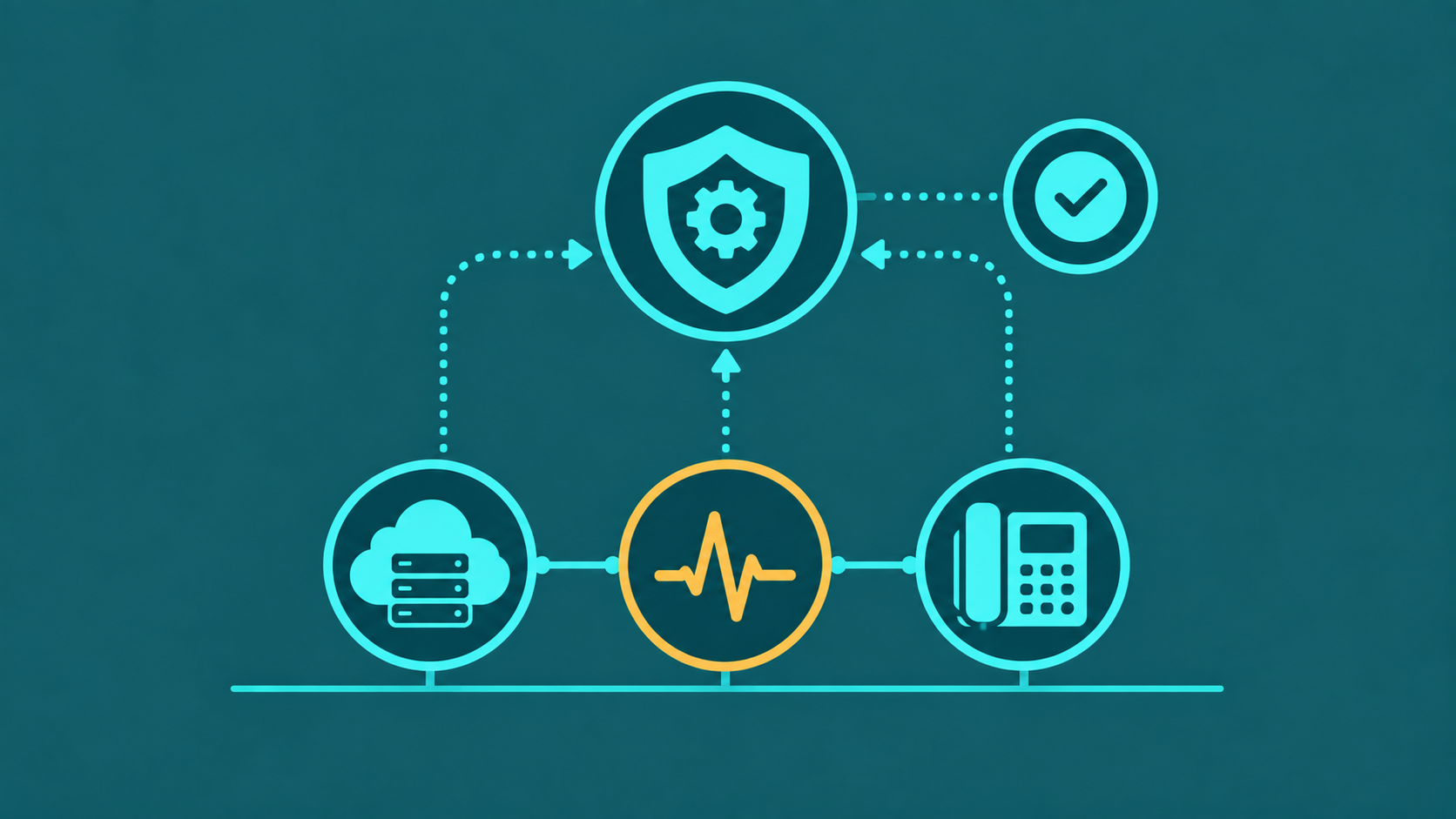
Geographic redundancy. A provider that runs your tenant from a single data center has a single point of failure. Enterprise-grade business phone service providers replicate your configuration across multiple geographically separated data centers with automatic failover. Ask specifically: how many data centers serve my tenant, where are they, and what is the failover mechanism if one goes down?
Internet failover for your office. Even a provider with 99.99% infrastructure uptime cannot protect you from your own ISP outage. Configure automatic call forwarding to mobile numbers as a failover so that calls continue reaching your team if your office internet connection fails. Most hosted PBX platforms support this — but it typically requires setup, not just activation.
SLA remedy terms. Read the SLA document, not the marketing copy. Service credits that require you to file a formal claim within a narrow window, get approved by the provider, and are capped at one month's service fee are very different from automatic credits applied at the contractual threshold. The credit structure tells you how seriously a provider takes its uptime commitment.
Number porting: how it works before you commit
Your existing business phone numbers are a business asset. They are on your website, your marketing materials, your Google Business profile, and in your customers' contact lists. The ability to keep those numbers when switching providers is guaranteed by law in the United States under Local Number Portability (LNP), established by the FCC under the Telecommunications Act of 1996. Carriers cannot refuse a valid port request.
For a complete walkthrough of the process, see our guide on how number porting works. Here are the essentials to confirm before committing to a new provider.
What you need to initiate a port. Your new provider will ask for: the phone numbers to port, your account number with the current carrier, the billing name and service address on the account, and in some cases a PIN. You will sign a Letter of Authorization (LOA) authorizing the transfer. The information on the LOA must exactly match what your current carrier has on file — mismatches are the primary cause of port rejections and delays.
Timeline. After your current carrier accepts the port request, a Firm Order Commitment (FOC) date is set — typically 3–10 business days out for US local numbers. Start the process three to four weeks before your planned go-live date. Do not cancel your existing service until the FOC completes.
What to confirm with a prospective provider. Ask whether porting is included at no charge or billed per number. Ask for a realistic estimate of the porting timeline for your current carrier specifically — some carrier pairs process faster than others. Ask what the provider does if your go-live date falls before porting completes.
Businesses with local presence in specific markets should also verify that their new provider can provision local numbers in those areas. For example, if you need local numbers in specific Texas markets, confirm availability before signing. For a provider evaluation in that region, our Dallas business phone service guide covers what to look for.
Security considerations
Business phone service carries sensitive data: customer conversations, voicemail messages, call recordings, and in some cases payment card numbers or protected health information spoken over the phone. Security posture is not optional due diligence — it is a baseline requirement.
Encryption in transit. Voice call data should be encrypted using TLS for signaling (the call setup and teardown process using SIP) and SRTP for media (the actual audio packets). Not all providers enable both by default. Ask specifically whether SRTP encryption is on by default or requires activation.
SOC 2 Type II certification. A SOC 2 Type II audit is a six-month or longer independent assessment of a provider's security controls. Type I is a point-in-time snapshot; Type II demonstrates sustained controls over time. For any business in a regulated industry — healthcare, financial services, legal — this is a minimum requirement. Ask for a current SOC 2 Type II report, not a marketing claim about compliance.
HIPAA compliance and BAA availability. Healthcare businesses are required to ensure that any vendor handling patient communications can sign a Business Associate Agreement (BAA). A provider that will not sign a BAA is not an option for healthcare use cases. Confirm BAA availability before evaluating any other feature.
PCI DSS call recording pause. If your team takes payment card numbers over the phone, your call recording configuration must be able to pause when card data is being entered. This is a PCI DSS requirement. Ask specifically whether pause-on-demand recording is supported in the plan you are evaluating.
Multi-factor authentication and admin access controls. Unauthorized access to a business phone system admin portal — particularly one with call recording access and number management — is a serious security event. Confirm that the platform supports MFA for admin accounts and that role-based access controls let you limit what individual users and admins can see and change.
Toll fraud protection. VoIP systems are a target for international toll fraud — unauthorized outbound calls to premium-rate numbers that generate charges before the attack is detected. Ask what automated fraud detection the provider includes, whether you can set per-user or per-account outbound calling restrictions, and how quickly the provider detects and responds to anomalous call volume.
Provider evaluation checklist
Use this checklist when comparing business telephone service providers. The goal is to ask the same questions to every vendor and compare specific answers — not demo impressions.
- Uptime SLA: Is the commitment 99.99% or better? What remedies apply automatically when the target is missed, and what is the claims process?
- Data center redundancy: How many geographically separated data centers serve your tenant, and what is the automatic failover mechanism?
- Security certification: Does the provider hold a current SOC 2 Type II certification, and will they share the report? Will they sign a HIPAA BAA if applicable?
- Encryption: Is TLS for SIP signaling and SRTP for media enabled by default, or does it require configuration?
- Porting fees and timeline: Is number porting included at no charge, or billed per number? What is the realistic timeline for your specific current carrier?
- Fully-loaded pricing: What is the total monthly cost including taxes, E911 fees, SMS registration, and the specific features you require — not just the base plan?
- Feature tier clarity: Which features — call recording, analytics, IVR depth, AI transcription — are included in the base plan vs. metered vs. paid add-ons?
- Support availability: What are actual support hours, and what is the response time commitment for a critical outage (all calls down)? Is there a dedicated contact or only a shared ticket queue?
- Contract terms: What is the minimum commitment, the auto-renewal window, and the early termination fee? Is month-to-month available, and at what premium?
- Integration quality: Are the integrations with your CRM and helpdesk native (built and maintained by the provider) or third-party connectors? What data syncs, and who maintains it when either platform updates?
- Pilot availability: Will the provider allow a structured trial on live traffic before a full contract commitment? Resistance here is a signal.