
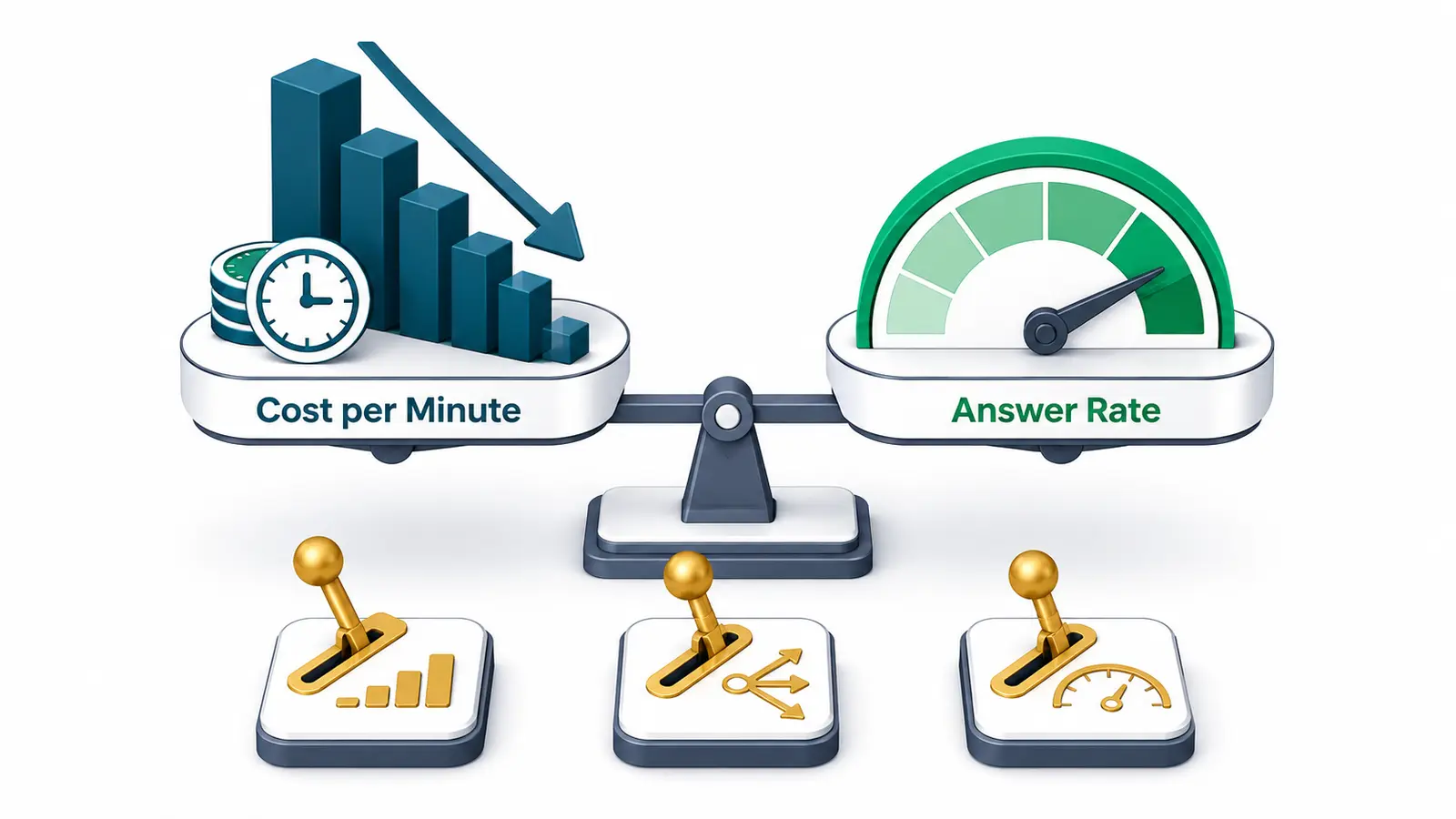
Termination cost is one of the more controllable line items in running a call center, but it's easy to optimize the wrong thing. Chasing the lowest per-minute rate on a rate sheet without accounting for how that route actually performs under real dialer traffic often ends up costing more, not less, once you factor in wasted agent time on dead air and missed connections. Here are the levers that actually move cost without quietly trading away answer rate.
Match billing increment to your actual call pattern
Call center traffic tends to run low average call duration — a large share of connected calls are short. Billing increment policy has an outsized effect on this kind of traffic because rounding overhead is proportionally larger on a short call than a long one. Compare providers on their billing increment structure specifically — full-minute billing, per-second billing, or a hybrid structure — rather than assuming a lower headline rate automatically means lower effective cost. Two providers quoting what looks like the same per-minute rate can produce different real bills once your actual call duration distribution runs through their billing increment rules.
Weight least-cost routing by ASR, not just price
A pure least-cost-routing setup that selects the cheapest available route regardless of quality will, over time, route more traffic to routes that are cheap because they're underperforming. A route with a materially worse answer-seizure ratio costs you in agent time spent on failed or dropped attempts, and in campaign results that don't reflect the volume you're paying for. Route selection logic that weighs ASR alongside price avoids that trap — it's not about ignoring price, it's about not letting price be the only input, since a cheaper route that fails more often is not actually the cheaper choice once wasted attempts are accounted for.
Consolidate volume with fewer, better providers
Splitting call center volume across many small providers to chase the best rate on each individual destination adds administrative overhead — more rate decks to track, more support relationships to manage, more places for a route to quietly degrade without anyone noticing quickly. Consolidating volume with a smaller number of providers who can demonstrate solid route quality across your core destinations tends to simplify monitoring and often improves negotiating leverage, since providers generally price more competitively for predictable, committed volume than for scattered, unpredictable traffic.
Re-check your rate deck periodically, not just at signup
Wholesale termination pricing shifts over time as carrier relationships, regulatory costs, and destination-level competition change. A rate deck that was competitive a year ago isn't guaranteed to still be competitive today. Building in a periodic review — comparing your current effective cost per destination against current market rates — catches drift before it accumulates into a meaningful gap. This doesn't need to mean constantly switching providers; sometimes it just means having the conversation and letting your current provider requote based on updated volume or destination mix.
Test new routes on a small allocation before shifting full volume
When evaluating a new route or provider, resist moving your entire campaign volume over immediately. Route a defined, smaller allocation of live traffic through the new route and compare ASR and ACD results directly against your existing routes over a meaningful sample size before committing more. Route quality claims are easy to make in a sales conversation and harder to verify without live traffic data specific to your actual destinations and calling pattern. A small test allocation limits downside if the new route underperforms, and gives you real numbers to negotiate from if it performs well.
Reduce wasted minutes at the dialer, not just the rate
Not every cost lever lives in the rate deck. A meaningful share of termination spend on a dialer campaign is paid on attempts that were never going to convert — calls that connect to voicemail, ring out, or get dropped because pacing over-attempted. Because you pay for minutes that terminate, the way your dialer is configured directly affects the bill. Tightening answering machine detection so agents aren't burning live minutes on voicemail, and pacing a predictive dialer so it isn't generating dropped calls, both reduce paid minutes without touching your per-minute rate at all. This is a lever many teams overlook because they treat the route and the dialer as separate cost centers when they compound.
There's a compliance dimension here too: over-aggressive pacing produces abandoned and dropped calls that are themselves regulated for outbound campaigns, so tuning pacing is rarely purely a cost decision. See predictive dialer compliance for the guardrails, and confirm the rules that apply to your program with qualified legal counsel.
Watch for destination-level cost concentration
Termination cost for call center traffic is rarely evenly distributed across destinations — a handful of area codes or prefixes typically account for a disproportionate share of total spend. Reviewing your rate deck at the destination level, rather than looking only at a blended average rate, often surfaces specific prefixes where a provider's pricing is notably out of line with the rest of their deck. Addressing those concentrated cost points tends to move the needle more than trying to shave a fraction off every destination uniformly.