
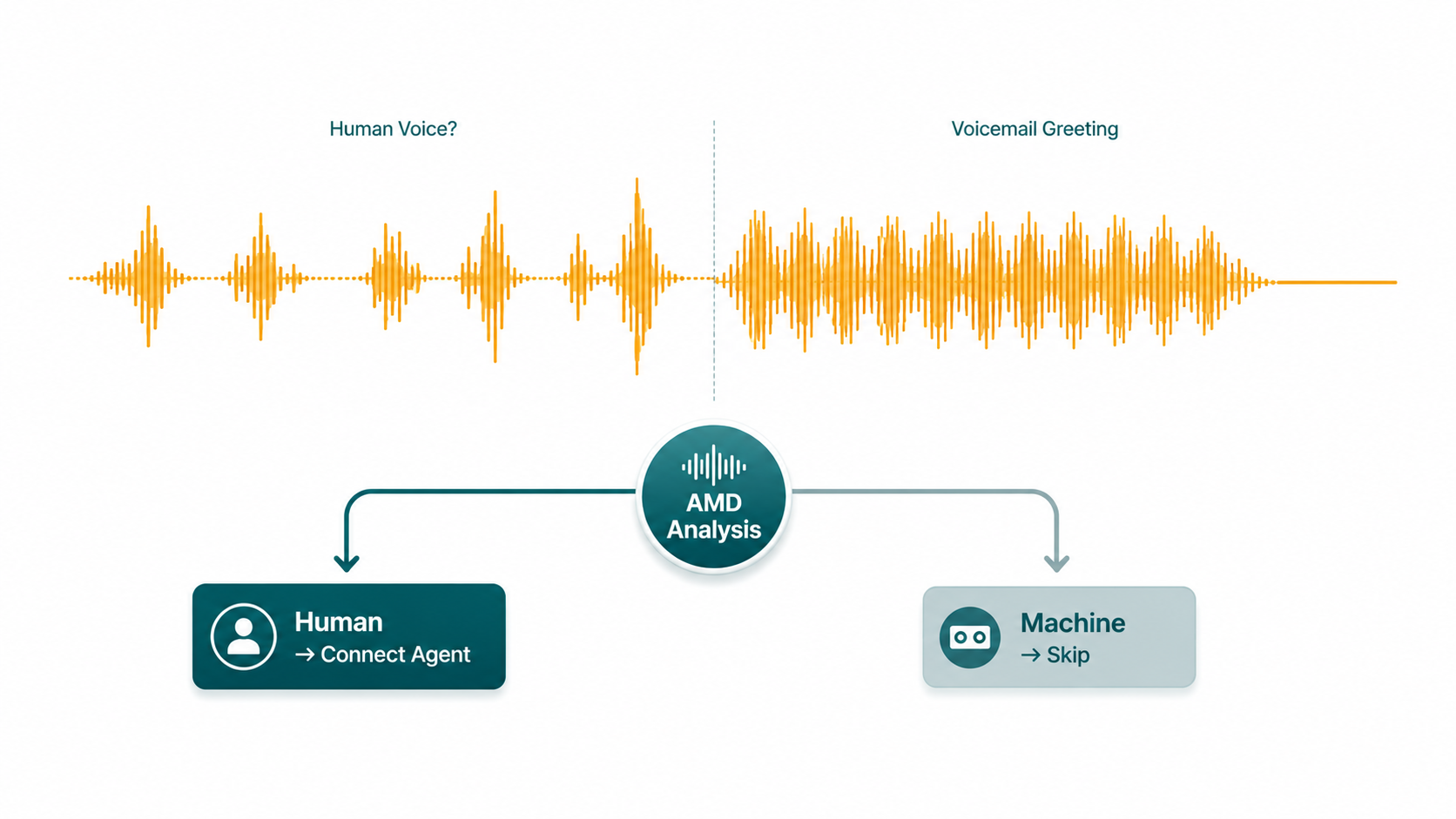
In outbound calling, agent time is the scarce resource. Every minute an agent spends listening to a voicemail greeting — waiting for the beep, deciding whether to leave a message, then hanging up — is a minute not spent in a conversation with a potential customer. Answering Machine Detection (AMD) exists to solve that problem: it intercepts calls the moment they connect, analyzes the first few seconds of audio, and routes live human answers to agents while handling machine answers automatically.
On campaigns where voicemail answers can represent 40% to 60% of all answered calls — which is common on cold residential lists — AMD is not a convenience feature. It is what makes the economics of high-volume outbound dialing work at all. But AMD introduces its own trade-offs, and understanding how it works explains both its value and its limitations.
What is Answering Machine Detection (AMD)? AMD is a technology component in outbound dialing systems that analyzes the audio on an answered call to determine whether a live human or a voicemail system picked up — before connecting the call to an agent. When AMD identifies a live human, the call is transferred to an available agent. When AMD identifies an answering machine, the call is handled automatically (typically by dropping the call, triggering a voicemail drop, or logging the outcome) without consuming any agent time.
How AMD Works Technically
AMD analysis begins the instant a call connects — the moment the remote end answers and audio begins flowing. The system has a narrow window to make its determination before the connection delay becomes perceptible to a live caller. What follows is a breakdown of the specific signals AMD systems use.
Silence detection at the start of audio
Voicemail systems frequently begin with a brief programmed pause before the recorded greeting plays. This is a carrier or voicemail platform artifact — a gap of 200 to 600 milliseconds where audio is technically connected but nothing is being said. Live humans, by contrast, typically begin speaking within a fraction of a second of answering because they are responding to a perceived connection.
Leading silence is one of AMD's earliest and fastest signals. It does not confirm an answering machine on its own — some callers pause before speaking — but it contributes to a composite probability score that AMD uses to make its classification.
Speech duration analysis
A live human answering a call typically says something brief: "Hello?", "Yeah?", or their name. That initial utterance is short — a fraction of a second to one second — followed by a pause waiting for the other party to speak.
A voicemail greeting, by contrast, tends to be a continuous, longer speech segment: "Hi, you've reached the voicemail of [name]. I'm unavailable right now. Please leave a message after the tone and I'll get back to you as soon as possible." That greeting can run three to ten seconds of uninterrupted speech with no pause for a response.
Speech duration analysis measures the length of the first uninterrupted speech segment after the call connects. A short utterance followed by silence suggests a live human; a long, uninterrupted utterance suggests a recorded voicemail greeting.
Cadence and energy patterns
Beyond raw duration, AMD looks at acoustic characteristics. Human speech has irregular cadence — natural variation in pace, emphasis, and volume. Professional voicemail greetings, particularly those recorded by businesses or carriers, tend to have more consistent energy profiles and a more uniform delivery pattern.
This signal is less reliable than duration — not everyone speaks in consistent patterns, and some people have naturally monotone voices — but it adds weight to the composite classification when combined with other signals.
Beep detection
The audible beep tone at the end of a voicemail greeting is one of the most definitive signals available. When AMD detects the specific frequency and duration pattern of a voicemail beep, it can classify the call with high confidence as an answering machine.
The problem with relying on beep detection is latency. Waiting for the beep means waiting for the entire voicemail greeting to finish before classifying the call — which can be 5 to 10 seconds into the call. For a live caller who has already said "Hello?" and been met with silence, 5 to 10 seconds of no response is almost certainly going to result in a hangup before the system ever tries to connect them to an agent. Beep detection is therefore used as a confirmation signal, not as the primary detection method.
Detection speed vs. detection confidence
This is the core engineering trade-off in AMD design. Making a classification decision quickly — within 1.5 seconds — means the system has seen very little audio to work with. Accuracy is lower, but live callers experience minimal delay before being connected to an agent.
Waiting longer — 3 to 5 seconds — gives the system substantially more signal: more speech, clearer cadence patterns, potentially a beep. Accuracy improves significantly. But a live caller who answered and said "Hello?" is now sitting in 3 to 5 seconds of silence. Many callers interpret that silence as a dropped call and hang up.
AMD systems allow operators to configure this threshold, and the right setting depends on campaign priorities. Operations where a false positive (losing a live call) is very costly — high-value sales leads, for example — may tolerate a faster, less accurate detection in order to minimize silent gaps. High-volume campaigns where agent time is the constraint may accept slightly more AMD errors in exchange for the accuracy benefit of longer analysis.
What Happens After AMD Makes Its Classification
When AMD determines: live human
The call is transferred to an available agent. The agent's phone rings (or their softphone receives the call), and the conversation begins. Any available screen pop — lead record, prior contact history, campaign context — is surfaced to the agent simultaneously.
The agent experiences no indication that AMD was involved. From their perspective, a connected call arrived and a live person is on the line. The AMD analysis happened in the background during the brief connection gap.
When AMD determines: answering machine
The campaign configuration determines what happens next. The three most common options are:
- Drop the call: The call is disconnected without any message being left. The outcome is logged as AMD/No-Message in the campaign records. This approach maximizes agent efficiency by not occupying a phone line for the duration of a voicemail message being played, but it leaves no trace with the prospect.
- Voicemail drop: A pre-recorded message is played to the voicemail system automatically after the beep is detected. The message is typically a campaign-specific recording — a callback number, a brief value proposition, or a simple notification. No agent time is consumed; the recording plays and the call concludes. Voicemail drops require specific regulatory consideration in some contexts (see the compliance section below).
- Log and skip: The outcome is recorded as answering machine in the campaign system. Depending on campaign rules, the number may be rescheduled for a later attempt at a different time of day, or marked as exhausted if multiple AMD outcomes have accumulated for the same contact.
False Positives and False Negatives
AMD accuracy is never perfect, and the two failure modes have meaningfully different consequences.
False positive: live human classified as machine
A live person answers the call. AMD analyzes the initial audio — perhaps the person's voice had an unusual cadence, or they paused before speaking — and classifies them as an answering machine. The call is dropped or sent to voicemail drop. The live person hears silence or a recorded message not addressed to them, and hangs up.
From the campaign perspective: a live lead is lost. The contact may have been a qualified prospect. The opportunity does not come back unless the number is redialed, and even then, the same person may not answer again. For high-value lead lists, false positives represent direct revenue loss.
From a compliance perspective: a call that connected to a live human and then disconnected or played an automated message without routing to an agent may be counted as an abandoned call under FTC Telemarketing Sales Rule metrics, depending on how the system logs and categorizes it. This is a point of complexity in abandoned rate calculations for predictive campaigns.
False negative: answering machine classified as human
An answering machine answers the call. AMD misreads the initial audio — perhaps the voicemail greeting was unusually brief, or the first word happened to sound like a one-word human answer — and routes the call to an agent. The agent picks up and hears a voicemail recording mid-message.
The agent typically hangs up, possibly after logging a disposition. Some agents, if campaign rules allow, may attempt to speak after the beep. Either way, the result is wasted agent time — the agent spent several seconds on a call that produced no conversation.
False negatives do not carry compliance implications, but they directly reduce the efficiency that AMD is supposed to deliver. On lists with high voicemail rates, frequent false negatives meaningfully erode agent productivity.
Factors That Affect AMD Accuracy
AMD accuracy is not a fixed characteristic of a platform — it varies based on conditions outside the dialer's control:
- Voicemail greeting style: Very short voicemail greetings ("Leave a message") can be mistaken for a one-word human answer. Very long, elaborate greetings with multiple pauses can create ambiguity. Standard carrier voicemail greetings tend to be more reliably detected than custom personal recordings.
- Call audio quality: VoIP connections with packet loss, jitter, or codec artifacts introduce noise into the audio signal that AMD has to analyze. Audio degradation of any kind reduces classification confidence.
- Ambient noise on the called line: If a voicemail system plays in a noisy environment (which doesn't actually happen for voicemails, but network-generated noise can simulate it), or if a live caller answers in a loud environment, the noise patterns can interfere with duration and cadence analysis.
- Carrier and connection type: Mobile networks and certain VoIP carriers introduce processing that alters the audio envelope — particularly the initial silence and the start of speech. AMD systems tuned for landline call patterns may perform differently on mobile-heavy calling lists.
- Detection threshold configuration: The sensitivity setting the operator configures affects where the line falls between "probably human" and "probably machine." More aggressive machine detection (catching more voicemails) increases false positive risk for live callers. More conservative detection (protecting live callers) increases the false negative rate for machines.
Some vendors publish accuracy benchmarks for their AMD implementations. Those benchmarks are measured under controlled conditions and may not reflect performance on a specific campaign list, carrier mix, or geographic calling region. Any accuracy claim should be understood as a best-case estimate rather than a guaranteed floor.
AMD and Compliance
AMD is not a compliance tool — it is an efficiency tool. But its behavior has compliance implications that outbound campaign operators need to understand.
The FTC's Telemarketing Sales Rule (TSR) sets a cap on abandoned call rates for telemarketing campaigns: no more than 3% of all answered live calls may be abandoned (the called party not connected to a live agent within 2 seconds of answering). AMD is intended to minimize the number of voicemail answers that consume agent capacity, which indirectly helps control the abandon rate. However, AMD false positives — live callers incorrectly classified as machines and dropped — may themselves be counted toward the abandonment rate, depending on how the dialer logs and categorizes those outcomes.
Voicemail drops — pre-recorded messages left automatically when AMD detects an answering machine — have their own regulatory considerations. In some interpretations of TCPA and FCC rules, a voicemail drop to a mobile number may trigger TCPA consent requirements. This is an area where legal interpretation continues to evolve, and operators should not assume that leaving a voicemail drop is automatically permissible for all list types.
For detailed compliance requirements, see the dedicated article: predictive dialer compliance.
EaseDial Campaign Dialer
Predictive, progressive, and preview dialing — built into a single outbound campaign platform with automated outcome tracking and DNC list management.