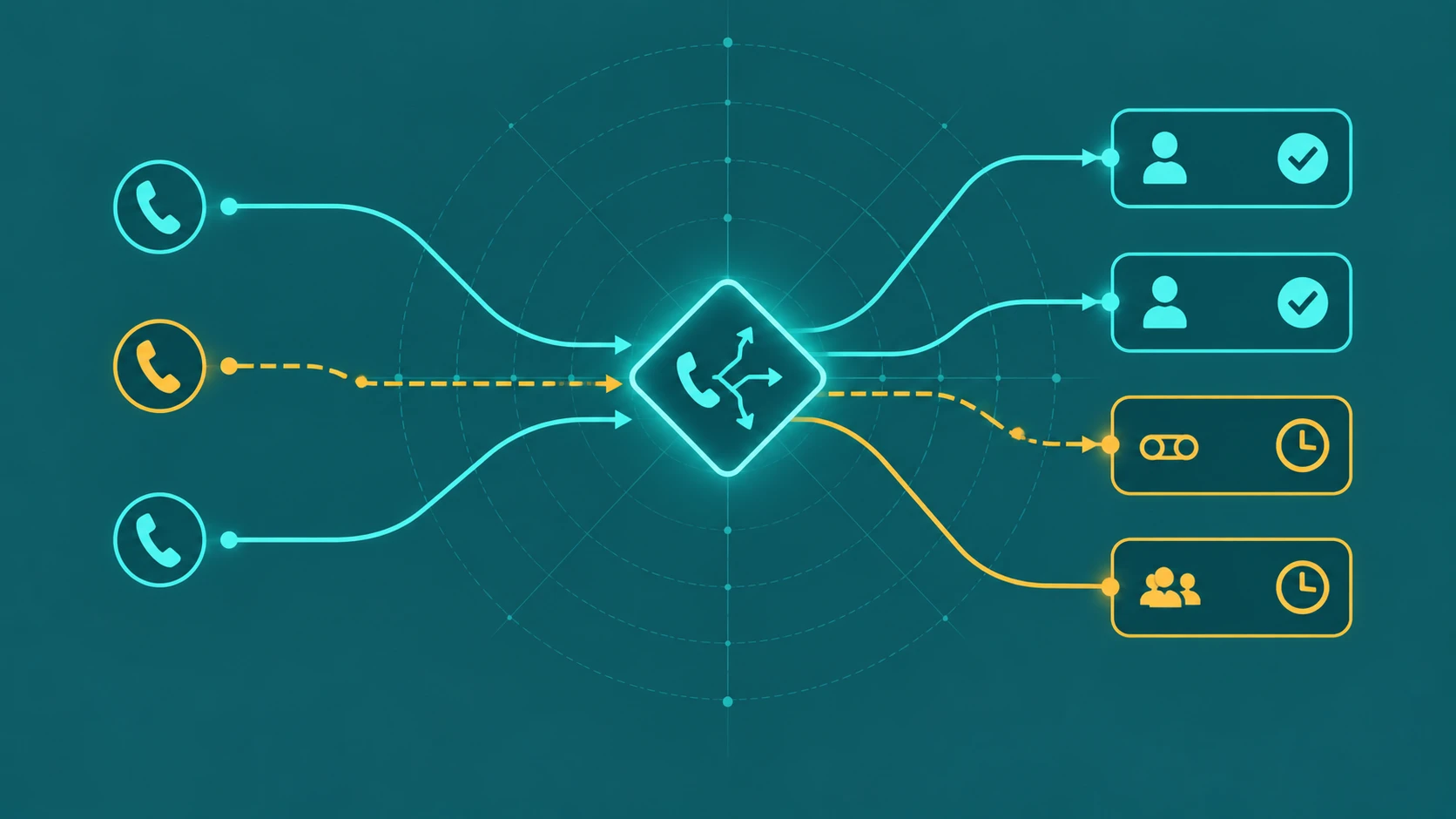
Longest Idle and Linear are two call queue routing strategies with very different design philosophies. Longest Idle continuously adjusts to give the next call to whoever has been waiting the longest. Linear applies a fixed priority order on every single call, always starting from position one. One is dynamic; the other is static.
Both are available in EaseDial alongside Ring All and Round Robin. Choosing correctly depends on what you are actually trying to optimize — workload consistency, agent specialization, or priority routing. This article covers how each works, what it optimizes, and when each is appropriate.
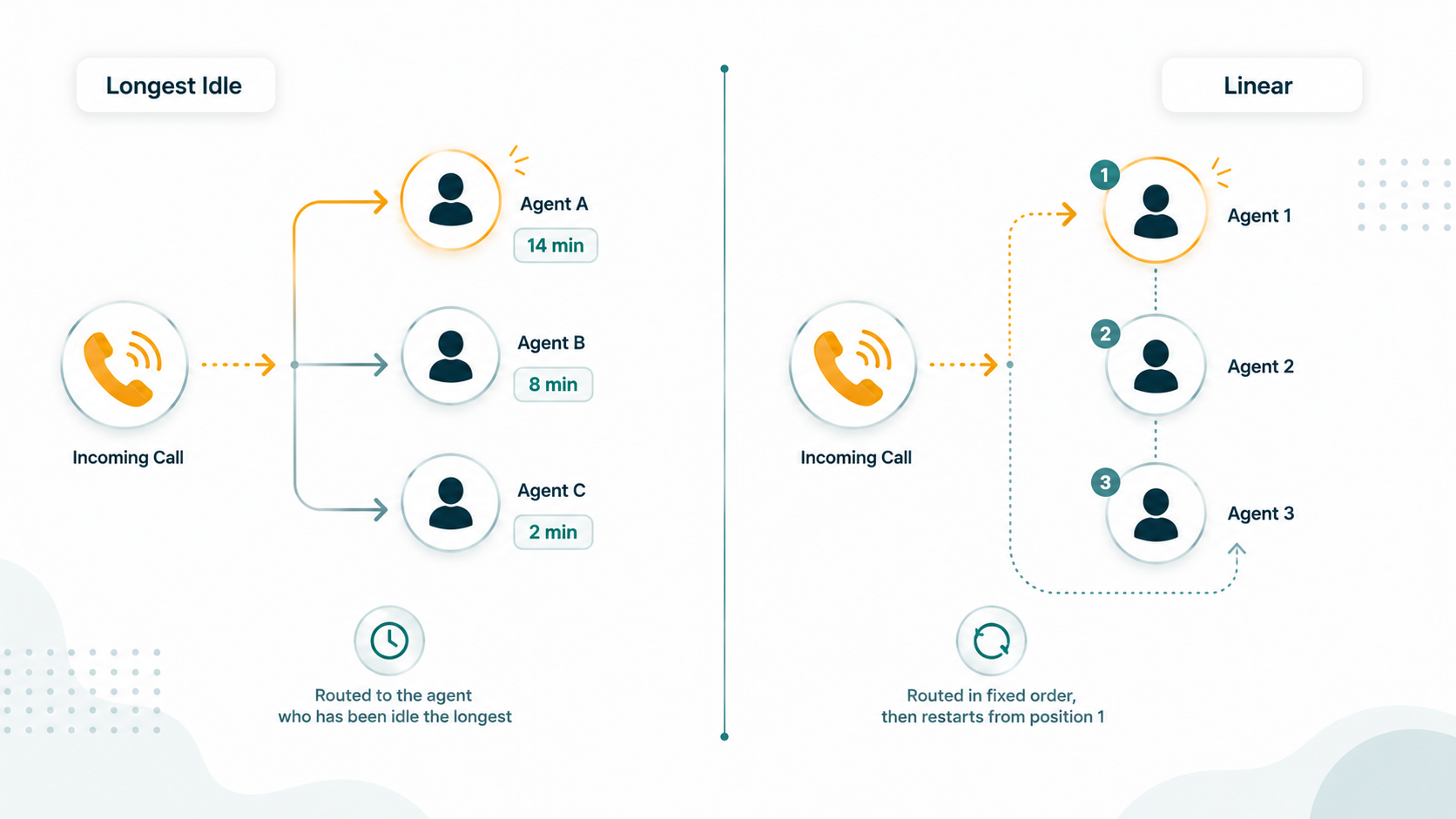
Core difference: Longest Idle routes each call to the available agent who has been idle the longest since their last call ended — producing the most consistent time-between-calls distribution. Linear routes each call in a fixed priority order: Agent 1 always gets the first available call if they are available; Agent 2 only if Agent 1 is not. Longest Idle optimizes for workload consistency; Linear optimizes for a defined priority hierarchy.
How Longest Idle Works
Longest Idle routing tracks a single metric per agent: elapsed time since their last call ended (or since they became available, if they haven't received a call yet in the current session). The available agent with the highest elapsed idle time receives the next call from the queue.
As calls complete and agents return to available status, the idle timer for each agent begins counting again. The agent who has been waiting the longest gets the next call. When that agent finishes their call and returns to available, their timer resets to zero — they go to the back of the priority order. The agent who has now been waiting the longest moves to the front.
What Longest Idle optimizes
Longest Idle naturally equalizes the time agents spend between calls. An agent who handles a quick two-minute call returns to available quickly and, if other agents have been idle during that call, will have a relatively low idle time when they return. Those other agents — who have been idle longer — get priority for the next call.
This produces more consistent idle intervals across the agent pool compared to Round Robin, which distributes calls by count regardless of call duration. Agents who handle longer calls are naturally given more idle time before receiving the next, because their idle timer only started running when the long call ended.
Longest Idle is particularly effective in environments where:
- Call durations vary significantly — some calls take two minutes, others take 20.
- Agent workload consistency is important for morale and performance.
- All agents handle the same call types and there is no priority hierarchy to enforce.
What Longest Idle does not account for
Idle time since the last call is the only variable. Longest Idle does not consider:
- How difficult the previous call was — an agent recovering from a difficult 15-minute escalation receives the next call as soon as their idle time surpasses their colleagues, regardless of the emotional or cognitive load of the prior call.
- Agent skill or specialization — all agents in the queue are equally eligible regardless of expertise.
- Multi-queue membership — if an agent is a member of multiple queues, their idle time may reflect idleness from any queue, which can create unexpected routing behavior if they've been busy in one queue but are nominally available to another.
How Linear Routing Works
Linear routing applies a fixed priority order to every call dispatched from the queue. When a call is ready to be delivered:
- Is Agent 1 available? If yes, deliver the call to Agent 1.
- If Agent 1 is not available: Is Agent 2 available? If yes, deliver the call to Agent 2.
- Continue down the ordered list until the first available agent is found.
Unlike Round Robin, there is no rotation pointer. The list always starts from position one for every single call. If Agent 1 is available, they receive every call that comes through while they are available. Agent 2 only receives calls when Agent 1 is occupied. Agent 3 only receives calls when both Agents 1 and 2 are occupied.
What Linear optimizes
Linear ensures that the highest-priority agent receives every possible call within their capacity. This is the right choice when agents are not interchangeable — when one agent should always be the first to handle calls because of their relationship with a customer, their seniority, their specialization, or a business rule that requires it.
Specific use cases for Linear:
- Dedicated account manager + backup. A named account manager should handle all calls from their accounts. Only if the account manager is on another call should a backup receive the call. Linear with the account manager at position 1 and the backup at position 2 implements this exactly.
- Escalation queues. A junior agent is at position 1 and handles routine issues; a senior agent is at position 2 and only receives calls if the junior is occupied; a specialist is at position 3 as the final escalation. This ensures the specialist doesn't receive calls that a junior can handle, while ensuring coverage at all levels.
- Priority coverage for senior staff. In some organizations, senior agents or principals should not receive calls unless no one else is available. Linear in reverse — juniors at the top, seniors at the bottom — implements this priority order.
The workload imbalance consequence
Linear creates severe workload imbalance by design. Agent 1 receives a significantly disproportionate volume of calls — all calls during periods they are available. Agents at the bottom of the order may receive very few calls, particularly in lower-volume periods when Agent 1 is rarely fully occupied.
Agents at lower positions in a Linear queue may struggle to maintain competency with low call volume. Conversely, Agent 1 may experience higher call density than is sustainable in high-volume periods. Linear is appropriate for small sequences (2–4 agents) with a genuine business reason for the priority order, not for general workload distribution.
Direct Comparison
| Factor | Longest Idle | Linear |
|---|---|---|
| Selection logic | Highest idle duration since last call | Fixed priority order, always from position 1 |
| Workload distribution | Even — naturally balances idle time | Heavily uneven — Agent 1 dominates |
| Agent hierarchy | None — all agents equal | Explicit priority order enforced |
| Adapts to call duration | Yes — longer calls create longer idle before next | No — position 1 gets every available call |
| Appropriate team size | Any — works at small and large scale | Small (2–4 agents); specific hierarchy required |
| Primary use case | Efficiency-focused, uniform call types | Primary agent + backup, escalation paths |
| Fairness concern | Low — self-regulating | High — agents at bottom rarely work |
When to Use Longest Idle
- Uniform call types where all agents handle the same interactions. When every agent can handle every call equally well and the goal is to distribute work evenly, Longest Idle produces the most consistent distribution.
- Operations with variable call duration. Round Robin distributes by count; Longest Idle distributes by time. When calls vary significantly in length, Longest Idle is fairer because agents who just finished long calls don't immediately receive the next one.
- Teams where fairness in workload is important for morale. Agents can see that the system naturally gives priority to whoever has been waiting longest — not who responds fastest (Ring All) or who happens to be next in a rotation regardless of their prior call load (Round Robin).
- Contact center environments focused on efficient utilization. Supervisors tracking idle time and occupancy will find Longest Idle produces the most consistent occupancy levels across agents, making staffing decisions more predictable.
When to Use Linear
- Dedicated account management. Specific customers should reach their named account manager first. If the account manager is unavailable, a backup takes the call.
- Tiered escalation queues. Junior agents handle what they can; escalations flow to senior agents only when junior agents are fully occupied.
- Emergency backup coverage. A primary agent or team is preferred; a secondary serves only when primary capacity is exhausted. The secondary agent is not intended to handle normal volume and should not receive calls during periods when primary agents are available.
- Small teams with a clear seniority or priority reason for the order. Linear should not be used for general workload distribution. It should be used when there is a genuine business reason why one specific agent should always be tried first.
Avoiding Common Mistakes
Using Linear for large teams
Linear with 10 agents means 9 of those agents may receive very few calls during most operating hours. They stay logged in, accumulate minimal experience, and may become disengaged. Linear is a small-pool strategy (typically 2–4 agents) with an explicit hierarchy reason. Using it for general workload distribution at any meaningful team size is a mistake.
Confusing Longest Idle with Round Robin
Both produce reasonably even distribution over time, but they optimize for different things. Round Robin distributes by call count (each agent receives roughly the same number of calls). Longest Idle distributes by idle time (each agent receives roughly the same time-between-calls). For uniform calls with similar durations, the two produce similar outcomes. For calls with highly variable durations, Longest Idle is significantly fairer.
Expecting Longest Idle to account for skill differences
Longest Idle selects agents by idle duration. It does not know or care that one agent is a senior specialist and another is a trainee. All agents in the queue are equally eligible. If skill-based routing is required, separate queues per skill level — with multi-queue membership and priority weights — is the appropriate approach, not trying to engineer skill matching within a single Longest Idle queue.
EaseDial
Longest Idle, Linear, Round Robin, and Ring All — configure the right routing strategy per queue for your team's needs.