Ring All and Round Robin are two of the most common call queue routing strategies — and the choice between them reflects a fundamental decision about what the queue is optimizing for. Ring All prioritizes speed; Round Robin prioritizes fairness. Understanding the difference, and when each is appropriate, is one of the more consequential configuration decisions in business phone setup.
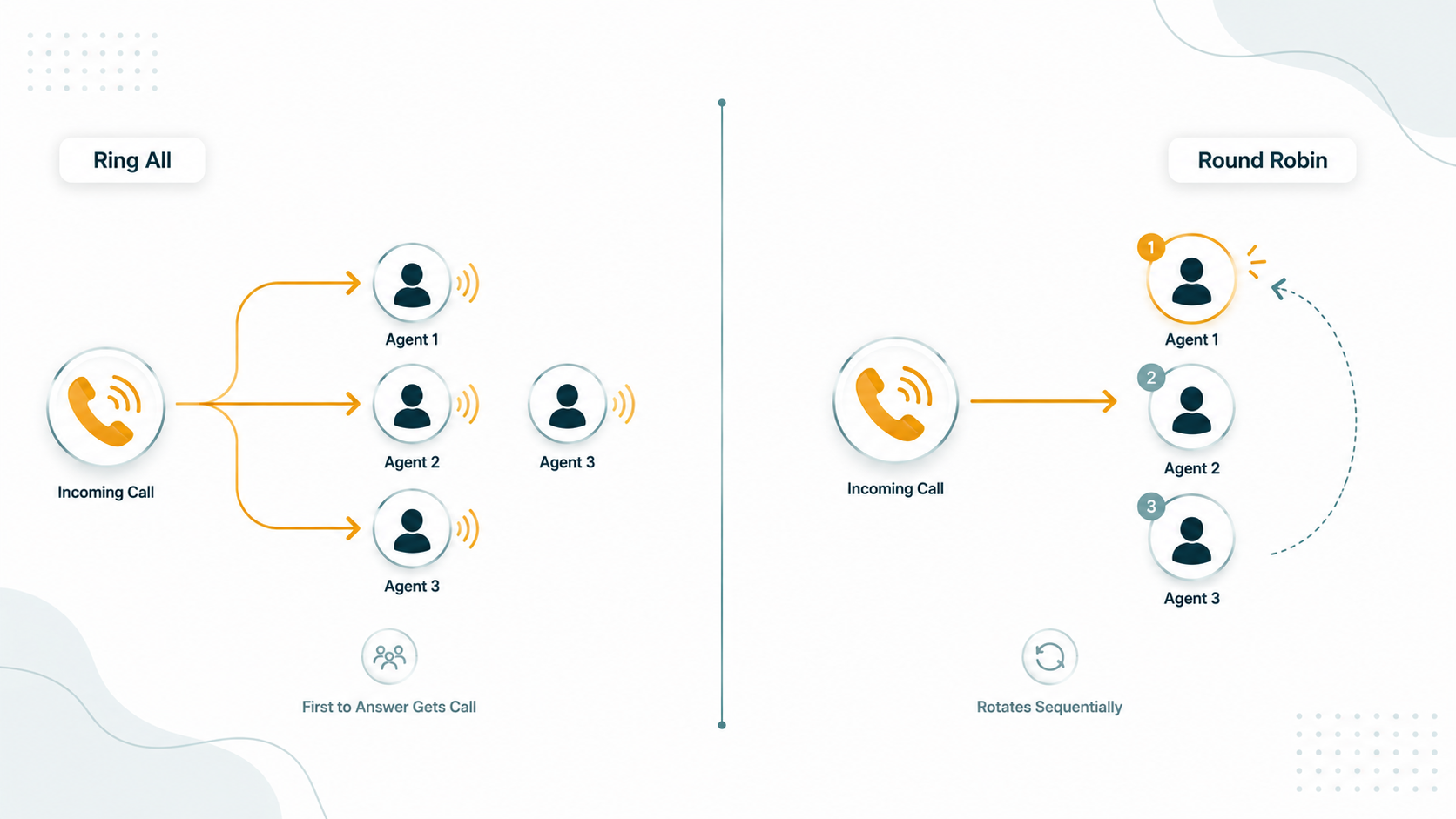
Core difference: Ring All prioritizes speed by ringing all available agents simultaneously and connecting the caller to whoever answers first. Round Robin prioritizes even distribution by rotating call assignments sequentially through the agent pool. Ring All is fastest for the caller; Round Robin is fairest for the agents.
How Ring All Works
When a call is ready to be dispatched from the queue, Ring All sends a simultaneous ring notification to every available agent in the queue. All of their phones ring at the same time. The first agent to answer takes the call — the call connects to that agent, and all other ringing alerts cancel immediately.
There is no selection logic in Ring All. The outcome is determined entirely by which agent responds fastest. The system does not consider which agent has taken the most calls, which has been idle longest, or any other workload factor. Speed of response is the only criterion.
What Ring All is good at
Ring All minimizes time-to-answer. In situations where getting to a live agent as fast as possible is the primary goal — urgent support lines, sales teams where every second of response time matters, on-call rotations — Ring All achieves the shortest possible connection time. No time is spent selecting an agent; the first available person picks up.
It is also operationally simple. There is no rotation pointer to maintain, no idle time tracking, no priority order to configure. Every agent in the pool is always in consideration for every call. Adding a new agent to the queue immediately includes them in the competition for calls.
Trade-offs and limitations
Ring All creates a "race to answer" dynamic. Agents who consistently answer faster — whether because they're less busy, faster to respond, or simply more competitive — receive a disproportionate share of calls. Slower-responding agents receive fewer calls without any fairness mechanism to compensate.
At larger team sizes, simultaneous ringing becomes disruptive. If 20 agents all receive a ring alert for every incoming call, and most of them immediately cancel it when someone else answers first, that's a lot of notification noise per call with a very low per-agent answer rate. Agents who lose the race repeatedly experience high notification volume with low productive engagement — a recipe for ring fatigue and decreased attentiveness.
Ring All also provides no workload fairness — agents with faster hardware, faster internet connections, or simply closer attention will consistently outperform others, regardless of competency or effort.
How Round Robin Works
Round Robin maintains a rotating pointer through the ordered list of queue member agents. When the next call is dispatched from the queue, it goes to the next agent in the rotation. After that agent receives the call (whether they answer it or not), the pointer advances to the next agent in the list. When the pointer reaches the end of the list, it cycles back to the beginning.
If the next agent in the rotation is unavailable — on a call, in wrap-up, or away — the system advances to the next available agent in the sequence. The pointer continues forward from where it advanced, not from the beginning.
The practical result: over any meaningful period, each agent receives approximately the same number of call dispatch events. No agent is systematically favored by response speed.
What Round Robin is good at
Round Robin produces even call distribution by count. In teams where calls are roughly similar in complexity and duration, Round Robin ensures each agent is doing approximately equal amounts of work over a shift. This is important for:
- Agent morale and perceived fairness — agents can see that the system distributes evenly and aren't competing against each other for every call.
- Performance evaluation — when workload is evenly distributed, individual performance metrics are more comparable across agents.
- Preventing burnout from call overload among faster-responding agents.
- Ensuring newer or slower agents develop skill through consistent call volume rather than being consistently outpaced by faster colleagues.
Round Robin is the standard choice for most inbound sales, appointment scheduling, and general inquiry queues where calls are uniform in type and every agent handles the same kind of interaction.
Trade-offs and limitations
Round Robin distributes calls by count, not by time or complexity. An agent who handles a 12-minute escalation call may immediately receive the next call in the rotation, while an agent who just finished a 90-second simple inquiry has several minutes of idle time before their turn comes around again. The rotation equalizes call quantity, not workload burden.
Round Robin also doesn't match calls to agent skills. Every agent in the rotation receives calls in sequence regardless of their expertise. If the queue receives a mix of simple and complex calls, Round Robin doesn't route complex calls to more experienced agents. Skill-based routing requires either separate queues per call type or more sophisticated routing logic beyond basic Round Robin.
Connection speed is slightly slower than Ring All. Round Robin selects a specific agent and rings only them — if that agent is briefly in a state the system doesn't detect as "unavailable" but also doesn't answer quickly, there's a short delay before the next agent in the rotation is tried. Ring All doesn't have this delay because all agents are notified simultaneously.
Comparison Table
| Factor | Ring All | Round Robin |
|---|---|---|
| Speed to connect | Fastest — first to answer wins | Slightly slower — one agent at a time |
| Workload fairness | Low — favors fastest responders | High — equal distribution by count |
| Notification volume per agent | High — every call rings everyone | Low — each call rings one agent |
| Best team size | Small (2–8 agents) | Any size; scales well |
| Configuration complexity | Simple — no ordering needed | Simple — automatic rotation |
| Skill matching | None — fastest hands win | None — equal rotation regardless of skill |
| Best use case | Urgency-first lines, on-call, small teams | Uniform call types, fairness-first operations |
When to Use Ring All
- Small teams of 2–8 agents. With a small pool, the notification volume per agent per call is manageable. Ring fatigue becomes significant above 10–12 agents.
- Time-critical inbound lines. Urgent support, emergency response lines, VIP queues where getting to a live person as fast as possible is the primary goal.
- On-call rotations. When a group of people is on-call and the first available person should answer, Ring All is the natural model — it replicates the behavior of a group pager or simultaneous ring.
- Sales teams where speed-to-lead matters. In some inbound sales contexts, the speed of human answer can affect conversion — Ring All ensures the call is answered as fast as possible regardless of which agent takes it.
- Low call volume. When calls arrive infrequently enough that simultaneous ringing isn't disruptive, Ring All's simplicity is an advantage.
When to Use Round Robin
- Teams where equal distribution matters for morale or performance evaluation. If agents are paid on call-based commissions or evaluated on call volume metrics, unequal distribution from Ring All creates fairness problems that Round Robin avoids.
- Larger teams (10+ agents). Once team size grows past small, the notification noise of Ring All per agent-call event becomes a real issue. Round Robin scales without increasing individual notification volume.
- Uniform call types with standardized handling. When every call in the queue is essentially the same — same script, same resolution paths, same expected duration — Round Robin distributes work evenly and every agent is equally suited to every call.
- Inbound queues where fairness is valued over speed. Customer service and support operations where the priority is handling volume consistently, not answering within milliseconds of queue dispatch.
Combining Strategies: Separate Queues
Many businesses run different routing strategies for different queues rather than choosing one for the whole organization. A VIP customer queue might use Ring All to ensure the fastest possible response; a general inquiry queue for the same team might use Round Robin to manage workload fairly. Two separate queues with two separate routing strategies, served by some or all of the same agents — this is queue-level skills routing, and it is more practical than trying to handle skill differentiation within a single-queue configuration.
See our articles on what is a call queue and call queue management for how queue configuration and routing strategy work together. For the other two strategies — Longest Idle and Linear — see Longest Idle vs Linear routing. For the caller-side experience while they wait for dispatch — including hold music licensing and configuration — see our dedicated guide.
EaseDial
Ring All, Round Robin, Longest Idle, and Linear routing — configure the right strategy per queue without IT involvement.