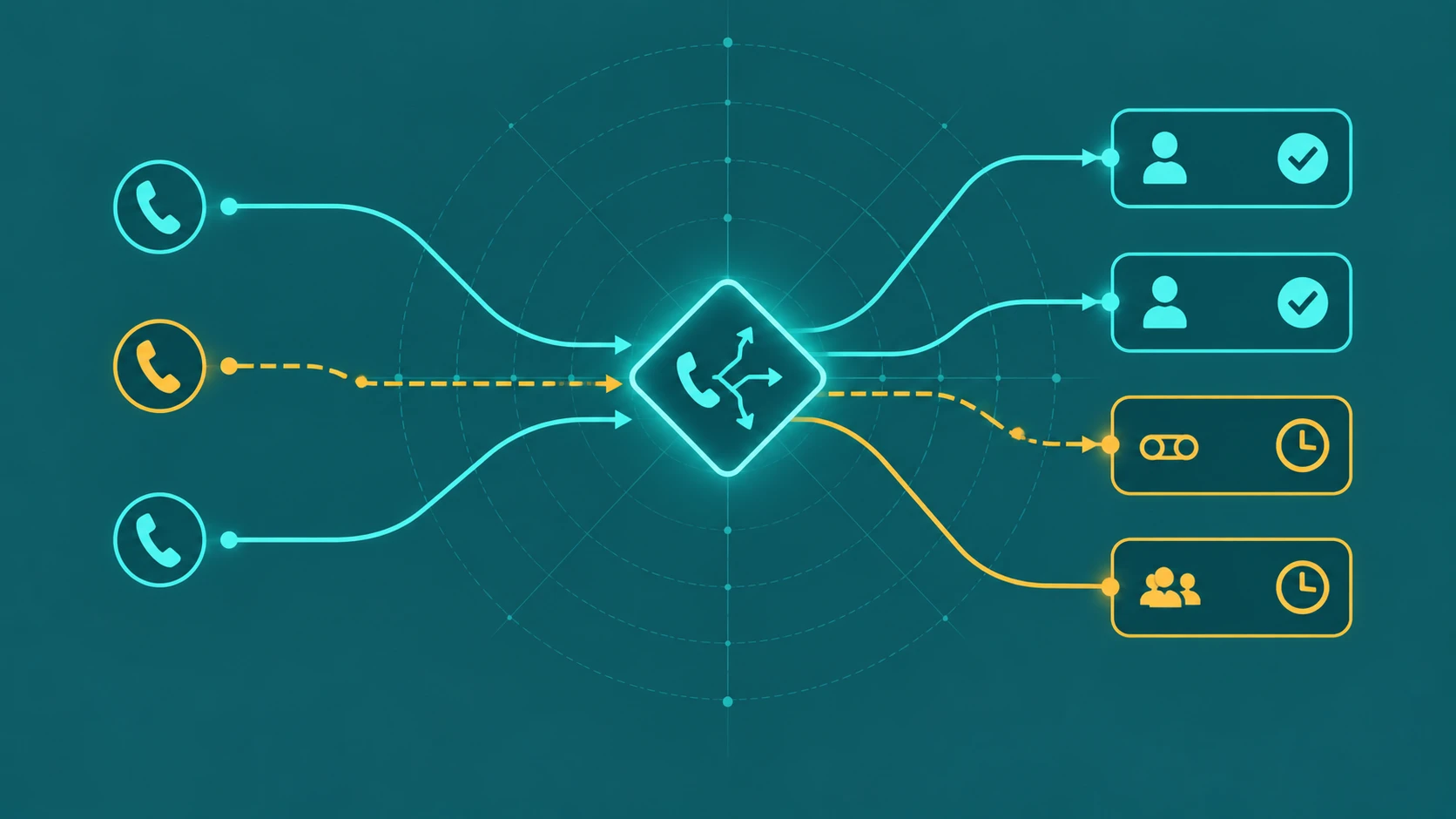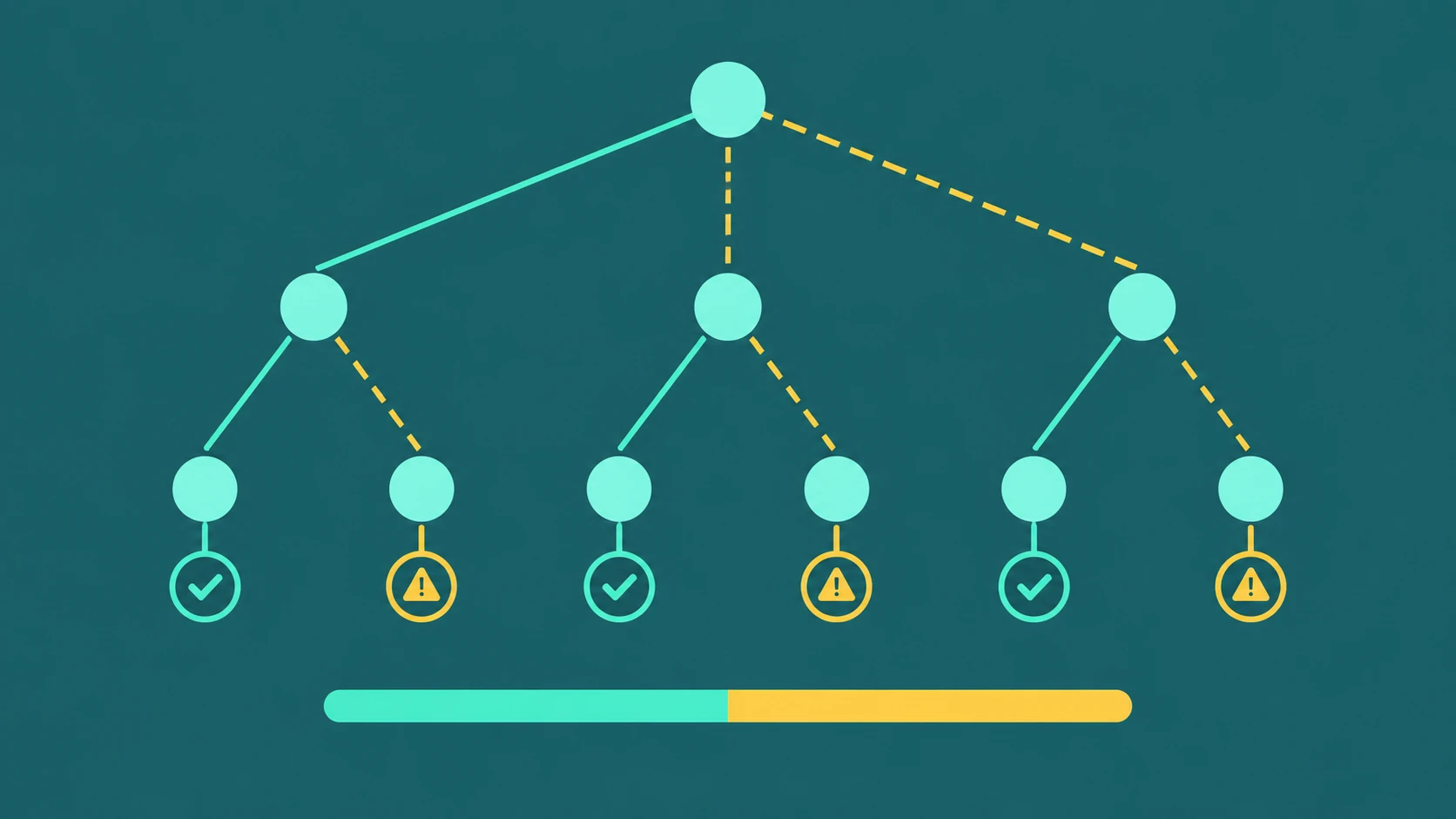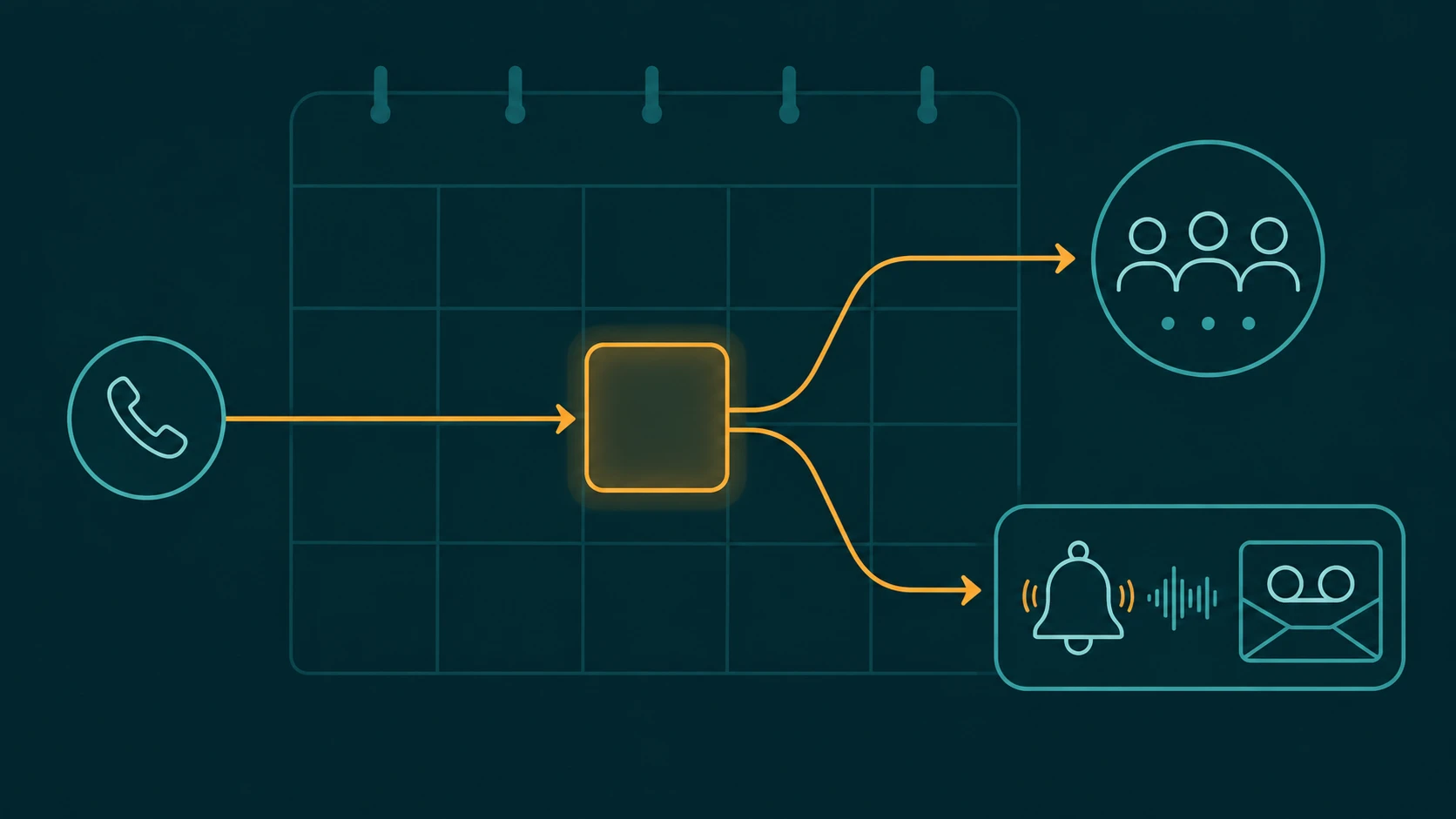
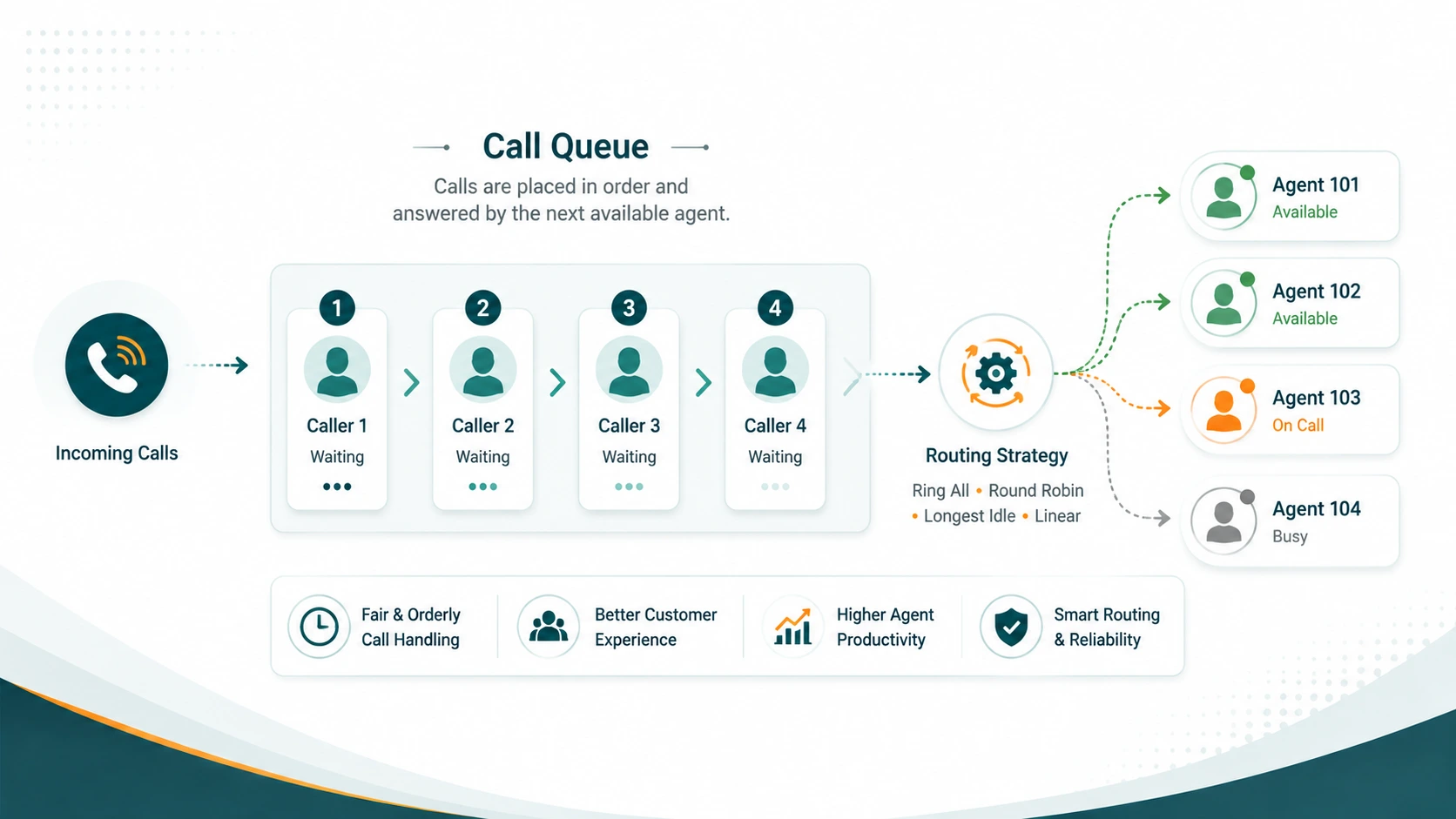
Every business that takes calls eventually runs into the same problem: more calls arrive at the same time than there are people to answer them. What happens next defines the caller experience. Without a systematic way to hold those calls, callers hit a busy signal, get dropped, or ring indefinitely with no indication of whether anyone will ever answer. With a call queue, they wait in an organized line, receive feedback about their position, and connect to an available agent as soon as one is free.
This guide covers what a call queue is, how one works step by step, the components that make up a well-configured queue, the different routing strategies available, and the practical decisions involved in designing a queue that serves both callers and agents well.
Note: This article focuses on what a call queue is and how it works mechanically. For strategies to reduce wait times, manage abandonment, and optimize queue performance, see our companion guide on call queue management. For how call queues fit into the broader call flow alongside IVR, see call queue vs IVR: what's the difference?
What Is a Call Queue?
Definition: A call queue is a feature of a business phone system or contact center platform that holds incoming callers in an organized waiting line when all agents are occupied, and distributes those calls to agents as they become available according to a defined routing strategy. The queue manages the order in which calls are answered, plays hold music or informational messages during the wait, tracks queue depth and wait times, and applies overflow rules when wait limits are exceeded.
Why Call Queues Exist: What Happens Without One
Call arrival is probabilistic. Even a business with perfectly staffed hours will occasionally see ten calls arrive in the same two-minute window. Without a queue, those ten calls compete for the available lines and agents with no organizing logic:
- Callers who reach an occupied line hear a busy signal and hang up — and most will not call back immediately.
- Calls that do ring through may ring indefinitely without any indication of when (or whether) someone will answer.
- There is no systematic prioritization — which caller gets through is determined by chance, not by who has been waiting longest or who has the most urgent need.
- There is no visibility for supervisors into how many callers are waiting, how long they have been waiting, or how many gave up.
A call queue solves all of these problems. It gives callers a place to wait with feedback, gives agents a managed flow of work, and gives supervisors data about the queue's health. It is the mechanism that makes inbound call operations manageable at any scale beyond a single phone with one person answering it.
How a Call Queue Works: Step by Step
A call queue is not a single action — it is a sequence of decisions and handoffs. Here is the full lifecycle of a call from arrival through connection:
- The call arrives at the system. A caller dials a phone number — either the business's main number or a DID assigned directly to a queue. The call reaches the cloud phone platform or PBX via the carrier's SIP trunk.
- The IVR or auto-attendant routes the call to the correct queue. If the caller dialed the main number, an IVR presents menu options ("Press 1 for sales, press 2 for support"). The caller's selection determines which queue they enter. If the caller dialed a DID assigned directly to a queue, this step is skipped — the call goes straight to that queue. Learn how IVR feeds into routing in our guide to IVR systems.
- The system checks agent availability. When the call enters the queue, the platform queries which agents are members of that queue and whether any are currently available (not on a call, not in wrap-up, not away).
- If an agent is available, the call connects immediately. The system selects an available agent based on the queue's routing strategy and delivers the call. The caller may hear a brief connection tone or a brief hold message, but typically connects within seconds.
- If all agents are busy, the caller enters the queue. The platform places the caller in the queue in their arrival-time order (or priority-adjusted order if priority queuing is configured — high-priority callers move ahead of standard callers). The caller's position is tracked. The system begins playing hold music, a branded hold message, or a combination of music and informational announcements.
- Position announcements and estimated wait times play. Depending on configuration, the caller may hear their queue position ("You are caller number 3") or an estimated wait time ("Your estimated wait time is approximately 4 minutes"). These messages repeat at intervals throughout the hold period.
- An agent becomes available. When an agent finishes a call and completes any configured wrap-up time, their status changes to available and they re-enter the agent pool for the queue.
- The routing strategy selects the next caller. The system applies the queue's routing strategy to determine which available agent receives the next call. This is not always simply "the agent who just became available" — the strategy determines the selection logic.
- The call connects to the agent. The caller stops hearing hold music and connects to the agent. On the agent side, the platform may deliver a screen-pop showing the caller's details, queue origin, and wait time.
- After the call, the agent enters wrap-up. Post-call work — logging notes, updating records, completing dispositions — keeps the agent off the queue temporarily. When wrap-up is complete, the agent returns to available status and becomes eligible for the next queued call.
If a caller waits longer than the configured maximum wait time, or if the queue reaches its maximum depth, an overflow rule triggers. The call may route to voicemail, transfer to another queue, forward to an external number, or connect to an AI voice agent that can handle the request without a human agent. Our guide on call queue overflow covers how overflow works and where calls can go. For a deep look at managing overflow and optimizing the full lifecycle, see our guide to call queue management.
Anatomy of a Call Queue
A call queue is made up of several configurable components. Understanding what each one does clarifies how to design a queue that performs well.
Queue name and DID assignment
Every queue has a name used for identification in admin interfaces and reporting. The queue is also assigned one or more DIDs — the phone numbers that route directly into it. A support queue might have its own support DID that frequent callers can use directly, in addition to being reachable through the IVR from the main number.
Member agents
The member agent list defines who can receive calls from this queue. Only agents explicitly assigned as members will receive queue calls. Agents can be members of multiple queues simultaneously, with priority weightings that determine which queue they service first when both have waiting callers. Adding or removing agents from queue membership is how supervisors adjust staffing in real time during high-volume periods.
Routing strategy
The routing strategy determines which available agent receives the next call from the queue. This is one of the most consequential configuration decisions. The five strategies available in most platforms are covered in detail in the next section.
Maximum wait time and maximum queue depth
Maximum wait time sets an upper limit on how long any individual caller can wait before an overflow action triggers. Maximum queue depth sets an upper limit on the total number of callers that can be in the queue simultaneously. Callers who arrive when the queue is full, or who reach the maximum wait time, are handled by the configured overflow action rather than continuing to wait indefinitely.
Both settings are important safeguards. Without them, a queue can grow to 50 callers, all waiting 45 minutes — which is worse service than simply telling a caller immediately that all agents are busy and offering a callback option.
Hold music and announcements
The hold experience shapes how callers perceive wait time. Options include branded hold music, informational messages about products or services, periodic position or wait time announcements, and offers to receive a callback rather than continuing to hold. Silence — the complete absence of any audio — is the worst hold experience; callers cannot tell if they are still connected and tend to abandon more quickly. For licensing rules, audio format guidance, and how to configure on-hold messaging effectively, see the guide on hold music and on-hold messaging.
Overflow behavior
When maximum wait time or maximum depth is reached, the overflow action determines what happens. Common overflow options:
- Voicemail — the caller is invited to leave a message with a callback promise.
- Transfer to another queue — the call moves to a backup queue, often staffed by a more generalist team.
- Forward to external number — the call routes to an answering service or after-hours provider.
- AI voice agent — an AI agent handles the call completely, resolving the immediate request without a human agent.
- After-hours message — the caller hears a message explaining the situation and stating when agents will be available.
Agent availability states
Queue routing is sensitive to agent state. A platform typically tracks several availability states:
- Available — the agent is logged in and ready to receive calls.
- On a call — the agent is handling an active call and is not eligible for queue routing.
- Wrap-up / ACW — the agent is completing post-call work. Depending on configuration, wrap-up may be timed (the agent returns to available after a fixed period) or manual (the agent self-reports when ready).
- Away / Break — the agent has manually set themselves as unavailable for queue calls.
- Offline — the agent is not logged in.
Only agents in the Available state receive queue calls. Accurate state management is essential for routing strategies like Longest Idle, where idle duration since the last call drives selection.
Queue Routing Strategies Explained
The routing strategy is the algorithm the system uses to select which available agent receives the next call from the queue. Each strategy optimizes for a different outcome. Choosing the right one depends on your team size, call type, and what you are trying to achieve.
Ring All
When the next queued call is ready to be dispatched, all available agents in the queue ring simultaneously. The first agent to answer takes the call; all other ring alerts cancel immediately.
How it works: The system sends a simultaneous ring notification to every available member agent. No selection logic is applied — speed of answer determines the outcome.
Best for: Small teams of 2–8 agents where minimizing time-to-answer is the priority — urgent inbound lines, small sales teams, on-call rotations. Ring All is the fastest strategy for connecting a caller to an agent.
Trade-offs: Creates a "race to answer" dynamic that rewards fastest-finger speed over any other factor. At larger team sizes (15+ agents), simultaneously ringing everyone for every call creates notification fatigue and coordination overhead. Ring All also provides no workload fairness — some agents will consistently answer more calls than others simply based on response speed. It does not account for agent skill or current workload.
Round Robin
The system maintains a rotating pointer through the list of queue member agents. Each new call dispatched from the queue goes to the next agent in rotation. The pointer advances after each call, cycling back to the beginning of the list after the last agent. If the next agent in rotation is unavailable, the pointer advances to the next available agent.
Best for: Teams handling uniform call types where equal distribution of call volume is the goal. Inbound sales queues, appointment scheduling lines, general inquiries. Round Robin is the standard choice for ensuring each agent receives roughly the same number of calls over any given period.
Trade-offs: Distributes calls by count, not by call complexity or duration. An agent handling a difficult 20-minute call receives the same count distribution as an agent handling 20-second calls. Does not match call types to agent skills — all agents receive the same rotation regardless of expertise. Wrap-up time variability can mean an agent returns to available at a slightly different rate than the rotation assumes, creating minor distribution drift over time.
Linear (Fixed Order)
Unlike Round Robin, Linear routing always starts from the first agent in a defined sequence for every call. Agent 1 is tried first. If Agent 1 is available, they take the call. If Agent 1 is unavailable, the system tries Agent 2. If Agent 2 is also unavailable, it tries Agent 3, and so on down the list.
Best for: Primary-agent-plus-backup scenarios. A dedicated account manager who should handle all calls from their accounts, with one or two backup agents who only receive calls if the primary is occupied. Escalation paths where you want the most senior available agent to handle calls first. Linear routing ensures the preferred agent gets every call they can possibly take.
Trade-offs: Severe workload imbalance by design. Agent 1 receives a disproportionate volume of calls; agents lower in the order rarely receive calls and may struggle to maintain competency. Not appropriate for teams larger than 3–4 agents in the sequence, and not appropriate when workload fairness matters.
Longest Idle
The system tracks how long each available agent has been idle — not on a call and not in wrap-up — since their most recent call ended. The next queued call goes to the agent who has been idle the longest.
Best for: Uniform call types where minimizing workload variance across agents is the goal. Efficiency-focused operations that want to ensure no agent is sitting idle while others handle back-to-back calls. Longest Idle produces the most consistent distribution of call frequency across agent shifts.
Trade-offs: Longest Idle tracks idle duration since the last call ended — it does not account for call complexity, duration, or outcome. An agent who just finished a 15-minute difficult call is treated identically to one who finished a 90-second call, if both have been idle for the same duration since. In multi-queue environments, idle duration is typically tracked globally — an agent who just became available from Queue A's call may immediately receive a call from Queue B even if Queue B has been idle for a long time.
Random
Each call dispatched from the queue is assigned to a randomly selected available agent. No sequential logic, workload history, or priority is applied.
Best for: Very small teams (2–3 agents) where all agents are interchangeable and the simplicity of the configuration is valuable. Also used as a control condition when A/B testing other routing strategies — a Random baseline makes it easy to measure the lift from a more sophisticated approach.
Trade-offs: Provides no workload guarantee, no fairness mechanism, and no skill-matching capability. At low call volumes, statistical clustering is a real possibility — the same agent may be selected multiple times in a row by chance. There is rarely a compelling operational reason to choose Random over Round Robin for teams of more than three people.
Strategy comparison at a glance
| Strategy | Selection Logic | Best For | Fairness |
|---|---|---|---|
| Ring All | First to answer wins | Urgency, small teams, on-call | Low |
| Round Robin | Sequential rotation | Equal distribution, uniform calls | High |
| Linear | Fixed priority order from position 1 | Primary + backup, escalation paths | Very Low |
| Longest Idle | Highest idle duration since last call | Workload variance reduction, efficiency | High |
| Random | Random selection among available agents | Tiny teams, A/B control group | Unpredictable |
Multi-Queue Membership
An agent can belong to multiple queues simultaneously. A support agent might be a member of the general support queue, the premium support queue, and the billing escalation queue — all at the same time. When a call arrives in any of those queues and the agent is available, they are eligible to receive it.
Most platforms let administrators set priority weights per agent per queue — for example, an agent might be Priority 1 in the premium support queue (meaning they are always tried first for premium calls) and Priority 2 in the general queue (meaning they are only tried if Priority 1 agents are occupied). This layering allows generalist agents to serve as overflow for specialist queues without taking calls away from the specialists when the specialist queue has waiting callers.
Multi-queue membership is the mechanism behind skills-based routing at the queue level. Rather than routing by agent skill tag within a single pool, you create separate queues for each intent type and assign agents to the queues matching their skills. See our full call routing guide for how skills-based routing and queue membership work together.
EaseDial
Configure queues, routing strategies, and agent availability — without needing an IT team.
Call Queue vs. IVR: How They Work Together
IVR and call queues are often mentioned together and sometimes confused, but they serve fundamentally different functions and operate at different points in the call flow.
The IVR (Interactive Voice Response) is the front-end layer. It greets the caller, collects their intent through menu selections or voice recognition, and determines which queue the call should enter. The IVR may also handle self-service requests — account balance checks, appointment confirmations, payment processing — that do not require a queue at all.
The call queue is the back-end mechanism that holds the call and distributes it to an agent once the IVR has classified the call and routed it to the right place. The queue operates after the IVR has done its job.
The two work together: the IVR determines which queue; the queue determines which agent; together they determine whether the caller reaches the right person quickly or waits a long time for the wrong one. Optimizing only one and ignoring the other is a common reason queue performance plateaus. See our guide to IVR systems for how to design the input layer that feeds your queues.
Call Queue vs. Ring Group
Ring groups and call queues look similar from the outside — both route an inbound call to a group of people — but they are different mechanisms with different capabilities.
A ring group is a simple routing mechanism: when a call comes in, the ring group rings one or more agents (usually Ring All or a simple sequential order). If no one answers within a timeout, the call goes to voicemail or another destination. Ring groups have no hold logic — there is no queue position, no wait time tracking, no hold music management, and no overflow rules beyond the basic no-answer handling. They are appropriate for small teams and internal use cases.
A call queue adds all the infrastructure around the ring group behavior: the ability to hold multiple callers simultaneously with position tracking, configurable routing strategies, wrap-up time management, overflow rules with maximum wait limits, hold music and announcements, and real-time analytics about queue performance. Call queues are the right choice for any business receiving more than occasional inbound call volume that needs to be managed rather than simply deflected.
| Feature | Ring Group | Call Queue |
|---|---|---|
| Hold multiple callers simultaneously | No | Yes |
| Queue position tracking | No | Yes |
| Configurable routing strategy | Basic (Ring All / sequential) | Yes — multiple strategies |
| Hold music and announcements | No | Yes |
| Overflow rules with wait time limits | No (no-answer only) | Yes — configurable |
| Wrap-up time management | No | Yes |
| Real-time queue analytics | Limited | Yes — depth, wait, abandonment |
| Best for | Small internal teams, simple setups | Managed inbound volume, customer-facing lines |
Queue Metrics: What to Track and Why
A call queue generates data continuously. The metrics that matter most tell you whether callers are being served efficiently and where the queue is breaking down.
Average wait time (Average Speed of Answer)
The mean time from when a caller enters the queue to when an agent answers. Industry benchmark varies by sector, but under 30 seconds is generally considered strong for most customer-facing queues. Important caveat: this metric only counts callers who were answered. Callers who abandoned before being answered are excluded, which means a low ASA can coexist with high abandonment — and the ASA figure will not show the problem.
Longest wait time
The maximum time any caller in a period spent waiting before connecting to an agent (or abandoning). Useful for identifying worst-case caller experiences that averages hide. A queue with a 30-second average wait but a 12-minute maximum wait has a real problem — even if the average looks fine.
Abandonment rate
The percentage of callers who hang up before reaching an agent. Industry average is approximately 6%; strong operations achieve under 3%. Abandonment rate should always be read alongside wait time — high abandonment with long wait times signals a staffing or routing problem; high abandonment with short wait times may indicate callers receiving a poor IVR experience before even reaching the queue.
Queue depth (calls in queue)
The number of callers currently waiting in the queue at any moment. A real-time metric used by supervisors to monitor queue health. Queue depth spiking during a specific time window points to a predictable volume pattern that can be addressed through staffing; depth spiking unexpectedly signals a surge event or an agent shortage.
Agent occupancy
The percentage of time agents spend actively handling calls versus available and waiting. Healthy occupancy for voice queues is 75–85%. Above 90%, wait times increase exponentially and agent burnout risk rises sharply. Occupancy is where the math of queue management becomes non-linear — a team at 92% occupancy does not experience a 2% wait time increase compared to 90%; the wait time impact is dramatically larger. Our call queue management guide works through the staffing math behind queue occupancy in detail.
When to Use Each Routing Strategy: A Practical Decision Framework
The choice of routing strategy follows from what you are optimizing for:
- Optimizing for speed of answer: Use Ring All. Every available agent races to answer, and the caller connects as fast as possible. Accept that workload distribution will be unequal.
- Optimizing for equal call distribution: Use Round Robin. Each agent receives approximately the same call count over any meaningful time period. Accept that some agents will handle more difficult calls than others.
- Optimizing for a specific agent hierarchy: Use Linear. Your preferred or most senior agent gets every possible call; backups only receive calls they overflow to. Accept that lower-position agents will have very low utilization.
- Optimizing for workload consistency: Use Longest Idle. Agents who finish calls faster do not immediately get loaded with the next call; the agent who has been waiting longest is prioritized. Produces the most even distribution of idle time across the team.
- Two or three people, simple setup: Any strategy works. Ring All or Round Robin are simplest to configure and understand.
- Team of 10+ handling specialized call types: Consider building separate queues per call type with Round Robin or Longest Idle within each, rather than trying to apply a single strategy to all calls. This is queue-level skills routing, and it is more maintainable than agent-level skill tags for most SMB and mid-market operations.