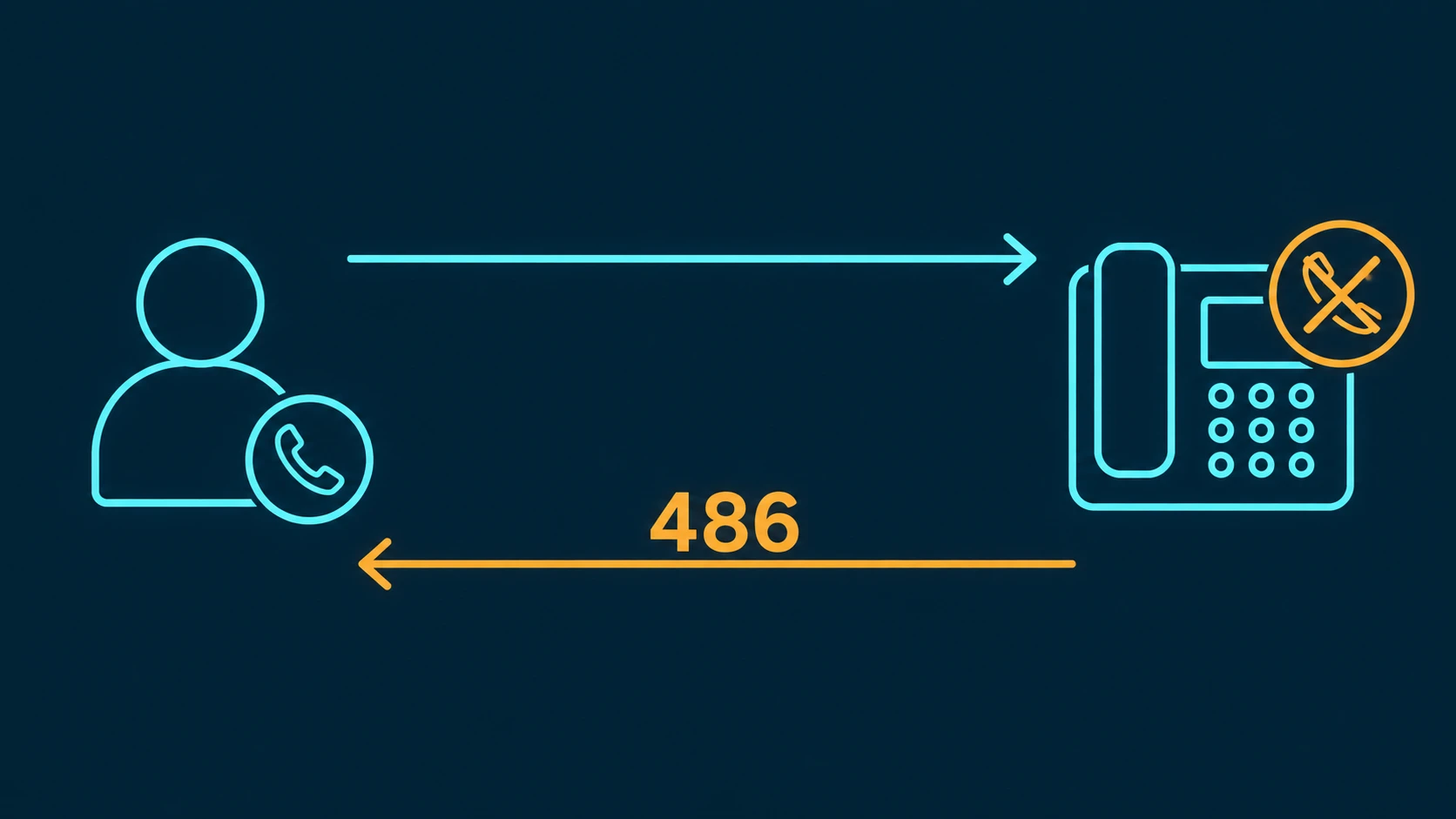
When a SIP endpoint is already occupied on a call and a new INVITE arrives, it rejects that incoming request with a 486 Busy Here response. The number is specific by design: "Busy Here" — not "Busy Everywhere," not "Temporarily Unavailable." That precision matters. 486 is a targeted, endpoint-level signal, and understanding exactly what it means is the difference between correctly diagnosing a routing problem and chasing the wrong cause.
For anyone managing a business phone system, a PBX, or a contact center, 486 appears regularly in SIP traces and call detail records. It shows up when call waiting is disabled, when extension call limits are hit, when agents are in wrap-up, and occasionally when a trunk runs out of capacity. This guide explains what 486 means under RFC 3261, how it differs from the related codes 600 and 480, what causes it, and how to resolve each cause.
Definition: SIP 486 Busy Here is a client-side response code defined in RFC 3261 §21.4.23. It means the specific user agent (UA) that received the INVITE is busy right now and cannot accept this call. It is an endpoint-specific signal — not a statement about the user's global availability across all devices. RFC 3261 instructs the UAC receiving a 486 that it SHOULD NOT retry the same endpoint, but MAY attempt to fork to another endpoint registered under the same address-of-record.
486 vs 600 vs 480: Understanding the Differences
Three SIP response codes deal with unavailability, and they are frequently confused. The distinctions between them carry real operational consequences for how calls are routed after a failure. For a complete guide to all SIP response code classes and how to use them for troubleshooting, see SIP response codes explained.
| Code | Name | What it means | Retry behavior |
|---|---|---|---|
| 486 | Busy Here | The specific endpoint that received the INVITE is busy on another call right now. Other endpoints registered to the same user may be free. | SHOULD NOT retry the same endpoint. MAY fork to another endpoint registered under the same address-of-record. |
| 600 | Busy Everywhere | The user is busy across all endpoints — globally unavailable. No fork will succeed. Rarely used in practice. | Do not fork. The user is globally busy and no other endpoint will accept the call. |
| 480 | Temporarily Unavailable | The UA is registered and known to the system, but is not ready to accept calls right now — for example, DND is active or the device is unregistered. | The endpoint is not engaged on another call. Try again later or route to voicemail/overflow. |
The clearest way to remember the 486 vs 480 distinction: 486 means the UA is registered, active, and currently on a call — it is engaged. 480 means the UA exists in the system but is not in a state to take calls right now, even though it is not necessarily on another call. The cause is different, and so is the correct routing response. A 486 from an agent endpoint in a call queue tells the PBX "this agent is busy, try someone else." A 480 from the same endpoint might mean the agent stepped away or enabled DND.
600 Busy Everywhere is included in RFC 3261 but is rarely encountered in real-world deployments. Most endpoints simply return 486 when busy rather than attempting to assert global unavailability. If you see a 600 in a SIP trace, treat it as a curiosity worth investigating — many modern endpoints generate it only as a result of misconfiguration rather than intentional use.
7 Common Causes of SIP 486 Busy Here
486 is always generated by the endpoint that received the INVITE — never by a proxy or intermediate server. That narrows down the diagnosis considerably. The following are the most frequent causes in business phone environments.
- 1. Call waiting disabled on the endpoint. When call waiting is turned off, a SIP phone that is already on a call will reject any incoming INVITE with 486. This is the most common single cause of 486 in business phone environments. The phone is registered, active, and occupied — and configured to refuse a second call. Enabling call waiting on the endpoint or in the PBX extension configuration resolves this immediately.
- 2. Maximum concurrent call limit reached. SIP phones and soft clients can be configured with a hard limit on how many simultaneous calls they handle. A phone set to a maximum of two concurrent calls will accept the first two INVITEs and return 486 on a third. This is a configuration parameter on the endpoint and in the PBX extension settings — usually labeled "max calls," "max concurrent sessions," or similar. Increase the limit if the extension legitimately needs to handle more simultaneous calls.
- 3. Do Not Disturb (DND) active. Some PBX platforms return 486 when an extension has DND enabled rather than returning 480. The behavior is PBX-dependent and sometimes configurable. If your SIP trace shows 486 responses from an extension you expect to be available, verify the DND status of that extension in the PBX console. This cause is easy to overlook because the extension appears registered and active in every other respect.
- 4. PBX trunk exhaustion. When all SIP trunk channels are in use, the PBX cannot send the INVITE outbound and may return 486 to the internal originator to indicate that no path is available. This manifests as 486 on outbound call attempts, not inbound. The root cause is insufficient trunk capacity rather than a busy endpoint. See the SIP trunk capacity planning guide for how to calculate the correct channel count and what happens when you run short.
- 5. Queue agent in after-call wrap-up. In contact center environments, agents are often placed into a wrap-up or after-call work (ACW) state after a call ends. During wrap-up, the PBX marks the agent's endpoint as unavailable. If the PBX attempts delivery to a wrap-up agent before the state transition completes correctly, a 486 may be returned. This usually self-resolves when the agent exits wrap-up, but frequent occurrences may indicate a timing issue in queue configuration.
- 6. Hard-coded call limit per extension in PBX configuration. Many PBX platforms allow administrators to set a per-extension call limit separately from the endpoint's own firmware setting. An extension might be capable of handling multiple concurrent calls at the device level, but the PBX has a separate limit set to one or two. Check both the device configuration and the PBX extension settings when diagnosing repeated 486 responses from a specific extension under moderate load.
- 7. SIP endpoint firmware bug. Some SIP phone firmware versions incorrectly return 486 when they should return 180 Ringing or accept the call. This typically presents as intermittent 486 responses from a specific device model on certain firmware versions, while other phones of the same model on different firmware behave correctly. If 486 responses are isolated to a specific device model, check the vendor's firmware release notes for known bugs and update the firmware.
How 486 Behaves in Call Queue Environments
In a call queue, 486 is a normal and expected part of agent delivery. When the PBX attempts to deliver a queued call to an agent, it sends an INVITE to that agent's endpoint. If the agent is already handling a call and call waiting is not enabled, the endpoint returns 486. The PBX treats this as a signal to move to the next available agent in the rotation, rather than as a final failure.
This is the designed behavior: 486 from one agent triggers the queue to try the next agent, cycling through the available pool until a free endpoint accepts. The call stays in the queue and is not lost. From the caller's perspective, nothing visible happens — they remain on hold while the queue engine works through its delivery attempts behind the scenes.
Problems arise when a large proportion of agents are simultaneously busy. If the queue cycles through all available agents and receives 486 from each, the call either continues waiting for an agent to become free or — depending on queue configuration — hits a timeout threshold and is redirected to voicemail, overflow routing, or a callback offer. Monitoring 486 rates per agent extension can reveal agents who are consistently receiving and rejecting queue delivery attempts, which may point to a misconfigured call limit or an unintended DND state.
It is also worth noting that 486 from an agent endpoint is distinct from a queue overflow event. Overflow is a queue-level condition triggered by total wait time or queue depth. 486 is an endpoint-level condition on individual delivery attempts. The two can coexist: a queue might be experiencing overflow because all agent endpoints are returning 486, even though the queue itself has not hit its overflow threshold.
How 486 Appears in Call Detail Records
A call that results in 486 is logged in CDRs as a busy — not as an answered call, not as a failed call in the error sense. The attempt is recorded with no billable duration. On most platforms, the disposition code will be "busy," "486," or an equivalent label.
This CDR behavior has a few practical implications. First, the call attempt is counted in your attempt volume even though it did not connect — relevant if you are tracking answer rates or evaluating route quality. Second, because the duration is zero, 486 calls do not appear in talk-time reports. If you are seeing lower-than-expected talk time for a specific extension alongside a busy call rate, correlating 486 CDR entries with that extension is the right diagnostic step.
In outbound call center environments running predictive dialers, 486 responses from external destinations (the called party's phone being busy) contribute to the dialer's connect ratio calculations. A high rate of external 486 responses on a contact list may indicate peak-hour calling patterns where many contacts are already on calls, and the dialer's pacing algorithm will adjust accordingly. The CDR trail makes this pattern visible for reporting purposes.
How to Fix SIP 486 Busy Here
The correct fix depends on which of the causes above is generating the 486. Here is a summary of resolutions by cause:
- Call waiting disabled: Enable call waiting on the endpoint's firmware settings and confirm the PBX extension policy also permits call waiting. On most SIP phones, this is a setting in the phone's web interface or provisioning template. On the PBX side, look for an extension setting labeled "call waiting" or "busy call handling."
- Max concurrent call limit too low: Increase the per-extension call limit in both the PBX and the endpoint configuration. Match the limit to the actual workflow — an agent who handles customer escalations and internal calls simultaneously may legitimately need a limit of three or four, not one.
- DND active unexpectedly: Check the extension's DND status in the PBX console. If DND is being triggered unintentionally — for example, by a feature code the user pressed accidentally — review the extension's feature code settings. Some PBX platforms also allow administrators to disable DND on specific extensions or require confirmation before activating it.
- Trunk exhaustion: Add channels to the SIP trunk or provision a secondary trunk for overflow. Review concurrent call peaks in your CDR data to determine the actual channel requirement. Trunk exhaustion that appears only during specific time windows is a capacity-planning problem, not an infrastructure fault.
- Wrap-up state timing: Adjust the after-call work timer in the queue configuration to ensure sufficient wrap-up time before the PBX attempts the next delivery. If the 486 rate from agents in wrap-up is high, the timer may be expiring before the agent is genuinely ready — a process issue as much as a configuration one.
- PBX extension call limit: Review per-extension call limits in the PBX admin console separately from the device setting. Update limits to match the intended workload for each extension type.
- Firmware bug: Update the affected SIP phone firmware to the latest stable release. If the problem is intermittent and version-specific, check the vendor's known issues list or support forum before updating to confirm the fix is included in the target version.