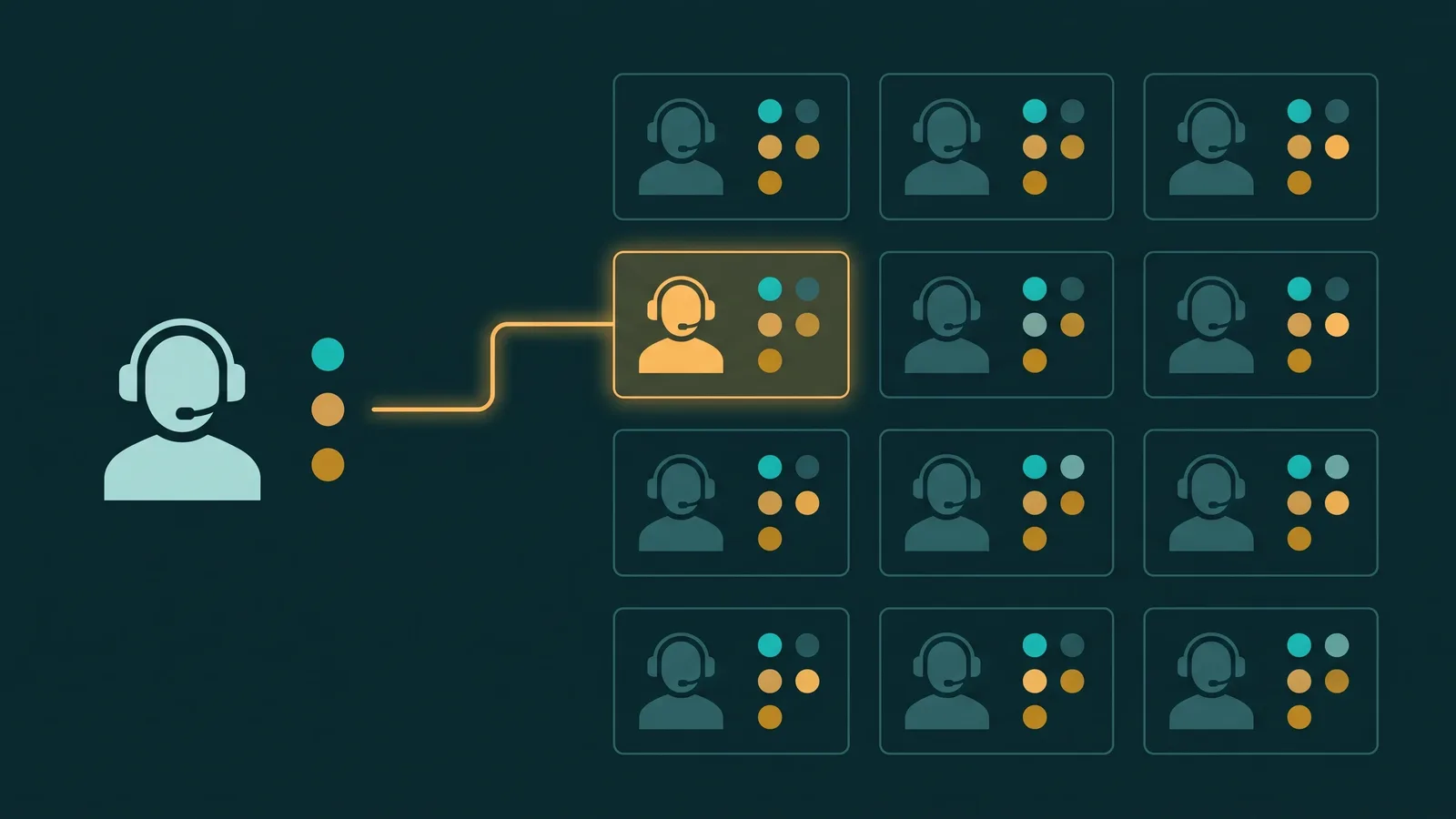
When a caller reaches an agent who cannot resolve their issue, the most likely outcome is a transfer — or a callback. Both destroy first-call resolution, inflate handle time, and frustrate callers who must repeat themselves. The usual culprit is not the agent's effort: it is the routing logic that connected them in the first place. A contact center routing purely by availability or round-robin has no mechanism to ask whether the available agent is actually equipped to handle the call.
Skills-based routing fixes this at the source. Instead of distributing calls across all available agents equally, the ACD checks whether each available agent holds the skills the call requires — and routes only to those who do. The result is a higher proportion of calls handled by the right agent on first contact, and a corresponding drop in transfer rate.
This guide covers the full mechanics: how the three components of skills-based routing work together, how proficiency scoring affects which agent is selected, why fallback rules are not optional, how to build and maintain a skills taxonomy, and what to measure to know whether your routing is actually working.
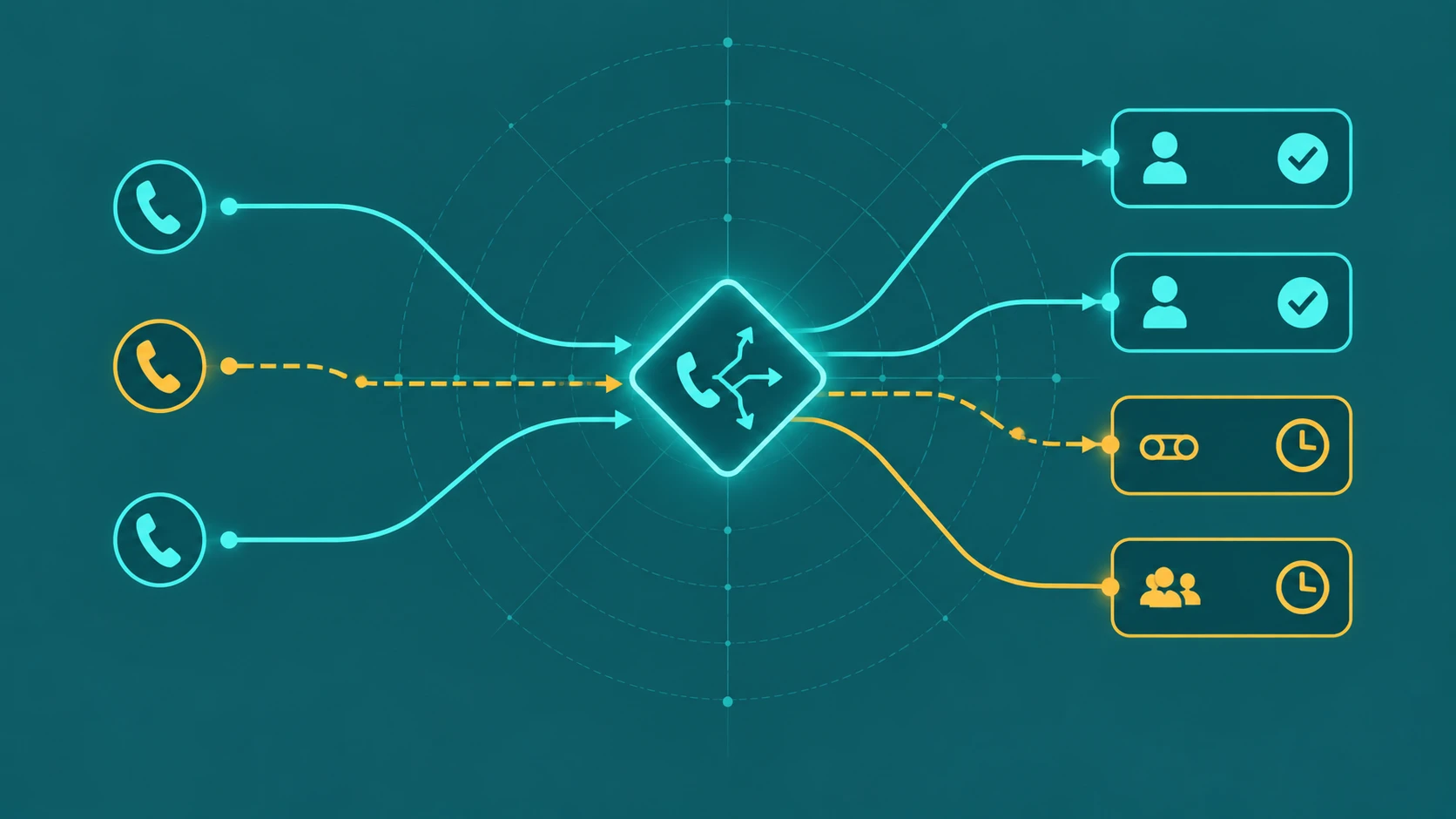
What is skills-based routing? Skills-based routing (SBR) is a call distribution strategy in which the ACD matches incoming calls to agents based on the agents' defined skills and proficiency levels, rather than routing by availability alone or in a fixed rotation. Every call carries a skill requirement; every agent carries a skills profile. The ACD evaluates available agents, finds those with the required skill, and selects among them using a secondary criterion — such as highest proficiency or longest idle time. The goal is to ensure the call reaches an agent equipped to resolve it on first contact, reducing transfers and improving FCR.
How Skills-Based Routing Works
Skills-based routing requires three components working together. Without any one of them, the system cannot function correctly.
1. The skills taxonomy
A skills taxonomy is the catalogue of skill types the ACD recognizes. Every skill in the catalogue must be defined, named consistently, and scoped to a single capability — not a vague category. Examples of well-scoped skills: Spanish language, billing disputes, technical escalations, enterprise account tier, PCI-scoped payment handling. Examples of poorly scoped skills: "customer service" (too broad to mean anything for routing), "senior" (describes seniority, not a distinct capability the call requires).
The taxonomy lives in the ACD and serves as the vocabulary for both call requirements and agent profiles. If a skill name is not in the taxonomy, it cannot be used in a routing rule or assigned to an agent. Building the taxonomy before anything else — before assigning skills or writing routing rules — prevents the inconsistency that causes most SBR implementations to underperform.
2. Agent skill profiles
Each agent has a profile listing which skills they hold and at what proficiency level. A typical proficiency scale runs 1–10, where 1 means the agent can handle that call type but is not expert, and 10 means they are the preferred agent for that call type. Some platforms use a 1–5 scale; the specific numbers are less important than their consistent application across the agent population.
A single agent may hold multiple skills with different proficiency scores. An agent might be scored 9 for Spanish language — a skill they use daily — and 4 for technical escalations, which they can handle but would not seek out. The 9 makes them a preferred agent for Spanish-language calls; the 4 makes them an acceptable fallback for technical escalations when higher-scoring agents are unavailable.
Agents should not be assigned skills they do not have, and should not be denied skills they demonstrably hold. Both errors produce routing failures: assigning phantom skills routes calls to unqualified agents; withholding real skills shrinks the eligible pool unnecessarily, increasing wait times.
3. Routing rules that map call types to skills
A routing rule specifies: "calls of type X require skill Y at proficiency level Z." The ACD applies these rules to each incoming call. When a call arrives, the ACD identifies its type — from IVR selection, spoken intent captured by NLU, DNIS, or CRM lookup — and matches that type to the applicable routing rule. The rule tells the ACD which skill is required and at what minimum proficiency level.
The ACD then scans available agents for those who hold that skill at or above the required proficiency. Among the eligible agents, a secondary selection criterion determines who receives the call. That secondary criterion is where the strategy choices begin.
For a broader overview of how routing strategies compare, see the call routing guide.
Proficiency Scores and How They Are Used
Proficiency scores serve two functions: filtering the eligible agent pool (only agents who meet the minimum proficiency threshold are considered) and, in some configurations, determining which eligible agent receives the call. How the ACD uses those scores depends on the secondary distribution strategy configured for the queue.
Best available (highest proficiency)
Among eligible agents, route to the one with the highest proficiency score for the required skill. This maximizes the quality of the match — the most skilled available agent handles the call. The trade-off is uneven workload distribution. Agents with top proficiency scores receive a disproportionate share of calls in their skill category, because they are always preferred over lower-scoring colleagues who are also available. Over time, this concentrates call volume and burnout risk on your most skilled agents.
Longest idle
Among eligible agents, route to the one who has been idle longest since their last call ended. This balances workload across the eligible pool but sacrifices skill depth: a lower-proficiency agent who happened to finish their last call two minutes ago may receive a complex call ahead of a higher-proficiency agent who became available 30 seconds ago.
Longest idle within a skills-matched pool is the right default for most operations. Workload balance matters for morale, staffing model accuracy, and agent retention. The skill match is already guaranteed — the agent is eligible — so the secondary selection can prioritize fairness. Longest idle vs linear routing examines the mechanics in detail.
Combination: proficiency threshold + longest idle
A practical middle ground: route to the highest-proficiency agent who has been idle more than N seconds. This keeps high-proficiency agents prioritized during the first N seconds of their idle window, but allows lower-proficiency agents to absorb calls if the higher-proficiency agents remain occupied long enough. The threshold N is calibrated to typical call duration — if average calls run five minutes, N might be set to 60–90 seconds.
This combination approach is worth considering for queues where skill depth genuinely matters for resolution quality, but where concentrating all volume on top-scoring agents would create an unsustainable workload imbalance.
Fallback Rules and Skill Expansion
Skills-based routing without fallback rules is a configuration that will eventually trap callers in indefinite hold. When all agents with the required skill are on calls simultaneously, an inbound call with that requirement has no eligible destination. If there is no fallback, the call sits in the queue until a matching agent becomes available — while general queue agents, who could handle the call adequately, are idle.
Fallback is not optional. It is part of the routing design.
Time-based skill expansion
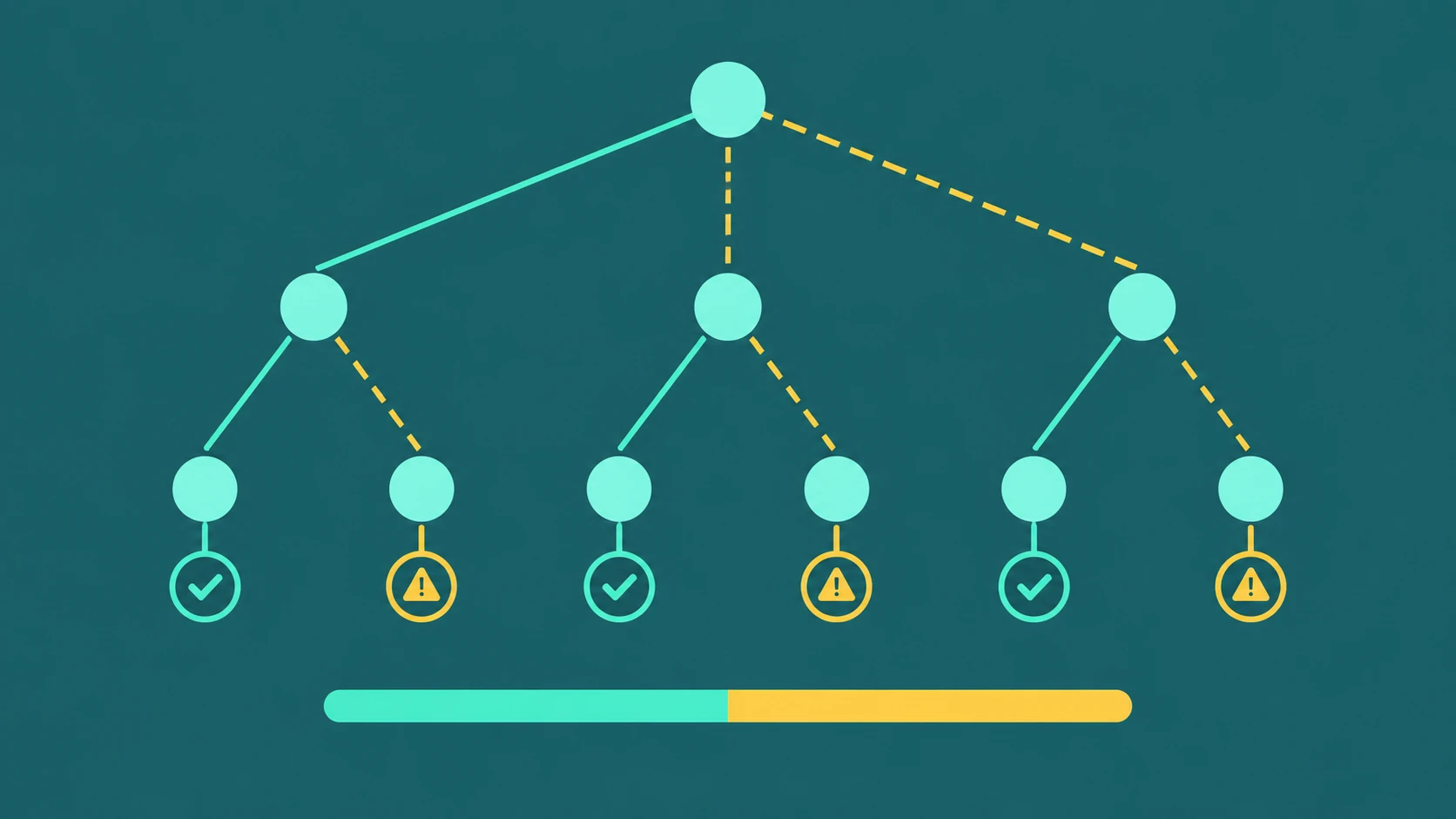
The most common fallback mechanism is time-based skill expansion, sometimes called bullseye routing. After N seconds of queue wait with no eligible agent available, the ACD expands the eligible pool — either by lowering the minimum proficiency threshold for the required skill, or by adding agents who hold a related skill.
A practical example: a Spanish-language billing call requires Spanish language at proficiency 7+. After 60 seconds with no match, the rule expands to Spanish language at proficiency 4+. After 120 seconds, the rule expands further to any agent with billing disputes skill, regardless of language proficiency, with a note to the agent that the caller may prefer Spanish.
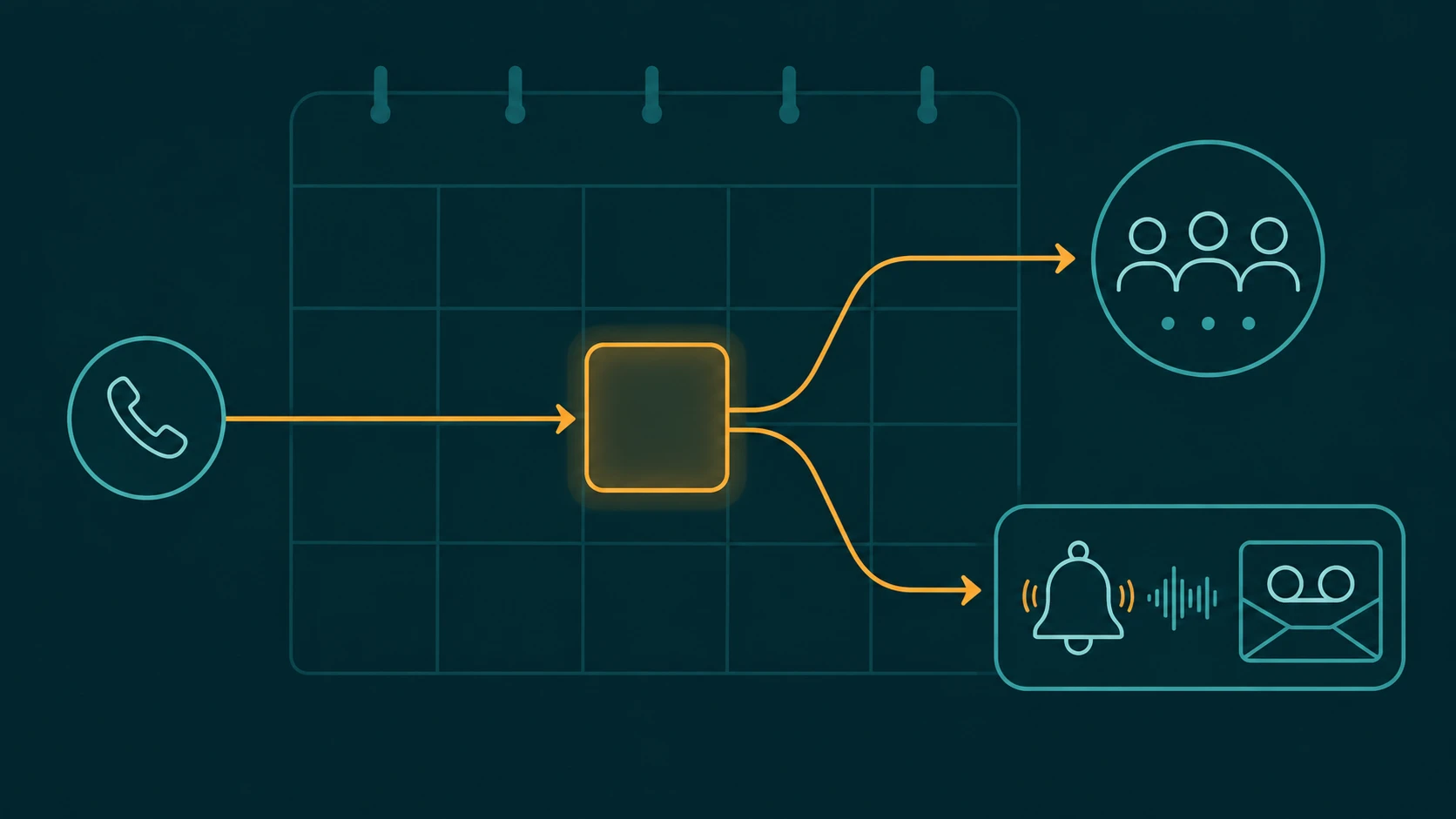
Each expansion ring should have its own timeout. The final ring should always include a general queue destination as the ultimate fallback — an overflow to any available agent. Without a general queue floor, a call requiring a rare skill during a busy period could wait indefinitely.
Queue-to-queue overflow
Separately from skill expansion, a queue can be configured to overflow to another queue if the wait threshold is exceeded, regardless of skill matching status. Queue-to-queue overflow is a coarser escape valve: it does not attempt to find a skill-matched agent in the second queue, it simply redirects the call. This is appropriate for high-volume situations where wait time has become the more urgent problem than perfect skill matching.
For more detail on overflow configuration, see call queue mechanics and how overflow destinations are configured.
Setting Up a Skills Taxonomy
The taxonomy design phase determines whether skills-based routing will work or produce routing failures masked as agent performance problems. These are the practical decisions that matter most.
Define skills by capability, not by role
A skill should represent a distinct capability the call requires — not the agent's job title, seniority level, or team. "Senior support agent" is not a skill; "technical escalations" is. "Team Lead" is not a skill; "enterprise account tier" is. Role-based skill assignment means the skill taxonomy changes every time you reorganize teams, and proficiency scores become meaningless because everyone on the team gets the same score.
Keep the taxonomy small and stable
Start with the minimum number of skills that meaningfully separate call types that require genuinely different agent knowledge. Ten well-defined skills produce more reliable routing than 40 overlapping ones. Every skill added to the taxonomy is a skill that must be assigned, scored, maintained, and audited across the entire agent population. Complexity compounds quickly.
A reasonable starting taxonomy for a mid-size contact center might include: two or three language skills, two product line skills, one escalation tier, and one regulated call type (billing, PCI payment). That is seven to eight skills — enough to route meaningfully, not so many as to create maintenance overhead that cannot be sustained.
Define proficiency anchors before scoring agents
Proficiency scores are only useful if they mean the same thing across all agents. Before assigning scores, write explicit behavioral anchors for each score level. An anchor for Spanish language at proficiency 3 might be: "Can handle routine account inquiries in Spanish, needs to transfer for complex billing disputes." An anchor for proficiency 8 might be: "Fluently handles billing disputes, technical explanations, and complaint escalations in Spanish without transferring." With written anchors, two supervisors scoring the same agent will produce similar scores. Without anchors, proficiency scores reflect individual supervisor judgment rather than agent capability.
Scope each routing rule to a single decision
A routing rule should answer one question: what skill does this call type require? If a rule needs to specify five skill requirements simultaneously, that is usually a sign the taxonomy has too many narrow skills that should be consolidated, or that the routing rule is trying to do the work of multiple rules. Routes with multiple simultaneous skill requirements dramatically shrink the eligible agent pool and increase the likelihood of long waits.
Maintaining Skills Over Time
Skills databases degrade silently. An agent whose proficiency scores were set at onboarding 18 months ago has changed — coached interactions, product training, role shifts, or simply accumulated experience that the original score does not reflect. The routing system has no mechanism to detect this drift. It continues routing based on stale data, producing matches that look correct on paper but fail in practice.
Maintenance is the operational burden that most SBR deployments underestimate.
Quarterly skills audits
A skills audit should happen at minimum quarterly. The audit has three tasks: review skill assignments (does each agent still hold the skills they are assigned, given role or product changes?), validate proficiency scores against QA data (does the agent's QA performance in that skill category support their current score?), and identify gaps in the skills pool (which skills have too few agents at sufficient proficiency to cover expected call volume?).
QA data is the most reliable source for proficiency validation. An agent scored 8 for billing disputes whose QA scores on billing calls average 62% is probably over-scored. An agent scored 5 for technical escalations who consistently earns 88% on those calls should be rescored upward. Aligning proficiency scores to QA outcomes tightens the feedback loop between routing logic and actual agent capability.
Attrition creates skill gaps
When an agent leaves, every skill they held at a given proficiency level must be accounted for in the remaining pool. If the departing agent was the only one scored above 7 for Spanish-language billing disputes, that queue now has no preferred-proficiency match for that call type. The call will still route — to the next eligible agent, or to fallback — but the match quality drops immediately and invisibly unless someone checks.
Attrition-driven skill gaps are the most common cause of unexplained FCR or CSAT drops in contact centers running skills-based routing. The routing appears to be working because calls are being delivered; the problem is who they are being delivered to.
A skills coverage report — showing how many agents hold each skill at each proficiency tier — should be reviewed at every attrition event, not just quarterly. An attrition event that drops a critical skill below minimum coverage thresholds requires an immediate response: cross-training, temporary proficiency reclassification with accelerated coaching, or routing rule modification.
Product and process changes require taxonomy updates
A new product line, a regulatory change, or a new call type creates a skills gap across the entire agent population until training and proficiency assignment are updated. If calls about a new product begin routing before relevant agent skills are defined and assigned, every call will fall through to fallback routing — or, worse, route to whatever agent happens to be available with a loosely related skill, producing poor resolution rates.
The process for adding a new skill to the taxonomy should be: define the skill and write proficiency anchors, identify which agents need initial assignment and at what level, assign skills in the ACD, validate routing rules, then activate routing for that call type. Activating the call type route before skills are assigned is a common sequencing error.
Skills-Based vs Other Routing Strategies
| Skills-Based | Round-Robin | Longest-Idle | |
|---|---|---|---|
| Optimizes for | Match quality | Fairness | Load balance |
| Requires skill taxonomy | Yes | No | No |
| Configuration overhead | High — taxonomy, scoring, rules, fallback, audits | Minimal | Low |
| Risk if misconfigured | Long wait for rare skill; stale scores cause bad matches | Transfer after routing | Same as round-robin |
| Impact on FCR | High when maintained; negative if stale | Neutral — no skill differentiation | Neutral — no skill differentiation |
| Best for | Specialized teams, multilingual, regulated call types | Homogeneous teams | Blended teams with variable call duration |
Skills-based routing is the right choice when your team has genuine specialization — not just different experience levels, but different knowledge domains that produce meaningfully different resolution outcomes. A contact center where all agents handle the same call types at comparable quality levels gains nothing from skills-based routing and inherits its configuration burden. Round-robin or longest-idle will produce equivalent outcomes with a fraction of the maintenance overhead.
The practical threshold for justified SBR implementation is roughly 20–25 agents across at least three meaningful skill groups, where FCR or transfer rate data suggests callers are regularly reaching unqualified agents.
What to Measure
Skills-based routing produces routing data that standard queue reports do not automatically surface. These are the metrics that tell you whether the routing is working.
Skill match rate
The percentage of calls that were delivered to a skill-matched agent on first routing — without falling through to a fallback tier. A high skill match rate means the eligible pool is sufficient for the call volume. A low or declining skill match rate means the eligible pool has shrunk (attrition, skill reassignment, increased call volume) or the routing rules are too restrictive for the available agent population.
Track skill match rate by skill group, not just in aggregate. A contact center with 95% overall skill match rate may have a specific Spanish-language billing queue running at 40% match rate — a gap hidden by the aggregate.
Post-routing transfer rate
Transfer rate after a skills-matched delivery is the most revealing signal in SBR reporting. If a call was delivered to a skill-matched agent and that agent immediately transferred it, one of three things happened: the skill taxonomy is wrong (the call type requires a skill that is not captured in the taxonomy), the agent's proficiency score is wrong (they were matched but cannot actually handle the call), or the IVR collected the wrong routing signal (the call was classified as type X but was actually type Y).
High post-routing transfer rate in a skills-based queue is not an agent performance problem — it is a routing configuration or skills maintenance problem. Investigating which skill-matched agents are transferring most, and which call types are being transferred, identifies the specific failure point.
Skill utilization
Skill utilization reports show how often each skill is the determining factor in routing decisions, and how heavily utilized each skill's agent pool is. High utilization on a skill with a thin agent pool signals a coverage risk: if two or three agents in that pool call out simultaneously, the queue will fall to fallback routing or long waits. Low utilization on a skill signals either low call volume for that type or an over-assigned skill (too many agents carrying it when fewer would suffice — a maintenance issue).
Skill utilization data is also the most reliable input for training investment decisions. If the technical escalations skill pool is heavily utilized and underperforming on FCR, that is the highest-value training investment. If the enterprise account tier skill is barely utilized, expanding that pool is a lower priority than other needs.
Average wait time by skill group
Significant wait time differences across skill groups reveal pool sizing problems. A skill group with an average wait time three times the overall queue average either has insufficient agent coverage or routing rules with too restrictive a minimum proficiency threshold. Either way, fallback rule configuration needs review.
EaseDial
Route callers to the right agent, every time — customizable skill tags, proficiency levels, and fallback rules configurable without engineering support.