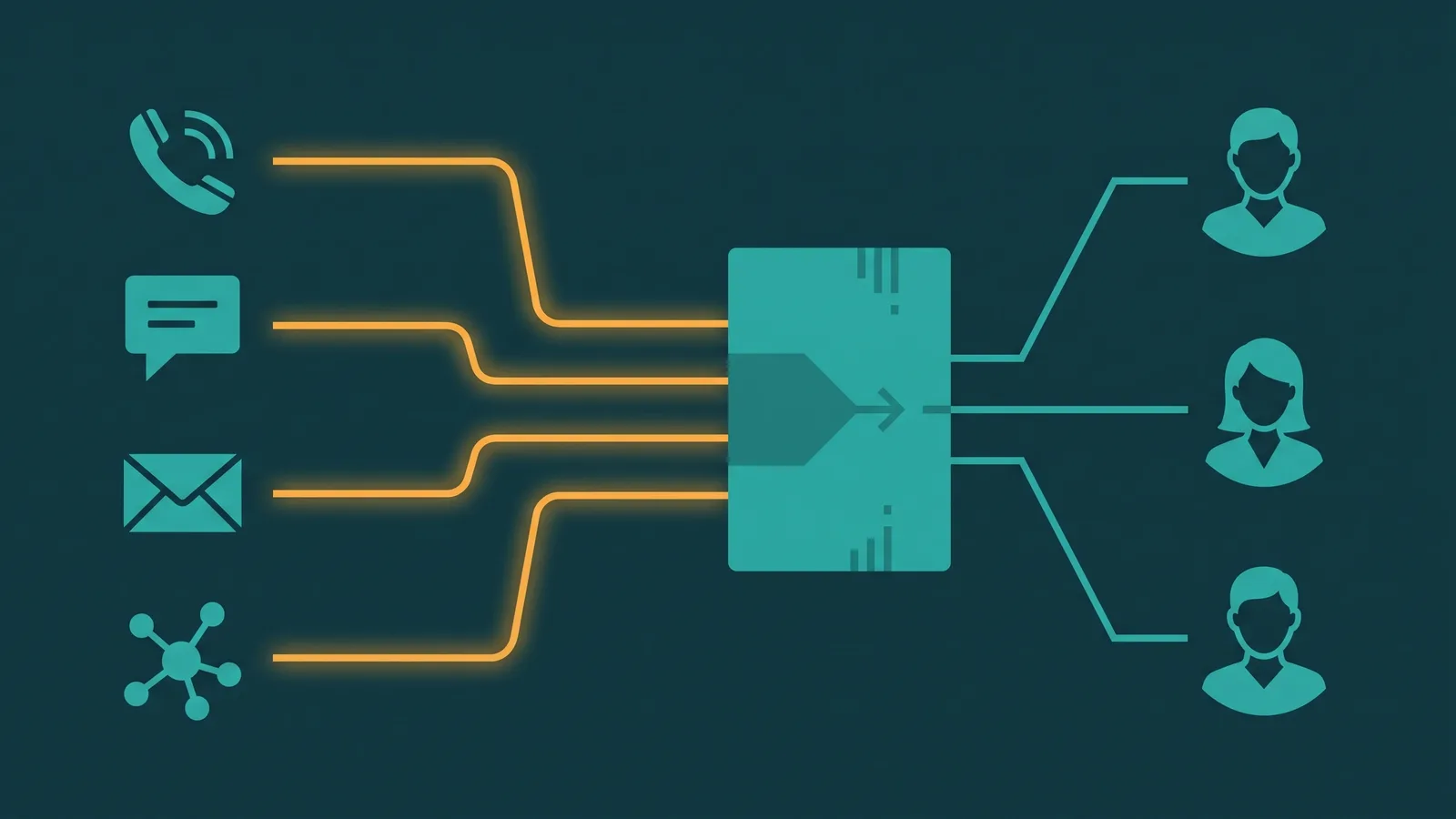
Most contact centers offer multiple channels — voice, chat, email, SMS, and increasingly social DM. But offering multiple channels is not the same as routing them coherently. In a multichannel operation, each channel has its own queue, its own staff, and its own SLA logic. An agent handling voice calls has no visibility into the email backlog. A customer who emailed yesterday and calls today starts from zero — the agent answering has no record of the earlier interaction. Channels coexist without connecting.
Omnichannel routing solves this at the assignment layer. Instead of separate queues per channel, a unified routing engine treats every interaction — regardless of channel — as a work item. The engine enriches each work item with metadata (channel type, customer identity, intent, priority), applies a routing profile to determine which agents are eligible, and assigns the interaction using the same skills-based logic whether the interaction is a live voice call, an inbound chat, an SMS thread, or a social DM. The agent pool is shared; the routing rules are unified; the customer history is visible.
This guide explains how the unified routing engine works at each step, why concurrency differs fundamentally across channels, how skills and routing profiles must account for those differences, how customer identity ties the model together, and what actually requires configuration before any of this works.
What is omnichannel routing? Omnichannel routing is a unified routing engine that treats customer interactions across all channels — voice, chat, SMS, email, and social DM — as work items in a single queue. Rather than maintaining separate queues and agent pools per channel, the engine applies shared skills-based routing logic to every work item, selecting the eligible agent based on skill match, current load, and priority. The same agent can handle voice calls, digital interactions, or both, depending on their skills profile and routing configuration.
How the Routing Engine Processes Every Work Item
The central concept in omnichannel routing is that the assignment logic layer does not fundamentally care which channel produced the work item. It operates on an abstraction: a work item with attributes. The channel is one of those attributes — it affects concurrency limits and SLA targets — but it does not change the routing algorithm. Understanding this abstraction is important because it explains both what unified routing can do and what it cannot automatically solve.
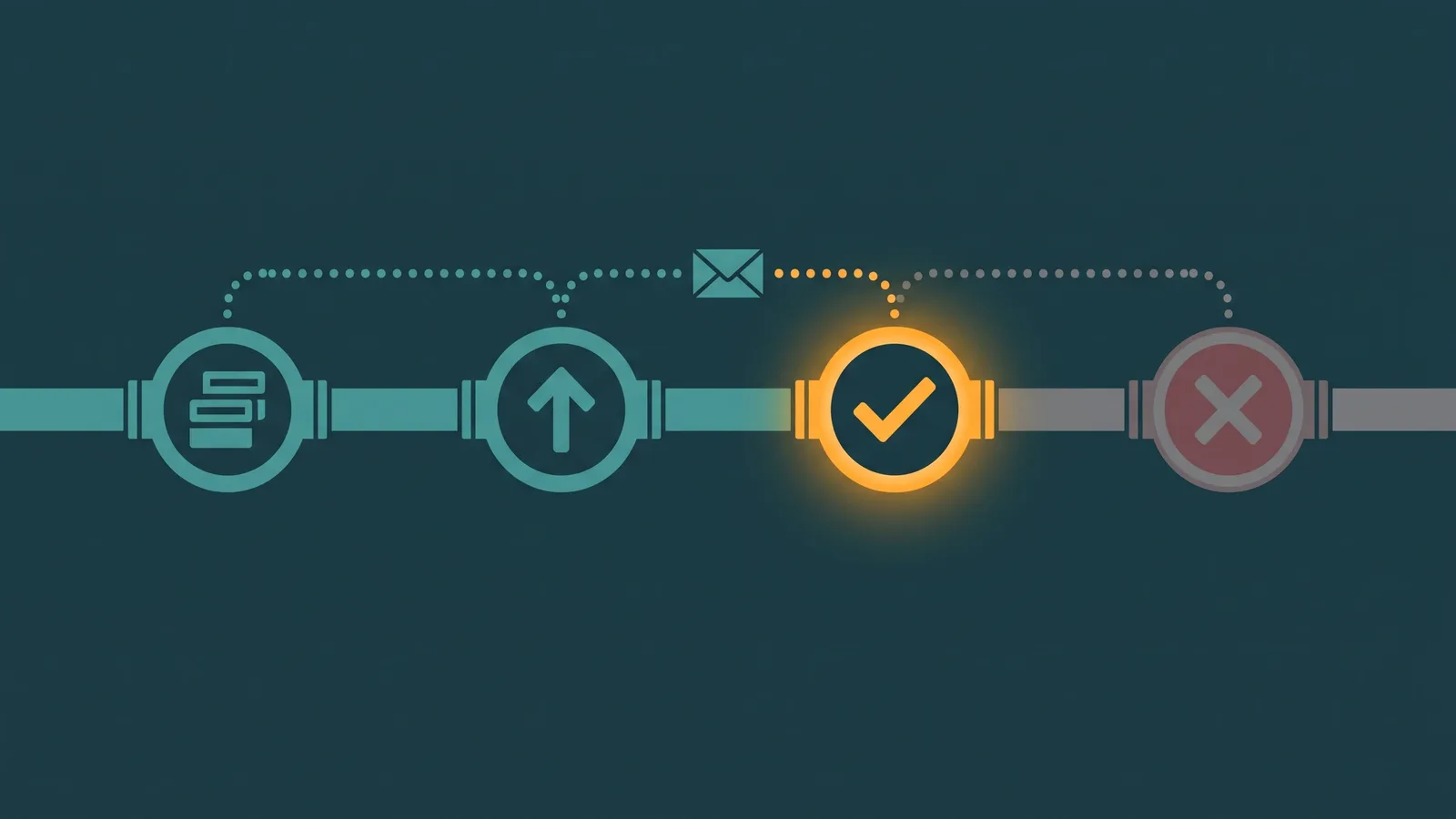
When an interaction arrives — a phone call, a chat session opened on your website, an inbound SMS, an email, or a DM on a social platform — the routing engine processes it through a consistent sequence of steps.
Arrival and enrichment. The work item arrives and is immediately enriched with metadata: which channel it came from, when it arrived, a customer identity lookup (matching the phone number, email address, or chat user ID against the customer database), any intent signals available at intake (from IVR selection, chatbot classification, email subject parsing, or keyword detection), and an initial priority level derived from channel type and customer tier.
Routing profile lookup. The enriched work item is matched to a routing profile — a configuration that specifies which agent skills are required, what concurrency limits apply, and what SLA thresholds govern the interaction. A live voice call from a billing inquiry routes to the billing-skill profile. A chat opened after a chatbot classified the intent as technical support routes to the technical support profile. The routing profile translates the work item's attributes into requirements the ACD can act on.
Agent selection. The ACD scans available agents against the routing profile requirements. An agent is eligible if they hold the required skill, are currently available on that channel, and have not exceeded their configured concurrency limit for that channel type. Among eligible agents, a secondary criterion — least occupied, longest idle, or round-robin — determines who receives the assignment.
Queue entry. If no eligible agent is immediately available, the work item enters a queue with an SLA timer. Priority weighting determines where in the queue it sits relative to other waiting items. As the timer advances toward the SLA threshold, priority can bump automatically or a supervisor alert can fire.
Assignment and acceptance. When an eligible agent becomes available, the work item is routed to them. Depending on configuration, the agent may receive an automatic push (the interaction appears in their interface without a manual accept step) or a notification that requires manual acceptance. For voice calls, this is a ring; for digital channels, it is typically a notification or a new conversation appearing in the agent's workspace.
For how this logic applies specifically to inbound voice calls, see the call routing guide. For the skills matching layer, see skills-based routing.
Concurrency: The Fundamental Difference Across Channels
The most important operational distinction between channels in a unified routing engine is concurrency — how many simultaneous interactions an agent can handle on that channel. Voice and digital channels work very differently here, and the routing engine must be configured to respect these limits or it will overload agents.
Voice calls are strictly 1:1. An agent handling a live phone call is fully occupied. The routing engine must exclude them from all further voice routing until the call ends. No exception.
Chat operates on a concurrent model. An agent can actively manage multiple chat conversations simultaneously because chat is turn-based: after sending a reply, the agent waits for the customer to respond. That waiting interval is time the agent can spend on other chats. A well-configured routing engine assigns chat conversations up to the agent's configured maximum — commonly two to four concurrent sessions — and does not exceed it. If an agent has three active chats and is at their limit, the routing engine treats them as unavailable for additional chat assignments until one conversation closes.
SMS is similar to chat in concurrency model: it is asynchronous enough that agents can handle multiple threads, though response time expectations vary by channel convention and business context.
Email carries the highest concurrency tolerance. Response time is measured in hours, not seconds or minutes. Agents can manage a much larger number of open email threads because the time pressure per item is lower.
Social DM varies by platform and business policy. DMs on platforms with a messaging convention similar to SMS are typically treated as concurrent digital interactions. Public mentions or posts handled as service interactions may have different SLA expectations.
| Channel | Concurrency Model | SLA Expectation | Routing Priority |
|---|---|---|---|
| Voice | 1:1 — one call per agent, no concurrency | Answer within seconds; caller is waiting in real time | Highest — real-time interaction |
| Chat | 1:N — commonly 2–4 concurrent sessions per agent | First response within minutes; customer is actively waiting | Medium — near real-time |
| SMS | Concurrent; async allows multiple threads | Minutes to hours depending on business convention | Medium — varies by context |
| High concurrency; many open threads manageable | Reply within hours; no real-time waiting | Lower — SLA tolerance is longer | |
| Social DM | Concurrent; treated like chat or SMS by most platforms | Platform-dependent; often similar to chat | Medium — depends on business policy |
The blended agent scenario deserves special attention. A blended agent is configured to receive both voice and digital channel interactions. When such an agent picks up a voice call, the routing engine must immediately suspend their eligibility for digital channel assignments. Chat sessions do not pause gracefully while a live call is in progress — if a new chat is routed mid-call, the agent cannot attend to it. The routing engine must detect the active voice call status and exclude the agent from digital queues for the call's duration, then restore digital eligibility when the call ends.
Skills and Routing Profiles for Omnichannel
In a voice-only environment, agent skills describe what call types an agent can resolve: billing disputes, technical support, Spanish language, enterprise account tier. In omnichannel routing, skills must also describe channel capability — which channels an agent is trained and configured to use. An agent who has never worked in chat, with no familiarity with concurrent conversation management, should not be routed chat interactions simply because they share a product skill with someone who does.
Practical skills categories in an omnichannel routing profile include: product or topic skills (billing, technical support, account management), language skills, channel capability flags (voice-capable, chat-capable, email-capable), and seniority or tier indicators for escalation routing. A work item's routing profile requires both a topic skill and a channel capability match. A Spanish-language billing chat requires an agent who holds both the Spanish language skill and the chat capability flag — not just one.
Routing profiles must also specify per-channel concurrency limits at the agent level. One agent may be configured for a maximum of two concurrent chats; a more experienced agent may be configured for four. The routing engine respects these per-agent limits during assignment. Without them, the engine has no mechanism to prevent routing a fifth concurrent chat to an agent whose capacity is two.
Overflow rules apply across channels, not just within them. If no chat-capable agent with billing skill is available after a defined threshold, the routing profile should define what happens next: extend wait time, lower the skill threshold, or escalate to a supervisor queue. The same fallback design that applies to voice skills-based routing applies here — omnichannel routing is only as reliable as its fallback configuration. See the omnichannel customer service guide for broader context on how channel strategy connects to routing design.
Priority, SLA, and Queue Position Across Channels
When voice, chat, email, and SMS items coexist in a unified queue, the engine needs a consistent priority model to determine which item is served first when an agent becomes available. Without an explicit priority model, the queue degrades to arrival-order FIFO across all channels — which means a voice caller who arrived 30 seconds ago may wait while an email that arrived two hours ago is being processed first.
The standard approach assigns base priority weights by channel. Voice interactions carry the highest base priority because the customer is waiting in real time with no alternative — they cannot do something else while on hold indefinitely. Chat carries medium priority because the customer is actively engaged and waiting, though the interaction is not as time-critical as a live call. Email and SMS carry lower base priority because their SLA tolerance spans hours rather than seconds or minutes.
On top of base channel priority, customer tier can elevate priority across any channel. A VIP customer's email can be routed with higher priority than a standard customer's chat, depending on configuration. This cross-channel priority elevation is one of the key operational advantages of unified routing: it applies the same business logic (value this customer highly) regardless of how they contacted you. For more on priority mechanics within queues, see call queue priority.
SLA timers start at arrival and advance continuously in the queue. If an item crosses the SLA threshold without being assigned, the routing engine can take configured actions: bump the item's priority weight to move it ahead in queue, alert a supervisor, lower the skill requirement to expand the eligible agent pool, or trigger an overflow to another queue. The design of these escalation steps — the thresholds, the actions, the fallback destinations — is configuration work that must happen before the channel goes live.
Customer Identity and Cross-Channel History
The channel-unifying benefit of omnichannel routing depends entirely on identity resolution. If the routing engine cannot link an inbound SMS from a given phone number to the same customer who emailed yesterday and called last week, the agent receiving that SMS sees a blank slate. The interaction is routed correctly by skill, but the agent has no context — and the customer must re-explain what they already communicated.
Identity resolution maps multiple contact identifiers — phone number, email address, chat session ID, social handle — to a single unified customer record. When an interaction arrives, the engine performs a lookup before enrichment and links the work item to the customer record if a match is found. The assigned agent's workspace then surfaces that customer's cross-channel history: prior calls, open email threads, SMS exchanges, and any disposition or resolution notes from previous interactions.
Affinity routing — routing a returning customer to the agent who previously handled their case — is an extension of identity resolution. When the routing engine identifies a returning customer, it can check whether their previous agent is currently available and, if so, prefer that agent for assignment. This continuity is particularly valuable for complex, ongoing cases where rebuilding context at each contact is costly. Affinity routing must be bounded: if the preferred agent is unavailable, the interaction must still be routed to an eligible agent rather than held indefinitely waiting for a specific person.
Without identity resolution, the same customer registers as a different contact on every channel. The routing engine treats each interaction as independent, the agent pool has no continuity, and the contact center cannot measure the true volume of a customer's interactions because they are fragmented across channel-specific records. See the omnichannel inbox guide for how unified history is surfaced to agents at the interface level.
Asynchronous Work Items and Blended Queue Management
Voice and live chat require immediate agent attention. Email and SMS do not — the customer is not actively waiting for a response in real time. This distinction creates a management challenge in a unified queue: how do you prevent low-urgency asynchronous items from consuming agent capacity that should be reserved for real-time interactions?
One approach is deferred queue surfacing. Email and SMS work items are held in a lower-priority queue and surfaced to agents only when their voice and chat load drops below a threshold — essentially filling idle time with async work. An agent between calls or with fewer concurrent chats than their maximum is offered email or SMS items from the deferred queue. When a voice call arrives or a new chat is assigned, async work is deprioritized again.
This blended model requires careful concurrency configuration to avoid the scenario where an agent is mid-email response when a voice call fires. In a correctly configured system, the agent's voice-capable status means inbound calls can preempt or interrupt async work, and the routing engine respects that. Poorly configured blended queues produce exactly the opposite: agents buried in email during a voice call spike because the routing engine continued surfacing async work without awareness of the real-time channel pressure.
Async items also need their own SLA treatment. An email with a four-hour response SLA that has been sitting in the deferred queue for three hours and forty-five minutes should begin escalating — bumping priority to ensure it gets assigned before breach, not after. SLA timers that only track time-in-queue rather than time-to-SLA-breach do not provide this signal.
What Omnichannel Routing Does Not Do on Its Own
It is worth being clear about the limits of the routing engine itself, because several common misunderstandings lead to failed implementations.
Omnichannel routing does not create agent capacity. The routing engine assigns work items efficiently, but it cannot assign more interactions than there are available agents to handle them. If the contact center is understaffed on a given channel during a volume spike, routing optimization will not close that gap. Routing makes existing capacity more efficient; it does not manufacture capacity that is not there.
The routing engine is only as good as its configuration. Skills profiles, concurrency limits, priority weights, SLA thresholds, fallback rules, and overflow destinations must all be explicitly configured. An out-of-box routing engine with no configuration produces the same routing behavior for every work item regardless of channel, skill, or priority — effectively no routing at all. The quality of omnichannel routing in practice is a direct reflection of the quality of the configuration and the ongoing maintenance discipline applied to it.
Omnichannel routing is also not the same as having multiple channels available. A contact center that offers voice, chat, and email but maintains separate queues, separate agent pools, and separate routing logic for each is multichannel — not omnichannel. The distinction is not in the channels offered but in whether the routing, identity, and priority logic is unified. Omnichannel vs multichannel customer service covers the comparison of these two models in full.
Finally, omnichannel routing does not automatically surface customer history. The routing engine can route correctly by skill and priority without identity resolution. It takes a separate customer data layer — unified customer records with cross-channel identifiers — to populate agent workspaces with the prior interaction history that makes context-aware service possible. Routing and identity resolution are separate systems that must be integrated for omnichannel to deliver on its full operational promise.