The question almost always gets framed as a binary choice: hire a receptionist or use AI. For most businesses, that is not the right frame. The more useful question is: which incoming calls genuinely need a human, and which can be handled reliably by an automated system — and how do you design a setup that delivers the right experience for each?
A dimension-by-dimension comparison follows: availability, conversational capability, cost structure, scalability, and the specific categories of calls that each handles well. For most businesses, the answer is not either/or — it is a hybrid model where AI handles the structured, repeatable work and humans handle everything that genuinely requires judgment.
What Each One Actually Does
Before comparing them, it is worth being specific about what we mean by each.
A human receptionist is a person — employed full-time, part-time, or provided through a virtual receptionist service — whose role is to answer calls, take messages, route callers, and often handle a range of administrative tasks. They bring language comprehension, social intelligence, empathy, and the ability to handle genuinely novel situations.
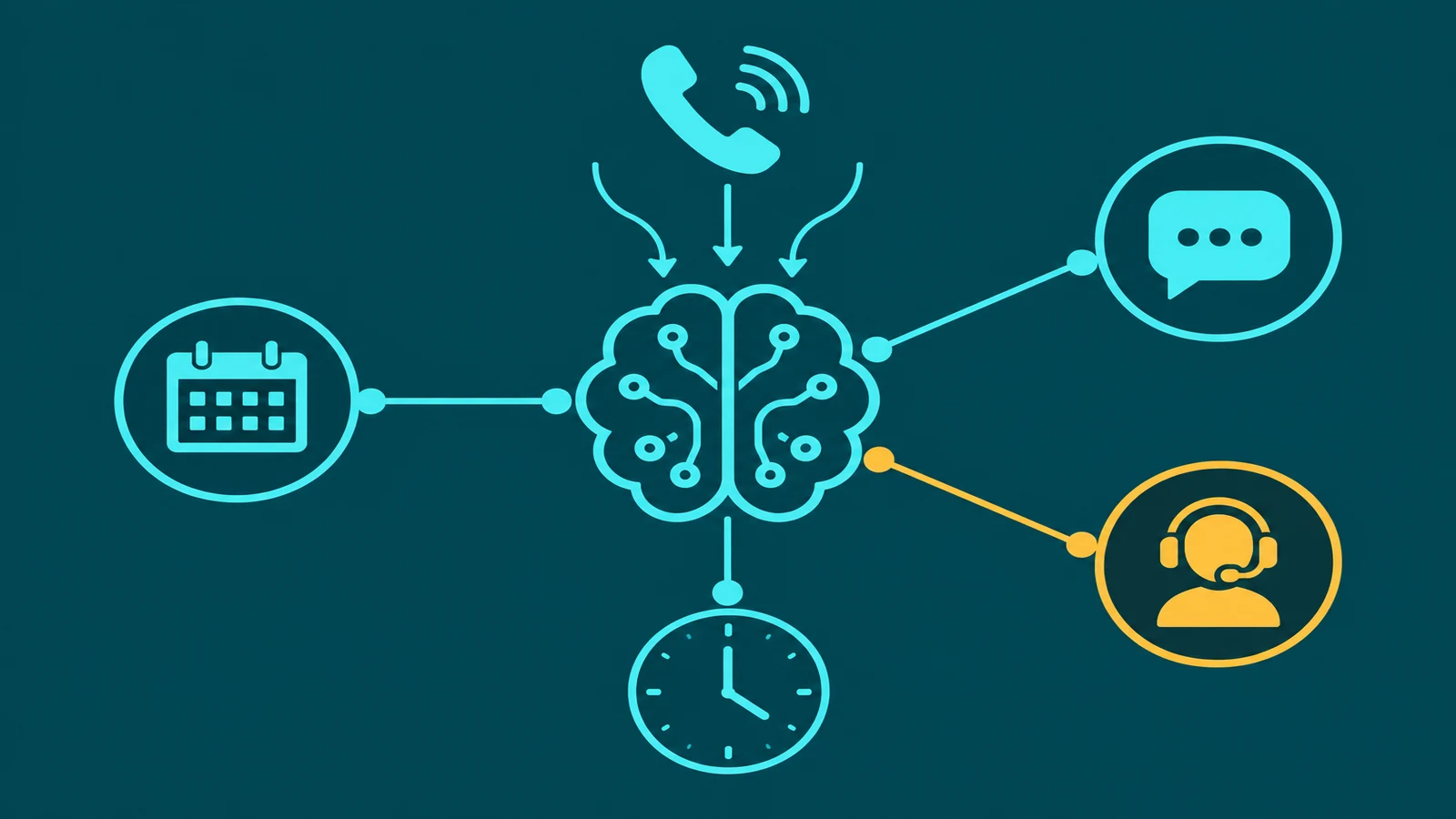
An AI receptionist is software that answers calls, understands spoken natural language, conducts a short conversation to capture intent and caller information, and takes a defined action (route, transfer, message, SMS follow-up). For a full explanation of how it works technically, see what is an AI receptionist.
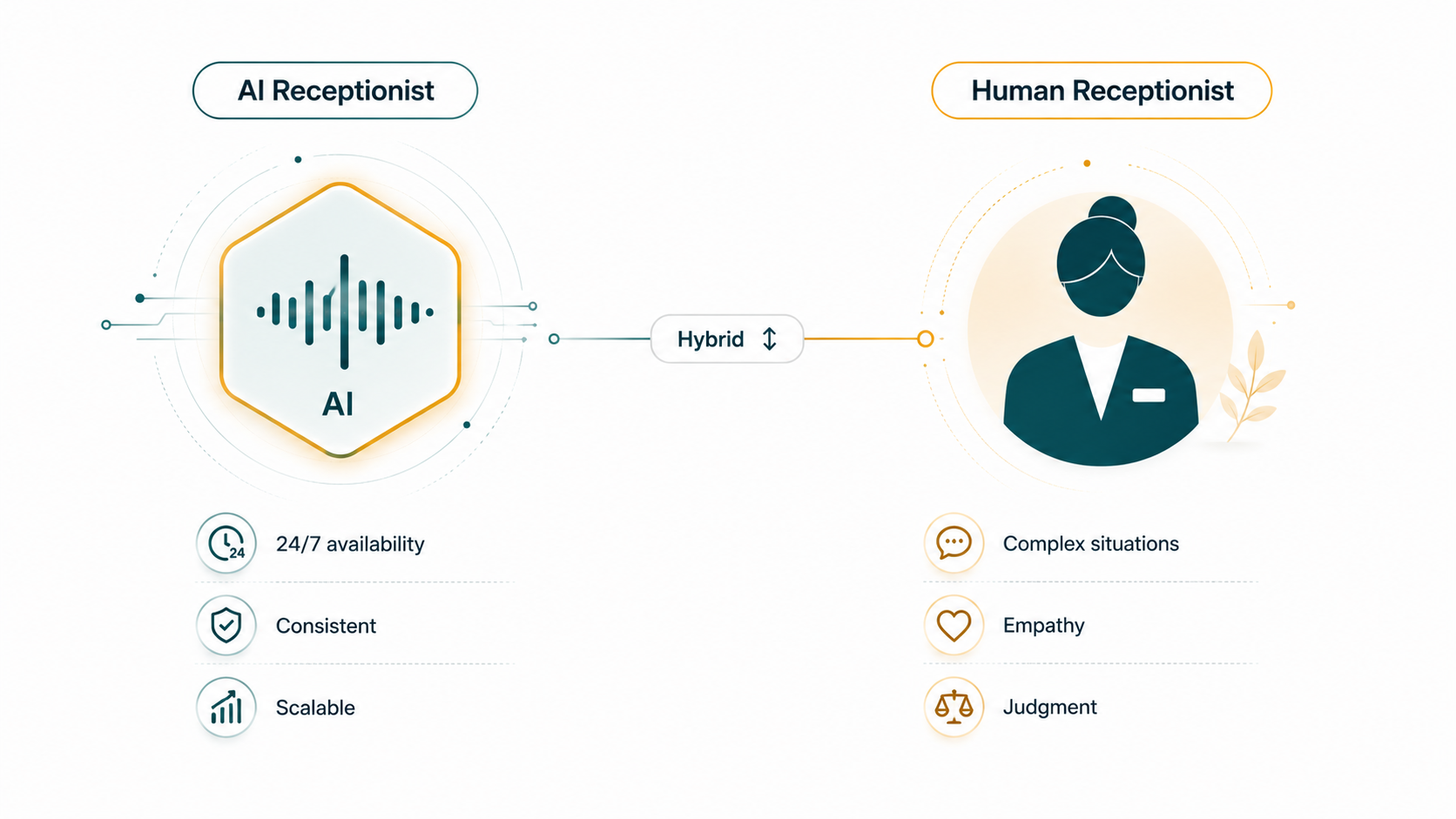
The core tradeoff: Human receptionists bring conversational intelligence, empathy, and the ability to handle unusual situations — but they are available during defined hours, can only handle one call at a time, and require hiring, training, and management. AI receptionists are available 24/7, can handle multiple concurrent inbound calls, and deliver consistent behavior on every call — but they work best on structured, repeatable interactions and need a clear path to a human when the conversation exceeds their scope.
Dimension-by-Dimension Comparison
Availability
A human receptionist works defined hours. Even in businesses with generous coverage, that typically means calls outside a 9–6 window go to voicemail. Weekends, holidays, and sick days create gaps.
An AI receptionist answers at any hour, on any day, with zero degradation in quality. Calls at 11 PM on a Sunday get the same professional greeting and information capture as calls at 10 AM on a Tuesday. For businesses where after-hours calls represent significant revenue — service businesses where emergencies happen outside business hours, professional practices where prospects are researching options in the evening — this is not a minor improvement.
Availability advantage: AI receptionist, clearly.
Consistency
Human receptionists have good days and bad days. Tone, patience, and attentiveness vary with workload, stress, time of day, and individual personality. A caller who phones during a busy period may get a rushed interaction. The hundredth caller of the day may get a less attentive response than the first.
An AI receptionist delivers the same experience on every call: the same greeting, the same questions, the same professionalism. For businesses that have struggled with inconsistent first impressions — different quality depending on who answered or when — this consistency has real value. The downside of consistency is that it can feel impersonal. When a caller really wants warmth and connection, uniform professionalism is not the same thing.
Consistency advantage: AI receptionist, with the caveat that consistency is not the same as warmth.
Conversational complexity
This is where the comparison reverses decisively. A human receptionist can handle conversations that go sideways: a caller who changes their mind mid-conversation, a caller who cannot articulate what they need, a call that involves a sensitive or unusual situation that does not fit any predefined category. Humans can ask clarifying questions naturally, can recognize when a caller is confused and re-approach the conversation differently, and can handle genuine ambiguity.
An AI receptionist works well on structured interactions with a defined set of likely intents. When a caller's need is unusual, emotionally charged, or requires genuine improvisation, the AI is not the right tool. A well-configured AI recognizes when it is out of its depth and escalates to a human — but that escalation is the point of handoff, not a capability of the AI itself.
Conversational complexity advantage: Human receptionist, clearly.
Empathy and emotional intelligence
Some callers call because they are frustrated, anxious, or distressed. A caller dealing with an urgent problem, a confused elderly caller, a caller who just experienced a difficult situation — these interactions benefit from a human who can modulate tone, acknowledge feelings, slow down, and offer genuine reassurance.
AI systems can be designed to detect frustration signals and respond with a different tone or escalation behavior. But the ability to genuinely convey empathy — to make a distressed caller feel heard — remains a human quality that AI does not replicate reliably. Callers who are in difficult moments and sense they are speaking with an automated system often become more frustrated, not less.
Empathy advantage: Human receptionist, clearly.
Cost structure
Human receptionists carry the full cost of employment: salary, benefits, payroll taxes, training, management time, and coverage for absences. Virtual receptionist services reduce some of these costs but typically charge per call or per minute, which can become significant at volume.
AI receptionist platforms typically charge per minute of call time or as a monthly platform fee. The cost per call tends to be lower than a human receptionist for routine, short interactions — but the comparison depends entirely on call volume, call complexity, and the specific pricing model of the platform. We are not going to suggest a specific savings figure here because the real-world numbers vary too much by business context to generalize honestly.
What can be said: AI receptionist costs do not scale linearly with call volume the way human staffing costs do. The cost of handling the 200th call in a day is the same as the cost of the first. Human staffing costs increase when call volume requires additional coverage.
Cost structure: AI receptionist scales better, but the absolute cost comparison depends on your specific situation.
Scalability and concurrent calls
A human receptionist handles one call at a time. If two calls arrive simultaneously, one goes to hold or voicemail. During busy periods — Monday morning rush, a promotional campaign, an unexpected surge — a single human receptionist is a bottleneck.
AI receptionist platforms can handle multiple concurrent inbound calls — eliminating the single-line bottleneck of a human receptionist. For businesses with unpredictable call volume spikes, this elasticity is a meaningful operational advantage, though the specific concurrency ceiling depends on platform capacity, carrier resources, and deployment configuration.
Scalability advantage: AI receptionist, clearly.
Repetitive call handling
A significant portion of incoming business calls are highly repetitive: directions and hours, status updates on pending requests, appointment confirmations, general pricing questions, routing to the right department. For a human receptionist, answering the same question for the fortieth time in a day is tedious and error-prone — and tedium affects call quality.
AI handles repetitive interactions without degradation. The fortieth call about business hours gets exactly the same quality response as the first. This is precisely the category where AI receptionist deployment pays off most reliably.
Repetitive call handling advantage: AI receptionist, clearly.
Unusual and novel situations
The counterpart to repetitive call handling. When a caller's situation is genuinely unusual — an emergency that does not fit a standard category, a complaint that requires judgment, a request that has never come up before — a human receptionist can reason about it, improvise, and find a reasonable path. An AI receptionist operating outside its configured scope is likely to fail or to produce an unhelpful response.
This is why a well-designed AI receptionist always has a human fallback path: not because the AI fails on every unusual call, but because unusual calls are exactly the category where the cost of a bad interaction is highest and human judgment has the clearest advantage.
Novel situations advantage: Human receptionist, clearly.
Lead capture and information accuracy
AI receptionists capture caller information systematically and accurately — name, number, intent, and any specified fields — on every call, logged automatically. Human receptionists may capture information inconsistently: handwritten notes that get lost, details that are not logged if the call volume is high, fields that are skipped during busy moments.
For businesses where lead capture from inbound calls is a priority, AI-driven capture is more reliable and more complete than informal human note-taking — not because humans are careless, but because consistent data entry is a task that automated systems do better than people under pressure.
Lead capture accuracy: AI receptionist advantage, particularly at volume.
EaseDial AI Receptionist
AI handles routine calls. Your team handles the ones that need them. Nothing falls through.
The Comparison at a Glance
| Dimension | AI Receptionist | Human Receptionist |
|---|---|---|
| Availability | 24/7, no gaps | Business hours, with absence gaps |
| Consistency | Identical experience every call | Varies with individual and workload |
| Concurrent calls | Multiple concurrent calls (subject to platform capacity) | One at a time |
| Conversational complexity | Structured, defined intents | Any — improvises freely |
| Empathy | Limited — detects signals, escalates | Full — reads tone, adapts |
| Repetitive call handling | No fatigue, no errors at volume | Quality degrades with tedium |
| Novel situations | Escalates — does not improvise well | Can reason and improvise |
| Lead capture accuracy | Systematic, complete on every call | Variable, depends on individual |
| Cost scaling | Does not scale with call volume | Requires more headcount at higher volume |
Customer Preference: What Callers Actually Want
Customer preference research on automated vs. human interaction is nuanced and context-dependent, and any simple summary misrepresents it. What the evidence does consistently show is that caller preference depends on the nature of the interaction.
Callers generally prefer human agents for complex, sensitive, or emotionally charged interactions — a billing dispute, a complaint, a situation where they feel they need advocacy. For simple, routine interactions — checking hours, confirming an appointment, finding out who to talk to — many callers are indifferent between AI and human, and some prefer the speed of an automated system that answers immediately.
What callers consistently dislike is a bad experience of either type: an AI that does not understand them and loops endlessly, or a human who keeps them on hold for eight minutes before answering. The quality of the individual experience matters more than the technology behind it.
Oversight and Quality Management
A human receptionist can be coached, evaluated, and improved through direct feedback. You observe their calls, provide training, and the person learns.
An AI receptionist is improved differently: by updating the configuration, refining the intent categories, adjusting the routing rules, and reviewing transcripts to identify patterns — calls where the AI misunderstood intent, routed incorrectly, or failed to capture information. This is a different kind of management process, but it is not inherently more or less demanding — it is just different.
One advantage of AI oversight: every call is recorded and transcribed. You can review 100% of AI receptionist interactions at any time. Reviewing 100% of human receptionist calls is rarely practical. This makes quality issues easier to identify systematically with AI, even if the remediation process is different.
The Hybrid Model: Where AI and Humans Fit Together
For most businesses, the right answer is not choosing between an AI receptionist and a human receptionist. It is designing a system where each handles the calls it is best suited for.
A practical hybrid model typically looks like this:
The AI receptionist answers every incoming call immediately — no hold time, no voicemail, 24/7. It captures intent and caller information, handles routine routing, and answers common questions from a configured knowledge base. Calls with a clear, structured intent (route to sales, route to support, take a message) are handled end to end by the AI.
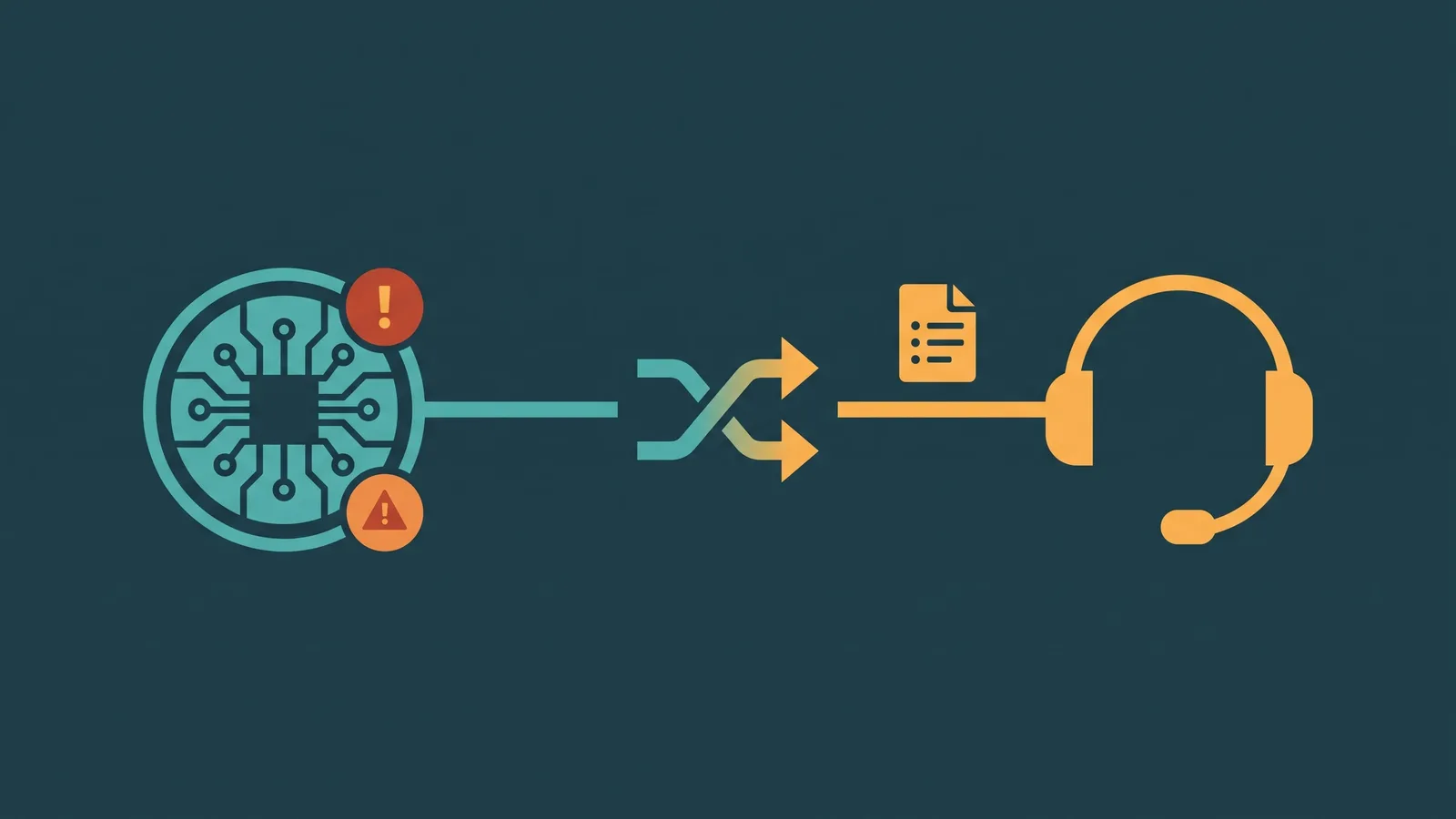
Calls that require human judgment — a distressed caller, an unusual request, an escalation, a high-value customer who has specifically asked to speak with a person — are transferred promptly to a human agent or receptionist with full context: what was captured, what was discussed, what action the AI attempted. The human does not start from zero.
After hours, the AI handles everything: taking messages, sending SMS confirmations, capturing lead details that the team picks up in the morning.
This model does not eliminate the need for human reception capacity in most businesses — it changes what humans spend their time doing. Instead of answering every call regardless of complexity, humans focus on the calls that need them. That is a better use of both human skill and business budget.
When to Use One or the Other
AI receptionist is the right primary tool when: Call volume is high relative to available staff. Many calls are routine and repetitive. After-hours coverage is valuable. Lead capture completeness matters. Simultaneous calls are a real issue. Budget does not support full-time dedicated reception staff. When an AI receptionist fits the need, comparing the leading AI receptionist software is a practical next step, since products differ widely in capability and setup effort.
Human receptionist is essential when: Call complexity routinely exceeds structured intents. Caller empathy and advocacy are core to the business experience. The brand depends on a personal, high-touch first impression. Sensitive or regulated conversations are common. Callers are primarily elderly or otherwise less comfortable with automated systems.
Hybrid model is appropriate when: Most businesses. A mix of routine and complex calls, limited after-hours coverage, a need for consistent lead capture, and specific categories of callers that genuinely benefit from human interaction — this describes the majority of small and mid-size business phone operations.