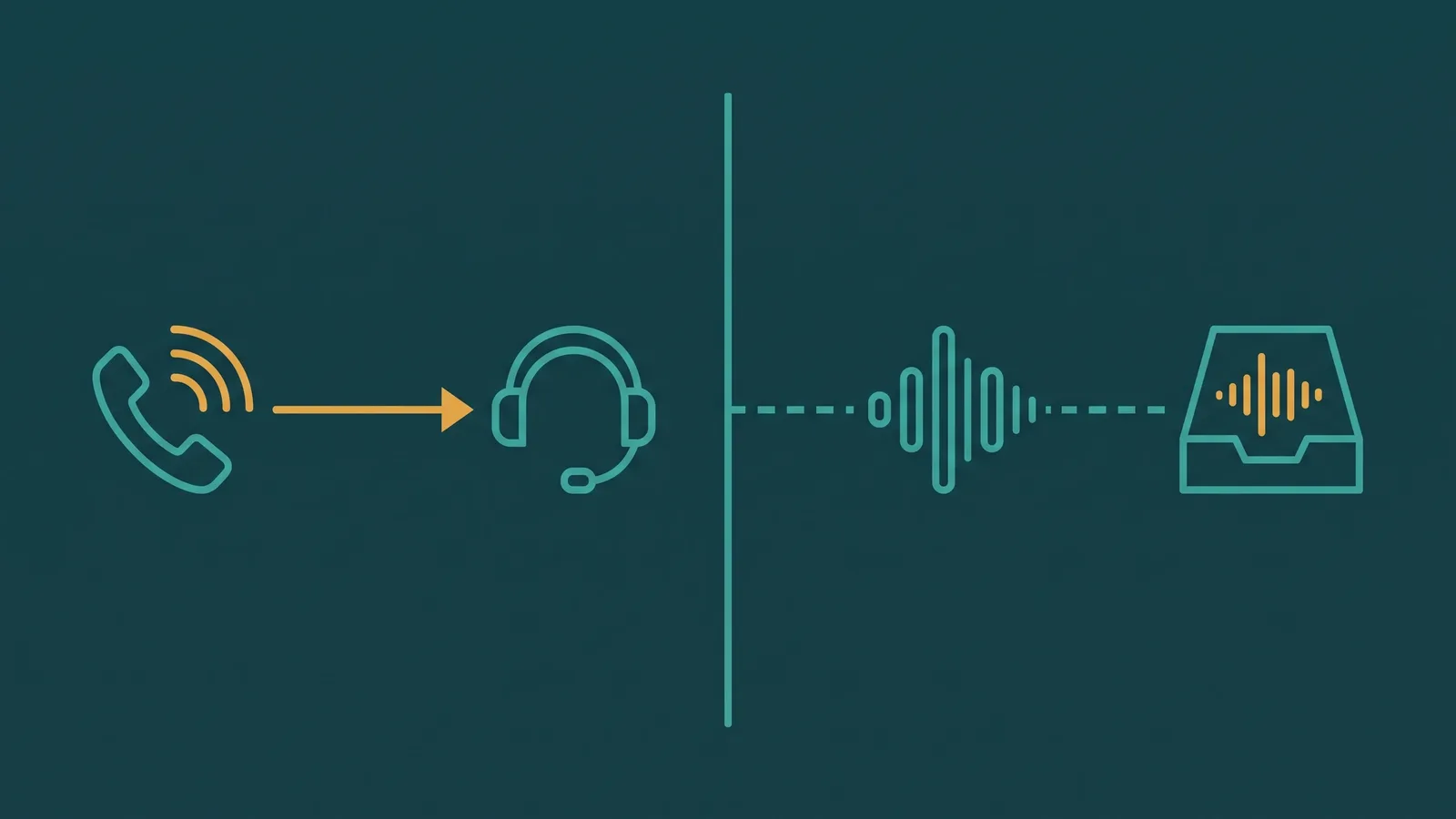
Call monitoring is a supervisor accessing a live call in real time — to listen silently, whisper guidance to the agent, or barge in as a full participant — without the audio being stored by default.
Call recording is the capture and storage of a call's audio as a file after — or during — the conversation, retained for later playback, QA evaluation, compliance review, dispute resolution, or training.
Both tools are standard in contact centers, and most organizations use them together. But they operate at different points in the call lifecycle, carry different legal obligations, leave different evidence trails, and serve different operational purposes. Treating them as interchangeable — or assuming that one covers the other — creates gaps in both your QA program and your compliance posture.
What call monitoring covers
Call monitoring gives a supervisor access to a live call while it is happening. The supervisor does not wait until the call is over — they join the call in progress. Three standard modes define how much the supervisor participates:
Silent listen
The supervisor hears both the agent and the caller. Neither party can hear the supervisor, and neither party receives any indication that a third party is present. The call proceeds exactly as it would without the supervisor. This is the foundational monitoring mode: fully passive, no disruption, no observer effect on the agent's behavior from the caller's side.
Silent listen is used for quality spot-checks during live calls, new agent observation during onboarding, and situational awareness when an alert or flag surfaces a potentially difficult interaction. It is also how a supervisor decides whether to escalate to a more active mode.
Whisper (coach)
The supervisor speaks to the agent only. The caller cannot hear the supervisor's voice. The agent hears real-time coaching in their ear while continuing the conversation with the customer. From the caller's perspective, it remains a two-party call.
Whisper is used to correct errors before wrong information reaches the customer, cue de-escalation, feed the agent a fact or policy they are uncertain about, or prompt a specific next step. It is more effective for brief, directional cues than for long instructions — the agent is processing two conversations simultaneously.
Barge (intercept / conference)
The supervisor joins as a full participant. All three parties — supervisor, agent, and caller — can hear each other and speak. The call becomes a three-way conversation.
Barge is the appropriate mode when the caller has explicitly requested a supervisor, when a decision requires supervisory authority the agent cannot convey on the supervisor's behalf, or when the call has escalated beyond what whisper coaching can address. Because the caller becomes aware of the third party, barge is a deliberate intervention — not a first resort.
The defining characteristic of all monitoring modes: by default, monitoring leaves no stored record. If the platform is not simultaneously recording the call, the supervisor's observation produces no audio file. The coaching, the situational awareness, the intervention — none of it is retained unless a separate recording is triggered.
What call recording covers
Call recording captures the audio of a call and stores it as a file — indexed with metadata (agent, date, time, duration, queue, disposition) — available for playback and review after the call ends. The recording is the persistent artifact; monitoring is the real-time activity.
Triggering modes
Recordings can be created in several ways depending on platform configuration and organizational policy:
- Automatic (always-on): Every call in a defined queue, campaign, or extension is recorded from the moment it connects. This is the most common contact center configuration — it ensures complete coverage and removes any discretion from agents about what gets recorded.
- On-demand: An agent or supervisor manually starts a recording for a specific call. Used in environments where only certain call types are recorded, or where agents have authority to initiate recording based on call content.
- Rules-based: The platform triggers recording based on defined criteria — specific queues, inbound caller segments, call type flags, or CRM-linked customer attributes. Provides targeted coverage without recording every call.
What recordings are used for
- Retrospective QA evaluation: QA analysts review recorded calls after the fact, scoring them against quality assurance rubrics for agent performance, compliance, and customer experience quality.
- Dispute resolution: When a customer disputes what was promised or agreed — an offer, a cancellation, a commitment — the recording is the authoritative record of what was actually said.
- Compliance audit: Regulated industries retain recordings as evidence that required disclosures were made, proper agent conduct was followed, and applicable scripts were adhered to.
- Training material: Recorded calls — positive examples and instructive negative ones — are among the most effective agent coaching and training resources. Real calls with real customers capture variation that role-play scenarios cannot reproduce.
- Incident evidence: If a specific call becomes the subject of a legal claim, regulatory inquiry, or internal investigation, the recording is primary evidence.
Consent and disclosure requirements
Legal note: The information below is general educational context. It is not legal advice. Recording and monitoring laws vary by jurisdiction, call type, context, and how courts have interpreted applicable statutes. The list of states with heightened consent requirements evolves. Always confirm your obligations with qualified legal counsel before implementing monitoring or recording programs.
The most consequential practical difference between monitoring and recording is the legal exposure each creates. Both involve listening to conversations — but because recording produces a stored artifact, it tends to attract stricter scrutiny.
One-party consent (US federal law and approximately 38 states)
Under the federal Wiretap Act, at least one party to a call must consent to monitoring or recording. Because a business is always a party to its own calls, the business's own consent satisfies the federal requirement. The same one-party standard applies in the majority of US states. In practice, this means a business may record or monitor its own calls without informing the other party — though disclosure is almost always the better practice regardless.
Two-party / all-party consent states
A number of states require that all parties to a conversation consent before recording or monitoring is lawful. These include California, Florida, Illinois, Maryland, Massachusetts, Nevada, New Hampshire, Oregon, Pennsylvania, Washington, and others. The scope of these laws, and how courts have applied them to interstate calls and specific fact patterns, varies and continues to evolve. California's law in particular has extraterritorial reach in some interpretations — if the person being recorded is in California, California law may apply regardless of where the business is located.
Standard approach: the disclosure announcement
Most organizations handle consent requirements by playing an automated disclosure message at call start: "This call may be recorded or monitored for quality and training purposes." Callers who remain on the line after hearing this message are generally treated as having implicitly consented in one-party consent states. This single disclosure typically covers both monitoring and recording under one notice.
In all-party consent states — particularly California and Illinois — implicit consent via a disclosure announcement may not satisfy the applicable standard. Affirmative, explicit consent may be required. Legal review is appropriate for any operation that regularly handles calls involving callers in these jurisdictions.
International considerations
Outside the US, recording and monitoring consent requirements vary significantly. In the European Union, the GDPR requires a lawful basis for processing personal data — which includes call recordings — and legitimate interest, contractual necessity, or explicit consent are the most commonly relied-upon bases, depending on context. The UK Information Commissioner's Office (ICO) has published specific guidance on recording business calls. Organizations operating across multiple jurisdictions should map their recording practices to each applicable legal regime rather than assuming a single disclosure satisfies all requirements. Confirm jurisdiction-specific obligations with legal counsel.
Storage, retention, and access
Because monitoring leaves no stored record by default, it creates no data management obligation. A supervisor who listened to a call in silent mode and took no action has nothing to store, index, retain, or protect.
Recordings are the opposite: every recorded call is a stored file that must be managed for its entire retention lifecycle.
- HIPAA (healthcare): Medical records — which can include recorded calls involving protected health information — must be retained for a minimum of six years from creation or the date last in effect, whichever is later. State law may impose longer periods.
- PCI DSS (payment card): The Payment Card Industry Data Security Standard prohibits storing sensitive cardholder data. Recordings that capture verbal credit card numbers (PAN, CVV, expiry) during payment processing may create PCI scope obligations for the storage environment. Standard practice is to pause recording during the payment segment or route card entry through DTMF (keypad) to keep it out of the voice channel.
- Financial services: Retention requirements vary by regulation and instrument type. FINRA, SEC, and state regulations impose specific periods for communications related to securities activity. Confirm with compliance counsel.
- General business: Even without specific regulatory mandates, recordings relevant to potential disputes should be retained for a period that covers realistic dispute timelines. Deleting a recording before a related dispute is resolved may destroy relevant evidence — which carries its own legal risk depending on circumstances and timing.
Access controls matter as much as retention. Not every employee should be able to play back any recorded call. Playback access should be restricted to supervisors, QA analysts, and administrators with a legitimate operational or compliance need. Systems should log who accessed which recordings and when.
Using them together in a QA program
Monitoring and recording are complementary, not competing. They address different points in the quality assurance workflow:
Monitoring enables real-time intervention. A supervisor who catches a problem during a live call can act immediately — whisper a correction, join the call, redirect the conversation — before the call ends with a bad outcome. Real-time observation also informs situational awareness: supervisors see what is happening across their team's active calls and can prioritize where to direct attention.
Recording enables calibrated retrospective QA. After calls end, QA analysts evaluate recordings against standardized rubrics — independently, consistently, across the full agent pool. Retrospective review catches patterns that real-time monitoring cannot: trends across dozens of calls from the same agent, systemic issues with a particular call type, or deviations from script that occur only in specific scenarios.
A well-structured QA program uses both. Supervisors monitor a defined percentage of calls live — particularly for newer agents, escalation-prone queues, or flagged interactions. QA analysts evaluate a separate sample of recorded calls from the full agent pool on a scheduled basis. Calibration sessions align the scoring team on how to apply the rubric consistently. See Call Center QA Calibration for how calibration sessions work and why they matter.
The two activities also feed each other. Calls that required barge or intercept during live monitoring are valuable material for retrospective QA — they represent edge cases where normal handling broke down. Patterns identified in retrospective recording review inform what supervisors should watch for when monitoring live.
Key differences at a glance
| Dimension | Call Monitoring | Call Recording |
|---|---|---|
| When | Real time — during the live call | After the call (or captured during, played back later) |
| Supervisor can intervene | Yes — whisper to agent, barge as participant | No — call has already ended |
| Stored by default | No — observation leaves no record unless recording is also active | Yes — audio file indexed with call metadata |
| Legal exposure | Consent to monitor (same party consent rules apply) | Consent to record (stricter scrutiny; stored artifact) |
| Primary use | Real-time coaching, escalation handling, live quality spot-check | Retrospective QA, compliance audit, dispute resolution, training |
| Data management obligation | None (no stored artifact) | Retention policy, access controls, compliance-driven deletion schedules |
Frequently Asked Questions
Use our free Call Recording Storage Calculator to estimate how much storage your recordings need and what they cost — supports G.711, G.729, and Opus codecs with configurable retention periods. No email required.
Both call monitoring and call recording are foundational tools in contact center quality management — but they work best when applied deliberately, with clear policies on when each is used, what consent disclosures are in place, and how recorded files are managed. For a deeper look at how each tool fits into your QA workflow, see What Is Call Recording?, Listen, Whisper, Barge, and Intercept Explained, and Call Center QA Calibration.