Running a contact center with the wrong number of agents on shift is expensive in both directions. Too few agents and customers wait too long, abandon calls, and take their frustration out on whoever eventually answers. Too many agents and you are paying for idle time that your budget cannot absorb quarter after quarter.
Workforce management is the discipline that tries to solve that problem systematically. It covers everything from predicting how many calls will arrive tomorrow morning to adjusting staffing in real time when Monday turns out to be busier than the model expected.
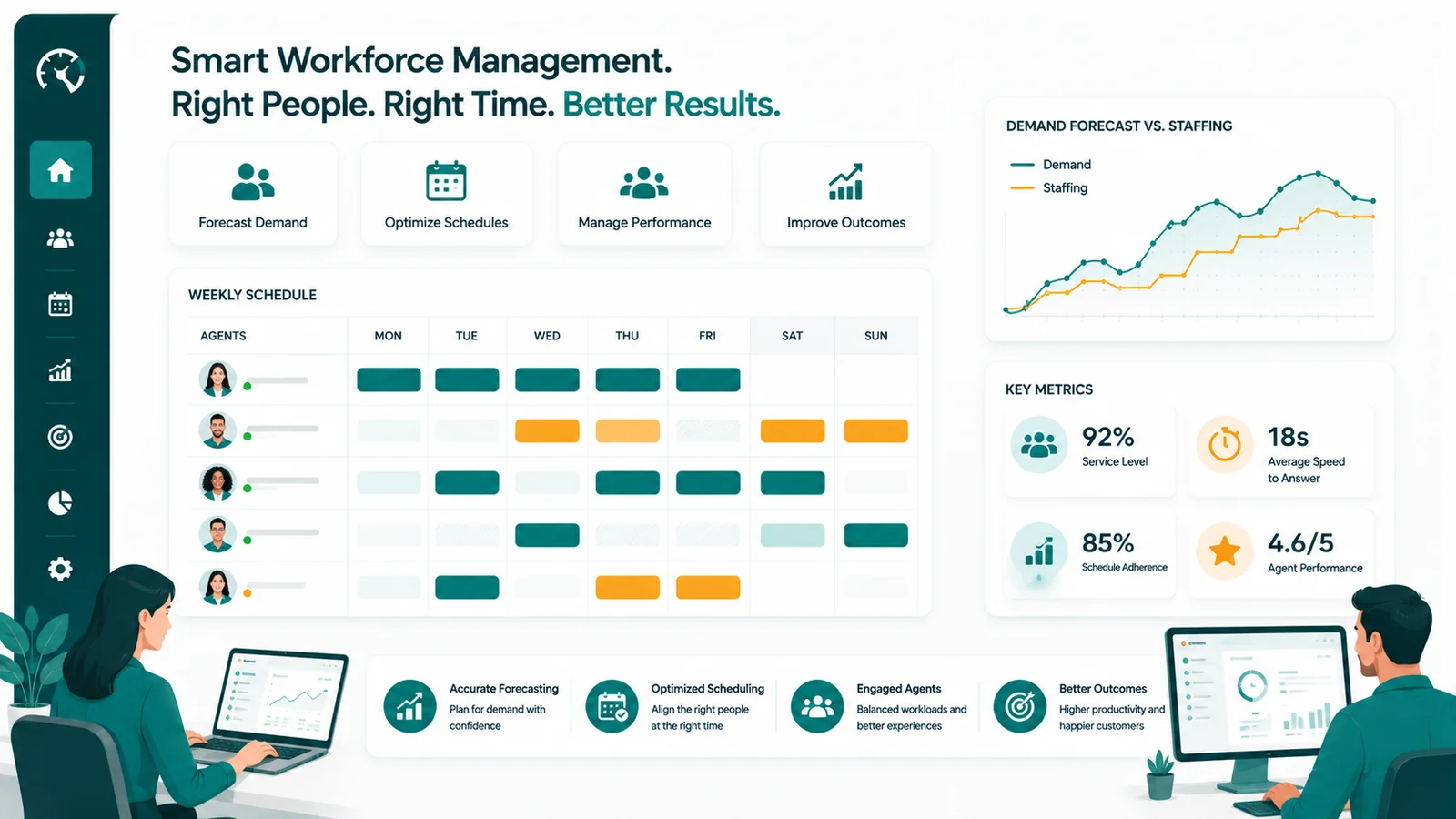
Call center workforce management (WFM) is the set of processes and tools used to forecast contact volume, schedule the right number of agents at the right times, manage staffing changes throughout the day, and track whether agents are following their planned schedules. The goal is to match agent supply to customer demand as precisely as possible while controlling labor costs and meeting service-level targets.
WFM is not software you buy and forget. It is an ongoing operational practice that requires accurate data inputs, disciplined processes, and regular calibration. The software accelerates and automates the work, but the underlying logic has to be right first.
The five stages of the WFM cycle
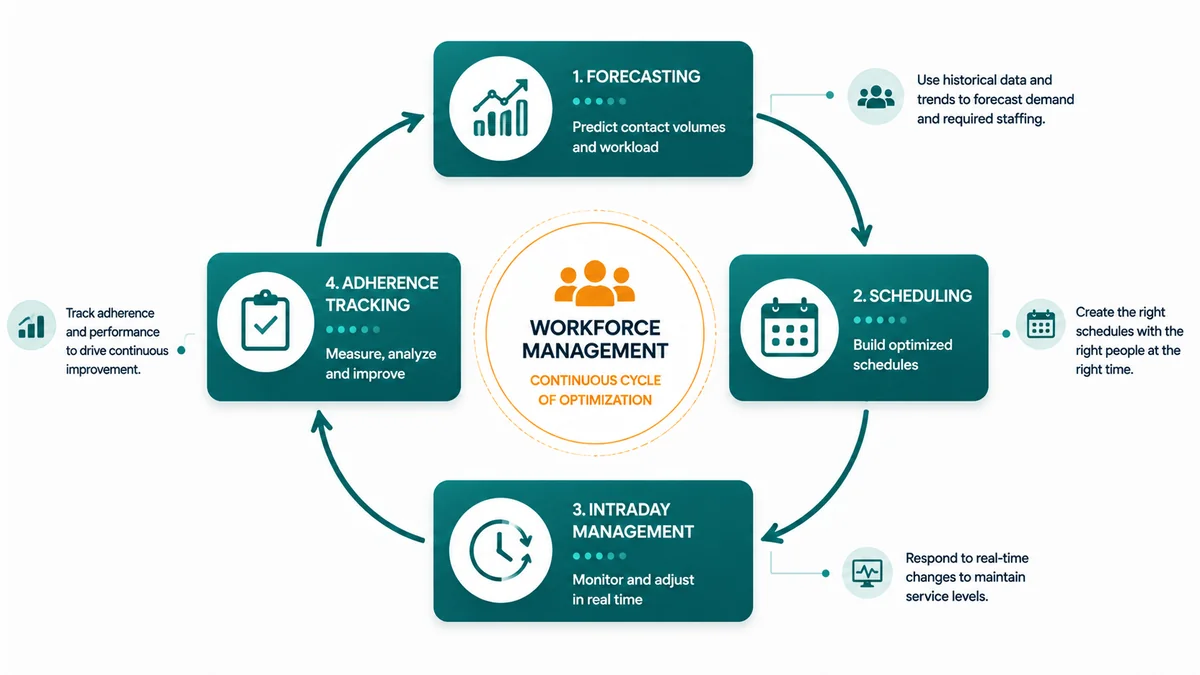
Most WFM practitioners describe the discipline as a cycle with four main stages. Each feeds the next, and the output of the last stage informs how you improve the first.
1. Forecasting
Forecasting is the starting point. Before you can schedule anyone, you need an estimate of how much contact volume is coming in, and when. That estimate is built from historical data: how many calls, chats, or emails arrived on equivalent days in the past, adjusted for known variables like promotions, seasonal patterns, or changes to your product lineup.
Most WFM systems let you break the forecast down to 15- or 30-minute intervals. A forecast that says "we expect 800 calls on Tuesday" is far less useful than one that maps the arrival pattern hour by hour. Contact volumes are rarely flat across a shift. They typically peak mid-morning, dip at lunch, climb again in early afternoon, and drop off toward the end of business. Your schedule needs to track that curve.
Forecast accuracy is critical because every downstream stage depends on it. A forecast that consistently over-estimates volume leads to overstaffing. One that under-estimates leads to understaffing and blown service levels. Most operations track forecast accuracy as a percentage variance between predicted and actual volume, and they review it weekly to catch systematic errors.
The inputs to a good forecast include: historical contact volume by interval, handle time trends (how long calls typically take), repeat-contact rates, and any known upcoming events that affect demand. Inbound volume can also be influenced by outbound campaigns, so if your contact center runs both, those schedules have to be coordinated.
2. Scheduling
Once you have a volume forecast, you can calculate how many agents you need at each interval. The standard method is the Erlang C formula, which takes call volume, average handle time, and a target service level (for example, 80% of calls answered within 20 seconds) and outputs a staffing requirement. Most WFM platforms run this calculation automatically.
The staffing requirement tells you how many agents you need. Building actual schedules is where the complexity grows. You have to account for:
- Agent availability constraints: part-time vs. full-time, contracted hours, legal rest requirements
- Breaks and lunches: an agent off the floor for 30 minutes is not handling contacts during that window
- Training time: if you are onboarding new hires or running product training, those hours come out of capacity
- Skills: not every agent handles every contact type, so scheduling has to match skill sets to the queues that need them
- Shift preferences and seniority rules: some centers give senior agents first pick of shifts; others use automated bidding systems
The output is a set of shift assignments that, in aggregate, cover the staffing requirements while respecting all constraints. This is a combinatorial problem that gets complicated quickly as team size grows, which is why automated schedule-building tools exist.
3. Account for shrinkage
The staffing requirement produced by Erlang C assumes agents are available to handle contacts. In practice, a meaningful portion of scheduled time is absorbed by breaks, training, meetings, coaching, and absenteeism — a factor known as shrinkage. A schedule built without accurate shrinkage adjustment will be short-staffed even when it looks correct on paper; the shrinkage guide covers how to calculate and apply it.
4. Intraday management
A schedule is built before the shift starts. Intraday management is what happens once the day is underway and reality starts diverging from the plan.
Agents call in sick. Volume spikes unexpectedly because a system outage triggered a surge of support calls. A campaign emails went out an hour earlier than expected. These deviations from the forecast require real-time responses: pulling agents from lower-priority queues, moving breaks, calling in part-time staff, or starting outbound work to keep idle agents productive when inbound volume drops.
Effective intraday management requires real-time visibility into two things: current queue state (how long are customers waiting, what is the abandon rate, how many contacts are in queue) and current agent state (how many agents are available, on call, in after-call work, or on break). Without that visibility, supervisors are making adjustments based on instinct rather than data.
Modern contact center platforms surface this data on real-time dashboards. The WFM layer connects to those dashboards and can alert supervisors when staffing is drifting outside acceptable bands, or automatically trigger pre-defined responses. For teams running AI in their contact centers, some of this intraday adjustment can be automated based on real-time signals.
5. Adherence tracking
Schedule adherence measures whether agents are doing what their schedule says they should be doing, at the time they should be doing it. An agent scheduled to be available at 9:00 who logs in at 9:12 has impacted your service level for those 12 minutes, even if only slightly. Multiply that across a team and it adds up.
Adherence is typically expressed as a percentage: if an agent is scheduled for an 8-hour shift with 30 minutes of breaks, they have 450 available minutes. If they were actually in an adherent state for 405 of those minutes, their adherence is 90%.
The goal of adherence tracking is not to punish agents for bathroom breaks or longer-than-expected calls. It is to identify systemic patterns: agents who routinely start late, queues that consistently run over average handle time, or break schedules that are poorly timed relative to volume peaks. That data feeds back into better forecasting and scheduling in the next cycle.
Adherence reporting also helps distinguish between an agent performing poorly and a schedule that is simply unrealistic. If adherence is low across the board, the schedule may be the problem.
Why WFM matters at scale
For very small teams — say, four or five agents — WFM might be nothing more than a shared spreadsheet and a supervisor who can see the whole floor at a glance. The overhead of formal WFM tooling would exceed its benefit.
As headcount grows, that changes fast. At 20 agents, the scheduling permutations become genuinely difficult to optimize by hand. At 50 agents, manual intraday management becomes reactive and error-prone. At 100 agents or more, the labor cost difference between a well-optimized schedule and a mediocre one can be significant enough to fund additional headcount.
Consider what happens when a 50-agent center is consistently 5% overstaffed due to a conservative forecast. That is 2.5 agent-equivalents of idle labor per shift. Across two shifts, six days a week, that adds up quickly. WFM is fundamentally a cost optimization exercise, but one that also affects customer experience: chronic understaffing shows up directly in service-level and CSAT metrics. See EaseDial’s workforce management tools for the scheduling and real-time adherence capabilities that support this cycle.
EaseDial Contact Center
Built-in scheduling, real-time dashboards, and adherence tracking — without the extra WFM license
WFM tool categories
| Tool category | What it covers | Best fit for |
|---|---|---|
| Integrated WFM (built into CCaaS) | Forecasting, scheduling, real-time adherence, basic reporting | SMB and mid-market contact centers that want one platform |
| Dedicated WFM suite | Advanced forecasting models, multi-skill optimization, long-range planning, complex union rules | Large enterprise centers with complex scheduling requirements |
| Scheduling spreadsheets + ACD reports | Manual scheduling, basic shift assignments | Very small teams (under 15 agents) |
| AI-powered WFM | Automated intraday adjustments, ML-based forecasting, agent self-scheduling | Mid-to-large centers adopting AI-first operations |
The most common integration point is between the WFM system and the automatic call distributor (ACD) or contact routing platform. The ACD generates the historical volume and handle-time data the WFM needs for forecasting, and the WFM publishes schedules back so the ACD knows which agents should be logged in at which times. For deeper background on how calls get distributed before they reach an agent, see our guide to call queue management.
Some organizations also connect WFM to HR and payroll systems. This closes the loop between scheduled hours and actual hours worked, which matters for labor cost accounting and compliance.
Choosing between integrated and dedicated WFM
The table above describes what each category covers, but the selection question is whether your operation's scheduling complexity justifies the overhead of a dedicated WFM suite on top of your contact center platform. These are the decision factors that actually drive that choice:
- Team size and scheduling load: Integrated WFM modules in CCaaS platforms are designed for small to mid-size operations. The scheduling optimization in dedicated suites handles more agents, more scheduling constraints, and more concurrent optimization variables more efficiently. Team size alone is not the deciding factor — it is team size combined with scheduling complexity. A large team with simple, uniform shifts and a single queue may run fine on integrated tooling; a smaller team with complex blended skills, variable shift patterns, and multiple service-level targets may hit the limits of integrated tooling sooner.
- Multi-skill and multi-queue complexity: If agents handle a single queue and a single skill, scheduling is relatively straightforward. If agents are cross-trained across queues, handle blended inbound/outbound campaigns, or are shared across multiple teams with different service level targets, the scheduling optimization problem becomes combinatorially harder. Dedicated suites are built for this complexity; integrated modules often handle it adequately up to a point, then become limiting.
- Multi-site and remote scheduling: Coordinating schedules across multiple locations or across a distributed remote workforce — including time zone management, split-team staffing, and cross-site overflow logic — is where dedicated WFM systems earn their cost. Integrated platforms vary considerably in how well they handle this.
- Labor compliance requirements: Union scheduling rules, regulated break intervals, overtime restrictions, and state-specific predictive scheduling laws add constraint layers that spreadsheets cannot handle and that integrated modules handle inconsistently. If labor compliance is a material concern, it is a strong argument for dedicated tooling with explicit compliance rule engines.
- Long-range planning horizon: Integrated WFM is primarily operational — schedule today and this week. Dedicated suites often include strategic capacity planning that models staffing requirements 6–18 months out against projected volume and headcount plans. If operations leadership needs this for hiring planning and budget forecasting, it is a gap in integrated tooling.
- Total cost of integration: Dedicated WFM suites require integration with your ACD/CCaaS platform, and those integrations take engineering effort to build and maintain. Before selecting a dedicated suite, validate that a supported, maintained integration exists for your specific CCaaS platform and that your team has the capacity to manage it. A poorly integrated dedicated suite is worse than a well-integrated native one.
For operations with straightforward scheduling — a single location, relatively uniform skills, and manageable intraday variation — the WFM capabilities built into a modern CCaaS platform are sufficient for the core forecasting-scheduling-adherence cycle. Dedicated WFM adds meaningful value when scheduling complexity, compliance requirements, or planning horizons push beyond what integrated tooling handles well.
Key WFM metrics to track
Any WFM implementation should produce a short list of metrics that the operations team reviews regularly. The most important ones:
- Forecast accuracy: Percentage variance between predicted and actual contact volume, measured at the interval level. Target is typically within 5% for daily totals.
- Schedule adherence: Percentage of time agents are in the state their schedule specifies. Industry target is often 90-95%, though this varies by operation.
- Agent occupancy: The percentage of time agents spend actively handling contacts versus waiting. High occupancy (above 85%) indicates overwork and leads to burnout. Very low occupancy indicates overstaffing.
- Shrinkage: The portion of scheduled time lost to activities that take agents off the phone: training, meetings, breaks, absenteeism, coaching sessions. Accurate shrinkage estimates are essential for building schedules that actually hit staffing targets.
- Service level: The percentage of contacts answered within a target threshold (for example, 80% of calls answered within 20 seconds). This is the ultimate output metric that WFM exists to protect.
Common WFM challenges
Even teams with solid WFM processes run into recurring problems. Knowing the common failure modes helps you address them before they become expensive.
Inaccurate shrinkage estimates
Shrinkage is the gap between agents scheduled and agents actually handling contacts. Most operations underestimate it. If your model assumes 20% shrinkage but actual shrinkage is 28%, you will be consistently understaffed even when the schedule looks correct on paper. Shrinkage should be calculated from historical data and reviewed at least quarterly, because it shifts as training needs, meeting cadences, and absenteeism patterns change.
Rigid scheduling that does not account for intraday variation
A schedule built around daily totals can look fine on paper but leave serious gaps at specific intervals. A team might be adequately staffed on average but understaffed from 10:00 to 11:30 when volume peaks. Interval-level scheduling and intraday monitoring close this gap.
Treating WFM as a one-time setup
A forecast calibrated to last year's volume will drift as your business changes. New products, new contact channels, seasonal shifts in demand patterns, and changes in average handle time all affect the model. WFM requires regular recalibration, not just an annual review.
Poor agent communication about schedules
Adherence suffers when agents do not have clear, accessible information about their schedules and what is expected of them. Modern WFM platforms address this with agent-facing self-service portals where staff can view schedules, request shift swaps, and submit time-off requests without going through a supervisor for every transaction.
Not accounting for multi-channel complexity
A contact center that handles voice, email, chat, and SMS faces a more complex scheduling problem than one handling voice only. Different channels have different handle times, different volume patterns, and different service-level targets. Agents skilled in multiple channels (blended agents) can be allocated flexibly, but the WFM model has to capture that complexity accurately. The guide on omnichannel operations covers how that changes the contact center model.
Ignoring the agent experience dimension
High-occupancy schedules that leave agents with no recovery time between calls increase burnout and turnover. Turnover is one of the largest hidden costs in contact center operations: recruiting, onboarding, and training a replacement is expensive, and the productivity loss during ramp-up is real. A WFM model that optimizes purely for cost efficiency at the expense of agent workload will often produce higher total costs over time.
WFM and AI: what is changing
AI is changing parts of workforce management, but not replacing the fundamentals. The areas where AI adds the most value are:
- Forecasting: Machine learning models can incorporate more variables than traditional statistical methods, improving accuracy for operations with complex or irregular demand patterns.
- Intraday automation: AI can trigger staffing adjustments in real time based on queue data, reducing the manual workload on supervisors during peak periods.
- Agent self-scheduling: Some platforms now allow agents to pick shifts within defined constraints, with AI optimizing the aggregate schedule across all choices made. This improves agent satisfaction while maintaining coverage requirements.
- Handle time analysis: AI can identify which calls or contacts are running longer than expected and flag the underlying reasons, helping operations teams address root causes rather than just reacting to schedule deviations.
For contact centers also exploring AI voice agents to handle routine contacts, WFM models need to account for the shift in contact mix. If AI handles 30% of inbound contacts autonomously, your human agent staffing requirement changes substantially, and the contacts that do reach humans will tend to be more complex. WFM and AI strategy have to be planned together.
Where to start if you are new to WFM
If your contact center is running without formal WFM, the practical starting point depends on your size and current data availability.
First, make sure you are capturing the right data from your ACD or contact platform: interval-level volume, average handle time by queue and contact type, and agent state data (available, on call, in after-call work, on break). Without this data, no forecasting model can work.
Second, calculate your actual shrinkage. Pull historical data to see what percentage of scheduled time is lost to breaks, training, absence, and meetings. This is usually higher than most managers expect.
Third, start with a simple 30-day rolling forecast using your historical data and compare predicted to actual volume at the end of each week. The variance will tell you whether your historical data is clean enough to use and whether there are patterns you are not accounting for.
From there, you can evaluate whether a built-in WFM module in your contact center platform is sufficient or whether you need a dedicated tool. For most operations under 150 agents, the integrated approach handles the core WFM cycle well. Dedicated suites add value when scheduling complexity grows: multiple sites, complex skill routing, long-range planning with variable shift bidding, or detailed labor compliance requirements. The type of dialer campaigns you run also affects the WFM model — outbound predictive campaigns create different staffing patterns than pure inbound queues.
WFM is a loop, not a setup: each measurement cycle feeds back into better forecasting, which produces better schedules, which reduces the gap between plan and reality.
Free calculators for every stage of the WFM cycle: Call Volume Forecast · Staffing (Erlang C) · Shrinkage · Occupancy — no email required.
EaseDial Contact Center Platform
Forecasting, scheduling, intraday dashboards, and analytics — all in one platform built for growing contact centers