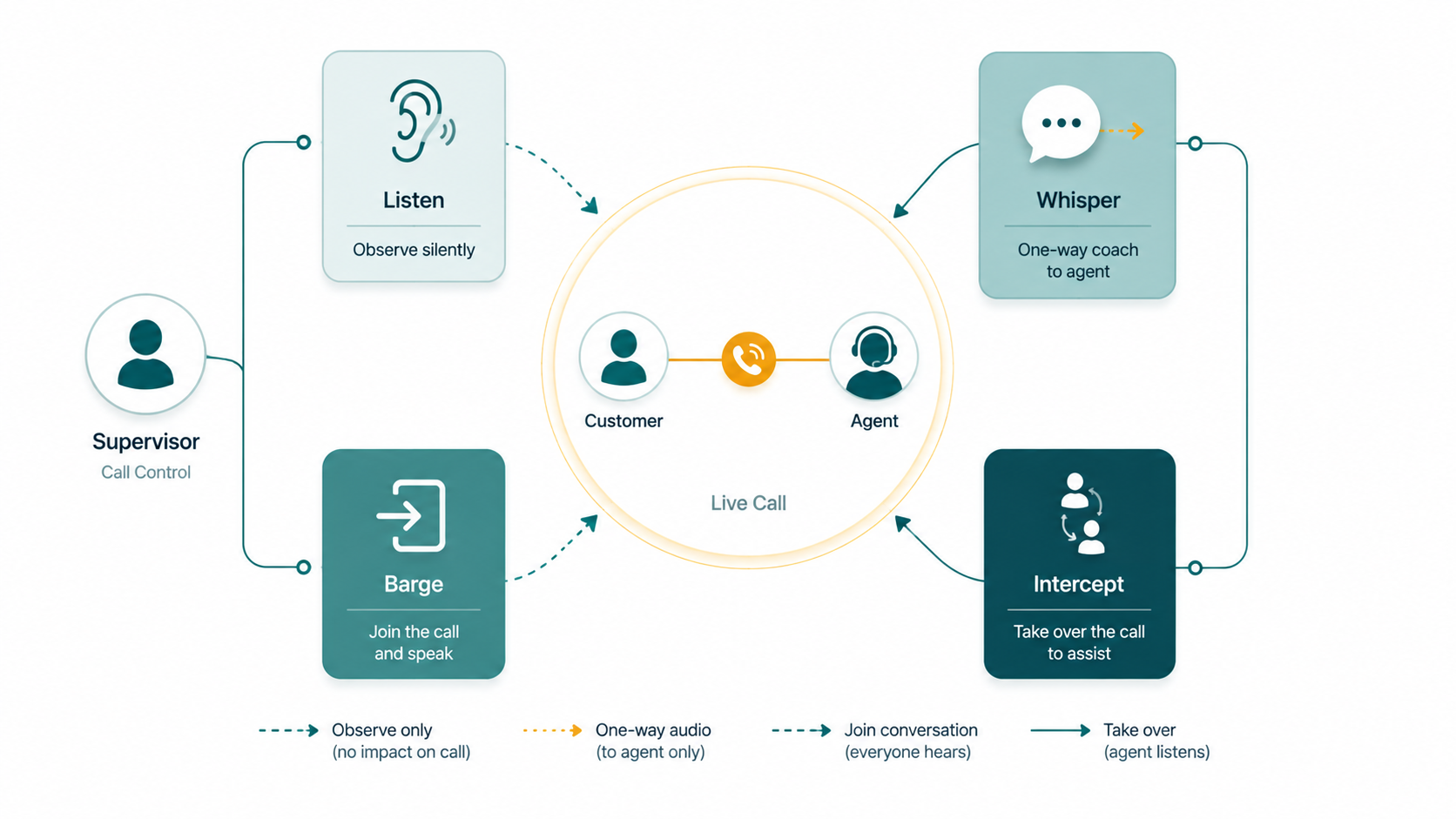
Call monitoring modes define how much a supervisor can hear and how much they can participate in a live call without disrupting it. The four standard modes — Listen, Whisper, Barge, and Intercept — form a spectrum from passive observation to high-intervention supervisory action, each designed for a different supervisory purpose.
Every contact center has some form of live call oversight. The question is how much control supervisors actually have and how quickly they can act when a call goes off track. Understanding what each monitoring mode does — and when to use it — is the difference between a supervisor who can only watch a call deteriorate and one who can step in at exactly the right moment.
The four monitoring modes explained
Listen (Silent Monitor)
In Listen mode, the supervisor joins the call and can hear both parties — the agent and the customer — but neither party can hear the supervisor. The call continues exactly as it would without the supervisor present. From the agent's and customer's perspectives, it is a two-party call.
Listen is the foundational monitoring mode. It is used for:
- Quality assurance: Supervisors or QA analysts monitor calls to evaluate agent performance against quality rubrics — without the observer effect that comes from the agent knowing they are being actively coached.
- New agent observation: During onboarding and early training, supervisors can listen to new agents handle real calls to assess readiness and identify skill gaps without interrupting the interaction.
- Situational awareness: When a flag or alert surfaces a potentially difficult call, a supervisor can silently join to understand the situation before deciding whether to escalate their involvement.
The limitation of Listen mode is that it is entirely passive. If the supervisor observes something going wrong, they cannot intervene without escalating to a different mode.
Whisper (Coach)
In Whisper mode, the supervisor can speak to the agent only. The customer cannot hear the supervisor's voice. The agent hears the supervisor's coaching while continuing to speak with the customer.
This is live, in-ear coaching — the supervisor can provide real-time guidance, feed the agent the right answer to a question the agent is uncertain about, cue the agent to de-escalate, or prompt a specific next step in the conversation. The customer experiences an uninterrupted two-party call.
Whisper is particularly effective for:
- Supporting agents on difficult or escalating calls: The supervisor can coach the agent through a tense situation without exposing the intervention to the customer.
- Correcting errors in real time: If an agent is about to give incorrect information, the supervisor can intervene before the wrong information reaches the customer.
- Accelerating agent development: New agents can receive real-time guidance on live calls rather than waiting until after the call for feedback that is already distant from the experience.
The constraint of Whisper mode is that the agent is managing two conversations simultaneously — the one with the customer and the coaching input from the supervisor. This requires the agent to process and act on guidance in real time, which works better for brief directional cues than for long instructions.
Barge (Conference)
In Barge mode, the supervisor joins the call as a full participant. All three parties — supervisor, agent, and customer — can hear each other and speak. The call becomes a three-way conversation.
Barge is the appropriate mode when the situation has moved beyond what the agent can resolve alone and when the supervisor's direct participation in the conversation with the customer is necessary. Common scenarios include:
- Customer explicitly requests a supervisor: Rather than placing the customer on hold and transferring, the supervisor can barge in and join the live call, maintaining continuity.
- Compliance or policy situations: When the conversation has moved into territory requiring supervisory authority to make decisions, the supervisor can join and take ownership of the relevant part of the conversation.
- Conflict escalation: When a customer has become highly upset and agent intervention alone is not de-escalating the situation, a supervisor's presence can shift the dynamic.
Barge changes the call from the customer's perspective — they are now aware there is a third person on the line — so it should be used deliberately rather than as a first resort.
Intercept
Intercept is the most direct supervisory intervention available. In EaseDial, Intercept allows a supervisor to step in and take a more direct role in managing a live call — going beyond the observer/coach role of Listen and Whisper, and beyond the three-way participation of Barge. The specific mechanics of how Intercept modifies the call state depend on platform implementation, but the intent is to give supervisors a high-intervention option when the other modes are insufficient.
Intercept is the appropriate tool for situations where escalating the supervisory role is necessary: a serious situation that has exceeded the agent's authority or training to handle, a conversation that has become counterproductive, or a scenario where a more direct supervisory presence is needed to achieve resolution.
Because Intercept is the most intensive supervisory mode, it should be reserved for situations where the other modes are insufficient. A supervisor who regularly reaches for Intercept when Whisper or Barge would have been enough risks undermining agent confidence and creating dependency rather than building capability.
Monitoring modes comparison
| Mode | Who hears the supervisor | Who can speak to the customer | Primary use case | Impact on call |
|---|---|---|---|---|
| Listen | Nobody — supervisor is silent | Agent only | QA observation, new agent monitoring | No disruption; invisible to both parties |
| Whisper | Agent only | Agent only | Real-time agent coaching during live call | Invisible to customer; agent manages dual input |
| Barge | Agent and customer | Agent and supervisor both | Supervisor-needed escalation, direct intervention | Customer aware of third party; call becomes three-way |
| Intercept | Customer (supervisor takes active role) | Supervisor (direct intervention) | High-intervention supervisory action | Supervisor takes direct role in call handling |
EaseDial Supervisor Tools
Listen, Whisper, Barge, and Intercept — built into every live call view.
How monitoring modes connect to coaching and QA
Live monitoring modes are not just emergency tools — they are core components of an ongoing coaching and quality assurance program, and they feed directly into QA calibration sessions where teams align on scoring standards across reviewed calls.
In structured coaching programs, supervisors schedule regular Listen sessions with each agent, followed by a debrief conversation that references specific moments from the call. The Listen session provides the observational data; the post-call debrief provides the learning. Over time, an agent who knows they may be observed in any interaction — and who receives regular, constructive feedback from those observations — improves more consistently than one who only hears feedback after something goes wrong.
Whisper coaching works best when the supervision relationship is established. An agent who trusts their supervisor and understands the coaching format can process a brief in-ear cue during a live call without becoming flustered. For brand-new agents, some teams run structured Whisper sessions — the new agent takes the call while the supervisor actively coaches — as a bridge between simulated training and independent live handling.
Barge and Intercept are less about coaching and more about call outcomes: they exist to protect the customer experience and the organization's interests when an individual call has moved past what coaching can address in the moment. After the fact, calls that required Barge or Intercept are valuable coaching material precisely because they represent edge cases where normal handling broke down.
For analytics built on top of this monitoring activity, see Contact Center Analytics and Call Center Metrics and KPIs.
Privacy and legal considerations
Call monitoring involves listening to and potentially recording conversations between agents and customers. Several legal considerations apply, and they vary by jurisdiction.
Employee monitoring disclosure: In many jurisdictions, employers are permitted to monitor employee calls for business purposes, but applicable employment law and labor regulations may require that employees are informed that monitoring may occur. This is typically addressed through employment agreements, workplace policies, or required notices. Organizations should review their obligations under applicable law before deploying monitoring.
Customer consent for monitoring: The rules for monitoring customer calls — and whether the customer must be notified or consent — vary by jurisdiction and by whether the call is also being recorded. In the United States, federal law generally requires that at least one party to the call consent to monitoring. Some states require all-party consent. International operations may involve different requirements entirely.
Recording of monitored calls: If a monitored call is also recorded, the same consent and notification rules that apply to call recording generally apply to the recording of a monitored call. A supervisor silently listening without recording may be treated differently than a monitored call that is saved as an audio file — for a detailed breakdown of where call monitoring vs call recording diverge legally and operationally, see that guide. See also What Is Call Recording? for a fuller discussion of recording consent considerations.
Practical recommendation: Organizations should work with legal counsel to ensure their monitoring policies comply with applicable federal, state, and international laws. Policy, disclosure practices, and technical configuration should all be aligned.
Frequently Asked Questions
For CSAT and quality measurement that connects to monitoring outcomes, see What Is CSAT?. For the full performance metrics context, see Call Center Metrics and KPIs.