When a business serves customers in another country, the phone number it displays matters more than it might seem. A caller in Germany who sees a US number faces an international call — with associated cost, uncertainty about whether anyone will answer in the right language, and the implicit message that the company is distant. A caller who sees a German local number has a different starting assumption: someone local is handling this.
International business phone numbers — local numbers provisioned in foreign markets but routed to wherever a business actually has people — are the mechanism behind that perception. This article explains how they work, the different types available, the regulatory complexity involved, and the practical decisions around deploying them.
Definition: International business phone numbers are telephone numbers with country-specific codes and area codes from a target market, provisioned through carrier network relationships and routed via cloud infrastructure to wherever the business's team is actually located. They allow businesses to present a local phone presence in a foreign market without a physical office there, while calls connect to agents or systems in another location entirely.
How International Numbers Are Structured: E.164
Every phone number in the global telephone network can be expressed in E.164 format — the international standard defined by the ITU (International Telecommunication Union) for representing telephone numbers. E.164 format consists of a plus sign followed by the country code followed by the subscriber number, with no spaces, dashes, or other formatting: +[country code][national number].
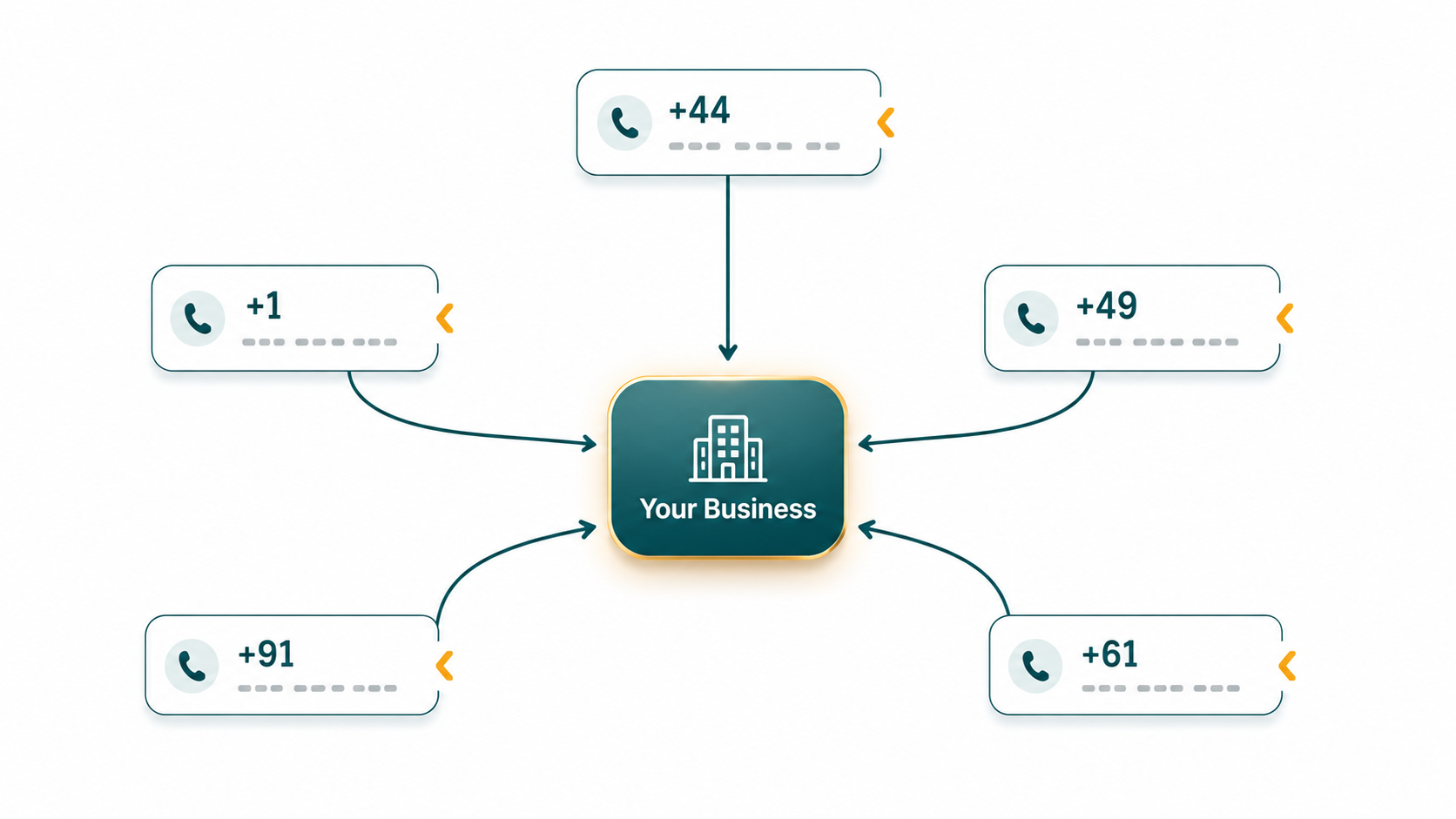
Examples: a UK number in E.164 is +44 followed by the national number; a German number is +49; a US number is +1. When you provision an international business number, you're provisioning a number with a specific country code — and often a specific city or area code within that country — regardless of where calls to it actually connect.
Understanding E.164 matters practically because it's how cloud phone systems and carrier networks represent numbers internally. When configuring outbound caller ID or routing rules, you'll encounter E.164 format in the platform interface.
Types of International Business Numbers
Local presence numbers
These are numbers with local area codes from a specific city or region within a foreign country. A business serving customers in Munich might provision a number with a Munich area code (+49 89 XXXXXXX) even though no one on the team is physically in Munich. To a caller, this looks exactly like a call to a local Munich business. Local presence numbers are the most common type used for international customer service and local market presence.
National numbers
Some countries have number types that work nationally rather than being tied to a specific geographic area. These look like a "national" number rather than a local city number — in some markets these are distinct number series. They signal national presence rather than local-city presence, which may be appropriate depending on how the business wants to be perceived in that market.
Country-specific toll-free numbers
Just as the US has 1-800 numbers, many countries have their own toll-free number ranges. A UK business toll-free might use the 0800 prefix; a German toll-free might use 0800 as well. If a business wants to appear local and cover inbound call costs for customers in a specific country, provisioning that country's toll-free number format is the approach. Note that international toll-free numbers are distinct from and more complex than domestic toll-free numbers — availability and regulatory requirements vary significantly by country.
DIDs in international context
A DID (Direct Inward Dialing) number is simply a full phone number that routes to a specific destination within a phone system. International business numbers are DIDs — they're provisioned in a foreign market's numbering plan and configured to route calls to wherever the business needs. See our guide on DID numbers for the underlying concept; the international layer adds geographic specificity and regulatory considerations on top of that baseline.
How Provisioning Works
Phone numbers in every country are administered by that country's telecommunications regulator and allocated through licensed local carriers. To provision a number with a German area code, for example, a provider needs a relationship with a German carrier that has been allocated that number range by the Bundesnetzagentur (Germany's telecoms regulator).
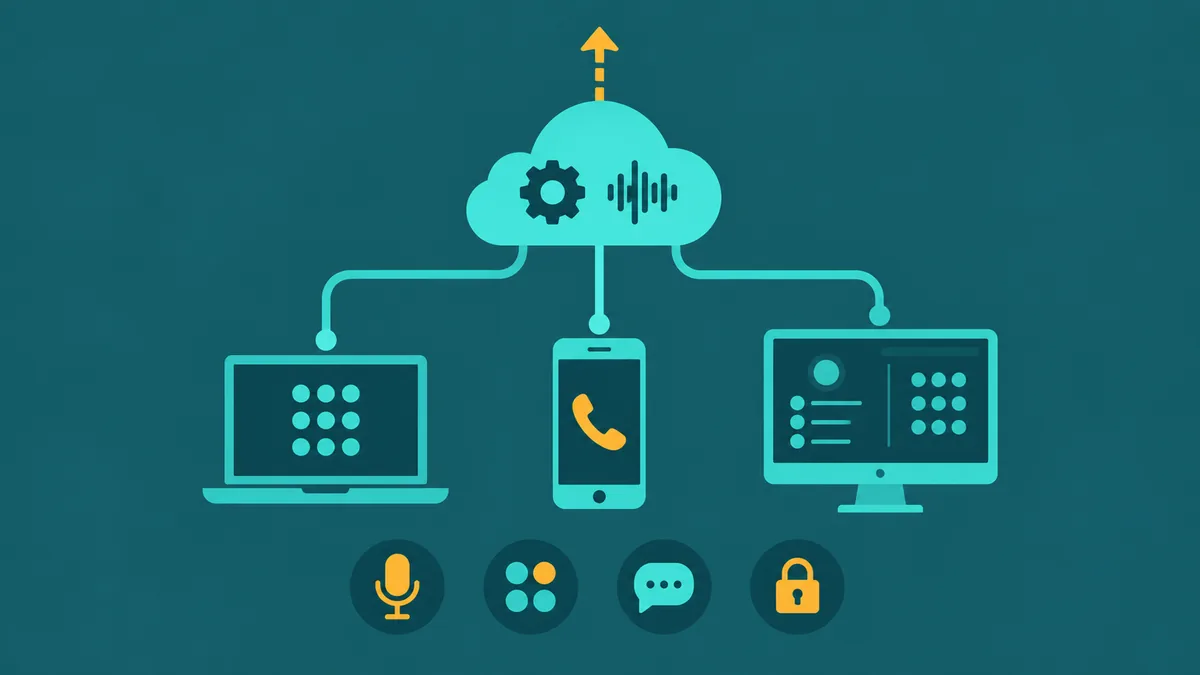
Cloud phone system providers who offer international numbers maintain carrier relationships across multiple countries. When your business provisions a number in a given market through such a provider, you're accessing that carrier relationship — the provider handles the underlying carrier network work; your business configures routing and usage.
Regulatory and KYC requirements
This is where international numbers get more complex than domestic ones. Many countries impose regulatory requirements on who can provision a local phone number. These vary significantly:
- Address requirements: Some countries require a local address (a registered business address in the country) to provision a local number. The address may need to be verified with documentation.
- Business registration: Some markets require that the entity provisioning the number be registered as a legal business in that country, not merely a foreign company operating there.
- Identity verification (KYC): Know-Your-Customer requirements for number provisioning vary by country — some require only basic contact information; others require government-issued identity documentation, business registration certificates, or proof of local address.
- Permitted use restrictions: Some countries restrict what international businesses can do with local numbers — some number types are limited to voice-only, some cannot be used for outbound calling, some have restrictions on call recording.
A reputable cloud provider handling international numbers will manage regulatory compliance requirements on your behalf and inform you of what documentation is needed for each market. Working with a provider who understands local carrier compliance is not optional — it's how you avoid provisioning numbers that get suspended or terminated for regulatory non-compliance after you've published them to customers.
How Inbound Routing Works
When a customer in Germany dials your Munich local presence number, the call travels through the German public telephone network, reaches the carrier holding that number range, and is then routed via SIP to the cloud provider's infrastructure. From there, it routes according to your configuration — to a specific agent, a call queue, an IVR, or a team in whatever location is handling that market's calls.
The caller experiences this as a normal local call. They don't see or experience the routing path through the cloud infrastructure. From your team's side, the call arrives in their softphone or IP phone exactly like any other inbound call, with the caller's number visible and potentially with context about which market number they called (useful for routing to language-appropriate agents or market-specific queues).
This routing architecture means your Germany-facing team can be located anywhere — another country, a home office, a distributed group across multiple time zones. The phone number's geography is independent of the agent's geography.
Outbound Caller ID: Displaying a Local Number
Inbound routing is only half the picture. When your team makes outbound calls to customers in a foreign market, the number displayed to the recipient matters equally. A recipient in Germany who sees an unfamiliar international number (+1 for US, for example) is less likely to answer than one who sees a familiar German number.
Cloud phone systems allow you to set the outbound caller ID to your provisioned local number for a given market. When an agent calls a German customer, the caller ID shows your Munich local number (+49 89 XXXXXXX) rather than the agent's home country number. This increases answer rates for outbound sales and follow-up calls.
Important caveat: carrier networks in some countries verify that the outbound caller ID matches a number the caller is authorized to present. Presenting a number you don't legitimately hold can result in calls being blocked. Provisioning the number through a provider who holds it legitimately is what authorizes you to present it as caller ID.
Use Cases
International customer support
A business with customers in multiple countries publishes local numbers for each market — customers call a familiar local number, costs are predictable for both parties, and the call routes to the appropriate team. This is operationally much cleaner than asking customers to call an international number.
Local market presence without a physical office
A US-based software company selling into the UK market publishes a UK local number on its website and sales materials. UK prospects see a familiar number, are more likely to call, and receive the implicit signal that the company has UK presence. The calls route to the US-based sales team during overlapping hours.
International sales teams
Outbound sales teams calling into foreign markets provision local numbers in those markets and use them as their caller ID. Answer rates are higher when recipients see a local number versus an international number.
Remote teams across multiple countries
A distributed team with employees in multiple countries all connects to the same cloud phone system. Each team member presents their local market's number for their respective calls. The phone system unifies them while maintaining geographic-appropriate caller ID per market.
EaseDial Business Phone
Business numbers across supported markets — managed from the same admin console as the rest of your phone system.
Limitations to Understand
Emergency calling
Emergency calling support for virtual and cloud-routed numbers varies by service, country, number type, and configuration. Virtual international numbers generally do not carry the physical location data that emergency call routing requires in most countries. Before deploying international virtual numbers for any team members who may need to reach emergency services, verify emergency calling capabilities and limitations with your provider for the specific country and service configuration involved.
Not every number type is available in every country
Number availability varies by market. Some countries have heavily restricted number pools; some number types (geographic local numbers with specific area codes) may have limited availability or may require documentation your business cannot easily provide; some markets may not be served by your provider at all. Confirm availability in your specific target markets before building it into your communications strategy.
Regulatory complexity accumulates across markets
Each country you add introduces its own regulatory requirements. A business operating numbers in five countries manages five sets of compliance obligations — documentation requirements, renewal processes, acceptable-use rules. Working with a provider who handles local carrier compliance on your behalf is important for managing this complexity, but it's still something to plan for, not ignore.
Frequently Asked Questions
Use our free DID Number Cost Estimator to estimate monthly costs for international DIDs by type and compare against VoIP benchmarks — no email required.