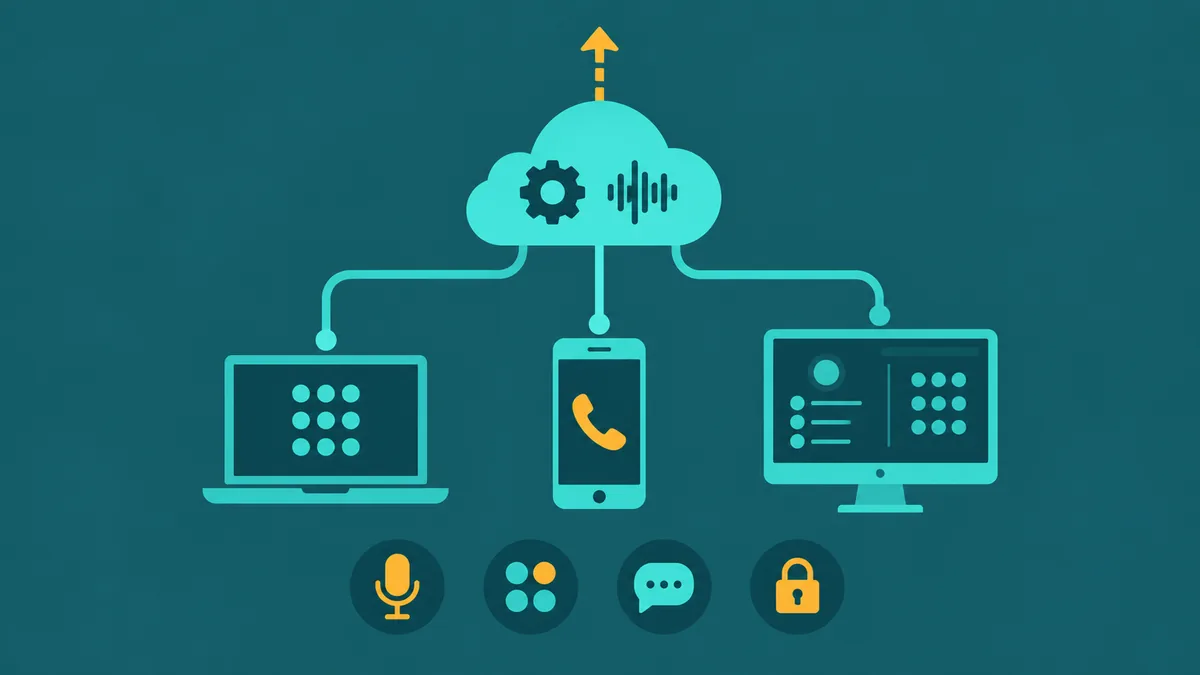
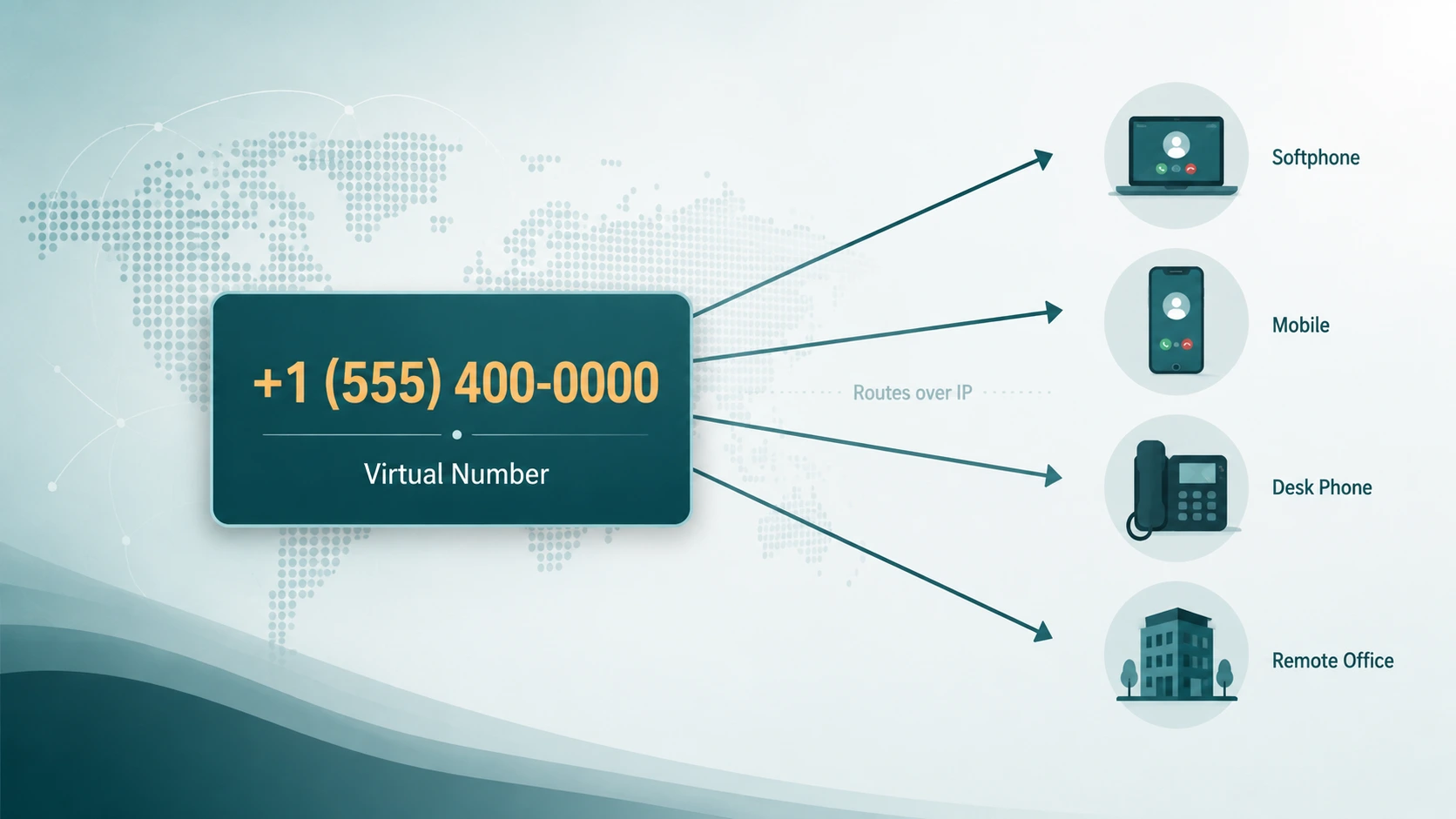
A virtual phone number behaves exactly like a regular phone number from a caller's perspective: they dial it, it rings, someone answers. What makes it virtual is what happens between those two moments. No physical line. No fixed geographic location. No piece of copper running from a central office to a specific building. The number exists as a routing entry in a carrier's system, and calls can follow it to anywhere you configure.
Definition: A virtual phone number is a telephone number that is not tied to a physical telephone line or a fixed location. Calls are routed to it through carrier infrastructure and then forwarded over VoIP (Voice over IP) to a destination you configure — a cloud phone system, a mobile app, a VoIP device, or a team of agents. The caller sees the virtual number on caller ID; the actual call path is internet-based.
How a virtual phone number works technically
The technical sequence is straightforward once you understand the two segments a call travels through.
Segment one: PSTN to carrier. A caller dials the virtual number from any phone — mobile, landline, or VoIP. The call travels through the public switched telephone network (PSTN) exactly as any call would, routing through the caller's carrier to the number's assigned carrier. At that point, the carrier's routing table identifies the number as a virtual number and passes the call to its configured destination.
Segment two: carrier to destination. Instead of delivering the call to a physical line at a fixed address, the carrier forwards it over SIP (Session Initiation Protocol) to the VoIP platform or cloud phone system where the number is hosted. That platform applies its own routing rules — ring a specific user, send to a queue, play an IVR menu — and delivers the call to whatever device is registered: a desktop app, a mobile app, or an IP phone.
Throughout this process, the caller's phone shows the virtual number as the destination they dialed. From the receiver's side, outbound calls placed through the same platform show the virtual number as caller ID — not a personal mobile number or a data center's IP address. The number is real and functions identically to a traditional number from every external perspective; what's "virtual" is the absence of a physical line at a fixed location.
Types of virtual phone numbers
Local virtual numbers
A local virtual number has a geographic area code — a 212 number for New York, a 312 for Chicago, a 020 for London — without requiring a physical office in that area. Callers see a familiar local number, which increases answer rates and creates the impression of local presence. Businesses use local virtual numbers to appear regional across multiple markets simultaneously, with calls from each number routing to the same team regardless of where individual agents are located.
Toll-free virtual numbers
Toll-free numbers (800, 833, 844, 855, 866, 877, and 888 prefixes in the US) shift the cost of the call from the caller to the business. They are inherently virtual — toll-free numbers have always been routing entries rather than fixed line assignments. Businesses use them for customer service lines, support queues, and main business numbers where free calling for the customer matters. Toll-free numbers are portable and can route to any VoIP destination.
International virtual numbers
An international virtual number gives your business a local phone number in another country without a physical office there. A US-based company can provision a UK number with a +44 country code, a German number with a +49 code, or numbers in dozens of other countries, with calls routing back to the same team. For businesses serving international customers, this avoids the barrier of customers facing international calling rates and improves answer rates. Provisioning typically takes minutes through a cloud phone provider rather than requiring a foreign business entity or local carrier contract — our guide to international business phone numbers covers the regulatory and KYC requirements that vary by country.
Vanity numbers
Vanity numbers spell a word or phrase on the phone keypad — 1-800-FLOWERS is the classic example. They are a specific type of toll-free number chosen for memorability in advertising. Like all toll-free numbers, they are virtual by nature: the digits map to a routing destination, not a physical line.
DID numbers (Direct Inward Dial)
A DID (Direct Inward Dial) number is a phone number that routes directly to a specific destination inside a business phone system — a particular user's extension, a specific queue, or a department — without going through a main number and IVR menu. Every user in a cloud phone system can have a DID that dials them directly. DIDs are virtual by definition: they are routing table entries that terminate on a VoIP extension rather than a physical line. The article on what a DID number is explains how DIDs work and how they differ from extensions and main numbers.
Phone number vs. DID vs. extension: the three clearly explained
These three terms are frequently confused in business phone documentation. They refer to distinct things.
Phone number is the public-facing identifier in the PSTN — the digits a caller outside your organization dials to reach you. It has a country code, an area code or prefix, and a subscriber number. Everyone with a phone can dial it. Your main business number and any individual user's direct number are phone numbers.
DID (Direct Inward Dial) is the specific mapping of a phone number to a routing destination inside a phone system. When a call arrives at a DID, the system uses that number's configuration to determine where the call goes — extension 101, queue B, IVR menu C. The DID is what makes a publicly dialable number point to a specific internal destination rather than the main line. Not all phone numbers assigned to a business are DIDs; the main number that reaches the IVR is a phone number but not necessarily a DID. Individual user numbers that bypass the IVR and ring the user directly are DIDs.
Extension is an internal shortcode — typically two to four digits — that identifies a user or group within the phone system. Extensions exist only inside the system. Someone calling from outside your organization cannot dial an extension directly; they need a phone number or DID that routes to it. Internally, agents use extensions to transfer calls to each other. The extension is the internal identity; the DID (if provisioned) is the external address that reaches it.
Why businesses use virtual phone numbers
Local presence without physical offices
A business with its team in one city can answer calls from a New York number, a Los Angeles number, and a Chicago number simultaneously — routing all three to the same agents. Local caller ID improves answer rates for outbound calls and reduces friction for inbound callers who prefer local numbers. This is particularly valuable for sales teams calling into new markets and for businesses expanding into new regions before establishing a physical presence.
Separate business identity from personal mobile
Employees who previously gave out their personal mobile numbers for business calls create problems when they leave: clients have a number that follows the person, not the company. Virtual business numbers stay with the organization. Employees install a mobile app, make and receive business calls showing the business number, and never expose their personal number to customers.
Call routing flexibility
A virtual number isn't locked to a single device. Calls to one number can ring multiple devices simultaneously (Ring All), distribute across a team in Round Robin order, or route to a queue that feeds agents based on availability. Business hours rules send calls to voicemail after hours. Routing rules can be changed in an admin portal in seconds without hardware reconfiguration.
Scale without physical installation
Adding a number in a traditional phone system required a carrier to provision a physical line, which took days and cost setup fees. Virtual numbers provision in seconds through an online portal. Removing them is equally instant. Businesses that scale seasonally — retailers during the holidays, tax services in Q1 — can add numbers and routing capacity during peak periods and remove them afterward.
Business continuity
A traditional phone number tied to a physical line at a specific office goes dark if that office has a power outage, a flood, or any other physical disruption. A virtual number keeps ringing to wherever it's configured — a different location, a mobile failover number, or a voicemail that continues to accept messages. The number follows the business, not the building.
International reach without foreign offices
International virtual numbers let a business accept calls from customers in other countries at local call rates for those customers, without establishing a foreign legal entity, signing a local carrier contract, or staffing a local office. Calls route internationally over VoIP to the same agents or platform handling all other calls.
Call routing with virtual numbers
The routing flexibility is where virtual numbers differ most meaningfully from traditional phone lines. A virtual number in a cloud phone system can be configured to:
- Ring a single user's device (desktop app, mobile app, or IP phone)
- Ring a ring group simultaneously (Ring All — whoever picks up first takes the call)
- Ring a ring group in sequence (Linear — first agent, then second, then third)
- Distribute calls across agents in Round Robin order to balance load evenly
- Route to a call queue with hold music and position announcements
- Play an IVR menu and route based on caller input
- Apply different rules based on time of day, day of week, or holiday schedule
- Forward to an external number (a mobile, a partner's line, an answering service)
These rules can stack. A virtual number might play an IVR during business hours, route after-hours calls to voicemail on weekdays, and forward to a mobile fallback on weekends. Changing any of these rules takes seconds in a web portal.
SMS and virtual numbers
Most virtual phone numbers provisioned through cloud phone systems support two-way SMS and MMS, not just voice calls. Agents can send and receive text messages from the same number that handles voice, with message history stored centrally rather than on individual mobile devices.
Business SMS in the US requires 10DLC (10-digit long code) registration with carriers — a process that verifies the business identity and use case to reduce spam. Most cloud phone providers handle registration during onboarding. Once registered, the number can send and receive SMS at scale without risk of carrier filtering.
Toll-free numbers can also be SMS-enabled, though toll-free SMS has a separate registration pathway (Toll-Free Verification). Shortcodes (5- or 6-digit numbers used for high-volume messaging campaigns) are a different category and are not virtual numbers in the standard sense.
Number porting: bringing your existing number to VoIP
Number porting is the process of transferring an existing phone number from one carrier to another — in this case, from a traditional carrier to a VoIP provider. In the US, porting is a right protected by FCC regulations: any carrier must release your number when you request it. The process requires a Letter of Authorization (LOA) signed by the account holder and account verification with the current carrier.
Timeline is typically 7 to 14 business days after the current carrier accepts the porting request, though some number types and carriers run faster. During the porting window, the number continues to work on the old system. At the moment the port completes, calls begin routing through the new VoIP system.
Porting matters because your business phone number carries years of customer recognition, marketing investment, and printed collateral. Switching to a VoIP provider doesn't mean getting a new number — you bring your existing number with you and keep it as a virtual number on the new platform.
Virtual number vs. traditional landline vs. mobile
| Factor | Virtual number | Traditional landline | Mobile number |
|---|---|---|---|
| Physical line | None required | Required; tied to address | SIM card; tied to device |
| Location dependency | None; routes to any device anywhere | Fixed address; rings only at that location | Follows SIM; one device |
| Call routing | Fully configurable; IVR, queues, ring groups | Basic call forwarding only | Rings one device; basic voicemail |
| Provisioning | Instant via online portal | Days to weeks; physical installation | Minutes; SIM activation |
| Business continuity | Number survives any physical outage; re-routes | Goes down if building loses power or line fails | Survives device loss if SIM is transferred |
| Multi-user | Multiple agents share one number; full routing | One line; manual rollover needed | One person per number |
EaseDial
Local, toll-free, and international numbers — provision instantly, route to any device or team
Limitations to know about
Virtual numbers work well for most business calling scenarios. There are a few areas where you should understand the constraints.
Call quality depends on internet and VoIP infrastructure. Because calls travel over IP after the PSTN handoff, audio quality depends on the quality of the VoIP path — latency, jitter, and packet loss on the network between the cloud platform and the agent's device. Poor Wi-Fi, an overloaded network, or a slow internet connection at the agent's location produces choppy audio. This is a solvable network configuration problem, not an inherent flaw in virtual numbers, but it's a real dependency that traditional landlines don't have.
Emergency services (E911) require address registration. Unlike a landline, which has a fixed address the carrier knows, a virtual number can ring anywhere. Cloud phone systems require users to register their physical address for E911 purposes so that emergency services route to the right location. Remote employees need to update their registered address when working from a different location. Reputable providers walk through E911 setup during onboarding; it should not be an afterthought.
Some services block virtual numbers for 2FA. Banks, social media platforms, and some online services use phone number verification (SMS one-time passwords) and may reject virtual or VoIP numbers because they're harder to tie to a verified identity. This matters for personal account verification more than business calling. If you need a number specifically for 2FA purposes on a consumer platform, a standard mobile number may be required.
Caller ID display varies by carrier. Most carriers pass the virtual number as caller ID on outbound calls, but display behavior can vary when calls route through multiple carrier interconnections. For regulated industries requiring specific caller ID presentation, confirm with your provider how outbound caller ID is handled across different destination carriers.
Getting a virtual number with EaseDial
EaseDial provides local, toll-free, and international virtual numbers that provision instantly through the admin portal. Numbers route to any combination of devices, extensions, ring groups, queues, or IVR menus — configuration changes take effect immediately without carrier lead times. Existing numbers can be ported in; the team handles the LOA process and coordinates with the releasing carrier.
Numbers on EaseDial support both voice and SMS/MMS, with 10DLC registration handled through the onboarding process. International numbers are available for businesses that need local presence in specific markets. For context on how virtual numbers fit into a broader business phone system, see the business phone system guide. For the cloud infrastructure that virtual numbers run on, see the cloud phone system overview. For how virtual numbers connect to the carrier layer at scale, see the wholesale VoIP guide.