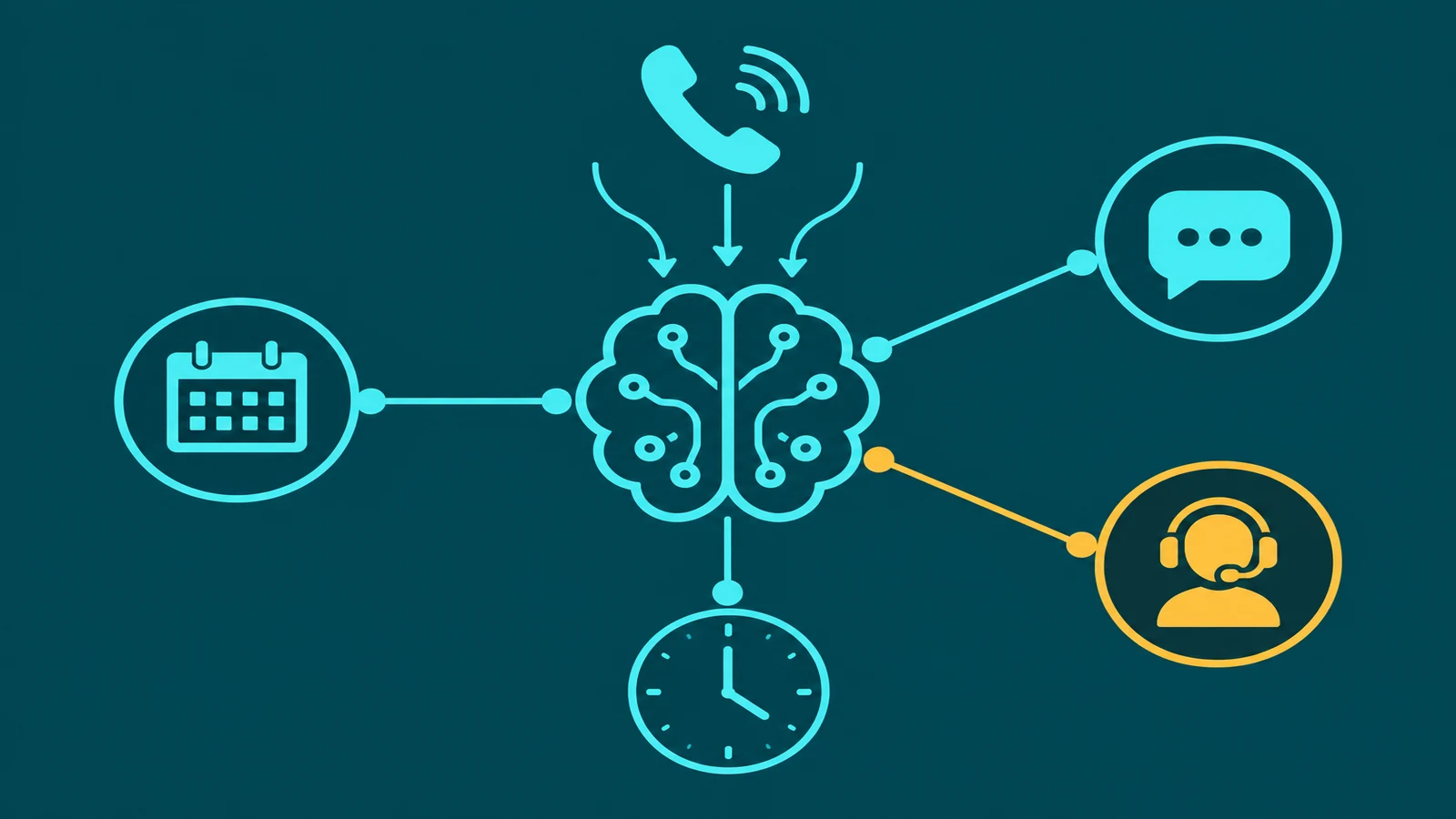
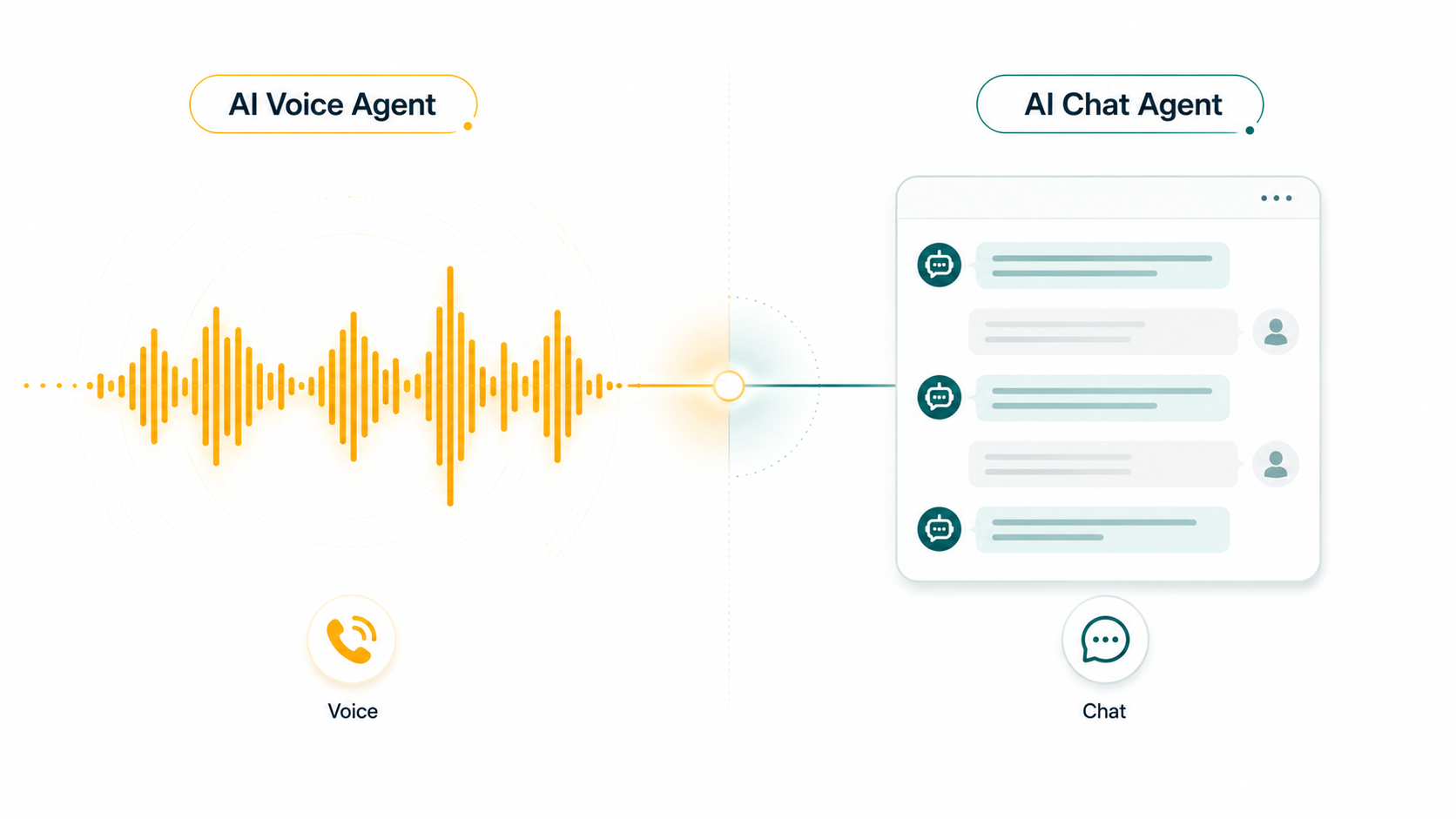
AI voice agents and AI chat agents share more in common than most comparisons suggest. Both use large language models to understand intent. Both retrieve answers from knowledge bases. Both escalate to humans when the conversation exceeds their scope. Both produce transcripts and can generate AI summaries.
What separates them is the communication channel — and that difference cascades into a set of technical constraints, user experience implications, and use-case fit that genuinely matters when deciding which to deploy. This article focuses on that comparison: not on redefining what each system is (that is covered in what is an AI voice agent and what is an AI chat agent), but on the dimensions where the two diverge meaningfully.
In short: An AI voice agent operates over phone calls using speech recognition and text-to-speech. An AI chat agent operates over text-based channels using typed input and written responses. Both use LLMs for understanding and knowledge bases for grounding — but voice requires near-instantaneous response times and adds complexity around audio quality, speech recognition, and real-time audio streaming that text channels do not face.
The Communication Channel Shapes Everything
The most consequential difference between voice and chat AI is not the intelligence layer — both use similar LLMs and knowledge base techniques — it is the channel. Phone calls are synchronous, time-sensitive, and unforgiving of delay. Text conversations are asynchronous by nature, tolerant of varied response times, and allow both parties to re-read, correct, and compose carefully.
This single difference — channel — produces a cascade of technical requirements, user experience constraints, and deployment considerations that separate these two technologies in practice, even when the underlying AI is similar.
Latency: The Central Voice Constraint
In a phone conversation, a response delay of more than 800–1,000 milliseconds feels like a pause. Callers wonder whether the call dropped. A delay of 1,500 milliseconds or more feels like a malfunction. For an AI voice agent, the entire round trip — from the moment the caller stops speaking to the moment they hear the AI start responding — must fit within this window. That means speech recognition, LLM processing, and text-to-speech audio generation all happen in sequence within roughly one second.
This is a genuine engineering constraint, not a minor detail. Every component in the pipeline — the speed of the speech-to-text engine, the time-to-first-token of the language model, the latency of the text-to-speech engine — contributes to the total delay. Platforms optimize specifically for this: streaming STT that returns partial transcripts before the caller finishes speaking, LLMs configured for low time-to-first-token, TTS engines that begin synthesizing audio from the first sentence while the rest is still being generated.
For an AI chat agent, latency constraints are much looser. A two-second response time in a chat conversation is unremarkable. Users type their message, send it, and wait while reading something else or doing something else. This allows the AI more time to process the query, retrieve from the knowledge base, and compose a thorough response. It also allows the AI to produce longer, more structured text responses — formatting that would be inappropriate in a phone conversation where the caller cannot see text.
Input Processing: Speech vs. Text
AI voice agents must convert spoken audio to text before they can process it — a step called automatic speech recognition (ASR). This introduces variables that do not exist in chat: microphone quality, background noise, speaker accent, speech rate, overlapping speech, and the specific vocabulary the speaker uses. ASR accuracy varies across all of these dimensions. An agent that performs well in a quiet office environment on standard accents may struggle with callers in noisy environments or speakers with accents underrepresented in the ASR model's training data.
Additionally, spoken language behaves differently from written language. Callers use contractions, pause mid-sentence, say "um," reformulate their phrasing, and may interrupt themselves. The AI voice agent's system must detect when the caller has finished speaking, finalize the transcription correctly, and begin processing — all while managing the possibility that the caller may continue talking while the AI is already generating a response.
AI chat agents receive clean text input. There is no speech recognition step, no audio quality dependency, and no end-of-turn detection challenge. Users compose their message, make corrections before sending, and submit it when they are ready. The AI receives a more precise, complete, and easily processed input than any voice system does.
Knowledge Retrieval: Both Use Knowledge Bases
This is an area where AI voice and AI chat agents are more similar than different. Both rely on a knowledge base — content provided by the business (PDFs, URLs, text) — to answer business-specific questions accurately rather than hallucinating from general training. When a caller asks about return policy on the phone or a website visitor asks the same question via chat, both AI systems perform the same retrieval step: search the knowledge base, retrieve the most relevant content, synthesize a grounded answer.
EaseDial's voice and chat AI agents both support knowledge base grounding. This means each channel can draw on the same policy documents, product FAQs, and pricing content — avoiding the need to maintain entirely separate content sets for each channel.
Conversation Length and Depth
Phone conversations have a natural pull toward brevity. Callers expect efficiency. Long explanations over the phone are hard to follow — the listener cannot scroll back, cannot re-read, and cannot pause to absorb information. AI voice agents are most effective when interactions are short and goal-directed: a few turns to capture intent and information, a routing decision or action, a handoff. Interactions that involve complex, multi-step explanations are better served by directing the caller to a resource or transferring to a human who can speak more expansively.
AI chat agents can support much longer, more complex conversations. Users can scroll back, copy information for later reference, absorb detailed explanations at their own pace, and ask precise follow-up questions. A complex technical support interaction — working through a multi-step troubleshooting process, for instance — is more naturally served by chat than by voice. The asynchronous nature of text also allows users to step away mid-conversation and return without losing context.
EaseDial AI
AI Voice Agent and AI Chat Agent on one platform, with knowledge base support on both channels and unified reporting.
Human Escalation: Similar Goal, Different Mechanics
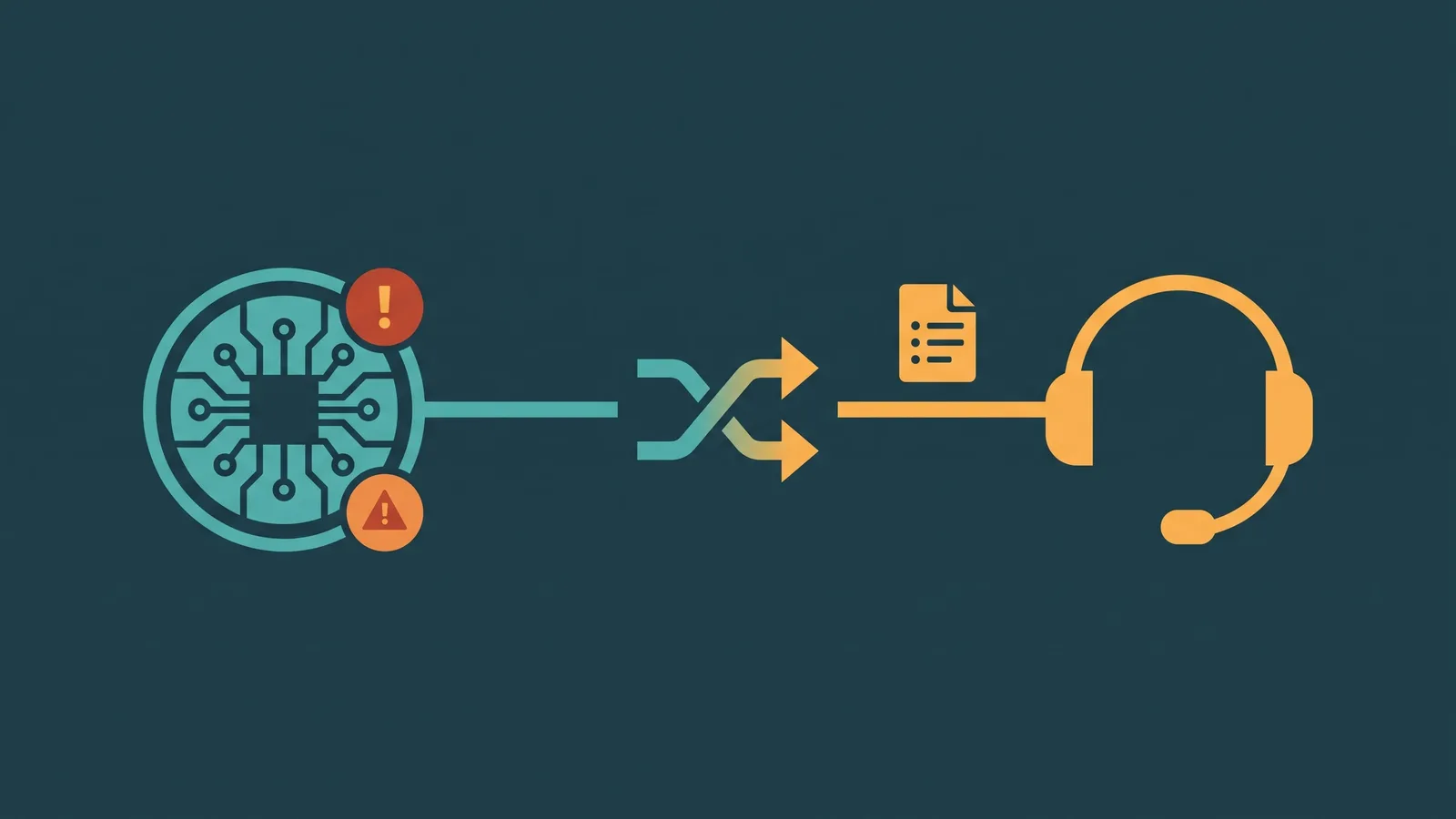
Both AI voice and AI chat agents escalate to humans when a conversation exceeds their scope. The goal is the same: get the customer to a qualified human without losing context. The mechanics are different.
For an AI voice agent, escalation is a call transfer. The AI initiates a warm transfer to a human agent, typically including a whispered summary briefing before the customer is bridged in. The human agent receives the caller with context but must handle the rest of the interaction live, in real time.
For an AI chat agent, escalation is a conversation handoff. The full transcript of the AI conversation passes to a human agent in the same inbox. The human sees everything that was discussed before they type their first response. There is less time pressure — the customer is waiting for a typed response, not holding on a live call — which gives the human agent more time to read the context and compose a thoughtful reply.
Chat-based escalation also allows a human agent to review the AI's responses before taking over, which can inform how they approach the conversation: if the AI already answered several questions correctly, the human can pick up from that point rather than covering the same ground.
Transcripts and AI Summaries
Both channel types produce conversation transcripts. For voice calls, a transcript is generated from the call audio — either in real time (live transcription) or from the recording (post-call transcription). For chat interactions, the text transcript is native — it is simply the conversation log.
In both cases, AI summaries can be generated automatically: a brief synthesis of what was discussed, what was resolved, what the customer's primary intent was, and what action was taken. These summaries are useful for coaching, quality review, CRM documentation, and follow-up — regardless of whether the interaction was voice or text.
Accessibility Considerations
The channel difference has accessibility implications worth noting. Voice interaction is more natural for users who have difficulty typing — elderly callers, callers with motor impairments, callers in situations where typing is impractical (driving, for example). Text interaction is more accessible for users who are deaf or hard of hearing, users who communicate better in writing than in speech, and users in environments where audio is not practical (a shared office, a quiet space where a phone call would be disruptive).
For businesses serving diverse customer populations, deploying both channels is more inclusive than choosing one. A customer who cannot use voice can use chat; a customer who cannot easily type can call. The interaction quality should be comparable across both.
Deployment Complexity
AI voice agents carry more deployment complexity than AI chat agents, primarily because of the telephony layer and the real-time audio processing requirements. Setting up an AI voice agent requires configuring a phone number (or porting an existing one), SIP trunking or VoIP connectivity, audio streaming infrastructure, and testing across a range of real-world audio conditions. Latency must be verified under production load — not just in demos.
AI chat agents have a simpler deployment path. Adding a chat widget to a website is a standard web integration. The AI does not need to process audio, manage real-time streaming, or detect end-of-turn signals. Configuration focuses on the knowledge base, scope, persona, and escalation rules — all of which are also required for voice, but without the audio infrastructure layer on top.
Direct Comparison
| Dimension | AI Voice Agent | AI Chat Agent |
|---|---|---|
| Channel | Phone (voice / audio) | Text (chat / messaging) |
| Response latency requirement | Sub-second (400–1,000 ms target) | Seconds acceptable; users not on hold |
| Input processing | Speech recognition (ASR) required | Native text — no ASR needed |
| Audio quality sensitivity | High — noise, accents, mic quality matter | None — text is channel-independent |
| Knowledge base use | Yes — RAG retrieval before response | Yes — RAG retrieval before response |
| Response format | Spoken — brief, linear, no formatting | Written — can be detailed, formatted, linkable |
| Context maintenance | Within the call | Within the session; potentially across sessions |
| Human escalation method | Warm or cold call transfer | Conversation handoff with full transcript |
| Transcripts | Generated from audio (STT) | Native — the conversation is the transcript |
| Accessibility | Better for users who cannot type | Better for users who are deaf or hard of hearing |
| Deployment complexity | Higher — telephony, audio infrastructure, latency testing | Lower — web integration, no audio layer |
| Best for | Inbound phone handling, brief goal-directed calls | Website support, complex multi-step queries, async triage |
Customer Preference by Context
Research on channel preference consistently shows that customer preference for voice vs. text depends on the nature of the interaction, not on a universal preference for one channel over the other.
Voice tends to be preferred for urgent issues, complex problems that are hard to articulate in writing, and emotionally sensitive situations where tone and immediate feedback matter. The phone call is still the default for many customers when they have a serious problem that they need resolved quickly.
Text tends to be preferred for non-urgent questions, situations where the customer wants a written record of the answer, interactions in environments where a phone call is impractical, and younger demographics who are generally more comfortable with text-based communication.
Neither channel universally dominates. Businesses that offer only one are creating friction for the customer population that prefers the other.
Choosing Between Them — or Deploying Both
For businesses deciding where to start, the channel where customer contacts are currently concentrated is usually the right first deployment. If the majority of your customer contacts come through your phone line, an AI voice agent addresses the highest-volume opportunity first. If your website chat is your primary support channel, an AI chat agent is the more immediate priority.
For businesses with volume across both channels, deploying both is the more complete solution. Customers who prefer phone get a consistent AI voice experience. Customers who prefer text get a consistent AI chat experience. Both channels can draw on the same business knowledge. Reporting is unified. The team sees all interactions in one place.
EaseDial provides both AI Voice Agent and AI Chat Agent on the same platform, with knowledge base support on both channels and unified conversation reporting — so businesses can manage both channels without building entirely separate systems.