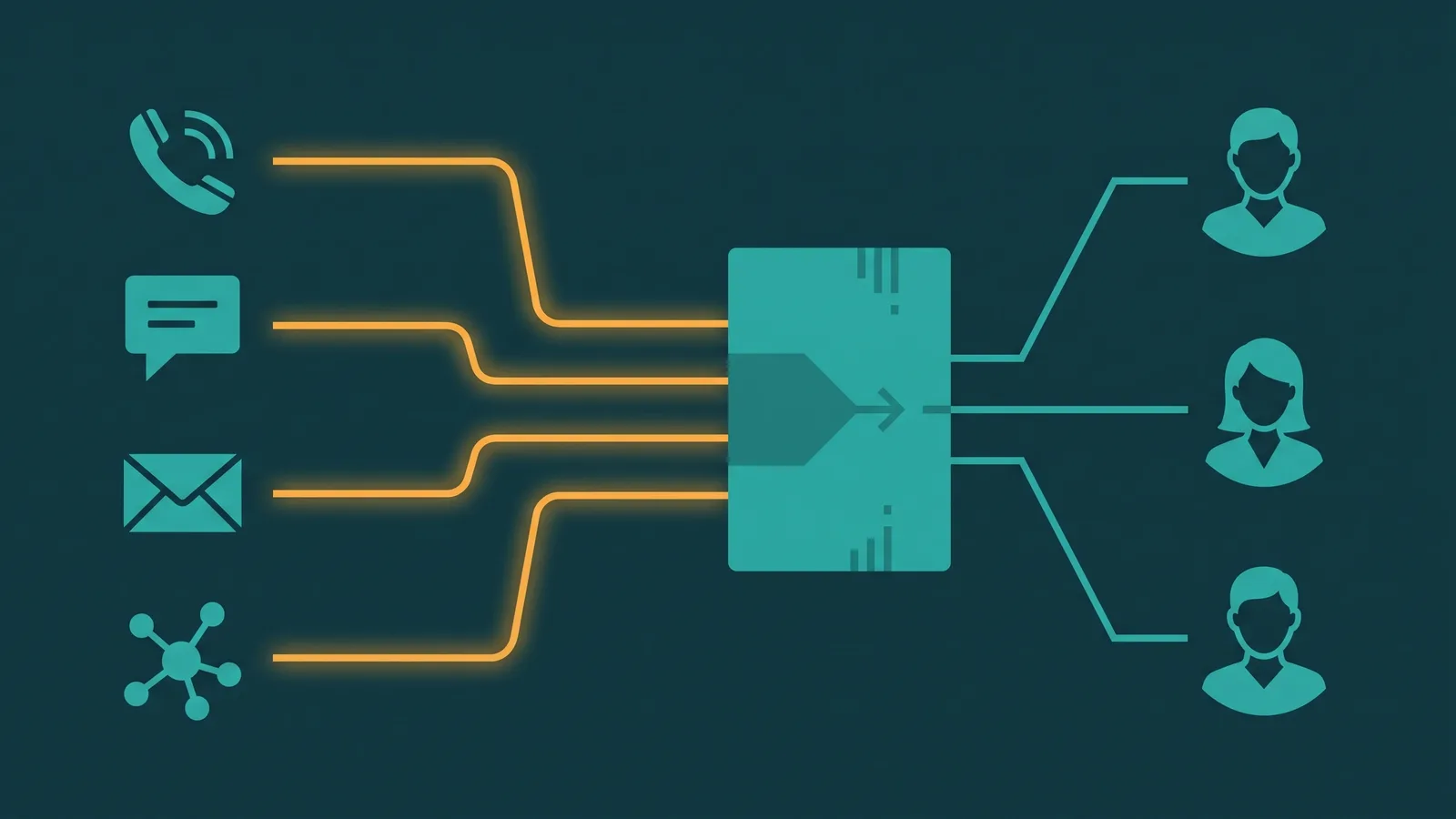
Most customers have felt the same friction at least once: they explained their problem to a chatbot, got transferred to a phone agent, and had to explain the whole thing again from the beginning. That experience is not just annoying. It is measurable. Research from SQM Group puts customer satisfaction at 67% for companies with consistent cross-channel service, compared with 28% for companies where channels operate in isolation.
That gap is the business case for omnichannel customer service. This guide explains what omnichannel actually means technically, how it differs from simply having multiple channels, how the underlying systems work, and what it takes to implement it without the common failure modes.
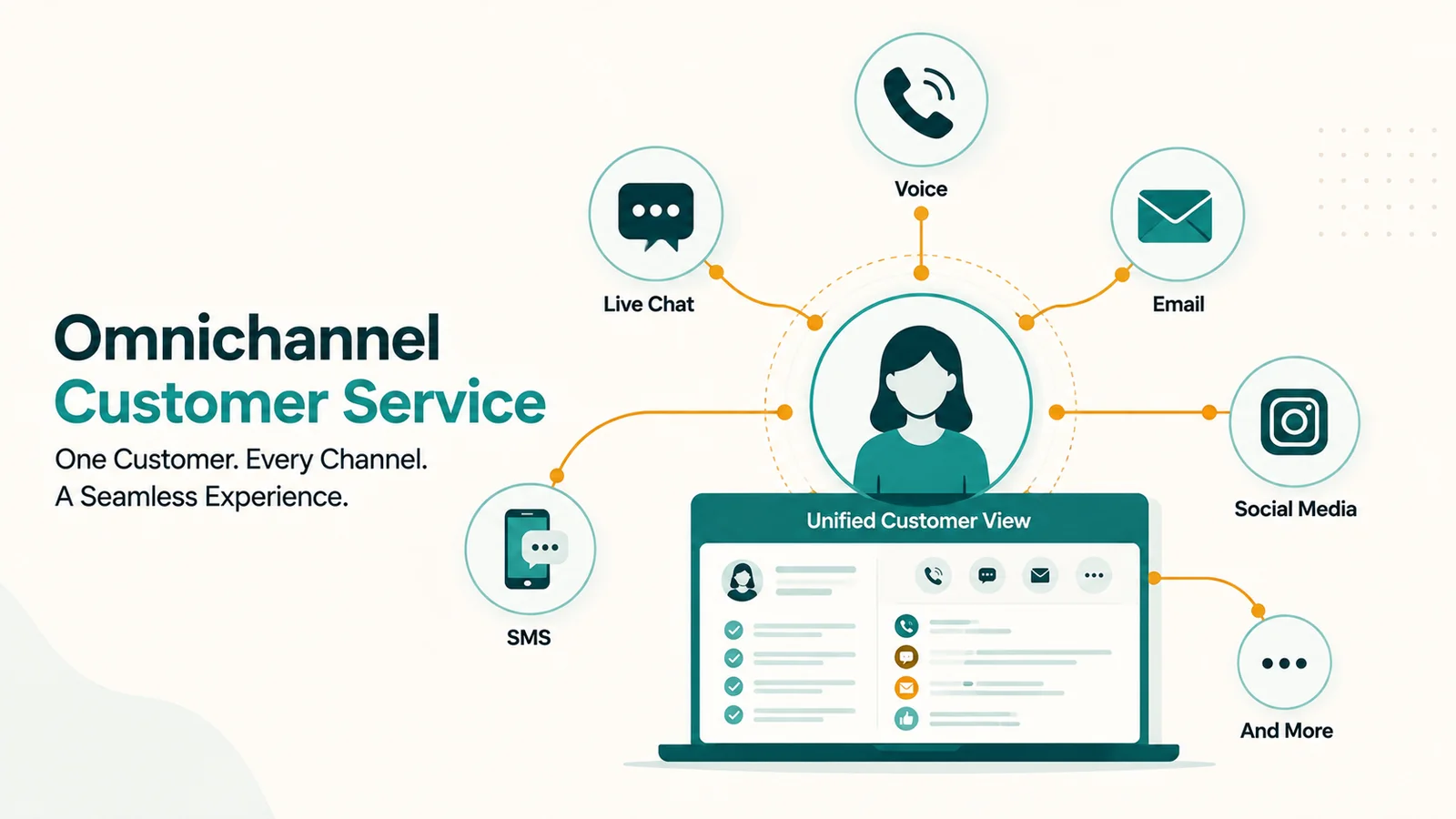
What is omnichannel customer service? Omnichannel customer service is a strategy in which every support channel a company uses — voice, email, chat, SMS, social media, WhatsApp, and messaging apps — is connected through a shared data system so that customer history and context travel from one channel to the next. Every agent, on any channel, sees the customer's full interaction history before the first word is exchanged. The defining characteristic is not channel breadth. It is data continuity.
Multichannel vs. Omnichannel: What Is the Actual Difference?
These two terms get used interchangeably, which causes real confusion. A business that offers phone, email, and chat is multichannel. But offering multiple channels says nothing about whether those channels share data. Most multichannel operations run siloed systems: the phone team sees call records, the email team sees tickets, the chat team sees transcripts — and none of them see each other's history. The customer is treated as a stranger every time they switch.
Omnichannel addresses the data layer, not the channel count. A company could technically be omnichannel with two channels if those two channels share a unified customer record. The question is not "how many channels do you have?" but "when a customer moves between channels, does their history move with them?" For a dedicated side-by-side comparison of these two models, see omnichannel vs multichannel customer service: what's the difference?
| Dimension | Multichannel | Omnichannel |
|---|---|---|
| Channel operation | Independent silos, separate systems per channel | All channels write to and read from a shared data layer |
| Customer experience | Start over on each channel — repeat your story every time | Context follows the customer across every channel switch |
| Agent view | History from their channel only | Full cross-channel timeline in a unified desktop |
| Routing logic | Separate queues per channel, no coordination | Unified routing engine across all channels simultaneously |
| Data architecture | Separate systems: ACD, ticketing, CRM not linked | Single CRM or CDP — all channels write back to it in real time |
| Focus | Channel coverage and availability | Continuity of the customer journey |
| Measurement | CSAT and metrics tracked per channel, in isolation | Metrics tracked per journey across all channels |
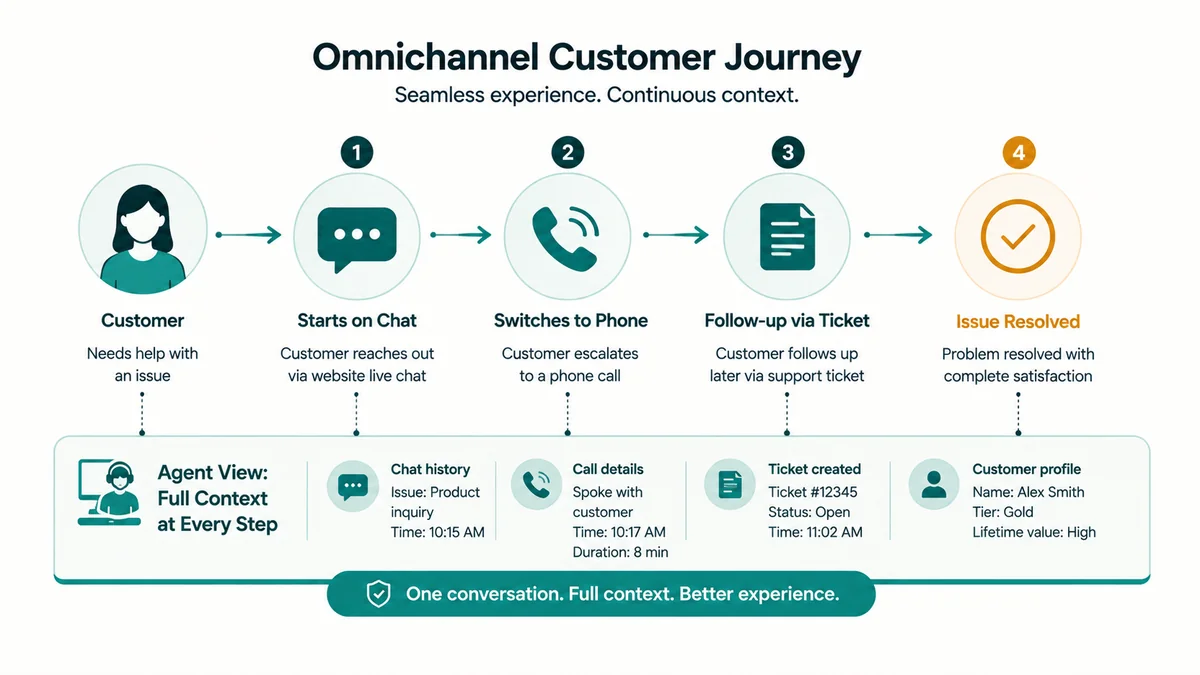
A concrete example: a bank where you can call, email, or open a web chat is multichannel. The same bank is omnichannel if the agent who answers your chat already knows you called yesterday about the same problem, sees the case notes from that call, and does not ask you to repeat your account number.
This distinction matters because many organizations believe they are omnichannel because they have many channels. Industry research consistently finds that a small minority of companies — estimates vary widely by methodology — actually carry customer context successfully across all their service channels.
How Omnichannel Customer Service Works
The technical architecture behind omnichannel has six stages. Understanding them helps explain both why real omnichannel is harder to build than it looks, and why the failure rate is high.
1. Channel intake
Every contact channel — voice, web chat, email, SMS, WhatsApp, social DM — has its own intake mechanism. Voice goes through an ACD (automatic call distributor). Chat comes through a widget API. Email arrives via an inbox or mail server. WhatsApp and SMS enter through carrier or platform APIs. All of these are distinct technical entry points.
2. Identity resolution
As soon as a contact arrives, the system tries to match the incoming signal (phone number, email address, cookie, customer ID) to an existing customer record in the CRM. This step is where most omnichannel implementations quietly fail. If the customer's phone number is not in the CRM, or if they used a different email address than the one on file, identity resolution fails and the context chain breaks. The matching key — usually phone number or email — must be consistent across all channels and accurately maintained in the CRM.
3. Intent and context enrichment
Once the customer is identified, the system retrieves their profile: interaction history, open cases, value tier, recent channel activity, any unresolved issues. Simultaneously, NLP (natural language processing) analyzes the incoming message or IVR input for intent — what the customer is trying to do — and sentiment signals. This enriched picture feeds into the routing decision.
4. Routing
The routing engine answers a single question: what should happen to this interaction right now? Options include: contain it in self-service, hand it to a virtual agent (bot), or assign it to a human agent with specific skills. For human routing, the engine weighs agent availability, skill match, current queue depth, and — in more advanced deployments — AI-predicted outcome scores that estimate which agent is most likely to resolve this specific customer's issue efficiently. See the call routing guide for a detailed breakdown of routing types.
5. Unified agent workspace
When the interaction reaches a human agent, everything is pre-loaded in a single desktop: the customer record from the CRM, the last three interactions across all channels, the current interaction's intent flag, and any AI-suggested responses or knowledge base articles. The agent does not need to open a separate CRM window, search for the customer, or ask what the issue is. This "screen pop" — typically delivered via Computer Telephony Integration (CTI) for voice, or equivalent for digital channels — is what makes the omnichannel experience visible to the customer.
6. Post-interaction write-back
After the interaction ends, the outcome (disposition code, resolution notes, CSAT prompt, AI-generated summary) writes back to the CRM in real time. The customer profile is updated for the next interaction, on any channel. This write-back is what makes the system progressively more complete over time, and it is also where many implementations have gaps — particularly in digital channels that do not have native CRM integrations.
Channels in an Omnichannel Strategy
Channel selection should follow where your customers actually contact you — not where it is most convenient for you to operate. That said, some channels have properties worth understanding before you include them.
| Channel | Best for | Key considerations | Compliance notes |
|---|---|---|---|
| Voice / Phone | Complex issues, high-emotion situations, senior customers | Highest cost per interaction; still preferred for complex resolution | PCI DSS for card capture; HIPAA for healthcare |
| Non-urgent issues, documentation, formal communication | Slow by nature; customer expectation is 24-hour response or less | Retention requirements vary by industry | |
| Web Chat | Real-time support during purchase or product use | High bot containment potential; needs clean escalation to human | GDPR consent for data collected in chat |
| SMS | Notifications, appointment reminders, quick confirmations | High open rate; limited rich media; TCPA consent required (US) | TCPA opt-in required; 10DLC registration for A2P |
| Global markets (LATAM, EMEA, South Asia); richer messaging | Per-message pricing; 24-hour conversation window resets on inactivity | Financial services must archive; Wall Street firms fined $2B+ for failures | |
| RCS | Rich media in native SMS app; verified sender branding | Apple iOS 18 support enabled mass adoption; 90% open rate within 15 min; business traffic grew 550% in 2024 (Infobip) | Carrier-level; GSMA compliance; message archiving evolving |
| Social (DMs) | Public-facing brand; complaint escalation; brand monitoring | 48% of customers expect response within 24 hours; often managed outside contact center | Platform terms vary; public visibility of complaints creates reputational risk |
RCS deserves specific attention as of 2025. Apple added native RCS support in iOS 18, removing the last major barrier to broad US adoption. Business RCS traffic grew 550% in 2024 (Infobip), and financial services is the vertical moving fastest — 49% of financial services firms in one Sinch survey are already using RCS for customer messaging. For customer service, RCS enables quick-reply buttons, verified sender badging, and rich media cards inside the native messaging app, without requiring customers to install anything.
Omnichannel Routing
Routing is the operational core of omnichannel. Get it wrong and you have channels that are unified in theory but chaotic in practice. There are four main routing approaches, and most mature deployments run at least two in combination.
Skills-based routing assigns interactions to agents whose skill set matches the interaction's requirements — language, product expertise, channel proficiency, or customer segment. This is the baseline. Every omnichannel deployment needs it.
Priority-based routing sequences the queue by customer tier, SLA urgency, or complaint severity. A high-value account or an escalated complaint jumps ahead of a routine inquiry from a new customer. Usually layered on top of skills-based routing.
Predictive (AI) routing uses machine learning models trained on historical outcome data to predict which specific agent is most likely to resolve a given customer's issue effectively. It goes beyond "who is available and has the right skill" to "who has historically produced the best outcome for customers like this one, with this type of issue, on this channel." Genesys, NICE CXone, and Zendesk all offer this as an overlay on their routing engines.
Behavioral routing attempts to match customers to agents based on inferred communication style or personality type. The technology exists but widespread enterprise deployment is still early, and the explainability of routing decisions becomes a governance concern when algorithms are opaque.
One under-appreciated aspect of routing governance: when an AI model makes a routing decision, a supervisor should be able to understand why. "The system routed this call here" is not acceptable for compliance teams in financial services or healthcare. Predictive routing is powerful, but the explainability requirement is real.
EaseDial Contact Center
Skills-based, priority, and AI routing across every channel — in one workspace
CRM Integration: What It Actually Requires
Omnichannel without CRM integration is just multi-tab. The agent might see the chat, the phone queue, and the email inbox in one place, but if the customer record is still in a separate window that the agent manually switches to, the experience has the same friction as a siloed setup. True CRM integration has four specific requirements.
Real-time record retrieval. When an interaction arrives, the routing engine queries the CRM (via REST API) and retrieves the customer profile before the agent is assigned. This must happen in milliseconds — the customer should not be waiting while the system looks them up after connection.
Bi-directional synchronization. Not just pulling data from the CRM, but writing back to it. Every interaction outcome — chat transcript, call summary, resolution code, CSAT score — must write back to the CRM record immediately so the next agent on any channel sees current state.
Unified customer ID. All channels must resolve to the same customer record. This sounds obvious, but it breaks down constantly in practice. A customer who contacts via work email and personal mobile number needs to have both linked to the same CRM record. Identity resolution logic must handle these cases, or context chains break silently.
CTI screen pop for voice. For phone interactions, Computer Telephony Integration (CTI) sends the CRM record to the agent's screen at the moment the call connects — before the agent says hello. Most major CRMs (Salesforce, HubSpot, ServiceNow) have native CTI connectors for common CCaaS platforms. Verify these are bidirectional, not read-only.
The three most common CRM integration patterns are: (1) a unified CCaaS platform like Genesys or NICE that natively integrates with Salesforce or ServiceNow via a connector; (2) a CRM-anchored approach like Salesforce Service Cloud, which uses Amazon Connect for telephony and treats the CRM as the system of record for all channels; and (3) a composable/API-first approach using programmable communications (Twilio, Amazon Connect standalone) with custom integration development.
Measuring Omnichannel Customer Service
The biggest mistake in omnichannel measurement is tracking metrics per channel rather than per journey. A customer who rates their chat interaction 5/5 but has to call back the next day because the issue was not resolved is a failed journey that looks like a successful chat interaction in per-channel reports.
The metrics that matter most in an omnichannel operation:
| Metric | What it measures | Why it matters for omnichannel |
|---|---|---|
| CSAT per journey | Customer satisfaction across the complete interaction sequence, not just one channel | Per-channel CSAT misses the journey failure pattern |
| First-contact resolution (FCR) | Percentage of issues resolved without repeat contact on any channel | "Resolved on first call" ignores channel switching; must be cross-channel |
| Repeat contact rate | How often the same customer contacts again about the same issue within a window (e.g., 7 days) | Directly signals resolution quality; best lagging indicator of omnichannel effectiveness |
| Channel switch rate | How often customers move from one channel to another before resolution | High rate signals friction or inadequate self-service on primary channel |
| Average handle time (AHT) by channel | Mean time to handle an interaction, per channel | Compares agent efficiency across channels; high AHT on context-rich interactions may indicate knowledge gaps, not routing problems |
| Customer Effort Score (CES) | How much effort the customer expended to resolve their issue | Effort is what omnichannel reduces; CES is its most direct proxy |
| Containment rate | Percentage of interactions handled by self-service or bot without agent transfer | Must be measured alongside CSAT — high containment with low CSAT means forcing customers into self-service they cannot complete |
| Cross-channel journey completion | Percentage of multi-channel journeys that reach resolution without abandonment | Most advanced metric; requires journey analytics, not basic contact center reporting |
Implementing cross-channel journey analytics requires a platform that tracks customer interactions at the journey level, not just the contact level. Most basic contact center reporting does not do this natively. For a full treatment of what to measure and how to build an analytics framework, see the guide to contact center analytics and KPIs.
Business Benefits of Omnichannel
The business case for omnichannel is well-documented across multiple research sources. A few numbers worth knowing:
- McKinsey research puts the revenue impact of strong omnichannel programs at 5–15% of total revenue.
- Forrester attributes a 46% rise in customer lifetime value and a 35% increase in loyalty to high-quality omnichannel engagement.
- Zendesk data from 2025 shows a 31% reduction in first-resolution times and a 39% decrease in customer wait times in omnichannel deployments versus siloed ones.
- McKinsey also puts the cost reduction effect at 3–7% of service delivery costs — primarily from lower repeat contact rates and more efficient routing.
- Harvard Business Review's study of 46,000 shoppers found omnichannel customers spend 10% more online and 30% more in-store than single-channel customers.
- 78% of consumers expect consistent interactions across all channels when contacting a company (Salesforce State of the Connected Customer, 2024).
One frequently cited retention figure — that companies with strong omnichannel programs retain around 89% of customers compared with 33% for companies with weak cross-channel engagement — comes from Aberdeen Group research. This figure is widely repeated but the original study's methodology is opaque and some versions report 77% rather than 89%. Treat it as directional, not precise.
Implementation Challenges
Omnichannel is not a software purchase. It is an organizational and architectural undertaking that most companies underestimate. The most honest framing: average enterprise deployments take 6 to 18 months, with complex multi-system environments sometimes running longer.
The data problem
Fragmented data is the single most common reason omnichannel implementations fail. Fifty-four percent of organizations cite fragmented data as their biggest barrier to using customer information effectively. If your CRM records are incomplete, duplicated, or inconsistently maintained across systems, omnichannel routing and context passing will fail silently — agents will get screen pops with wrong or missing data, and customers will still repeat themselves. Fixing data quality before adding channels is not optional.
Legacy system integration
On-premise ACDs, mainframe CRMs, and siloed telephony systems cannot share data in real time without middleware or replacement. The API-based integration required to connect a legacy ACD to a modern CRM is expensive and fragile. Many mid-market organizations face a choice between replacing the legacy system or building custom middleware that becomes a maintenance liability.
Organizational alignment
Channel ownership is a political problem as much as a technical one. Social media is typically owned by marketing. Email might be in customer service. Phone is in the contact center. Each team tracks its own metrics and optimizes for its own channel. Omnichannel requires cross-functional ownership of the customer journey — including agreement on which metrics matter, who is accountable for cross-channel outcomes, and how routing decisions are made. This alignment takes longer than the technical work in most organizations.
Agent training
Agents transitioning to a unified multi-channel workspace need training on more than the new software. They need protocols for multi-channel triage (when to switch a conversation to a different channel), context reading (how to use the pre-loaded interaction history efficiently), and channel-switch etiquette (how to hand off a conversation without the customer losing continuity). Most implementations allocate insufficient time for this.
Compliance on new channels
Adding WhatsApp or RCS to your channel mix without configuring message archiving, retention policies, and consent workflows is a compliance risk. In financial services, message archiving on digital channels is a regulatory requirement, not a best practice — the fines for failures have been substantial. In healthcare, HIPAA requirements mean not all messaging channels are appropriate for clinical information.
Ten Mistakes to Avoid
- Adding channels before unifying data. Each new channel becomes another silo if the shared data layer is not ready.
- Treating channel presence as omnichannel. Having a phone number, a chat widget, and a Twitter handle is not omnichannel.
- Deploying bots without escalation design. Customers who cannot reach a human when the bot fails abandon, not just escalate.
- Measuring channels in isolation. Per-channel CSAT masks failed journeys. Measure at the journey level.
- Skipping agent training. A unified desktop is only as good as the agent's ability to use it efficiently under pressure.
- Treating routing as a one-time configuration. Routing logic requires ongoing tuning as channel mix and customer behavior change.
- Forecasting staffing per channel separately. Cross-channel WFM requires blended interaction-level forecasting, not independent channel forecasts stacked on top of each other. See the guide to call queue management for how this affects planning.
- Ignoring compliance on new channels. Particularly WhatsApp and RCS in regulated industries.
- Buying a platform before mapping the customer journey. The journey map should drive vendor selection, not the other way around.
- Treating it as a project with an end date. Channel preferences evolve. Customer expectations rise. Omnichannel is an operating model, not a deployment.
Omnichannel and the Broader Technology Stack
Omnichannel customer service sits inside a larger technology ecosystem. Understanding how it relates to adjacent categories prevents expensive architecture mistakes.
CCaaS vs. UCaaS. UCaaS (Unified Communications as a Service) handles internal employee communications — voice calls between colleagues, team messaging, video conferencing. CCaaS (Contact Center as a Service) provides the customer-facing interaction platform where omnichannel lives. They are complementary: UCaaS handles agent-to-supervisor communication and expert consults; CCaaS handles every customer interaction. Many vendors now sell bundled UCaaS+CCaaS. For a full comparison, see the UCaaS vs. CCaaS breakdown.
Cloud contact center. The cloud contact center is the platform that omnichannel runs on. For an overview of how cloud contact center infrastructure works and what to look for in a platform, see the cloud contact center guide.
AI in the contact center. AI contributes to omnichannel in three distinct ways: virtual agents that handle tier-1 inquiries autonomously on any channel; agent assist tools that surface relevant knowledge and suggest responses in real time; and predictive routing models that optimize agent-customer matching. For a full treatment, see AI in contact centers and the AI voice agent guide.
IVR systems. The IVR is the self-service layer for voice interactions — it handles call containment, authentication, and routing for the phone channel. In an omnichannel architecture, the IVR must integrate with the same CRM and routing engine as every other channel, not operate as a standalone system. See the IVR system guide for how this integration works and how IVR compares to AI voice agents.
Frequently Asked Questions
See how EaseDial manages omnichannel: EaseDial's unified inbox brings voice, WhatsApp, web chat, SMS, and email into one workspace — with AI classification for automatic agent assignment. Omnichannel inbox details →