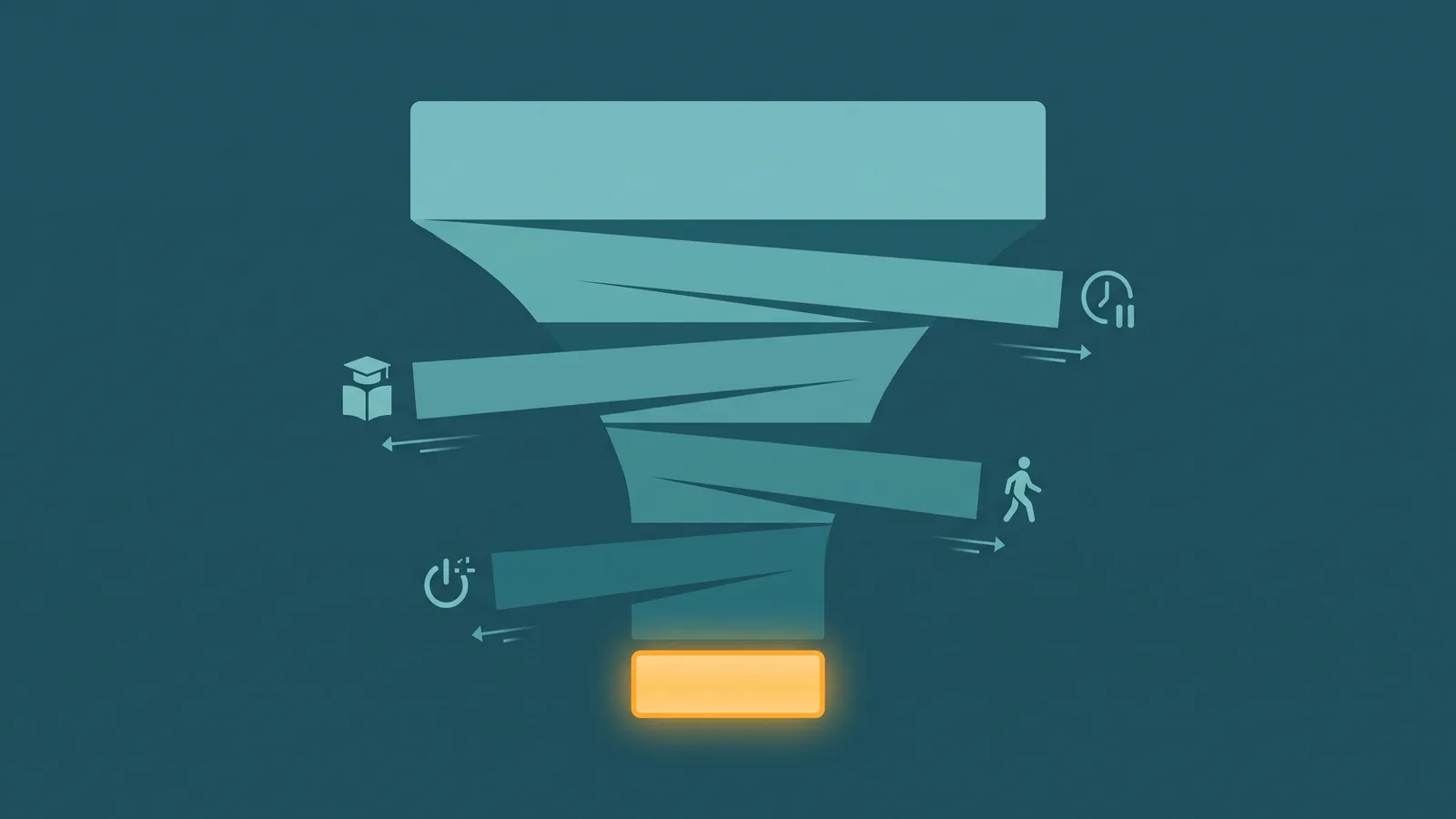
Call center shrinkage is the portion of an agent's paid shift during which they are not available to handle contacts. It is expressed as a percentage and used as a multiplier in staffing calculations to determine how many agents need to be scheduled in order to have the required number actually on the phones at any given interval.
When a contact center builds a staffing plan, the first step is calculating how many agents need to be handling contacts — a number that comes from the Erlang C formula applied to your volume forecast. But that number is not the headcount you schedule. Every agent has time during their paid shift when they are doing something other than handling contacts: taking a break, eating lunch, sitting in a training session, attending a team meeting, or simply not showing up because they called in sick. Shrinkage is the formal accounting of all that unavailable time, and it bridges the gap between the agents-handling-contacts number and the agents-on-the-schedule number.
Getting shrinkage right is one of the most consequential inputs in contact center planning. Underestimate it by even a few percentage points and you will be chronically short-staffed even when every other part of the model is correct.
The shrinkage formula
Shrinkage is calculated two ways depending on what you are trying to do.
To measure your actual shrinkage rate from historical data:
Shrinkage % = (Total Unavailable Time / Total Paid Time) × 100
If agents are scheduled for 8-hour shifts and on average spend 2.4 hours per shift in breaks, training, meetings, and absent time, shrinkage is (2.4 / 8) × 100 = 30%.
To convert a staffing requirement into a scheduled headcount:
Required Agents on Schedule = Required Agents Handling Contacts / (1 − Shrinkage Rate)
If your Erlang C calculation says you need 40 agents handling contacts and your shrinkage rate is 30%, you need to schedule:
40 / (1 − 0.30) = 40 / 0.70 ≈ 57 agents
The 17-agent difference between 40 and 57 is the buffer that accounts for all the time your scheduled agents will spend doing things other than handling contacts. Those 17 agents are not excess — they are the plan for breaks, training, meetings, and absence.
Internal vs external shrinkage
Shrinkage is most usefully divided into two broad categories based on whether it can be anticipated and planned for.
Internal shrinkage (planned)
Internal shrinkage covers activities that are scheduled and known in advance. Because you can see it coming, you can distribute it strategically — placing training sessions and team meetings in lower-volume intervals, staggering break times to ensure coverage during peaks, and building the schedule around these events rather than treating them as surprises.
- Scheduled paid rest breaks
- Meal breaks (paid or unpaid depending on jurisdiction and policy)
- Team meetings and briefings
- Training and coaching sessions
- One-on-one supervisor meetings
- After-call administrative project time scheduled into the shift
External shrinkage (unplanned)
External shrinkage covers absences and disruptions that are not on the schedule when it is published. You cannot prevent all of it, but you can budget for it by measuring your historical rates and building those rates into your gross staffing calculation. You can also manage it operationally through attendance programs and intraday responses.
- Unplanned absence — sick leave, family emergencies, personal days taken without advance notice
- Tardiness and early departure — agents who arrive late or leave before their scheduled end time
- System or tool downtime — agent workstations, telephony infrastructure, or CRM systems unavailable
- Unexpected facility issues — weather events, building problems, or other disruptions to physical presence
What typically goes into shrinkage
Industry sources commonly cite total shrinkage in a range of 25–35% for most contact center environments, with high-turnover or training-heavy operations sometimes reaching 35–40%. The right number for any given site depends on local regulations, scheduling practices, training cadence, and workforce stability. The breakdown below shows approximate contribution ranges; your actual figures will differ.
| Shrinkage component | Approximate contribution | Type |
|---|---|---|
| Scheduled breaks and meal periods | 10–15% | Internal (planned) |
| Training and coaching sessions | 3–8% | Internal (planned) |
| Team meetings and briefings | 2–5% | Internal (planned) |
| Unplanned absence (sick leave, emergencies) | 5–10% | External (unplanned) |
| Lateness and early departure | 1–3% | External (unplanned) |
| System downtime | 1–3% | External (unplanned) |
| Total (typical range) | 25–35% |
Breaks and meal periods consistently make up the largest single component because they are mandatory and occur in every shift. Training is the most variable: a stable, tenured team may run near the low end; an operation running continuous onboarding cohorts or a major system migration may push toward the high end or beyond.
EaseDial CCaaS
Real-time agent state data and interval-level reporting — the foundation for accurate shrinkage measurement.
The double-counting risk
One of the most common errors in shrinkage planning is double-counting: including an activity in both the scheduled headcount and the shrinkage calculation in a way that incorrectly inflates the staffing requirement.
Consider a training session scheduled from 10:00 to 11:00 for a cohort of agents. Those agents appear on the schedule — they are being paid — but they are not handling contacts during that hour. If your shrinkage calculation already includes that training hour as unavailable time, and you also reduce your expected available headcount by removing those agents from the floor, you have counted the same unavailable time twice.
The correct approach is to be explicit about what the denominator of your shrinkage calculation is. Two defensible methods:
- Whole-shift shrinkage: Measure unavailable time as a proportion of the entire paid shift. Apply the resulting rate uniformly when calculating scheduled headcount from Erlang requirements. This is simpler but mixes planned and unplanned shrinkage together.
- Interval-specific shrinkage: At each scheduling interval, explicitly account for which agents are in training, on break, or in a meeting, and only apply the unplanned shrinkage rate on top. This is more accurate but requires your scheduling system to track activity by interval.
The key discipline is consistency: whichever method you use, ensure that every unavailable-time category appears in either the scheduled activity layer or the shrinkage multiplier, not both.
How shrinkage interacts with forecasting
Shrinkage is applied after the Erlang C calculation, not before it. The sequence matters:
- Forecast contact volume at the interval level (15 or 30 minutes)
- Apply Erlang C to calculate how many agents must be handling contacts to meet the service level target
- Divide by (1 − shrinkage rate) to determine how many agents to put on the schedule
If you apply shrinkage at step one — reducing forecast volume by the shrinkage rate before running Erlang — you produce a staffing number that is too low, because Erlang C is a non-linear model. The relationship between agents and service level is not proportional; each additional agent provides diminishing returns as you approach 100% service level. Running Erlang on a reduced volume figure gives a different result than running it on the full volume and then dividing by (1 − shrinkage).
This is also why understating shrinkage causes chronic understaffing even when every other input to the model is correct. If your actual shrinkage is 33% but your planning assumption is 20%, your schedule calls for 40 / 0.80 = 50 agents when you actually need 40 / 0.67 = 60. That 10-agent gap plays out across every interval of every shift, day after day, as a persistent service-level failure that no amount of intraday management can fully correct.
Reducing shrinkage vs planning for it
Not all shrinkage is equally reducible. The right management approach depends on which component you are looking at.
Planned internal shrinkage — breaks, meals, training, meetings — is largely irreducible and in many cases legally or contractually required. The goal is not to eliminate it but to schedule it intelligently. Move training to off-peak intervals. Stagger break times so coverage stays consistent across the interval. Batch short team meetings into lower-volume periods. You are managing when the shrinkage occurs, not whether it occurs.
Unplanned external shrinkage — sick leave, tardiness, no-shows — is where management intervention can actually reduce the rate over time. Common approaches include:
- Attendance management programs with clear, consistently applied policies
- Flexible scheduling options that allow agents to adjust shifts within defined constraints, reducing the incentive to call in sick when personal obligations arise
- Agent engagement and wellbeing programs — high-burnout environments produce higher absence rates; sustained occupancy above 85–90% is directly associated with increased sick leave
- Return-to-work processes that address the root causes of frequent short-term absence rather than just tracking occurrences
System downtime shrinkage is addressed through reliability engineering rather than workforce management: redundant infrastructure, failover routing, and rapid incident response.
The practical rule is to budget accurately for planned shrinkage and address unplanned shrinkage operationally. A contact center that tries to plan for zero training time or zero sick leave will simply be surprised by reality every shift. One that builds realistic assumptions into its staffing model and then works to improve attendance rates separately will operate more predictably.
Frequently asked questions
Use our free Call Center Shrinkage Calculator to model your exact shrinkage rate and see how many agents to schedule — no email required.
Shrinkage is the bridge between your Erlang output and your actual schedule. Getting it right — measuring it accurately, tracking planned and unplanned components separately, and applying it correctly in the staffing formula — is what determines whether the number of agents on the floor matches what the forecast said you needed. For the full forecasting and scheduling context around shrinkage, see Call Center Forecasting and Scheduling. For the broader workforce management cycle that shrinkage planning fits into, see What Is Call Center Workforce Management? and the EaseDial WFM tools. For how well agents follow the schedules built from those calculations, see Call Center Schedule Adherence. For the metrics that reflect how well your staffing is working in practice, see Call Center Metrics and KPIs.