The terms "multichannel" and "omnichannel" are often used interchangeably in vendor marketing, which obscures a meaningful operational difference. Both describe businesses that support customers across more than one communication channel — phone, email, chat, SMS, social. But the similarity ends there.
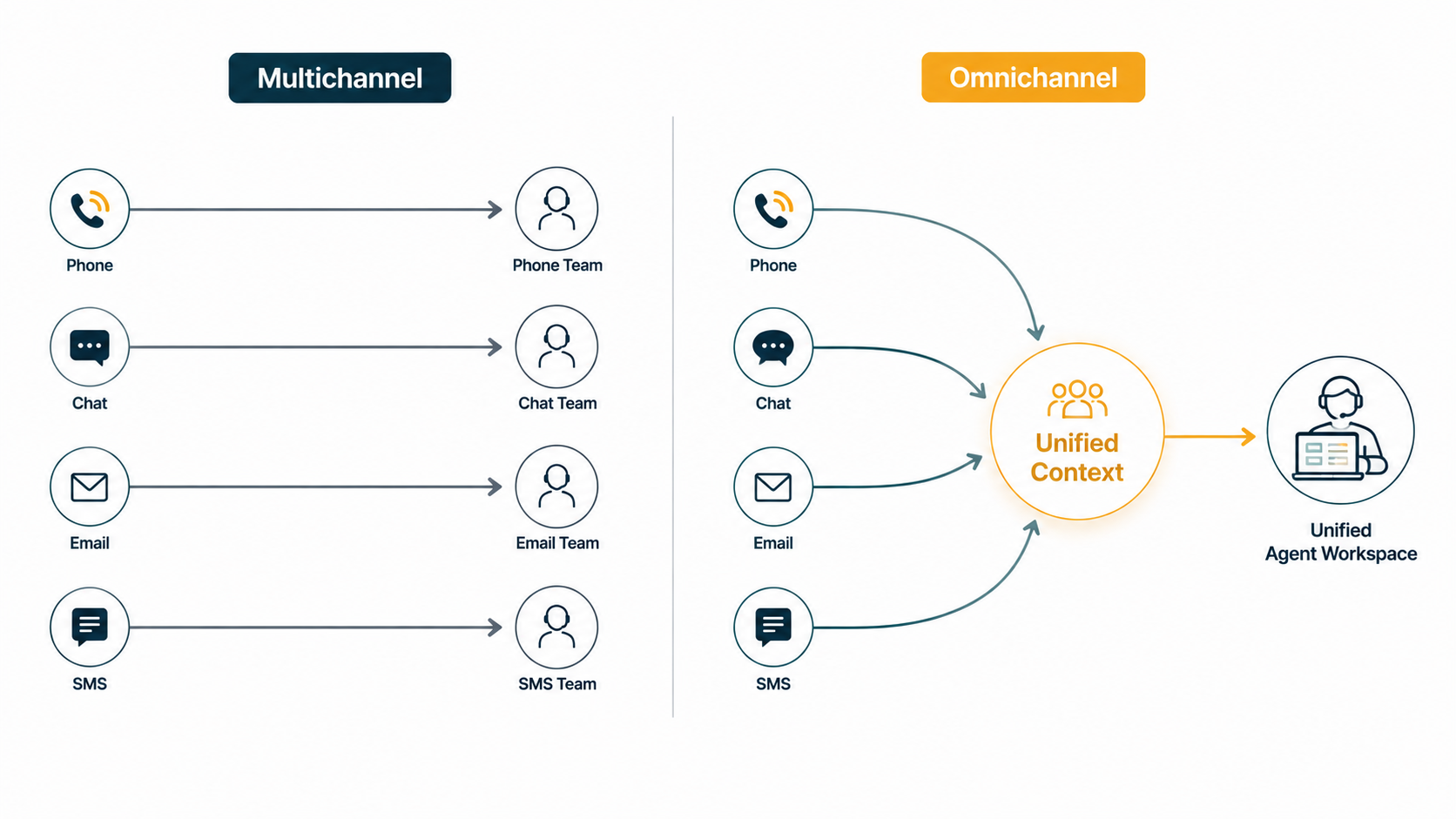
Multichannel means the channels exist. Omnichannel means the channels are connected — and more specifically, that customer context travels with the customer as they move between them.
The core distinction: Omnichannel is not about how many channels a business supports — it is about whether those channels share customer context. A business with two channels that share a unified customer record is more omnichannel than a business with eight channels that each run in a separate silo. The defining characteristic is context continuity, not channel breadth.
Side-by-Side Comparison
| Dimension | Multichannel | Omnichannel |
|---|---|---|
| Customer journey | Separate per channel; starts fresh on each contact | Unified across channels; context persists across contacts |
| Customer history | Siloed per tool; phone doesn't know chat, chat doesn't know email | Shared across agents and channels via unified customer record |
| Agent experience | Multiple separate tools; agents switch between platforms | Single workspace with full interaction history surfaced automatically |
| Channel handoff | Customer re-explains when switching channels | Context transfers; agent already knows the history |
| Identity resolution | Per-channel; same person may be unknown across channels | Customer-level; same person recognized across channels |
| Implementation complexity | Lower; each channel can be added independently | Higher; requires integration architecture and shared data layer |
Multichannel in practice
A multichannel business supports customers across multiple contact points. That could be phone, email, a chat widget on the website, and SMS. Each channel works. Customers can reach the business through any of them.
The problem is what happens when a customer uses more than one. Imagine a customer who starts with a chat session about a billing issue, doesn't get it resolved, and calls the next day to follow up. In a multichannel setup:
- The chat conversation lived in the chat platform. The phone agent has no access to it.
- The phone agent asks the customer to explain the issue from the beginning.
- The customer, who already explained everything yesterday, is frustrated before the conversation begins.
- The phone agent makes decisions without the full context — potentially giving an answer that conflicts with what the chat agent said.
Each channel works perfectly in isolation. The failure is at the handoff — specifically, the absence of any mechanism to carry context across that handoff.
This is not a symptom of a careless team. It is the structural outcome of running separate tools for separate channels without integration. The email ticket system does not know what the chat platform recorded. The phone system does not know what either of them holds. The agent on the phone is not being negligent by asking the customer to re-explain; they simply have no information to work with.
What omnichannel changes operationally
An omnichannel setup runs the same scenario differently. The customer who chatted yesterday and is now calling reaches an agent who already has the chat transcript visible. The agent knows the issue, knows what was tried, and can either pick up where the previous agent left off or acknowledge clearly why they are approaching it differently.
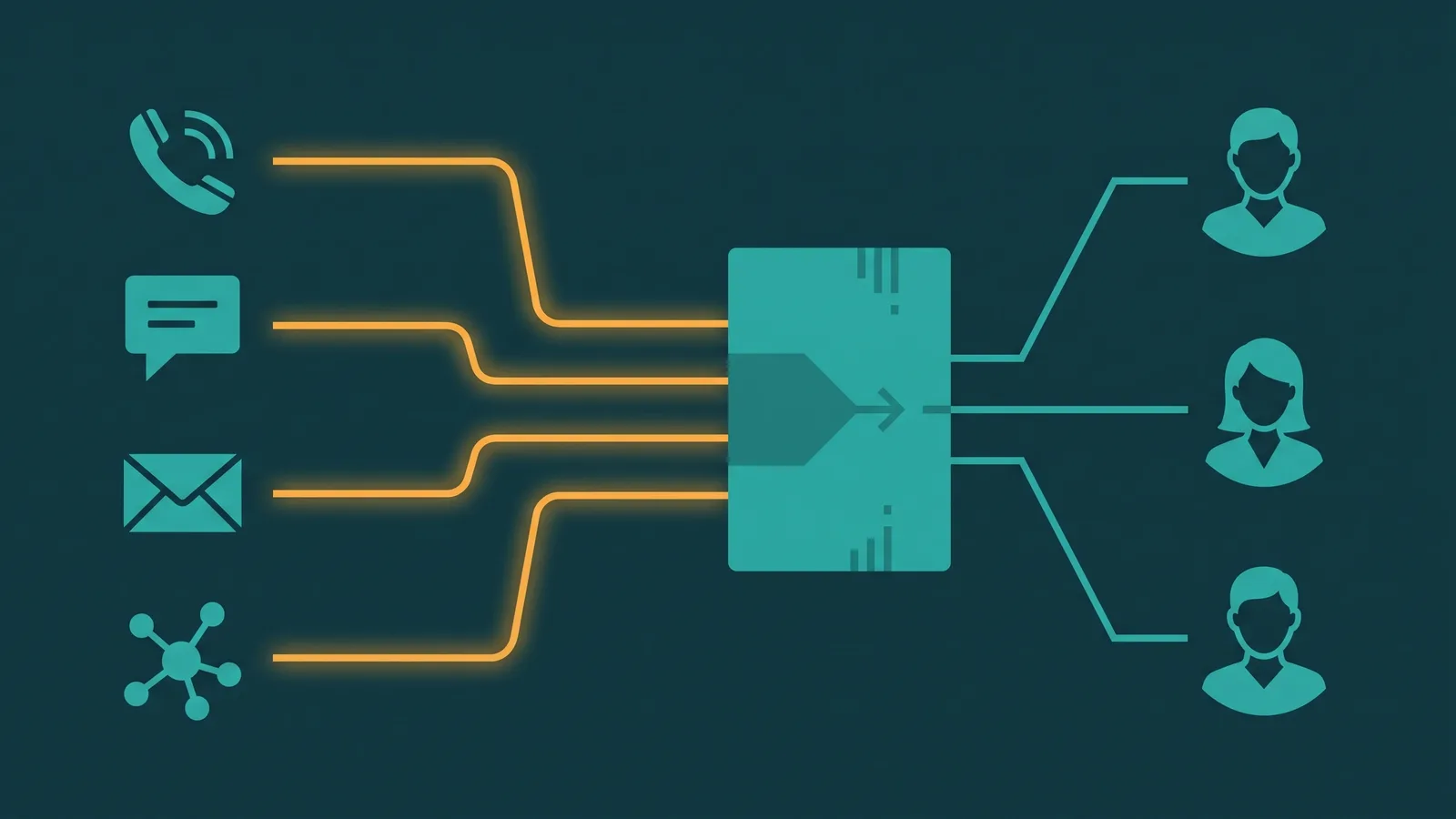
The channels themselves — phone, chat, SMS, email — may not look any different to the customer. The difference is entirely on the agent side: a single workspace that surfaces the full interaction history regardless of which channel each interaction occurred on.
This requires more than just "integrating the tools." True omnichannel depends on three underlying capabilities:
- Identity resolution: The system must recognize that the customer who chatted yesterday and the caller today are the same person. This sounds obvious but is technically non-trivial — chat sessions often have only an email or name, phone calls have a phone number, and matching those across systems requires either a customer ID that spans systems or logic that can infer the match.
- Shared data layer: All channel interactions must write to a shared customer record that all agents can read. This is typically a CRM or a contact platform that all channel tools connect to.
- Agent workspace integration: Agents must see the full history from a single interface, not by toggling between separate tools. A phone agent who has to open a separate chat window to check the prior conversation still has a degraded experience compared to having it surface automatically in the same workspace.
The Business Impact of the Gap
"Customers who re-explain themselves are more dissatisfied" is not a new insight, but it is frequently underestimated in operational planning. The dissatisfaction is not simply that re-explaining is inconvenient — it is what the re-explaining signals to the customer about how the business views them.
A customer who calls after a failed chat interaction and has to re-explain the entire issue from scratch is receiving an implicit message: the business has no record of them. They are starting as a stranger with a problem, not as a customer with a history. That experience has measurable effects on satisfaction scores, resolution rates, and churn.
From the agent side, handling calls without context slows everything down. Agents who do not have prior interaction history spend the first several minutes of a call gathering information that should already be available. Average handle time increases, first-contact resolution rates drop (because agents may not have the full picture to resolve correctly the first time), and the probability of giving an inconsistent answer relative to a prior interaction is higher.
The Most Common Misconception
Adding more channels does not make a business omnichannel.
This point is worth stating directly because it runs counter to how many vendors market their products. A business that deploys phone, email, chat, SMS, WhatsApp, Instagram, Facebook, and Twitter — all running in separate tools with no shared customer record — has expanded their multichannel footprint, not achieved omnichannel. Eight disconnected channels are still multichannel. In some respects, eight disconnected channels is worse than three disconnected channels, because the context fragmentation problem is larger.
The inverse is also true: a business that unifies phone and email around a shared customer record — just two channels — is genuinely omnichannel within those channels. The number of channels is secondary to whether they share data.
When multichannel may still be enough
Not every business needs full cross-channel orchestration. A business where customers rarely contact via more than one channel — or where contacts are self-contained transactions — may find that well-organized multichannel channels serve them adequately. The implementation cost and complexity of true omnichannel should be weighed against how often customers actually cross channels in your specific context.
What omnichannel implementation requires
Omnichannel is an outcome of system architecture, not a feature you enable. The implementation requirements are real:
- Shared customer data: All channels must write interaction records to a common data store — typically a CRM or a contact platform's native customer record. This requires that each channel tool can authenticate against and write to that store.
- Identity resolution across channels: The system must be able to match a phone number, an email address, a social handle, and a chat session to the same customer record. This is a data problem that requires either a common customer ID embedded in all channel interactions or matching logic that can infer identity across data types.
- Agent workspace integration: The agent's interface must surface unified history, not just the channel-specific record. This usually means either a purpose-built contact center platform that handles multiple channels natively or deep API integrations between channel tools and the CRM.
- Cross-channel routing consideration: If a customer's prior contact was by phone, and now they are contacting by chat, routing logic can take that history into account — for example, routing to the same agent who handled the last call if available, or surfacing the prior call details to whoever takes the chat.
Where EaseDial Fits
EaseDial's contact center platform consolidates SMS, MMS, WhatsApp, Telegram, Instagram, Facebook, website chat, and voice into a unified agent inbox — with a shared customer record across all channels. Agents handle cross-channel interactions from a single workspace without switching tools. When a customer who previously chatted now calls, the agent can see the chat history in the same interface.
For a deeper look at the strategic principles of omnichannel customer service — what it means to build a service model around the customer journey rather than individual channel metrics — see the full guide: omnichannel customer service.
EaseDial Contact Center
Voice, SMS, MMS, WhatsApp, Telegram, Instagram, Facebook, and chat — unified in one agent workspace with shared customer context.